Shell Castle Island, NC 
Select a photograph to view a photo gallery
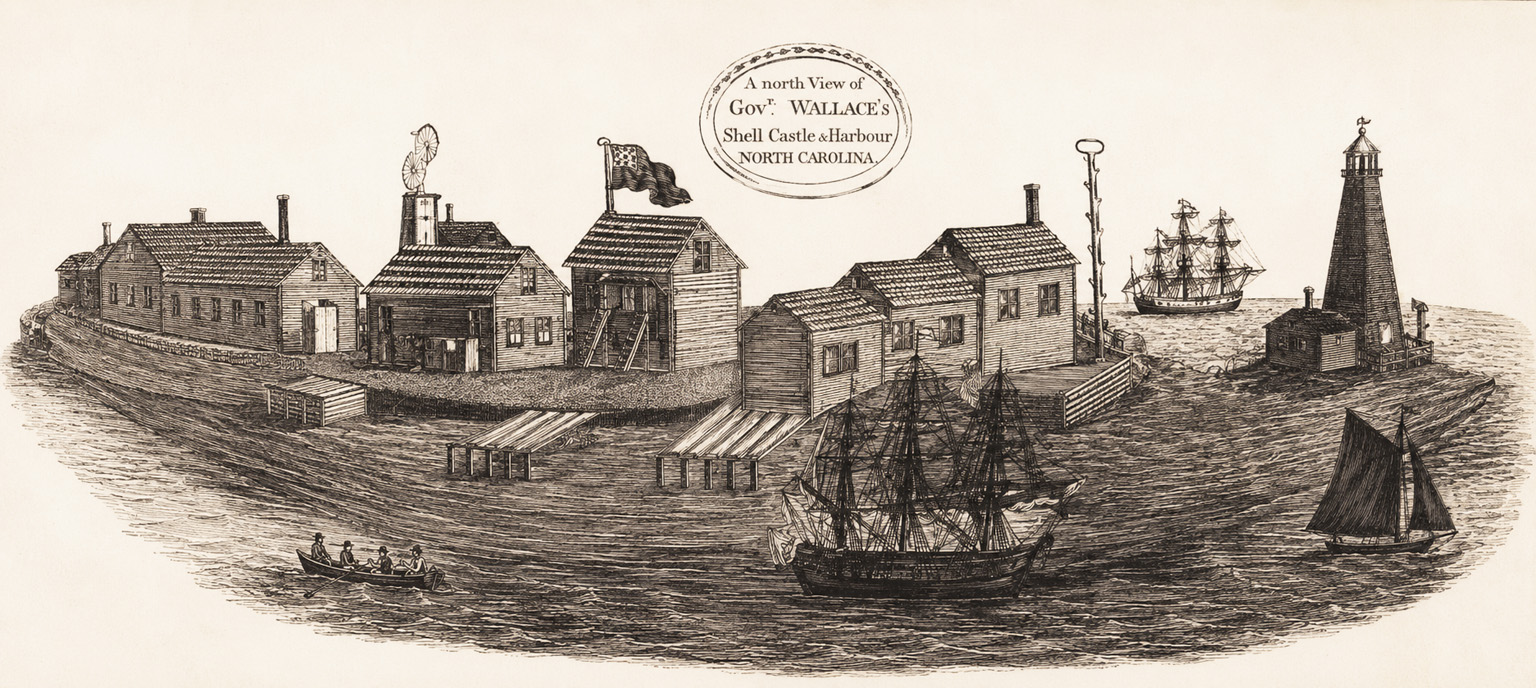
Photo Gallery
Photo Gallery
Photo Gallery
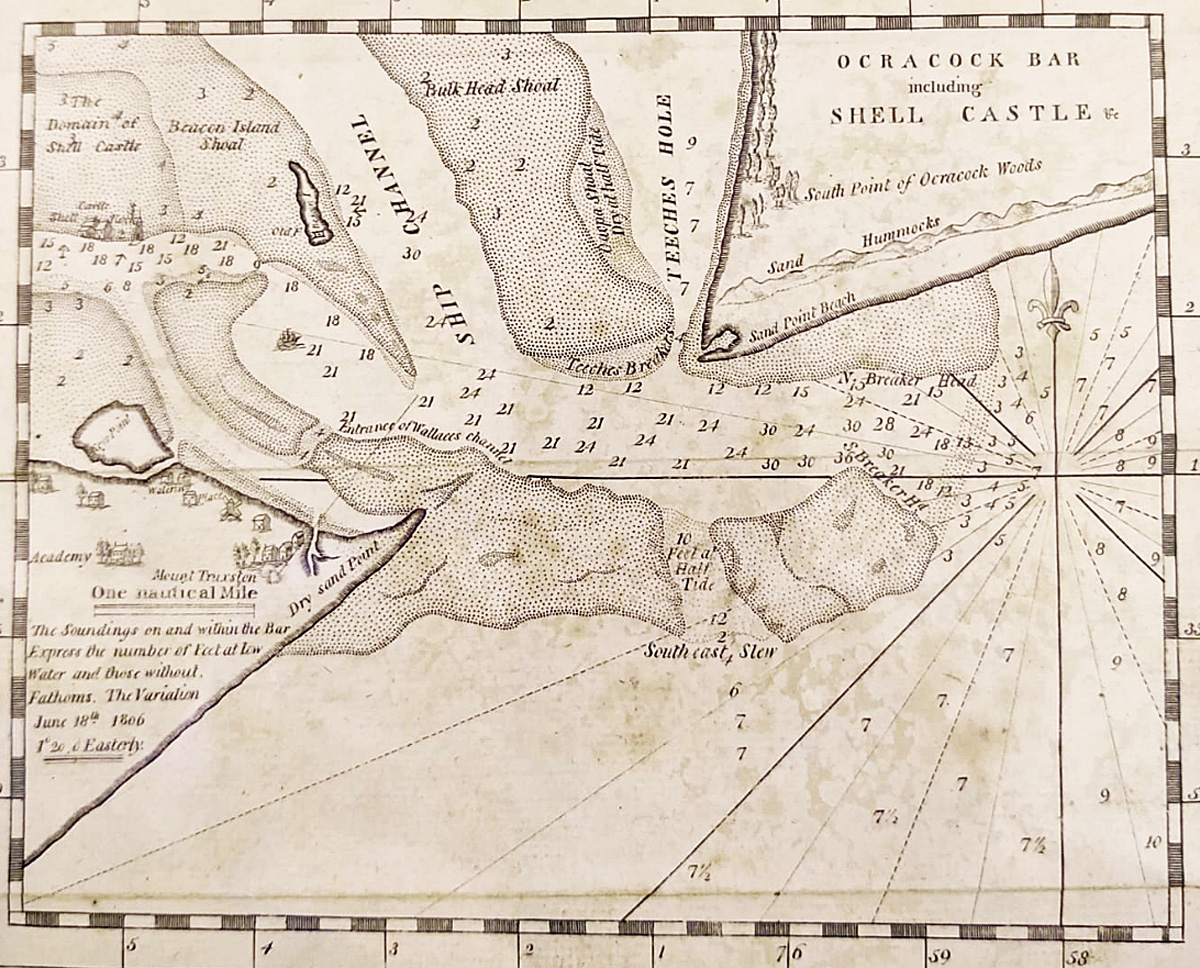
At the broad opening where the Atlantic Ocean met the sheltered waters of Pamlico Sound, Ocracoke Inlet long stood as North Carolina’s principal maritime gateway. For much of the colonial and early national periods, vessels entering the state’s shallow sounds and rivers depended on this narrow, shifting passage to reach ports such as New Bern, Edenton, and Washington. Before deeper inlets opened farther north in the mid-nineteenth century, Ocracoke Inlet was the most important entrance into North Carolina’s interior waters, serving as the artery through which much of the colony’s and state’s oceangoing commerce passed. It was here, on a tiny island built of oyster shell near the inlet’s channel, that one of North Carolina’s earliest federally constructed navigational aids arose: the Shell Castle Island Lighthouse.
The inlet’s importance stretched back to the earliest years of English colonization. In June 1585, the Tiger, flagship of Sir Richard Grenville’s expedition sent to support Sir Walter Raleigh’s Roanoke colony, grounded while attempting to enter Ocracoke Inlet. By the late seventeenth century, the inlet appeared on maps as “Ocock,” and in 1718 it became the site of one of colonial America’s most famous pirate battles when Lieutenant Robert Maynard cornered and killed Edward Teach, better known as Blackbeard. During the American Revolution, the inlet served vessels supplying American forces. Despite its dangers, shifting shoals, and treacherous bars, Ocracoke remained indispensable because North Carolina possessed few usable ocean entrances and its shallow waterways prevented large vessels from reaching inland ports.
By the late eighteenth century, merchants John Gray Blount and John Wallace had developed an ingenious solution to North Carolina’s maritime limitations. Large oceangoing ships often could not navigate the state’s shallow rivers and sounds, forcing merchants to unload cargo at coastal transfer points. In 1789, Blount and Wallace began transforming a narrow oyster-bank island known as Old Rock, situated near Ocracoke Inlet, into a bustling transfer depot they named Shell Castle.
|
Although tiny—roughly half a mile long and scarcely sixty feet wide in places—Shell Castle quickly became one of the most commercially important sites in North Carolina. Positioned beside Wallace’s Channel, a comparatively deep passage through Ocracoke Inlet, the island functioned as a transshipment hub where large ships unloaded cargo onto barges and smaller vessels capable of navigating inland waterways. From Shell Castle, goods flowed toward North Carolina’s principal interior ports.
The island became densely packed with commercial activity. Warehouses, wharves, a windmill, a gristmill, a lumberyard, tavern, store, notary office, and a reported three-hundred-foot main building crowded its shell-covered surface. Blount and Wallace also controlled much of the piloting and lightering business at Ocracoke Inlet, further strengthening Shell Castle’s role as the center of maritime commerce. Because so much shipping passed through the inlet, mariners increasingly sought a dependable navigational aid to guide vessels approaching the dangerous bar.
Curiously, the movement to establish a light at Ocracoke Inlet indirectly resulted in the construction of North Carolina’s most famous lighthouse. In 1794, federal officials studying navigational needs along the North Carolina coast concluded that while Ocracoke desperately needed a beacon to assist vessels entering the sounds, a larger lighthouse at Cape Hatteras would provide broader benefits to coastwise shipping. Treasury officials therefore recommended constructing both: a major lighthouse at Cape Hatteras and a smaller beacon at Shell Castle Island.
On May 13, 1794, Congress authorized “a lighted beacon” on Shell Castle Island and a lighthouse at Cape Hatteras. The original legislation envisioned a wooden-framed beacon approximately fifty-five feet high with a lantern containing a large lamp fueled by four wicks. However, construction could not begin until North Carolina ceded sufficient land to the federal government.
Progress came slowly. Although Congress approved the project, difficulties securing land and contractors delayed construction for years. Federal officials struggled unsuccessfully to interest local builders, many of whom considered commerce and agriculture more profitable than such difficult construction work in isolated coastal locations. Several proposals were rejected as overly expensive or impractical.
On November 29, 1797, Shell Castle owners John G. Blount and John Wallace sold a seventy-by-one-hundred-forty-foot tract on the eastern end of the island to the federal government for $200. Significantly, the deed prohibited taverns, merchandise storage, retailing spirits, or commercial operations on the government lot, ensuring that the beacon site would remain solely for navigational purposes rather than blending into Shell Castle’s commercial bustle.
In 1798, the federal government contracted with Henry Dearborn to construct both the Shell Castle beacon and the Cape Hatteras Lighthouse. Dearborn, who had previously built the lighthouse on Seguin Island in Maine and would later become Secretary of War, undertook one of the earliest major federal lighthouse projects in the South.
Construction proved difficult and expensive. The final approved plans called for a wooden octagonal beacon tower approximately sixty-four feet tall, including its lantern, accompanied by a frame keeper’s house and oil storage buildings.
|
Dearborn reached Shell Castle with building materials in late summer 1799 after delays and mishaps, including damage to his vessel during transport. Working simultaneously on the Cape Hatteras and Shell Castle projects, Dearborn moved crews between the two isolated sites under often difficult conditions.
Shell Castle presented unusual engineering challenges. Though more stable than surrounding sandy islands because of its shell foundation, the site remained vulnerable to storms and erosion. Concerned about the stability of the station, Dearborn later agreed to reinforce the foundation by constructing a surrounding wall and filling the enclosed area with stone to elevate and protect the lighthouse grounds.
Construction also suffered from sickness among laborers, delays in material shipments, and interruptions caused by harsh conditions on the Outer Banks. By late 1800, the Shell Castle beacon itself stood largely complete, lacking only its lantern, while the keeper’s house neared completion. Yet bureaucratic delays and logistical complications slowed activation. Though the structures were substantially completed by 1802, the “raising of the light,” as contemporaries termed the first lighting of a lighthouse, did not occur immediately.
By late 1803, both Shell Castle and Cape Hatteras were finally in operation after nearly a decade of delays, and in March 1804 mariners received formal notice that the lights were functioning. The Shell Castle light reportedly bore west-northwest from Ocracoke Bar at a distance of nearly two leagues, helping vessels locate a favorable position for obtaining pilots before crossing the dangerous inlet in daylight.
Importantly, officials emphasized that no prudent vessel should attempt crossing Ocracoke Bar at night. Instead, the beacon helped captains orient themselves offshore and safely position their ships until pilots could guide them through the ever-changing channels the following morning.
Living at Shell Castle Lighthouse proved difficult. The isolated station offered few comforts, and successive keepers struggled with the hardships of life on the tiny island. John Mays, initially appointed keeper in 1802, declined the position after learning the salary amounted to only $250 annually. John Wallace—co-owner of Shell Castle itself—accepted the appointment instead, though disagreements quickly arose regarding compensation.
Federal officials considered Shell Castle less significant than Cape Hatteras and paid its keepers less, despite the difficulties of maintaining the station. Collector Samuel Tredwell later argued that the Shell Castle keeper deserved equal pay because the site was harder to inhabit. Firewood had to be transported by boat, the property offered no space for gardening, and isolation complicated daily life. Washington, however, ignored his recommendation.
Despite these hardships, the beacon remained an important aid to mariners navigating what was still North Carolina’s principal inlet. In 1816, Shell Castle became one of several federal lighthouses upgraded with Winslow Lewis’s patented lamp-and-reflector system, a major technological improvement that significantly increased brightness while reducing oil consumption. Federal officials praised the new illumination, claiming American lights had become equal or superior to those abroad.
The history of Shell Castle Lighthouse ended suddenly and dramatically. On the afternoon of August 16, 1818, lightning struck the beacon tower. Reports indicated that the station’s lightning rod—sometimes called a Franklin rod—had rusted through or become defective. Rather than safely conducting electricity into the ground, the bolt passed into the structure itself.
Within minutes the lighthouse burst into flames. Fire spread rapidly to the adjoining keeper’s dwelling, and both buildings were quickly reduced to ashes. News spread rapidly along the coast as local newspapers warned mariners that the light at Ocracoke had disappeared.
Recognizing the danger posed by the loss of such an important navigational aid, Treasury officials authorized the erection of a temporary light if practical and soon sought congressional funding for a permanent replacement. Yet by this time, conditions at Shell Castle had changed dramatically. The inlet’s shifting channels, always unstable, had moved farther away from the island. What had once stood beside the navigable passage now sat roughly a mile from the principal channel, rendering the site increasingly ineffective.
Congress responded in 1820 by appropriating funds either for a new lighthouse or for a lightship near Shell Castle Island. Two years later, lawmakers authorized construction of a replacement lighthouse near Ocracoke Inlet at a site the President would select. In 1823, contractor Noah Porter completed the new lighthouse near Ocracoke village for approximately $11,359. That structure—today known as the Ocracoke Lighthouse—effectively replaced the lost Shell Castle beacon.
Meanwhile, Shell Castle itself declined. A devastating hurricane in 1806 had badly damaged the settlement, and gradual shoaling during the War of 1812 era increasingly prevented ships from reaching the once-thriving port. Commerce shifted toward Portsmouth and Ocracoke village, and Shell Castle eventually disappeared beneath time and tide.
For several decades after its construction, however, Shell Castle Island Lighthouse occupied a vital place in North Carolina maritime history. Standing beside the state’s most important inlet, it helped guide vessels entering the sounds during an era when Ocracoke served as the principal doorway to North Carolina’s interior commerce. Only after the hurricane of 1846 opened Oregon and Hatteras Inlets, providing deeper entrances and redirecting maritime traffic, did Ocracoke lose the prominence it had enjoyed for centuries. Though the lighthouse itself vanished in fire and the island settlement disappeared, Shell Castle remains inseparable from the story of North Carolina’s early maritime economy and the federal government’s first efforts to illuminate its dangerous coast.