Egg Rock, MA 
Select a photograph to view a photo gallery
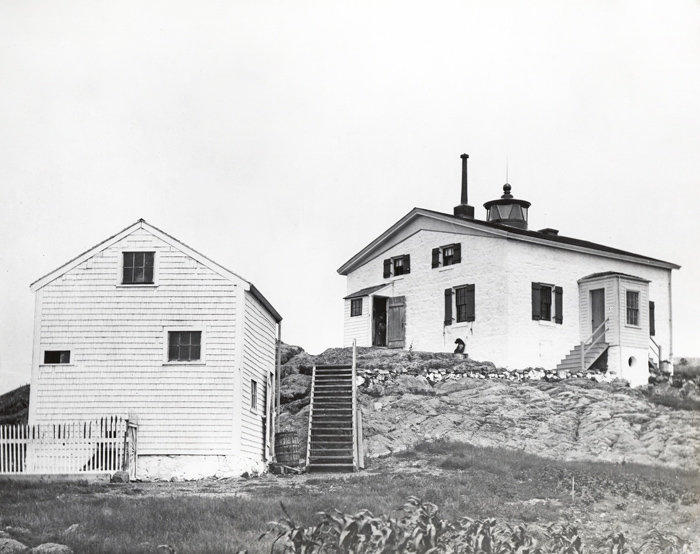
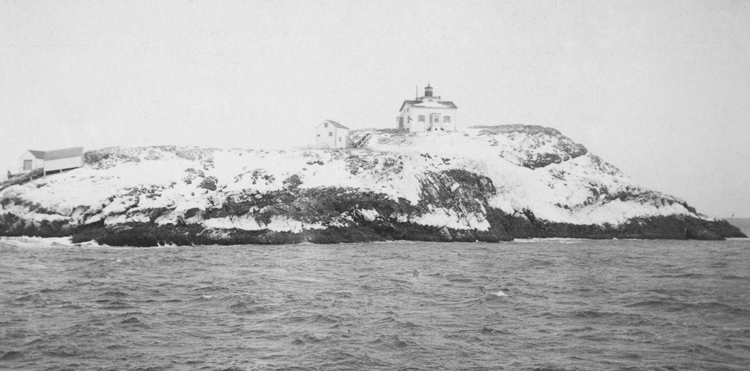
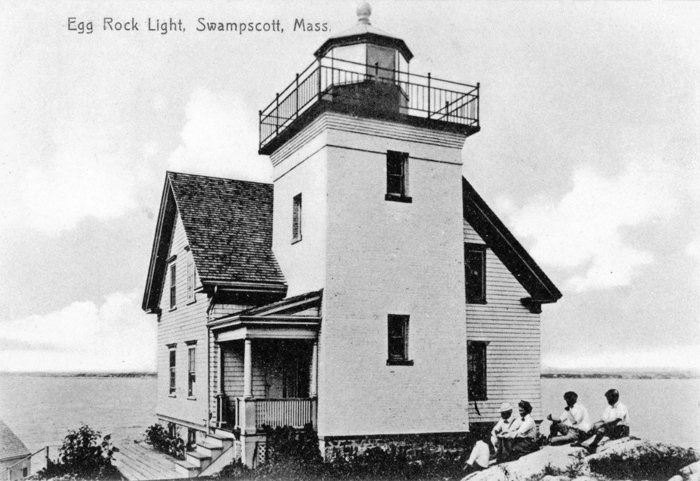
Photo Gallery
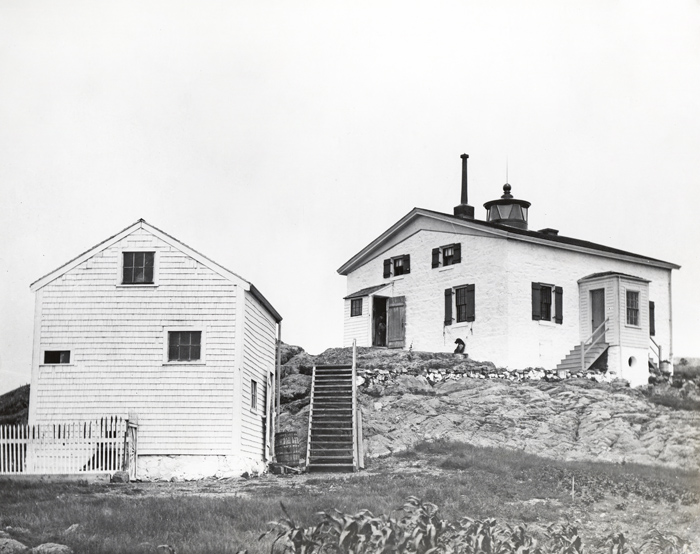
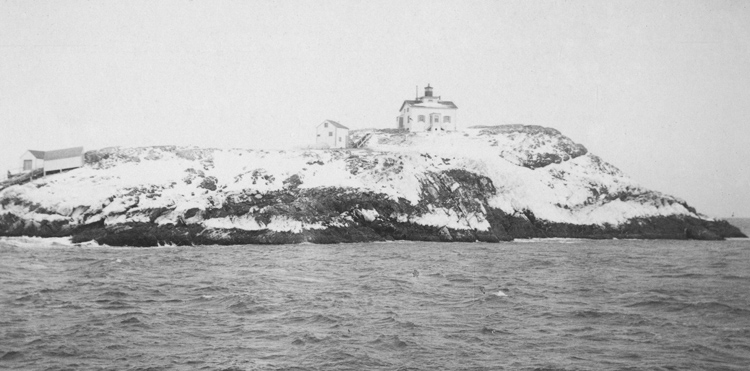
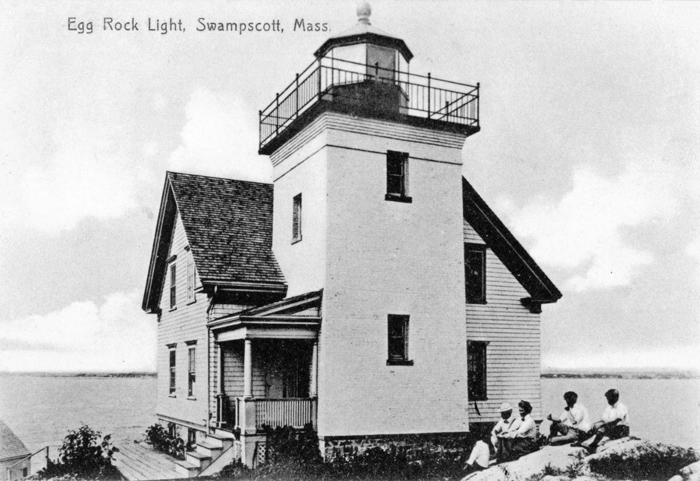
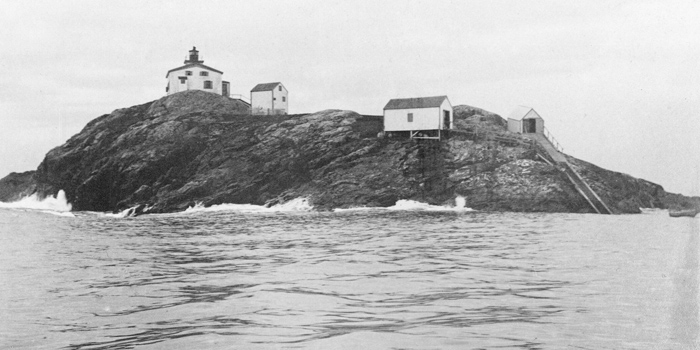
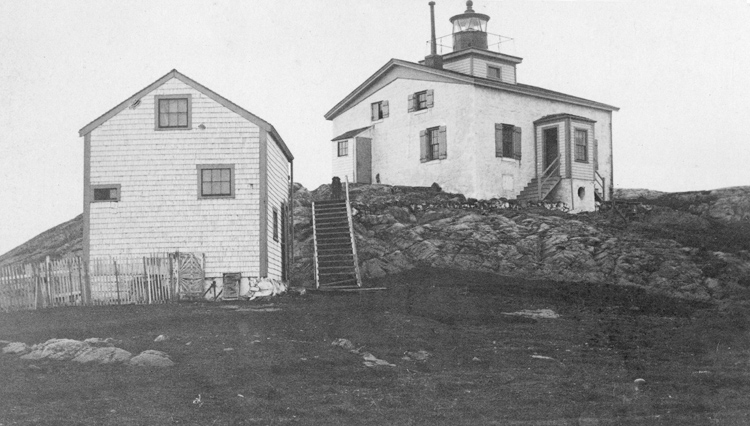
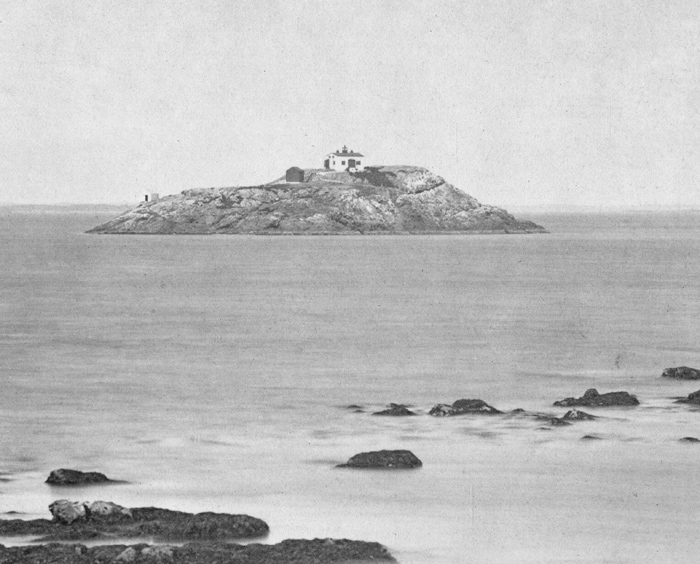
Photo Gallery
Photo Gallery
Rising from the waters of Massachusetts Bay less than a mile northeast of the town of Nahant, Egg Rock is a rugged, whale-shaped outcrop that once supported one of the most picturesque lighthouse stations on the North Shore. For sixty-six years, Egg Rock Lighthouse guided vessels along the coast north of Boston before advances in navigation rendered it unnecessary. Though the lighthouse itself has long since disappeared, the story of the station—its keepers, rescues, storms, and everyday life—remains one of the most colorful chapters in the maritime history of the region.
|
Egg Rock is a small island of about three acres that rises roughly eighty feet above the sea. Its pale gray granite surface and distinctive shape make it visible from many points along the North Shore, including the shores of Lynn, Swampscott, and Marblehead. Long before a lighthouse stood there, mariners recognized the rock as both a landmark and a hazard.
Local historian and engineer Alonzo Lewis described Egg Rock in his 1855 book The Picture of Nahant. He noted that seabirds nested there in great numbers—hence the name—and that the approach to the rock was dangerous except in calm weather. From certain angles, he wrote, the rock resembled a lion lying before the coast, as if guarding the city.
During the mid-nineteenth century, the waters around Egg Rock grew increasingly busy. Swampscott alone maintained a fishing fleet of roughly 150 vessels, and Nahant was rapidly developing as a popular seaside resort. As maritime traffic increased, fishermen and coastal mariners urged the federal government to establish a lighthouse on the rock to mark the reefs and ledges in the area.
Congress responded by appropriating $5,000 for the project on September 28, 1850. However, the work stalled because of difficulties obtaining a satisfactory title to the island. The appropriation had to be renewed in August 1854, but even then construction did not begin immediately.
In 1855, thirty presidents of Boston life and property insurance companies signed a petition urging Congress to proceed with construction. Later that year, on August 27, a contract was awarded to local builder Ira P. Brown to complete the lighthouse by December 1.
Work began in 1855, though bad weather and rough seas slowed progress. At one point, several workers were stranded on the island for more than three days when storms prevented boats from reaching them. The project nevertheless moved forward, and the lighthouse was completed in the summer of 1856.
The original structure consisted of a stone dwelling, thirty-two feet square, with a lantern mounted on its roof. Much of the building stone was quarried directly from Egg Rock itself. The lantern housed a fifth-order Fresnel lens displaying a fixed white light 86 feet above the sea. The light was first exhibited on September 15, 1856.
Soon afterward, the light’s color was changed to red. The change followed the wreck of the schooner Shark, whose captain had mistaken the Egg Rock beacon for the light at Long Island Head Light.
The first keeper, appointed on July 28, 1856, was George B. Taylor of Nahant. Taylor lived on the island with his wife and five children, along with chickens, goats, a dog named Milo, and even a tame crow. The isolated station soon became known for its lively household.
A newspaper article from 1860 described the dwelling as plain but comfortable, with three rooms on the ground floor and two upstairs. Taylor maintained a small garden on the rocky island, producing vegetables so large that the reporter claimed his beets could rival those grown on fertile farmland.
|
Visitors were common in summer—sometimes as many as 300 people in a single month—though winters were quiet and often harsh.
One of the station’s most famous residents was Milo, the Taylor family’s enormous Newfoundland–Saint Bernard mix. Milo became locally renowned for retrieving objects thrown into the sea and for assisting fishermen. In foggy weather, the dog even barked at approaching vessels, serving as a sort of unofficial fog signal. His fame spread so widely that the British artist Edwin Henry Landseer painted a portrait reportedly inspired by him titled Saved.
Taylor served until 1861, when he lost his position for political reasons. He was succeeded by Thomas Widger of Swampscott, who remained for a decade. Widger and his wife raised several children on the island, continuing the small garden and livestock traditions established by the Taylors.
Life at Egg Rock was often dramatic. In December 1865, Widger rowed ashore to fetch a midwife for his wife, who was about to give birth. During the return trip heavy surf capsized the dory, and the midwife refused to continue. Widger rowed back alone, and his son Abraham was born shortly afterward.
Over the following decades, the station underwent continual maintenance. Boatways, a boathouse, and a storm house were added in 1857. In later years various repairs were made to the dwelling, landing steps, cisterns, and walkways.
One of the more colorful entries in the station log came from keeper Henry H. Richardson in April 1873:
A severe rainstorm. Keeper went ashore to get some groceries and got caught in the storm; was detained away four days on account of the rough seas. The wife kept the light all trimmed and burning bright and clear. Keeper was drunk ashore all the time.
Several keepers followed in succession, including Civil War veteran Charles J. Hooper and later Charles Dunham. Dunham’s log entries vividly describe the harsh winters surrounding the island, with heavy seas breaking across the rock and ice surrounding the station.
In 1889, the lantern was raised and a wooden parapet and railing were built beneath it. That same year George L. Lyon became keeper. Lyon would remain for more than two decades and become the station’s most famous resident.
George L. Lyon, a native of Lynn and former assistant keeper at Minot’s Ledge Light, brought remarkable energy and ingenuity to Egg Rock. A large, athletic man with a wide range of mechanical skills, he turned the station into a small workshop where he repaired boat engines, built dories, and experimented with new mechanical devices.
|
Landing on Egg Rock was notoriously dangerous, and Lyon devised an elaborate landing stage that allowed boats to be hoisted from the water by winch and lifted into the boathouse. This greatly improved safety at the station.
Lyon also became famous for his rescues. During his twenty-two years on the island, he saved numerous fishermen and pleasure boaters caught in sudden storms. In August 1895, he rescued the occupants of several overturned fishing dories during heavy seas, taking them safely to shore. In later rescues, he pulled exhausted sailors from the water after their boats capsized near the island.
By 1910, Lyon estimated that he had saved at least 200 lives.
He was assisted for many years by a young housekeeper, Ada Foster, who eventually became his close companion. Foster learned every aspect of lighthouse work and sometimes tended the light alone when storms prevented Lyon from returning to the rock.
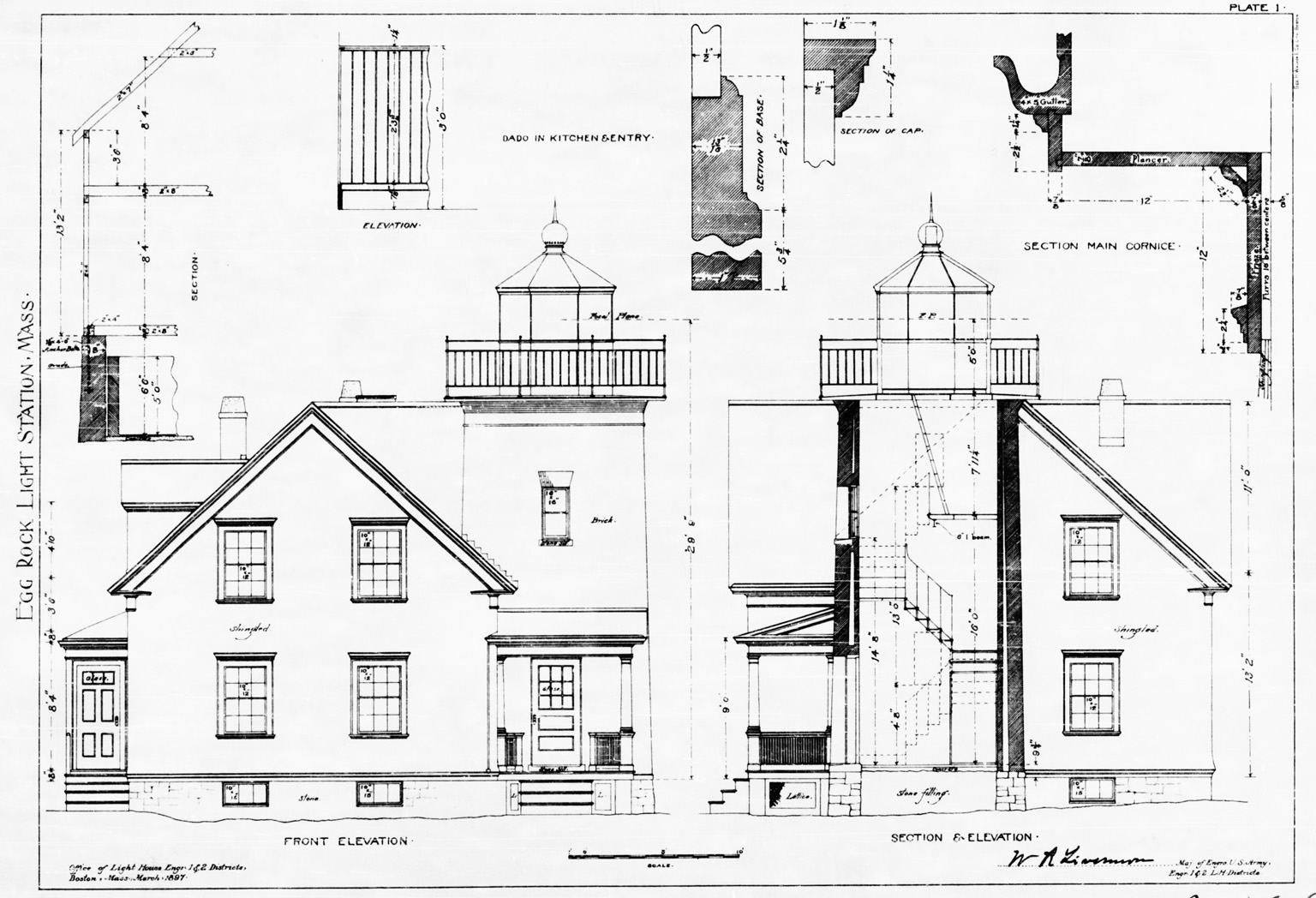
After decades of exposure to harsh weather, the original lighthouse building required major repairs. In 1897, a contract was awarded to rebuild the dwelling and tower on the existing foundations.
Construction materials had to be transported to the island by small boats, and a young local resident reportedly made more than 300 round trips carrying supplies.
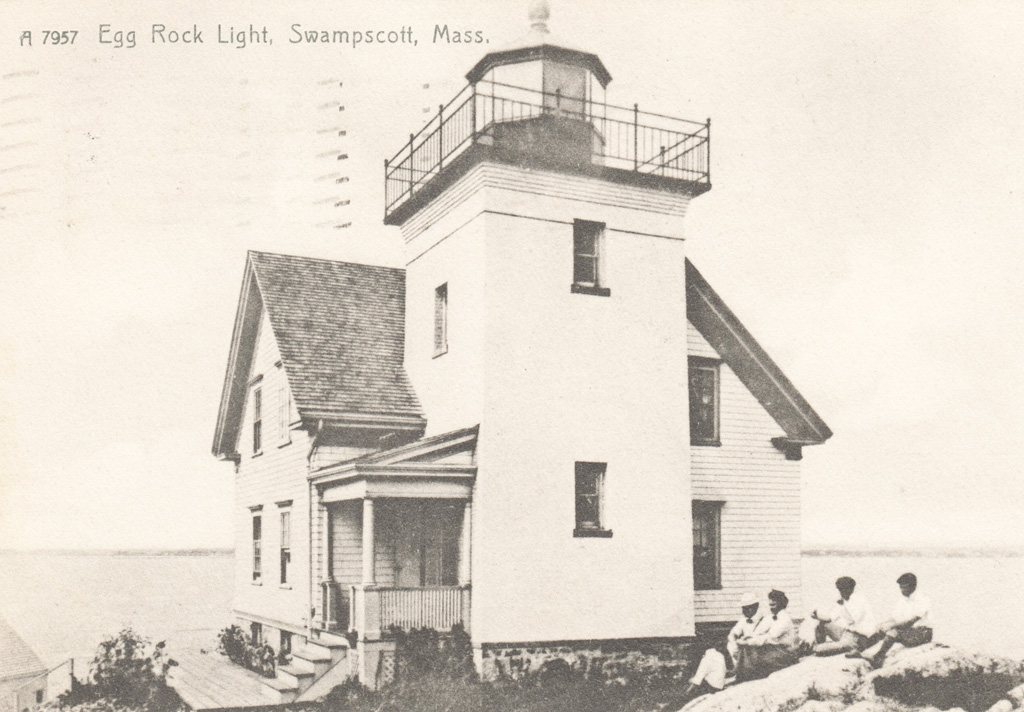
The new lighthouse, completed in 1898, consisted of a square red-brick tower topped by an octagonal lantern and attached to a six-room wooden dwelling measuring about thirty by thirty-two feet. The fixed red light was displayed from a focal plane ninety feet above mean high water.
In 1900, the tower’s color was changed from red to white, and various improvements were made in the following years, including new landings, plank walks, a cistern, a boat winch, and an oil house.
After Lyon left the station in 1911, Malcolm N. Huse, Andrew S. Nickerson, and James Yates served as keepers, with Yates leaving in late 1918.
During World War I, the light was sometimes dimmed because of fears of enemy submarines along the coast. Around this time, the station was connected to the mainland by telephone cable, allowing communication with shore. After Keeper Yates left, the lighthouse tender Mayflower stopped by the rock each week and left one of its crew to mind the light.
On January 21, 1919, the lighthouse was converted from an oil-wick lamp to an automatic acetylene system producing a white flash every three seconds. With automation in place, the need for resident keepers disappeared.
Only three years later, on April 17, 1922, the light was discontinued entirely. Officials concluded that powerful modern lights around Boston Harbor provided sufficient guidance for vessels, making Egg Rock unnecessary.
The government soon decided to sell the station buildings, provided the purchaser could remove them from the island. In May 1922, the structures were auctioned for $160 to a Dorchester resident who planned to relocate the keeper’s house to Quincy.
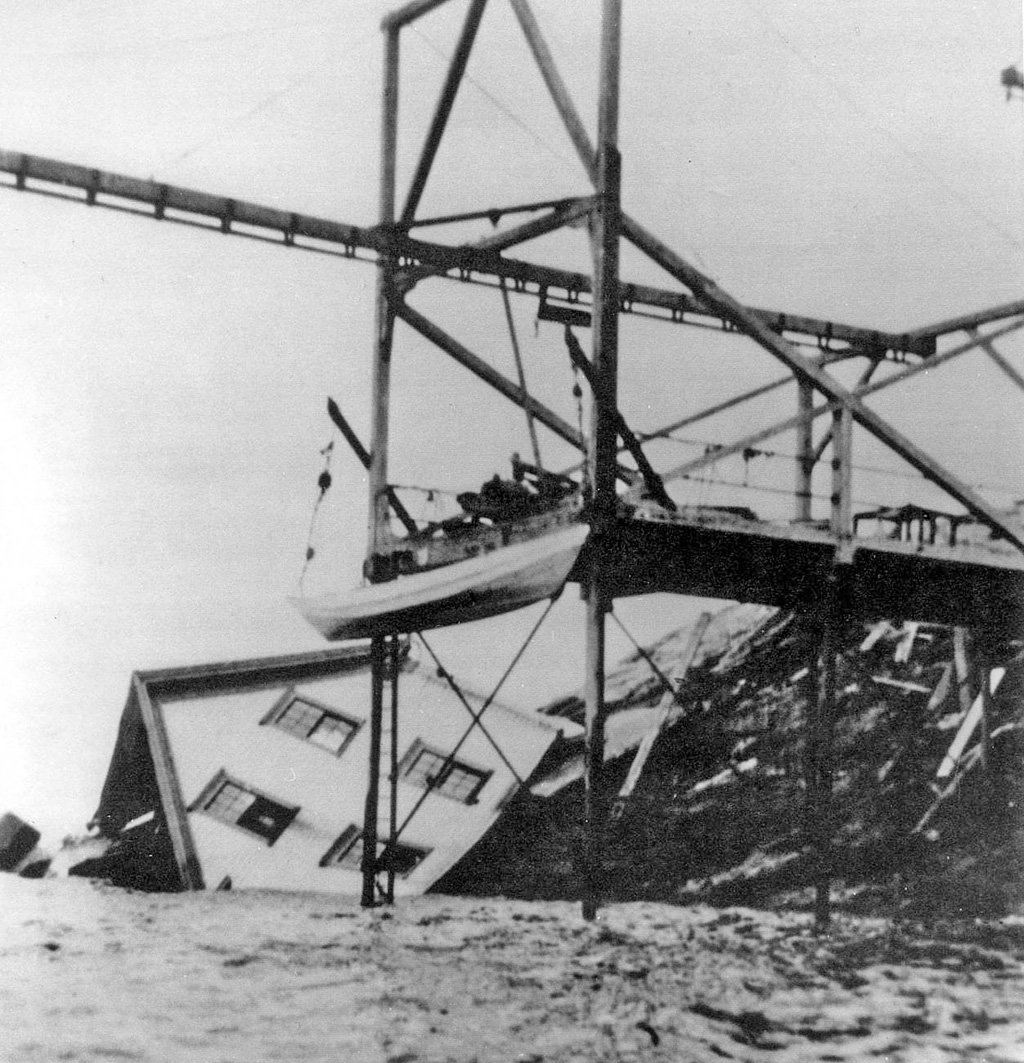
During the attempted move in October 1922, disaster struck. As workers attempted to haul the two-story building across the rock toward a waiting barge, a cable snapped. The house slid down the slope and partly into the ocean. Within days, the wrecked dwelling fell apart in the surf, and fragments of lumber later washed up along nearby beaches.
The brick tower remained standing for several more years but was finally destroyed in 1927. All remaining wooden structures on the island were burned, and the state of Massachusetts later designated Egg Rock as a bird sanctuary.
Keepers: George B. Taylor (1856 – 1861), Thomas Widger (1861 – 1871), Edward H. Caswell (1871), Henry H. Richardson (1871 – 1874), Charles J. Hooper (1874 – 1883), Charles Dunham (1883 – 1889), George L. Lyon (1889 – 1911), Malcolm N. Huse (1911 – 1912), Andrew S. Nickerson (1912 – 1917), James Yates (1917 – 1918).