Billingsgate, MA 
Select a photograph to view a photo gallery
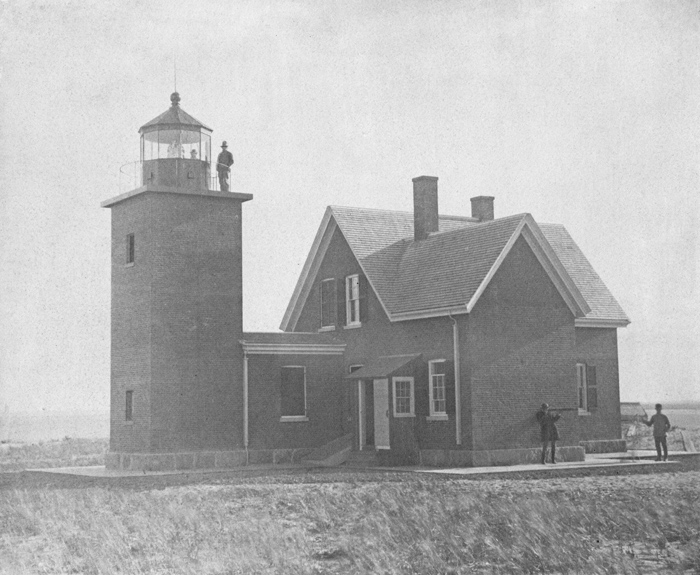
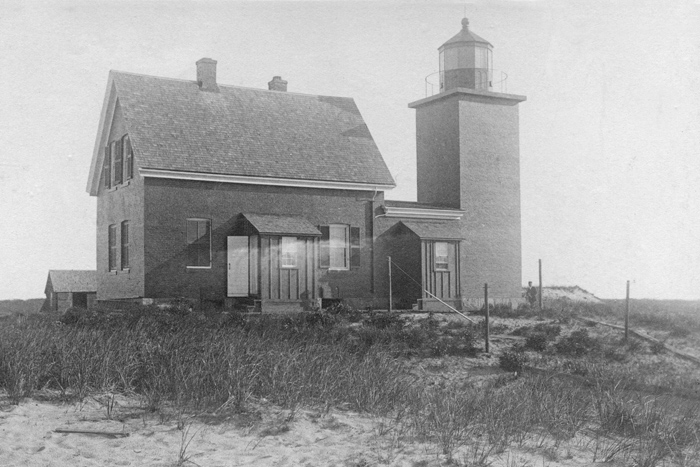
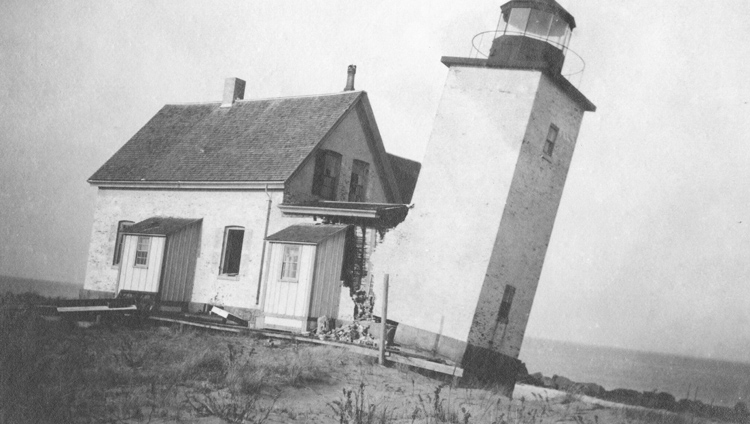
Photo Gallery
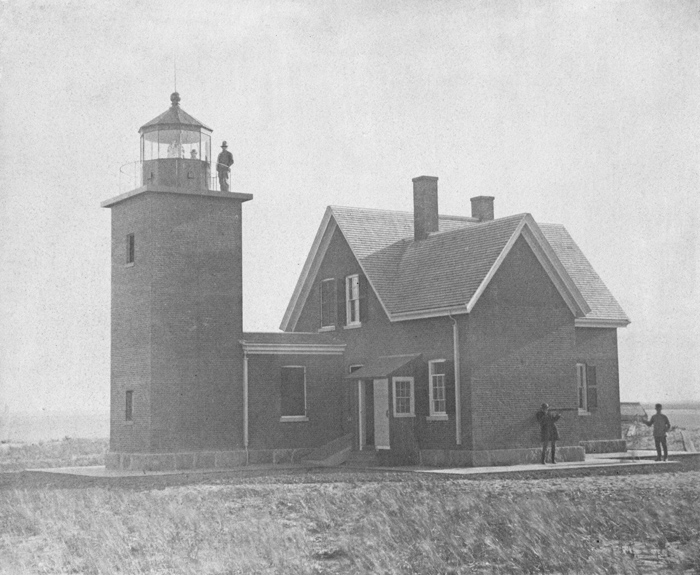
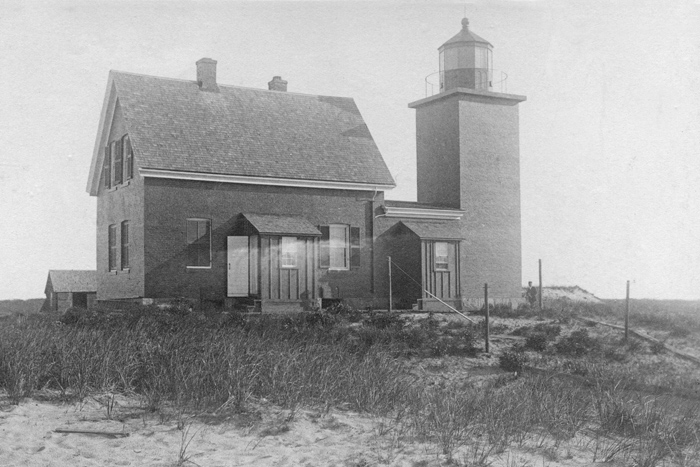
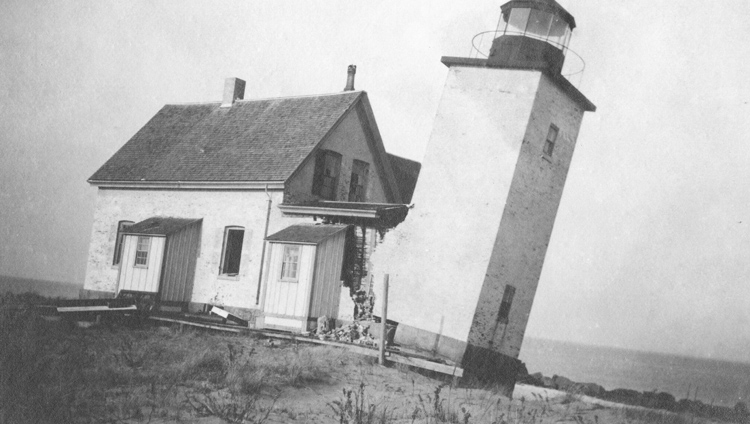
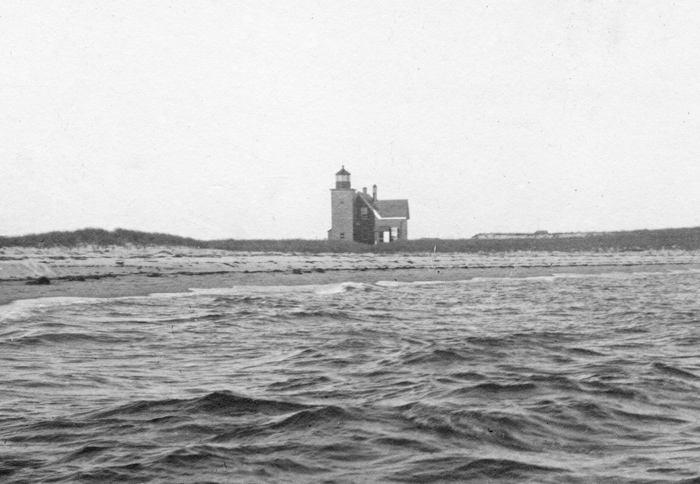
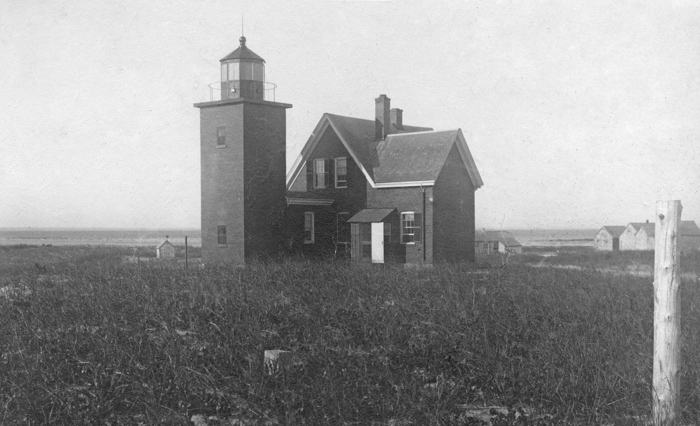
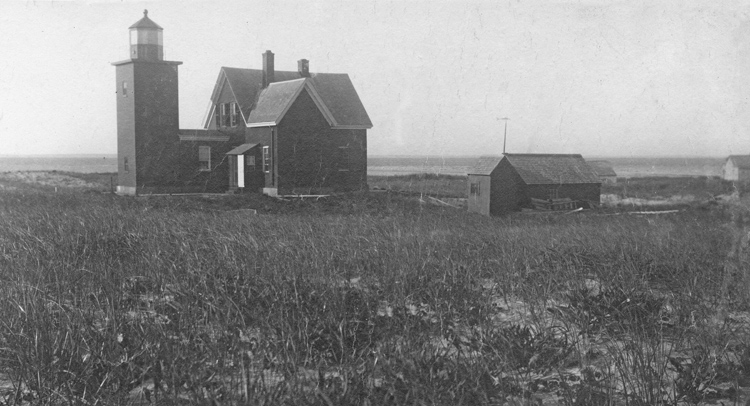
Photo Gallery
Photo Gallery
In the shallow waters of Cape Cod Bay, near the entrance to Wellfleet Harbor in Massachusetts, once stood a lighthouse whose history was inseparable from the fragile island beneath it. For nearly a century, Billingsgate Lighthouse guided fishermen and coasting vessels into the harbor while the sea slowly consumed the land on which it stood. Storms, shifting sands, and relentless erosion continually threatened the station, forcing repeated rebuilding and ultimately leading to its disappearance.
The small sand island known as Billingsgate had been noted by early European explorers long before a lighthouse was built there. In 1620, the Pilgrims aboard the Mayflower described a sandy island in the bay near present-day Wellfleet. Governor William Bradford referred to it as “a tongue of land, being flat, off from the shore, with a sandy point.” Tradition holds that Myles Standish and a small party once spent a cold night there while exploring the coast.
|
By the early nineteenth century, the waters around Wellfleet had become a center of fishing and shellfishing. Billingsgate Island lay directly at the entrance to the harbor and provided an ideal location for a navigational light. According to local tradition, a sea captain named Michael Collins strongly advocated for the project, arguing that a lighthouse would greatly aid vessels returning to port.
Congress agreed. On May 7, 1822, it appropriated $2,000 for the construction of a lighthouse on Billingsgate Island.
Construction was quickly arranged by the Treasury Department, which oversaw American lighthouses at the time. In August 1822, Acting Commissioner of the Revenue Stephen Pleasonton approved the proposal of lighthouse contractor Winslow Lewis to build the lighthouse and keeper’s dwelling for $1,850. Lewis also received a contract for installing his patented lamps and reflectors.
The completed structure consisted of a keeper’s dwelling with a small tower rising from its roof. Inside the lantern were eight oil lamps with metal reflectors, producing a fixed white light about forty feet above the sea. The light was first exhibited on October 29, 1822. Superintendent Henry A. S. Dearborn later informed mariners: “The new Light House on Billingsgate Island is fitted up with Eight Lamps and Reflectors… It is a fixed light, and situated so far up Barnstable Bay that it cannot be mistaken for any other.”
Michael Collins became the first keeper, earning $350 per year for tending the light.
Almost immediately the island began to change. Billingsgate Island was little more than a sandbar rising a few feet above high water, and storms constantly altered its shape. By the early 1830s the sea had begun undermining the lighthouse.
In 1834, the government ordered the structure moved to safer ground. The relocation was carried out under the supervision of Winslow Lewis, who built a new dwelling with a wooden tower on the roof. The lantern from the original lighthouse was reused.
The new building, however, was poorly constructed. Civil engineer I. W. P. Lewis inspected the station in 1842 and delivered a scathing assessment. According to his report, the house had been built directly on sand without any foundation. The result was disastrous.
The keeper, Abijah Gill, explained what happened: “In consequence of erecting the light-house upon the sand without any foundations, the front brick wall of the house fell entirely down, and the whole structure was nearly demolished.”
Although repairs were made, Gill insisted the building would never be sound. Storms drove sand through the roof and rain leaked through the lantern. The lighting apparatus also performed poorly. Lewis observed that the station’s lamps produced a “dim uncertain light in the clearest weather.”
Despite these problems, the lighthouse remained important to local navigation.
By the mid-nineteenth century, Billingsgate Island had become a small community. At its peak it supported several dozen homes, a schoolhouse, and facilities connected with the local fishing industry. Whale oil processing plants operated nearby, and pilot whales sometimes stranded themselves along the shore. One morning, Keeper Elisha Cobb of Billingsgate Lighthouse found a large school of pilot whales that had run ashore during the night. He cut his initials into the whales to mark his claim and sold his rights to the carcasses for $1,000.
|
Life for lighthouse keepers was isolated and often difficult. During inspections in 1850, the station was reported to be operating properly under keeper Francis Krogman, though the inspector noted ominously that “the island is washing away very fast.”
By the 1850s erosion had again made the lighthouse unsafe. Congress appropriated $2,000 in 1854 to protect the site with stone and timber structures, but winter storms quickly destroyed the work. C. A. Ogden, Major Corps Engineers, wrote to the newly established Lighthouse Board:
The previous history of this island would indicate that it would be better and cheaper to build a new light house on screw piles, than to make further attempts to secure the permanency of the present site. I therefore ask an appropriation of $14,000 for that purpose.
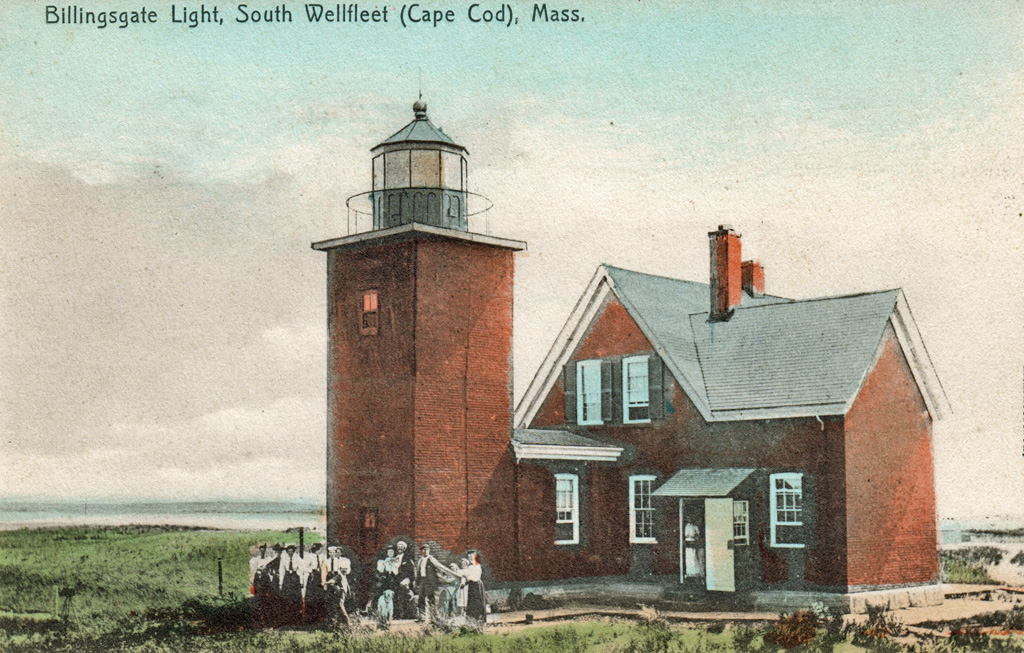
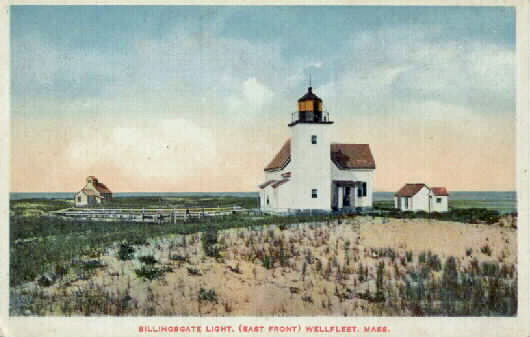
Congress provided the requested sum on August 18, 1856, and work began in August 1857. The new lighthouse consisted of a square brick tower attached to a brick keeper’s dwelling instead of the recommended screwpile structure. Unlike the earlier lighting system of multiple lamps, the new light used a fourth-order Fresnel lens—a modern optical system that dramatically increased efficiency.
On September 1, 1858, the rebuilt lighthouse was illuminated for the first time. The official notice to mariners stated: “The illuminating apparatus is a catadioptric lens of the fourth order of the system of Fresnel, showing a fixed light… which should be seen in ordinary states of the atmosphere twelve nautical miles.”
The tower rose thirty feet above the ground, with the light about forty feet above sea level.
The new lighthouse was stronger than its predecessors, but it still stood on an island constantly reshaped by the sea.
Keeper Heman S. Dill recorded the dangers in his logbook during the 1870s. After a severe storm in December 1874 he wrote: “The sea broke through at the north end of the island… filling the middle of the island full… I could stand on the south corner and jump into four feet of water.”
In February 1875 Dill described the isolation caused by heavy ice: “It has been very Cold here for the last month… I have not seen a living man for over a month… I do get the blues sometimes to think I cannot get from here.”
Only a year later tragedy struck. On March 27, 1876, Dill went hunting and was later seen returning by boat. When his daughter went to the landing she found him sitting motionless with his gun across his lap—dead. His family spent the night alone on the island with the body until help arrived the following day.
By the late nineteenth century, the island itself was disappearing. The government repeatedly attempted to protect the lighthouse using bulkheads, jetties, and stone barriers.
In 1888, engineers constructed hundreds of feet of timber jetties and plank bulkheads designed to trap drifting sand. These works initially succeeded; sand accumulated around the structures and temporarily stabilized the shoreline. Yet the sea continued its slow advance.
Additional repairs were made throughout the late nineteenth and early twentieth centuries. Bulkheads were extended, buildings repaired, and new protective structures added. But erosion never truly stopped.
Technological changes eventually altered the role of the lighthouse. In 1912, the station was automated with an acetylene lighting system, and the position of keeper was abolished. The last keeper, Manuel A. Francis, was transferred to Minots Ledge Lighthouse.
Three years later, severe storms damaged the tower so badly that it developed a dramatic lean. The Secretary of Commerce commended Ralph H. Goddard, local lighthouse inspector, and William G. Remsen, first officer of the tender Mayflower for bravery and meritorious service in removing the lighting apparatus from the tower. The Secretary noted in his letter that “the light was exhibited every night as usual without discontinuance.” The tower toppled during a storm on December 26, 1915.
Even after the lighthouse tower disappeared, a light continued to mark the site for a time. In 1922, exactly one hundred years after the original lighthouse had been established, the light was discontinued.
A new light was briefly erected in 1931 in response to requests from local mariners, but the constantly shifting sands made any permanent structure impractical. In 1933, a lighted bell buoy replaced the light on the island.
By 1942, Billingsgate Island had nearly vanished beneath the waters of Cape Cod Bay. At low tide the remnants of the island sometimes reappeared as sandbars, a reminder of the once-busy community and its lonely lighthouse.
In 1990, granite portions of the lighthouse foundation were visible at low water and acted as dangerous reefs during high tide. Chuck Cole lost his boat Sunspirit after striking the lighthouse remains. It’s rather ironic that a lighthouse, constructed to save navigation, reached up from its watery grave and destroyed a boat that it would have guided to safe harbor in earlier days.
Michael Collins (1822 – 1830), Abijah Gill (1830 – 1847), Elisha Cobb (1847 – 1849), Francis Krogman, Jr. (1849 – 1853), Elisha Cobb (1853 – 1861), Thomas K. Paine (1861 – 1869), Thomas J. Paine (1869 – 1872), Heman S. Dill (1872 – 1876), Thomas K. Paine (1876 – 1884), Ira W. Ingalls (1884 – 1892), James P. Smith (1892 – 1899), Axel Stone (1899 – 1900), Albert L. Whitten (1900 – 1902), George W. Bailey (1902 – 1910), Manuel A. Francis (1910 – 1912).