Wickford Harbor, RI 
Select a photograph to view a photo gallery
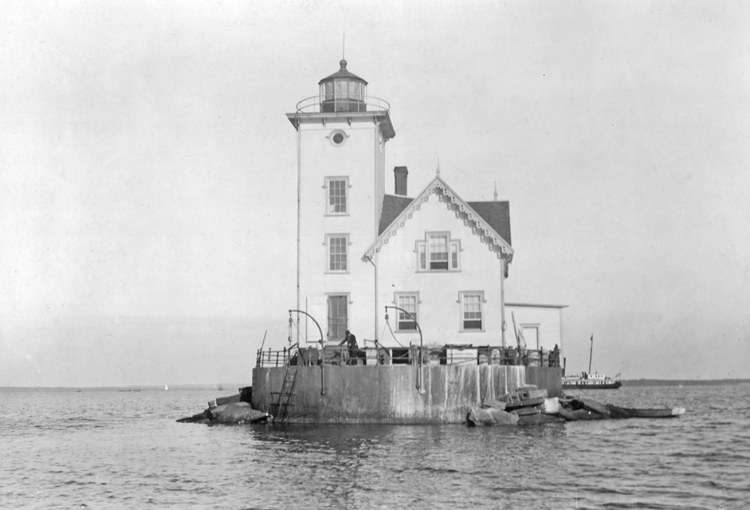
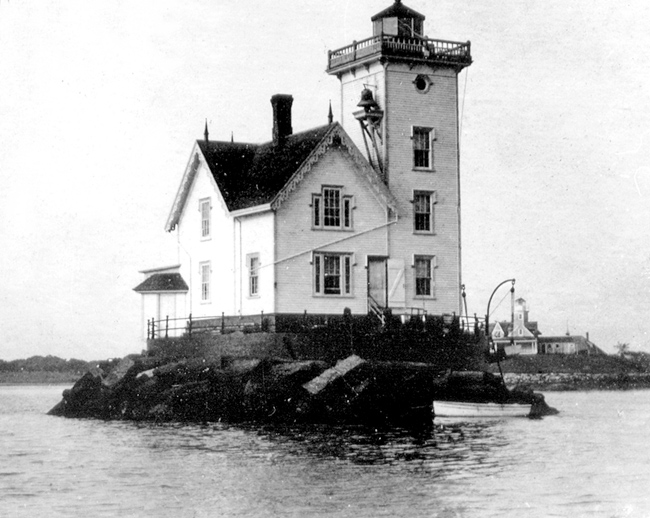
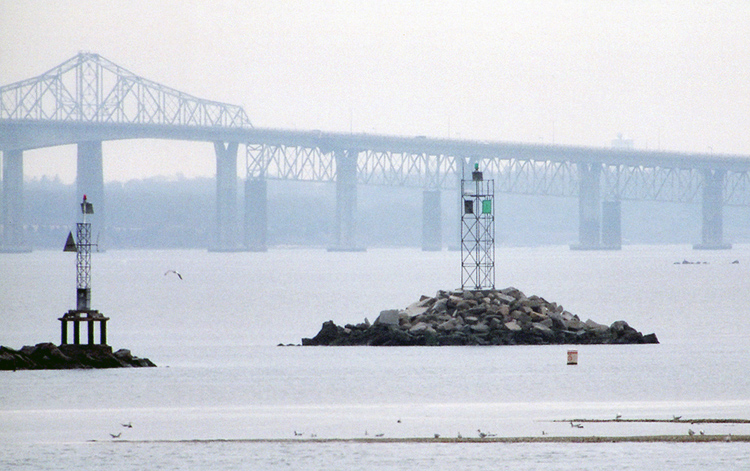
Photo Gallery
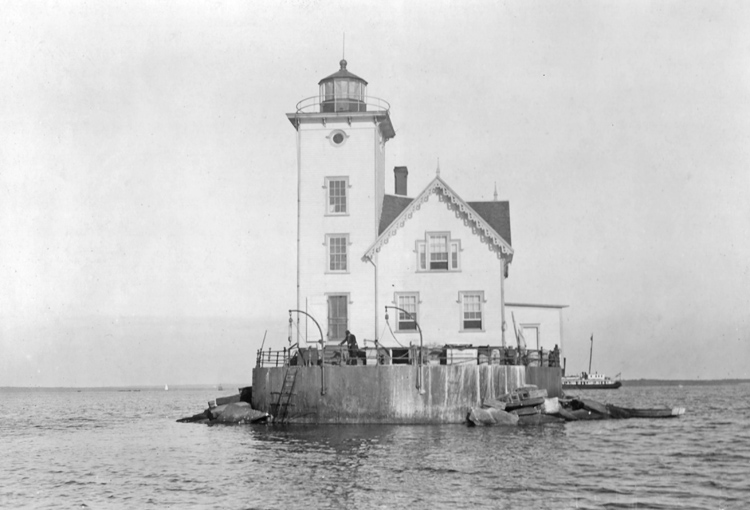
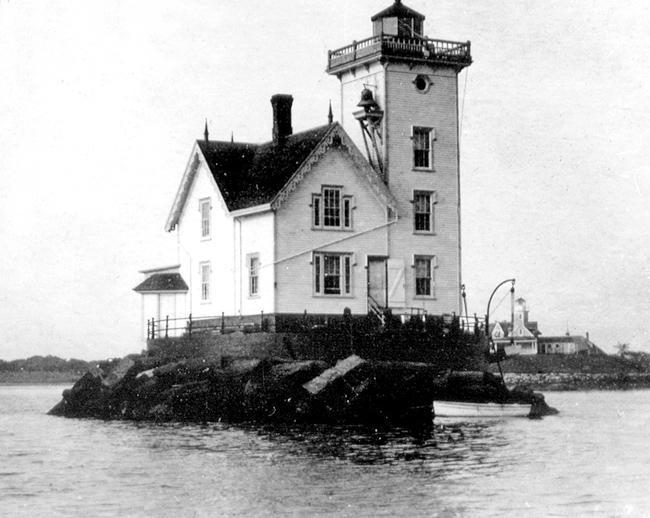
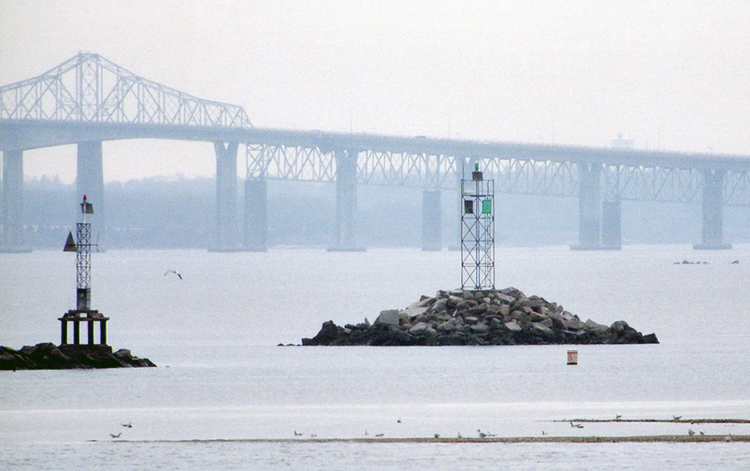
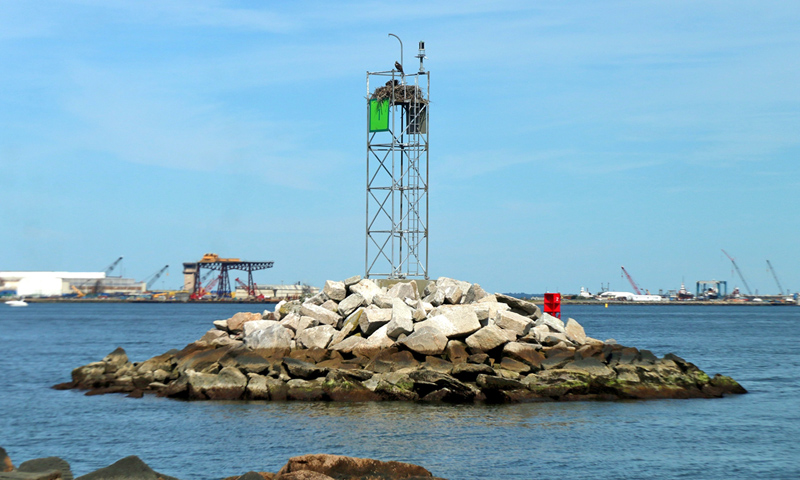
Photo Gallery
Photo Gallery
Wickford Harbor Lighthouse, constructed on Old Gay Rock at the entrance to Wickford Harbor in Narragansett Bay, was one of the most distinctive offshore light stations in Rhode Island. Its history reflects both the growing demands of nineteenth-century maritime traffic and the evolving technology of lighthouse construction, as well as the human stories that unfolded within its isolated yet vital setting.
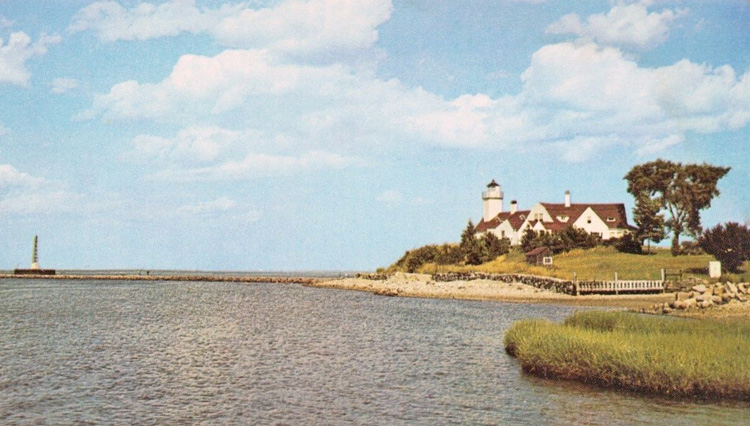
The origins of navigational aids at Wickford date to March 3, 1831, when Congress appropriated $3,000 to establish a beacon light near the harbor entrance in the town of North Kingstown. This early light, built at Poplar Point, served mariners for decades. However, as coastal trade and especially ferry traffic between Wickford and Newport increased, the limitations of the original site became increasingly apparent.
|
The annual reports of the Lighthouse Board in 1878 and 1879 emphasized the need for improved aids to navigation. The entrance to Wickford Harbor was complicated by reefs and ledges, particularly the dangerous outcrop known as Old Gay Rock. The Board recommended constructing a granite pier with a light on this exposed location, along with additional day-beacons on nearby hazards such as the Brothers Rocks and James Ledge. Importantly, officials noted that once a light was established on Old Gay Rock, the older light at Poplar Point could be discontinued.
Congress acted on these recommendations on June 15, 1880, appropriating $45,000 for the construction of a new lighthouse on Old Gay Rock. This marked a decisive shift toward placing the principal light directly on the hazard it was meant to mark, rather than on the shoreline.
Before construction could begin, the State of Rhode Island formally ceded jurisdiction over Old Gay Rock to the federal government in February 1881. This transfer included not only the rock itself but also a strip of submerged land connecting it to Poplar Point, ensuring full federal control of the site for lighthouse purposes.
Work proceeded rapidly thereafter. A temporary wharf was erected in 1881 to facilitate the landing of materials, and a fog bell was installed to warn mariners during construction. Contracts were issued for a massive iron pier—fifty feet in diameter and composed of 132 cast-iron plates weighing, in total, approximately seventy tons.
The engineering of the foundation was particularly noteworthy. Workers first deposited roughly 1,500 tons of stone around the rock to create a stable base, followed by additional stone in the spring. A large iron cylinder was then placed over the site and filled with a carefully mixed mass of cement, sand, broken stone, and pebbles. This “caisson” formed a solid artificial island capable of supporting the superstructure. Riprap stone—ultimately thousands of tons—was added around the base to protect against waves and ice.
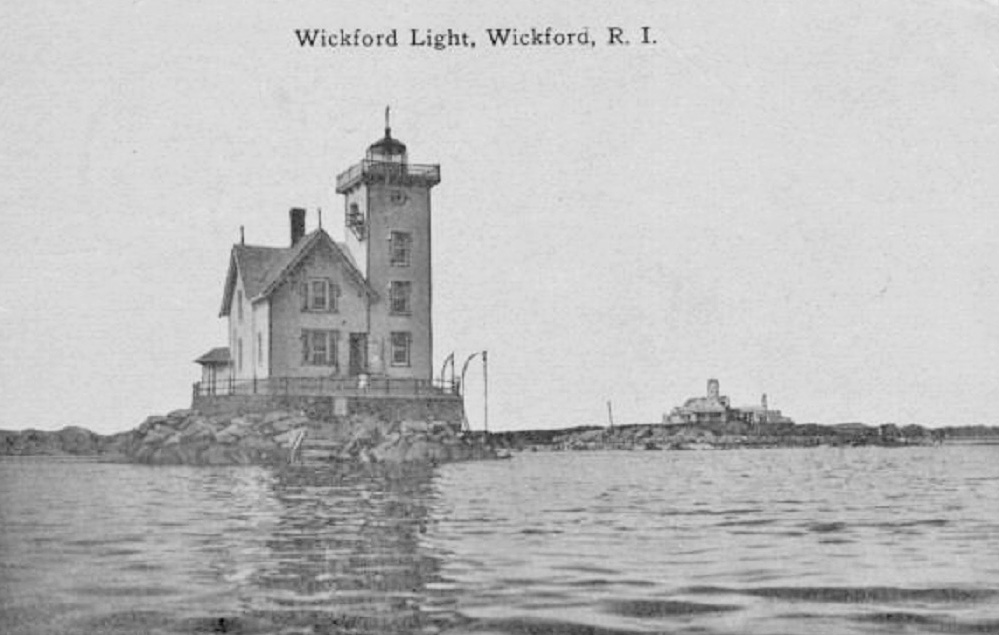
Despite delays caused by winter weather, construction resumed in early 1882. By autumn, the dwelling and tower were nearly complete. The new lighthouse was a striking structure: a one-and-a-half-story wood-frame dwelling with an attached square tower, all painted white, standing atop a red iron pier.
On November 1, 1882, the light was first exhibited. It consisted of a fixed white light produced by a fifth-order Fresnel lens, visible for approximately twelve nautical miles. A fog bell, struck mechanically at twenty-second intervals, provided an audible warning in poor visibility. With the activation of this new light, the old Poplar Point light was discontinued.
Wickford Harbor Light was as much a home as it was a navigational aid. The eight-room dwelling was designed in a picturesque Victorian style, with practical adaptations for its offshore environment. The caisson foundation housed a basement containing an oil room and a 2,500-gallon cistern for collecting rainwater. The first and second floors each contained multiple rooms connected by a central hallway, while the tower rose from one corner to house the lantern.
Daily life required constant vigilance and adaptability. Supplies had to be brought by boat, storms battered the structure, and isolation was a constant reality. Yet the station also supported family life. Children of the keepers grew up surrounded by water, finding creative ways to occupy themselves—even riding bicycles in circles around the narrow iron-railed perimeter.
The first keeper of the new light was Henry F. Sherman, who had previously tended the Poplar Point light. He served until 1885, when he was succeeded by Nathaniel Dodge, an experienced keeper who had worked at Block Island Southeast Light and Whale Rock Lighthouse.
In 1893, Edward Andrews assumed command of the station, after having previously served as an assistant and head keeper at Whale Rock Lighthouse. Andrews would become the most enduring figure in the lighthouse’s history, serving until its automation in 1930. During his tenure, the station underwent continual maintenance, including the addition of hundreds of tons of riprap to reinforce the foundation against erosion and ice damage.
One of the most dramatic episodes in the history of Wickford Harbor Lighthouse occurred in 1898 and demonstrated the critical role lighthouse keepers played beyond simply tending the light.
On a stormy Thursday night, between 8 and 9 o’clock, a violent squall swept across Wickford Harbor. Charles H. Ecclestone and his son Edward Ecclestone were returning home in a seventeen-foot catboat after dredging for scallops in nearby waters. As they approached the harbor, the sudden intensity of the storm caught them off guard. Although they attempted to manage their sail, the squall struck with such force that the boat capsized.
Both men were thrown into the dark, churning water. In the chaos, the elder Ecclestone disappeared, while his son struggled to stay afloat. The overturned boat, still towing a small dory, drifted away into the night, leaving the younger man alone in the water.
At the lighthouse, Keeper Andrews heard faint cries for help carried over the wind from the northeast. Recognizing the urgency, he acted immediately. Despite the dangerous conditions—heavy seas, strong winds, and darkness—he lowered his boat from the davits and set out toward the sound.
Rowing approximately a quarter of a mile into the storm, Andrews eventually spotted the struggling swimmer, who was by then nearly exhausted and barely able to keep himself above water. Bringing the man aboard was no easy task; the combination of rough seas and the victim’s weakened state made the rescue physically demanding.
|
By the time Andrews returned to the lighthouse, the young man had lost consciousness. Inside, Andrews and his wife worked quickly to revive him. Through determined efforts, they succeeded in expelling a large quantity of seawater from his lungs and restoring his breathing.
Once revived, the survivor recounted the tragedy and confirmed that his father had been lost. Despite subsequent efforts and reports of others attempting to assist from shore, the elder Ecclestone’s body was never recovered.
The rescue highlighted not only Andrews’ courage but also the broader humanitarian role of lighthouse keepers, who were often the first—and sometimes only—line of aid in maritime emergencies.
Although Andrews was widely respected, his tenure was not without controversy. In 1907, he was investigated for allowing unauthorized individuals to stay at the lighthouse. Andrews explained that he had been ill and had relied on his brother-in-law for assistance in caring for his family and maintaining operations. While he was reprimanded, officials ultimately considered his prior good service and allowed him to remain in his position.
Further challenges arose over the years, including periods of illness within his family and occasional criticisms of station conditions. Nevertheless, inspections also praised the lighthouse at various times, noting it to be in excellent order.
Andrews declined a transfer to another station in 1909, expressing a preference for a land-based assignment that was never granted. He continued his duties at Wickford for decades, maintaining the light through changing technologies and administrative oversight.
By 1930, advances in lighthouse technology and a push for cost-saving measures led to the automation of many stations. Wickford Harbor Light was among them. The picturesque dwelling and tower were removed and replaced with a skeletal steel structure displaying a flashing white light. The fog bell was discontinued, and the new light operated unattended.
After forty years of service, Edward Andrews retired that same year due to declining health. He was granted a pension and later died in 1939, the year the U.S. Lighthouse Service was absorbed into the Coast Guard.
Though the original structure no longer stands, Wickford Harbor Lighthouse remains an important chapter in the maritime history of Narragansett Bay. The site, now marked by a modern skeletal tower, continues to guide vessels into Wickford Harbor.
The story of the lighthouse is one of engineering ingenuity, adaptation to changing maritime needs, and, above all, human dedication. From its origins as a modest shore light to its transformation into an offshore beacon, and through the long service of keepers like Edward Andrews, Wickford Harbor Light exemplified the vital role lighthouses played in safeguarding coastal navigation—and the lives that depended upon it.