Whale Rock, RI 
Select a photograph to view a photo gallery
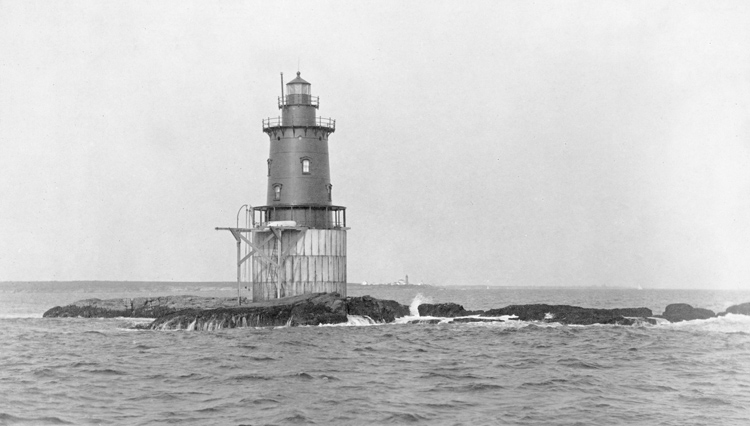
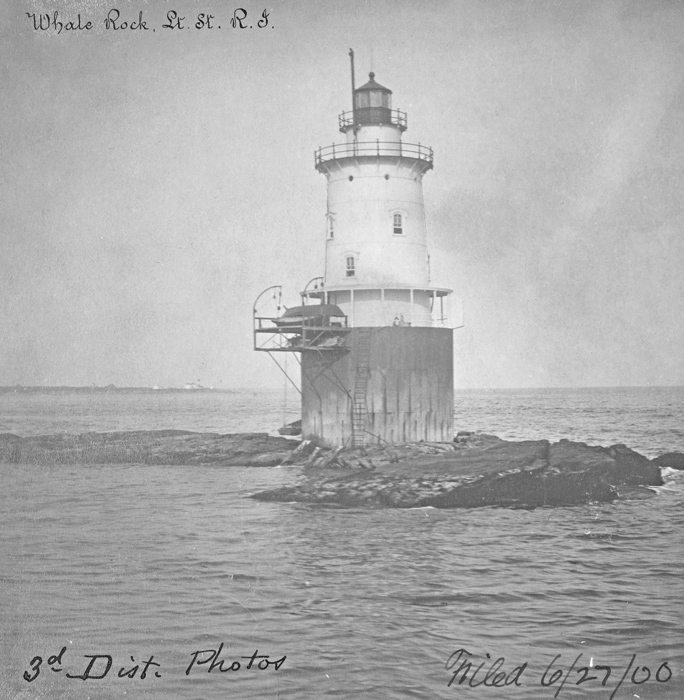
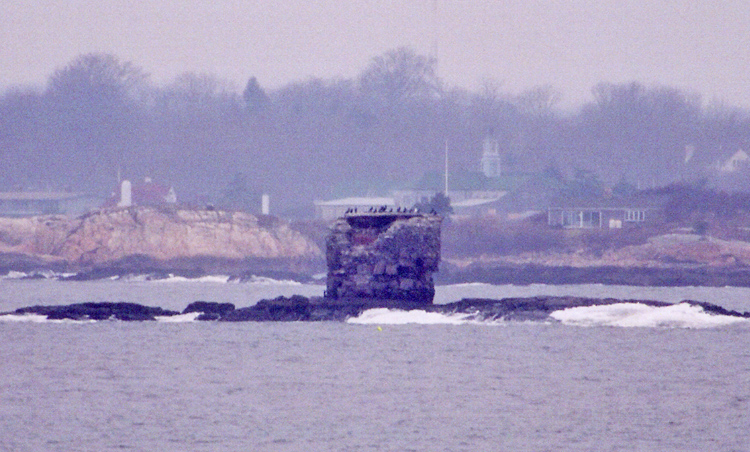
Photo Gallery
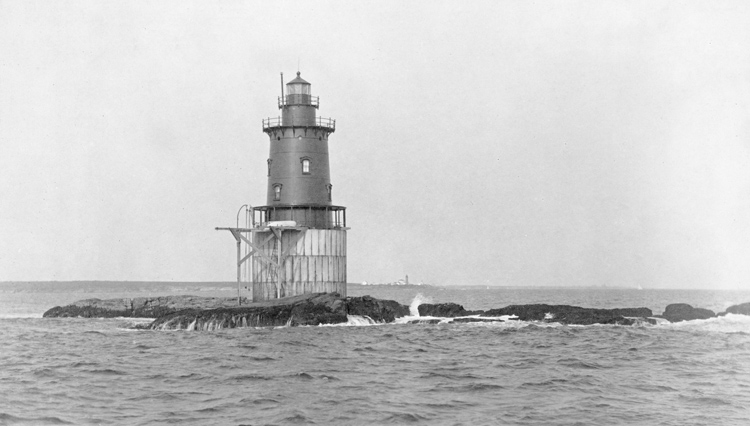
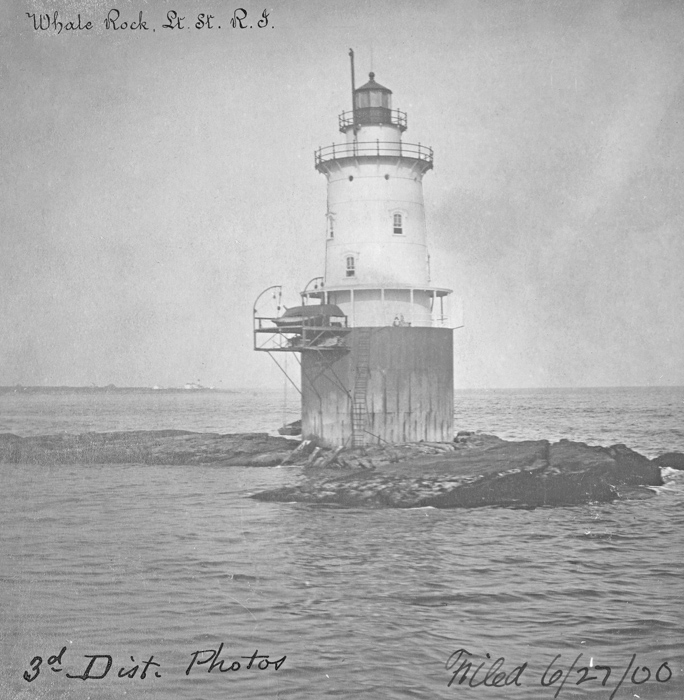
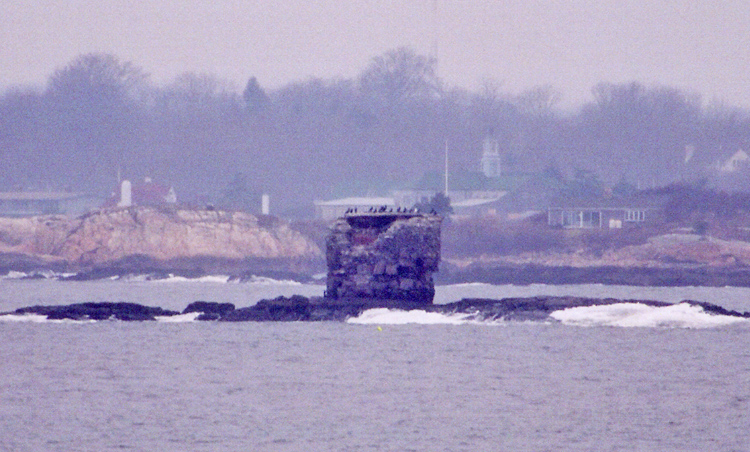
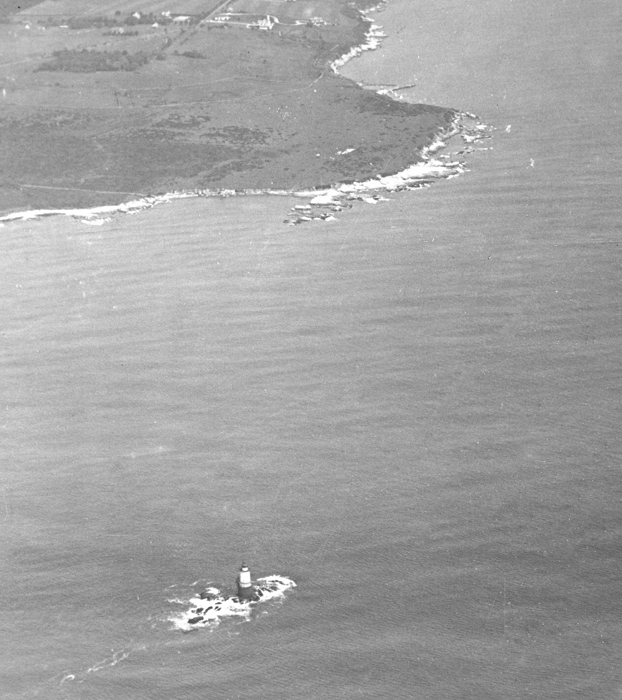
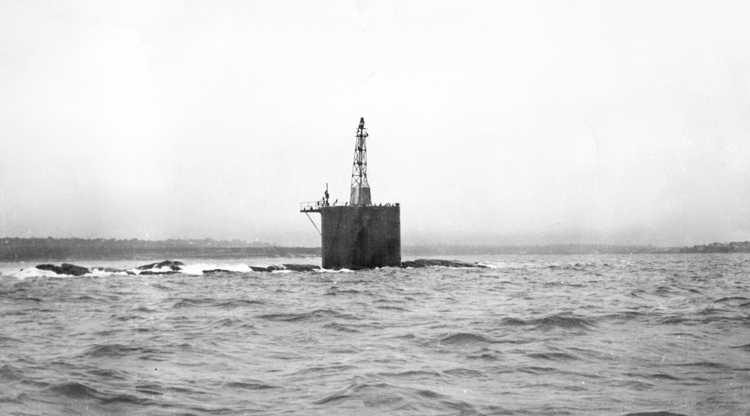
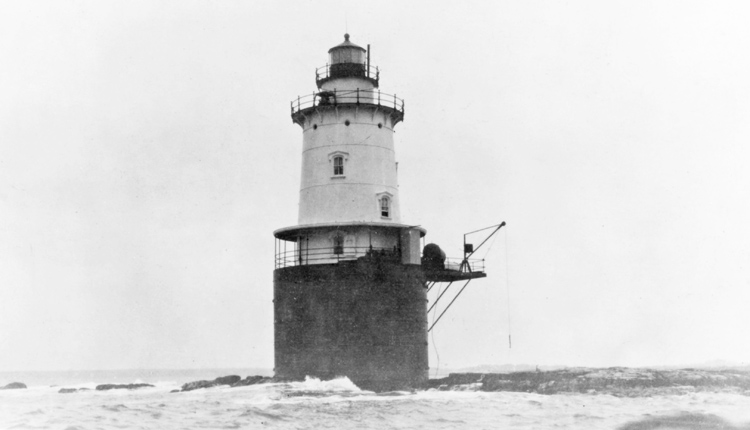
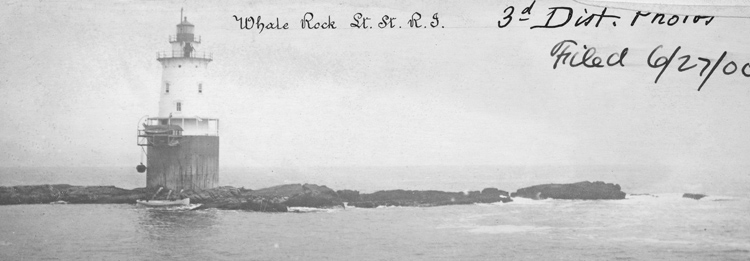
Photo Gallery
Photo Gallery
At the western entrance to Narragansett Bay, between the shores of Jamestown and Narragansett, lies a long, jagged reef known as Whale Rock. Barely awash at all stages of the tide, the formation presented one of the most dangerous hazards to navigation in southern New England. For decades, vessels entering and leaving the busy West Passage passed perilously close to this obstruction, often in darkness, fog, or heavy weather. The history of Whale Rock Lighthouse is therefore not merely the story of a structure, but of a persistent struggle between maritime necessity and the unforgiving forces of the sea.
Long before a lighthouse rose from the rock, Whale Rock had already established a grim reputation. Shipwrecks were frequent, and the reef claimed both property and lives. One early tragedy occurred in November 1862, when the schooner Ann M. Sill, bound for Fall River with a cargo of oysters, struck the rock and sank within fifteen minutes. Though the captain was rescued, three crew members were likely lost. Incidents such as this were not isolated; mariners widely regarded Whale Rock as a menace lying directly in the track of coastal traffic.
By the early 1870s, the danger had become impossible to ignore. Reports to federal authorities described the reef as “a dangerous obstruction to navigation,” especially given its position along a heavily traveled route used by Providence steamers carrying passengers and valuable freight. The Lighthouse Board made recommendations in 1872 and again in 1873 for the construction of a lighthouse and fog signal, with an estimated cost of $35,000. Despite the urgency, funding was not immediately forthcoming.
Meanwhile, wrecks continued on Whale Rock. The loss of vessels such as the schooner Israel H. Day and the damaging of the steamer Oceanus reinforced the need for action. After mentioning these two vessels, an 1875 newspaper article noted: “There are few places in the vicinity where a light is needed more than here.” In 1876, prominent Rhode Island merchants and navigators petitioned for at least a beacon or spindle to mark the rock, citing tens of thousands of dollars in losses.
A turning point came in November 1880, when the large and elegant steamer Rhode Island ran aground near Whale Rock in dense fog. Though all passengers were saved, the vessel—valued at $500,000—was declared a total loss. The dramatic wreck underscored the inadequacy of existing navigational aids and likely hastened congressional action.
In March 1881, funding was finally appropriated for the construction of a lighthouse and fog-bell. Work began soon afterward under challenging conditions. Engineers cut a ring into the solid rock to anchor the foundation, and a cast-iron caisson was erected and filled with stone and concrete. The exposed location made construction difficult; workers were often limited to only a few hours of labor per day due to rough seas.
The design followed the “sparkplug” style common to offshore lighthouses of the era—a cylindrical iron tower rising from a broad base. The structure incorporated living quarters for the keepers, with multiple levels containing a kitchen, sitting room, and sleeping chambers. A cistern built into the base collected rainwater, an essential feature for a station isolated more than a mile from shore.
G. W. and F. Smith Iron Company of Boston supplied the ironwork for the lighthouse, while Merritt, Chapman, and Scott of New London, Connecticut erected the structure. Dutch Island, a few miles to the north, was used as a staging area for the project.
By late 1882, the lighthouse was nearing completion. On October 1 of that year, a fixed red light was officially exhibited for the first time, visible up to fourteen nautical miles in clear weather. A fog bell, sounded at regular intervals during poor visibility, supplemented the light. The tower stood approximately seventy-three feet above mean low water, its white-painted upper section contrasting with the red pier below.
The completion of Whale Rock Lighthouse marked a significant improvement in maritime safety. Yet life at the station was far from easy. The isolated setting, constant exposure to wind and waves, and difficulty of landing made it one of the more challenging assignments in the Lighthouse Service. Turnover among keepers was high, and the work demanded both physical endurance and mental resilience.
The characteristic of the fog bell was changed in December 1882 from a single blow to a double blow every twenty seconds. The color of the tower was changed from white to brown in 1886 or 1887, but this change was reversed in 1892, when the tower was once again painted white.
The dangers of the station were not limited to the surrounding waters. In August 1897, a dramatic and violent incident unfolded when assistant keeper Henry Nygren returned to the lighthouse intoxicated and attacked keeper Judson Allen with a knife. The two men engaged in a desperate struggle inside the tower before Allen escaped by climbing down a rope and fleeing by boat. Nygren pursued him, firing a couple shots with a shotgun. Allen raced on foot to a farmhouse, where he commandeered a horse and galloped off. Nygren abandoned pursuit and retreated to the lighthouse. Authorities removed Nygren from the lighthouse the next day, and he was promptly dismissed from the service. The episode highlighted the psychological strains of isolation and confinement at offshore stations.
Tragedy struck again in December 1901, when assistant keeper Martin W. Ekman drowned while attempting to land at the lighthouse with Christmas provisions and mail. His small boat capsized in rough conditions, and he was lost within sight of the station. The event cast a somber shadow over what should have been a festive season and underscored the ever-present risks faced by lighthouse keepers.
A couple of unusual and surprising events also occurred at the lighthouse. In 1901, Keeper Silas Stanton was cleaning out the boat that was suspended from the davits, when he heard a hissing sound behind him. He turned to find a coiled-up land snake on the rocks poised to strike. He sprang aside, grabbed a stick, and quickly dispatched the four-foot-long serpent. In 1902, Keeper Joseph Meade witnessed a meteorite of large proportions strike the water 300 yards from the lighthouse and explode. Such incidents added to the sense of unpredictability that characterized life at Whale Rock.
Over the years, the station saw various improvements. A landing platform supported by brackets and equipped with davits was installed in 1890 to assist in handling boats and supplies. The fog bell striking machinery was upgraded in 1897, and an oil tank was added in 1914 to safely store fuel. Despite these enhancements, the fundamental challenges of the site remained.
Storms frequently battered the structure. In August 1924, a severe storm tore away sections of the gallery roof, railings, and water collection system and damaged the station’s boat. Keepers reported that waves swept entirely over the roof of the main gallery, with spray reaching the lantern itself. Repairs were made, but the vulnerability of the lighthouse was evident.
The ultimate test came on September 21, 1938, when a powerful hurricane struck New England with little warning. At Whale Rock, assistant keeper Walter B. Eberle was alone on duty. As the storm intensified, enormous waves pounded the tower.
When the storm subsided, the lighthouse was gone.
Investigations revealed that the caisson foundation remained largely intact, but the tower itself had been torn apart. Evidence suggested that the upper sections—including the watch room and lantern—had broken free and been swept into the sea. The remaining lower structure collapsed afterward. Eberle, who had likely taken refuge in the upper portion, perished in the disaster. His body was never recovered.
The destruction of Whale Rock Lighthouse was one of many tragedies of the 1938 hurricane, but it stood out as a stark example of the vulnerability of offshore structures to extreme natural forces. The loss also marked the end of an era, as advances in technology and changing priorities led to the gradual replacement of manned lighthouses with automated aids.
|
Daniel A. Sullivan, whose twelve-year tenure as head keeper at Whale Rock was the station’s longest, was ashore when the hurricane struck. After Whale Rock Lighthouse was washed away, Keeper Sullivan was offered a transfer to Minot's Ledge Lighthouse, another wave-swept structure. Rather than accept this transfer, he requested disability retirement due to pain in his back. This request was denied, but he was granted a leave of absence from October 7, 1938 until February 13, 1939, when he was transferred to Eastern Point Lighthouse. Keeper Sullivan served in quick succession as an assistant at Eastern Point, Stepping Stones, and Race Rock lighthouses before spending the last decade of his career, from 1940 to 1950, as head keeper of New London Ledge Lighthouse.
In the wake of the disaster at Whale Rock, a lighted whistling buoy was established to mark the site. Residents of nearby communities complained about the mournful sound of the horn, which served as a constant reminder of the hurricane and its toll. As a result, a lighted gong buoy was anchored near the remains of the lighthouse in June 1939 instead of the whistling buoy.
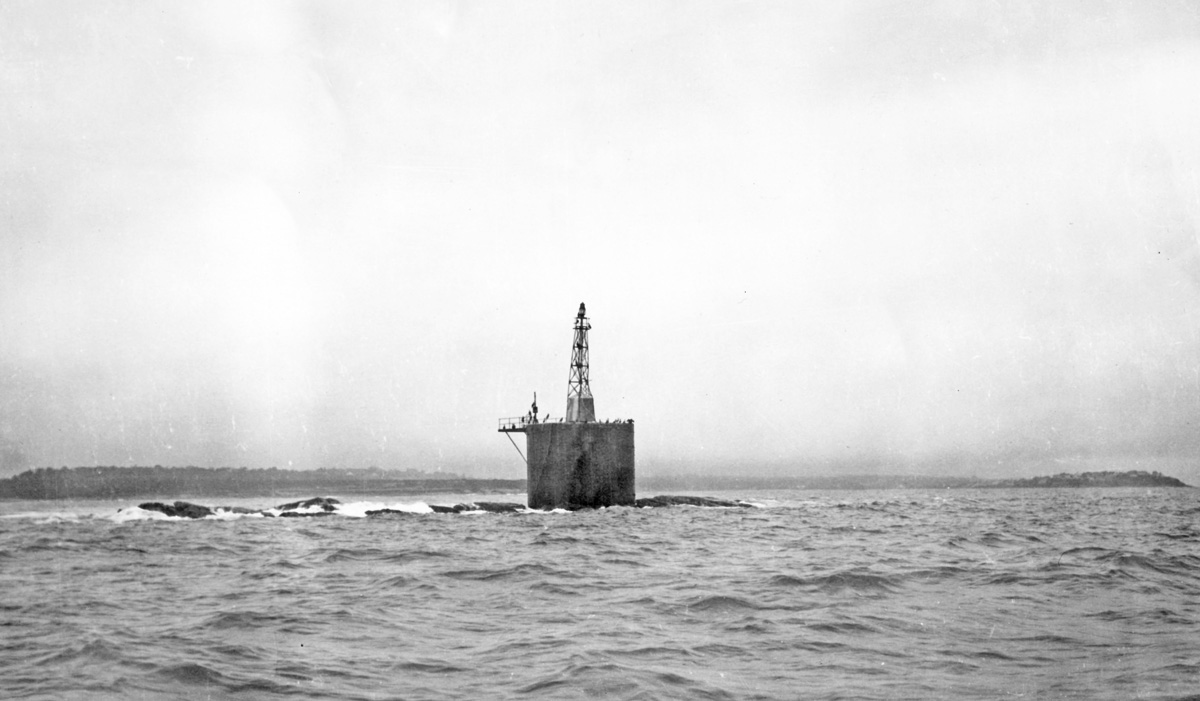
After the remains of the tower were cleared, a concrete pad was poured on top of the caisson foundation, and a thirty-foot tower was installed to display an automatic, blinking green light. The lighted gong buoy was then replaced by a gong buoy.
Though the original lighthouse was gone, its memory endured. In time, the site became the focus of historical and archaeological interest, with divers documenting scattered fragments of the structure on the sea floor.
Walter Eberle’s story, in particular, has resonated across generations. A former Navy man and father of six, he had chosen a life at sea and ultimately died in service to others. Memorial efforts, including a plaque dedicated in 2008 at Beavertail Lighthouse, have ensured that his sacrifice is not forgotten.
Today, a lighted gong buoy again marks Whale Rock. All that remains of Whale Rock Lighthouse is the concrete and rock portion of the caisson foundation that has long since lost its protective iron shell and is gradually eroding away.