Fuller Rock, RI 
Select a photograph to view a photo gallery
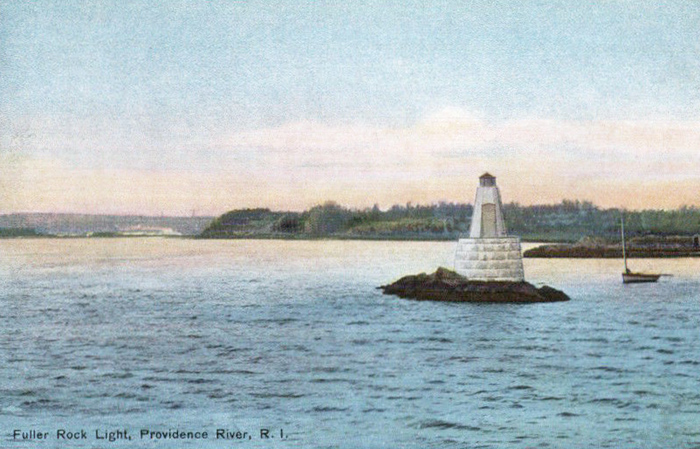
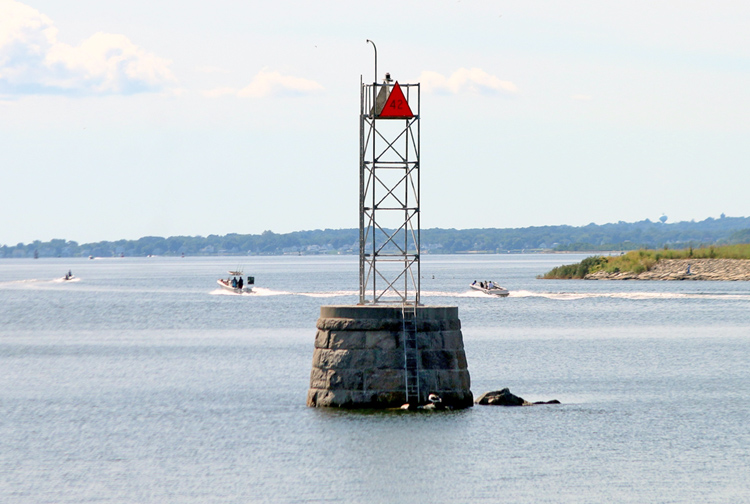
Photo Gallery
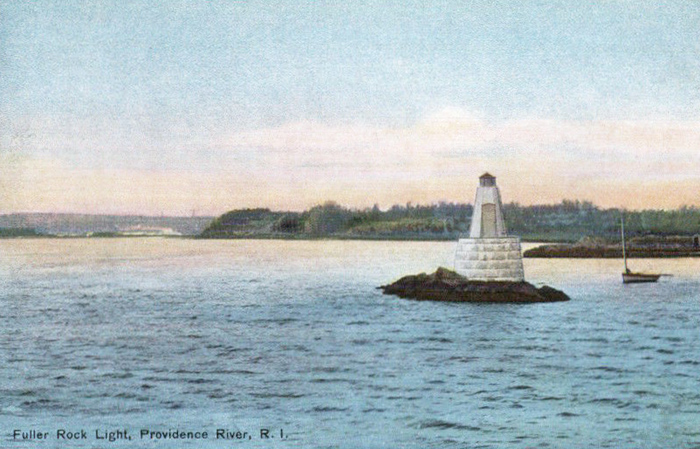
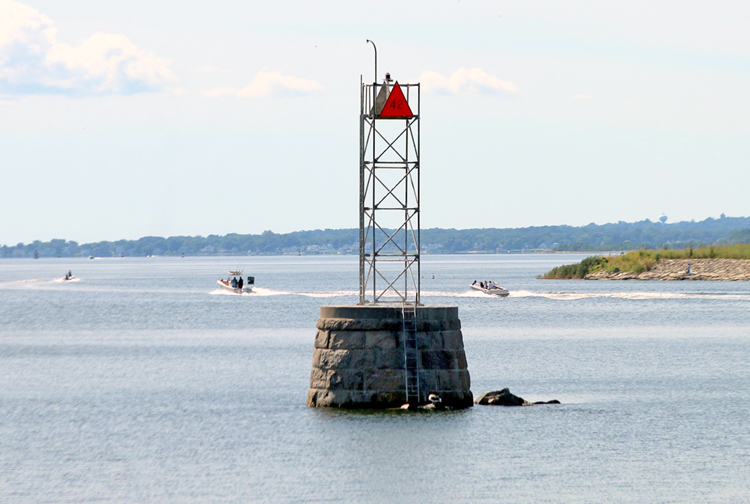
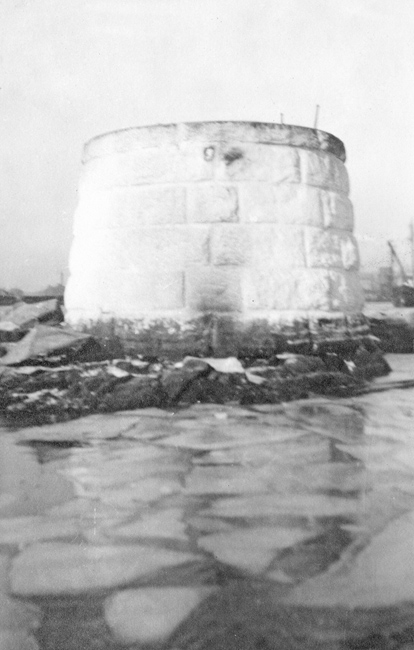
Photo Gallery
Photo Gallery
As maritime commerce surged in the nineteenth century, the Providence River became one of New England’s busiest industrial waterways, carrying coastal schooners, steamers, and deep-draft vessels to the thriving port of Providence. Shoals, rocks, and narrow channels made the upper river particularly treacherous, and federal efforts to improve navigation included the establishment of lighted aids such as Conimicut Point Shoal (1868), Pomham Rocks (1871), Sabin Point (1872), and Bullock’s Point (1872). Among the additional dangers requiring attention were Fuller Rock, nearly in mid-channel, and a shoal off Sassafras Point on the western side of the river.
Recognizing the need for permanent aids at these hazards, Congress appropriated $20,000 on July 15, 1870, for three lights above Sabin Point: Pomham Rock, Fuller Rock, and Sassafras Point. Plans called for Fuller Rock and Sassafras Point to consist of granite piers surmounted by identical fourteen-foot hexagonal wooden pyramidal towers capped by small cast-iron lanterns. Fuller Rock light would stand twenty-eight feet above mean high water, while Sassafras Point’s would rise twenty-five feet.
|
Construction moved forward in 1871 under contract, though not without challenges. Bids called for substantial granite piers at Fuller Rock and Sassafras Point, eighteen feet in diameter at the base, fifteen at the top, and twelve feet high. Fuller Rock itself was bare at ordinary high water, while a granite riprap foundation had to be built up to low water at Sassafras Point.
Lorenzo D. Clark was hired as the first keeper of the two lights on July 11, 1872 at an annual salary of $320. He was removed in November of that year, and Charles H. Salisbury of nearby Pomham Rocks Lighthouse looked after the lights for a few weeks until John S. Whittemore was hired. Whittemore soon resigned, as did Edward Beard his successor. Samuel D. Heard, appointed on September 2, 1873, was the first keeper to remain more than a year. He served until 1882.
Fixed white lights from sixth-order Fresnel lenses were initially displayed at both Fuller Rock and Sassafras Point, though Sassafras Point’s light was changed to red on October 1, 1872, to better distinguish the pair. Their placement on opposite sides of the river, about a mile apart, formed an important navigational system guiding vessels through the upper Providence River.
Because neither beacon had living quarters, one keeper tended both stations, rowing daily to each light in all weather. The Lighthouse Board secured $5,000 in 1874 to purchase a site and build a keeper’s dwelling. Yet industrial development along the waterfront thwarted the plan. Landowners feared a keeper’s house would diminish property values, and despite repeated efforts in 1875 and 1876, no site could be obtained. The dwelling was never built, leaving keepers to continue commuting from shore—an arrangement that made these seemingly modest lights unusually difficult posts.
The early towers suffered from exposure. By 1879, their wooden structures showed “considerable evidence of decay,” prompting a recommendation that cast-iron towers replace them, though funding never materialized. Repairs continued as needed. In 1889, the Fuller Rock pier was repointed, cavities beneath it filled with concrete, and seventy-five tons of riprap added around its base. Additional riprap was put in place in 1897 to protect Sassafras Point Light.
The most memorable chapter in the lights’ history belongs to keeper John J. “Jack” Mullen, appointed in 1886 and who tended the lights for more than twenty-five years. Initially paid $550 a year, Mullen became a local legend—part lighthouse keeper, part fireman, part celebrated clog dancer. Yet his most famous role was as the steadfast mariner who braved Providence River in all seasons to keep his lights burning.
One bitter New Year’s Eve in the 1890s, Mullen nearly perished performing that duty. As later recounted in a Providence Journal article, “It was tough pulling, but his lights were burning at sunset as his orders called for.” Returning after lighting the beacons, he hoisted a ragged sail in his yawl to hasten home. Then disaster struck. A sudden gust overturned the boat near Kettle Point, leaving Mullen clinging to the upturned hull in freezing water.
As he later recalled, he was “struggling to find a toehold on the bottom,” shouting into the wind as he waited for death. Salvation came when neighbor Ed Grogan spotted his plight while chopping wood ashore and rowed out to rescue him.
The story became still more famous for Mullen’s dry wit. The next day, a pious acquaintance remarked, “Surely the Lord was with you when you were in the water.” Mullen agreed: “He certainly was on my side.” But when she asked if he had been thinking of the Lord the entire time, the practical keeper admitted, “Not all the time.” Confused, the woman asked, “Why, what else could you have been thinking of?” Keeper Mullen bluntly replied, “How in blazes I was going to get ashore.”
The anecdote captured both the hazards of tending Fuller Rock and Sassafras Point and the rugged humor of those who kept such isolated stations.
Mullen’s era also saw changes in the lights themselves. In 1900, the Lighthouse Board revised many Narragansett Bay lights to establish white lights on the port hand and red on starboard when entering channels. Fuller Rock’s light characteristic thus changed from white to red, and that at Sassafras Point changed from red to white.
Life around Fuller Rock could occasionally veer into the comic as well as the dramatic. In February 1912, residents of Kettle Point awoke to a strange white-clad figure moving ghostlike across the ice-covered rock. Alarmed citizens debated whether it was a lunatic or an apparition. One suggested calling police, another proposed shooting at it to see if it was real. When acting keeper Ed Grogan ventured out to investigate, the “ghost” hailed him in a bass voice: “Is it cold enough for you this morning?” It proved to be a duck hunter disguised in one of his wife’s nightgowns to blend with the snow. The tale became one of the river’s enduring maritime legends.
But 1912 also marked the end of an era. Dredging operations removed the shoal marked by Sassafras Point, and the light was permanently discontinued in July. Fuller Rock survived, but automation transformed it. Converted to an acetylene-powered unmanned beacon, its former fixed red light became a flashing red beam. Mariners were notified in August that the light now flashed every three seconds from an acetylene lens lantern, ending the long tradition of daily tending by resident keepers.
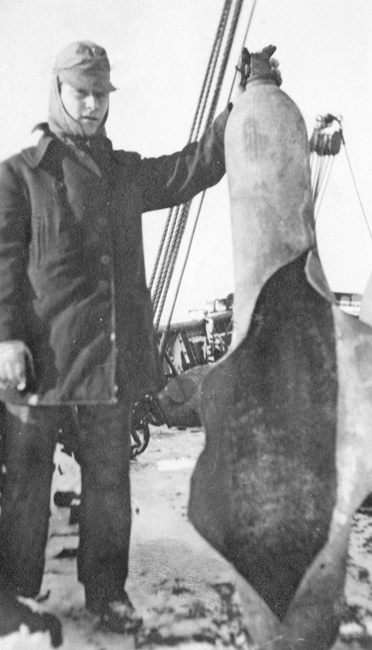
Though automated, Fuller Rock’s story was far from over. On February 5, 1923, catastrophe struck when the lighthouse tender Pansy arrived to replace the acetylene tanks. Six heavy new tanks had been installed and the crew had gone aboard for lunch. Returning for a final inspection, they were caught in a violent explosion.
A newspaper reported that “five members of the crew… were hurled through the air,” suffering burns and broken limbs. The blast ignited the wooden structure, destroying the light in flames. Miraculously, no one died. The accident underscored the risks even “unmanned” lights still posed to those who serviced them.
A replacement steel skeleton tower soon rose on the old granite foundation, and in 1924 plans were announced for a rebuilt and elevated beacon, partly to accommodate expanding oil terminal development at Kettle Point. The new structure raised the lantern forty feet above the water—twice the previous height—and ensured the light remained visible amid growing industrial obstructions.
Captain Jack Mullen lived long enough to see Sassafras Point gone and Fuller Rock transformed beyond recognition. In a 1936 reminiscence, he was remembered not only for his adventures but as one of the colorful waterfront characters of old Providence—a man as comfortable dancing clogs at social gatherings as rowing winter seas to tend lonely beacons.
Though Sassafras Point disappeared in 1912, Fuller Rock endures. The original granite pier, strengthened over generations by repairs and riprap, still supports a modern automated beacon. In 1997, the Coast Guard refurbished the foundation and installed a new tower, continuing a lineage begun in 1870.
Together, Fuller Rock and Sassafras Point represent an often-overlooked class of navigational aids: small beacon lights that lacked the grandeur of major lighthouse stations but played an essential role in maritime commerce. They guarded a working river, demanded extraordinary perseverance from their keepers, and generated stories ranging from humor to heroism.
And perhaps no story defines them better than Captain Jack Mullen’s icy struggle for survival. His blunt words—“How in blazes I was going to get ashore”—remain a fitting epitaph for the keepers of these isolated little lights, whose daily work was less about romance than endurance, seamanship, and getting safely home.
Keepers: Lorenzo D. Clark (1872), Charles H. Salisbury (1872), John S. Whittemore (1872 – 1873), Edward Beard (1873), Samuel D. Heard (1873 – 1882), Edward P. Hoxie (1882), William Dunwell (1882 – 1886), Patrick Fitzpatrick (1886), John J. Mullen (1886 – 1912).
References