Bullock Point, RI 
Select a photograph to view a photo gallery
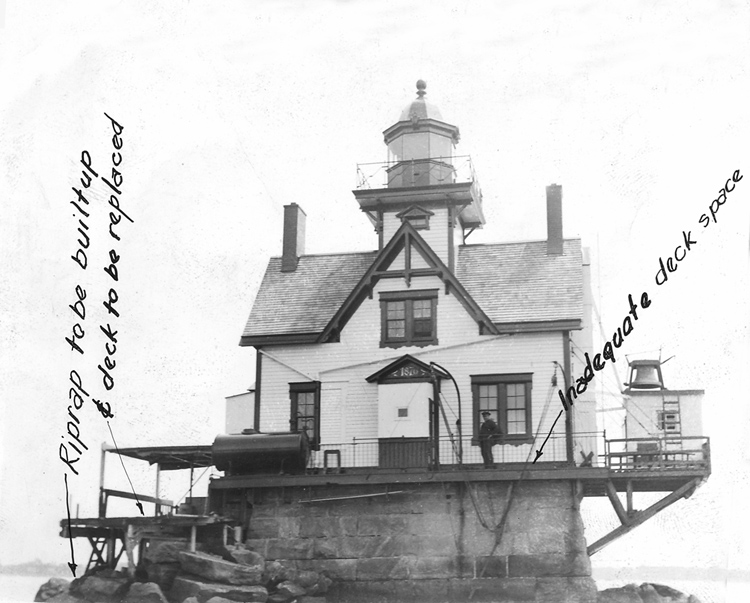
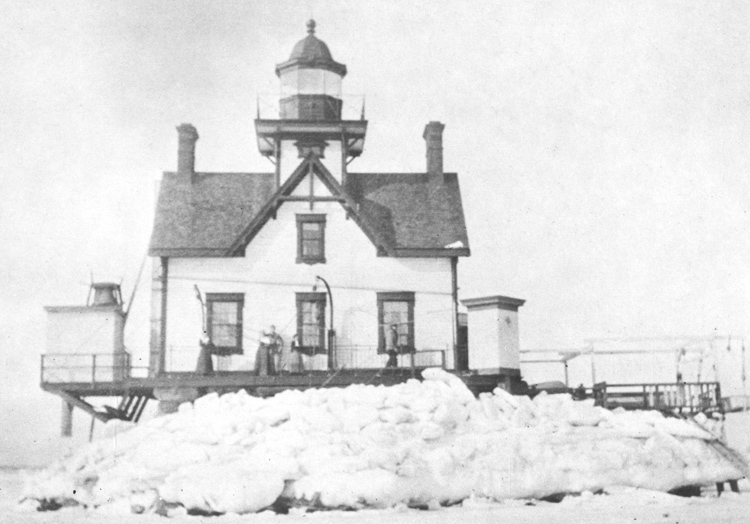
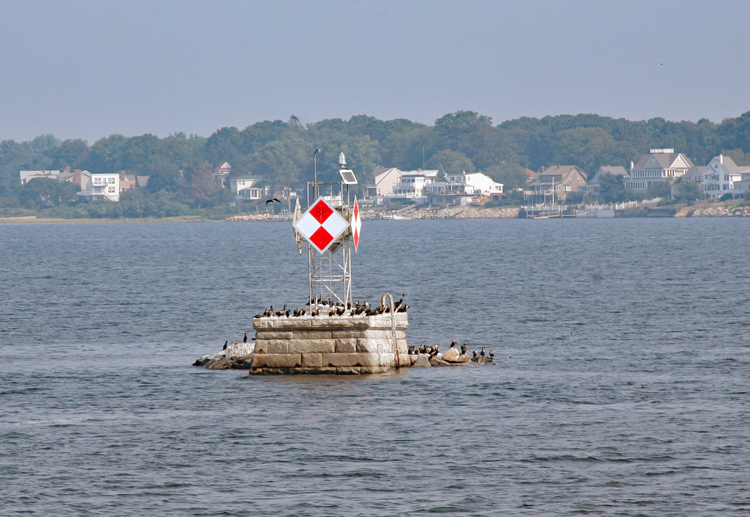
Photo Gallery
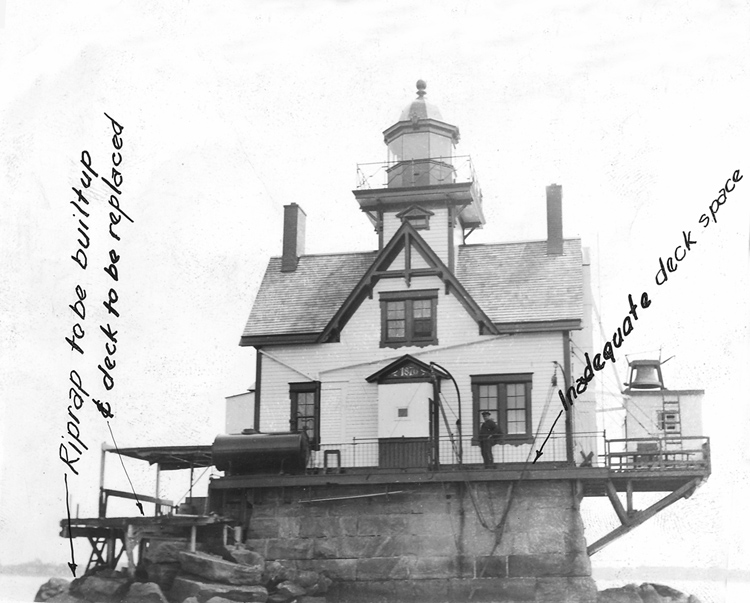
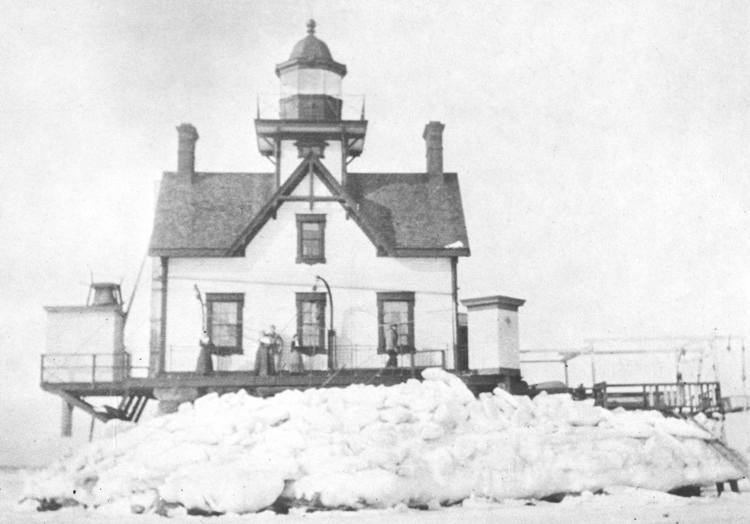
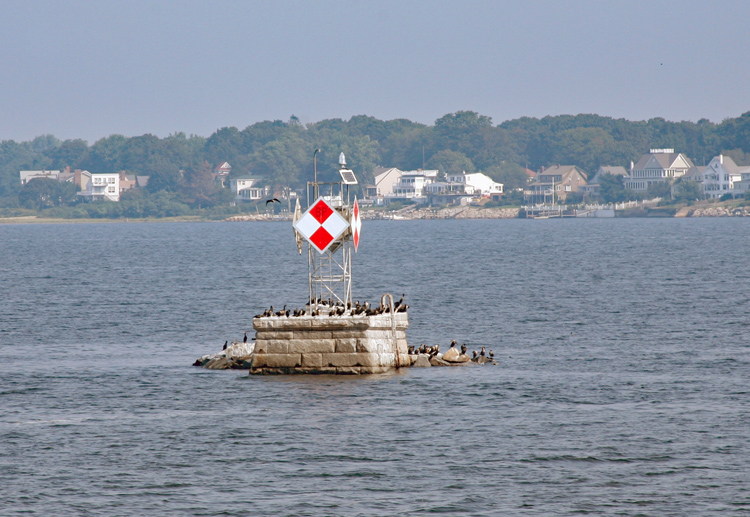
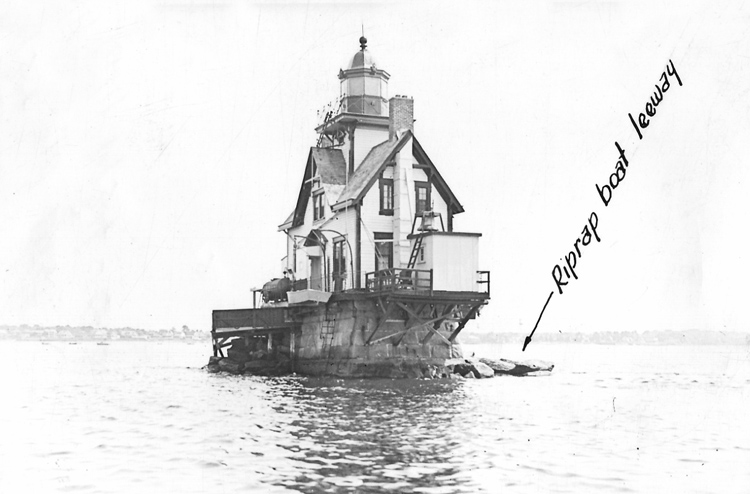
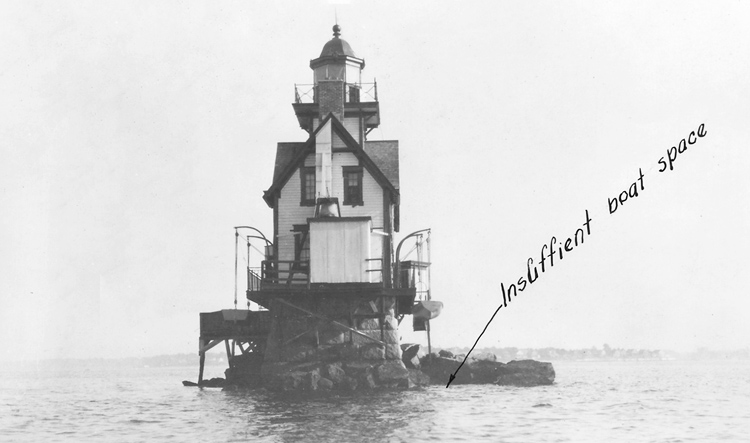
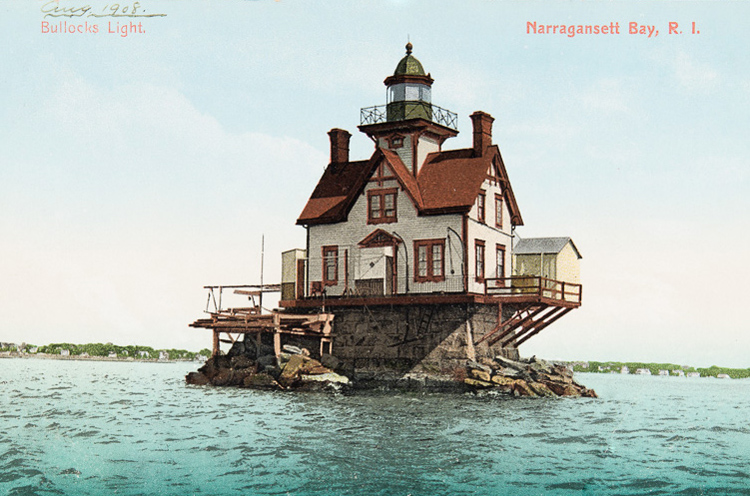
Photo Gallery
Photo Gallery
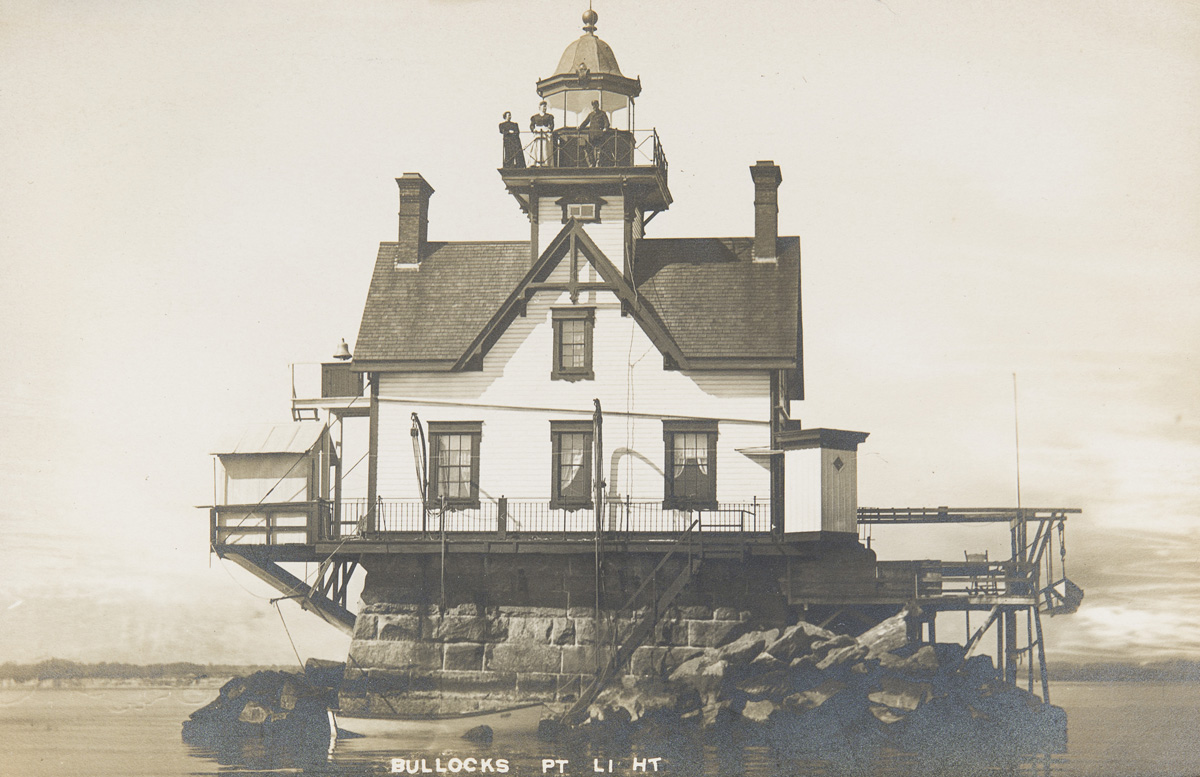
Along the eastern side of the Providence River, just off the point of land that bears the name of early settler Richard Bullock, once stood one of the most unusual lighthouse structures in New England. Bullock Point Lighthouse, perched on a granite pier amid the tidal currents of Narragansett Bay, served for more than six decades as a vital guide to vessels navigating the busy waterway between Providence and the open Atlantic. Though modest in scale, the station played an important role in safeguarding maritime traffic and became home to generations of lighthouse keepers and their families before its destruction in the late 1930s.
|
Bullock’s Point takes its name from Richard Bullock, who established a farm there in 1666 while serving as town clerk of Rehoboth, Massachusetts. For many years afterward, the surrounding shoreline remained sparsely settled. Farmers and fishermen occupied scattered homesteads along the east bank of the Providence River between Watchemoket and the point, an area that would later become the Riverside section of East Providence.
During the nineteenth century, however, maritime commerce in the Providence River expanded rapidly. Steamship lines connected Providence with major ports such as New York and Boston, while coastal schooners and local fishing vessels regularly navigated the channel. The shoals extending southwest from Bullock’s Point presented a persistent hazard to this growing traffic.
Congress first addressed the need for navigational improvements in the area in June 1860, appropriating $3,000 for beacons at Conimicut Point and Bullock’s Point. The funds proved insufficient for suitable structures, however, and the project stalled until April 7, 1866, when Congress approved an additional appropriation of $17,000. Work proceeded swiftly after this, and the day beacons were in place later that year.
By the early 1870s, mariners petitioned the government for a proper light at the location. Responding to these requests, Congress appropriated $1,000 on June 10, 1872, for the erection of a portable beacon at Bullock’s Point. The small lighthouse was built on the existing granite pier and equipped with a sixth-order Fresnel lens displaying a fixed red light visible through an arc of 270 degrees. The focal plane stood twenty-six feet above mean tide. The tower itself was painted white with a black lantern, while the pier retained the natural color of its granite stonework.
The new beacon was placed in service on November 4, 1872. Initially it was maintained by Joseph Bowes, the keeper of Sabin Point Light farther up the river, who rowed out periodically to tend the small light.
The growing importance of the Providence River soon made it clear that a permanent lighthouse station was needed at Bullock’s Point. In 1873, the Lighthouse Board recommended constructing a keeper’s dwelling and enlarging the pier to support it. Congress approved $15,000 for the project on June 23, 1874.
Work began the following year. The first step involved enlarging and strengthening the pier to support the new structure. Stone for the expansion was quarried and delivered during the summer of 1875. The framing of the dwelling and tower was prepared at a depot during the winter months so that it could be quickly assembled at the site.
The stone pier was finished during the summer of 1876. The severity of the weather and running ice delayed the work the following winter, but the two-story lighthouse dwelling and tower were finally finished in the early spring of 1877.
The completed structure was unlike most New England lighthouses. Instead of a separate tower, the lantern rose from the center of the roof of a Victorian-style keeper’s house built directly on the granite pier. The design produced a picturesque yet somewhat isolated appearance—an entire home standing alone above the water. The sixth-order Fresnel lens from the earlier beacon continued to display its fixed red light.
John F. Weeden, keeper of Sabin Point Light, looked after a temporary light at Bullock Point during construction of the lighthouse, and George W. Doane, Weeden’s assistant, moved into the new lighthouse in March 1877. Doane resigned after a month, and Stephen A. Hopkins succeeded him at Bullock Point Lighthouse, remaining in charge until 1885.
Living at Bullock Point required resilience. The keeper and his family were surrounded by water and connected to shore only by boat. Supplies had to be purchased well in advance in case storms prevented travel, and rainwater was boiled for drinking. The light itself burned oil or kerosene and required regular cleaning and maintenance. There was no electricity during the station’s years of operation.
Ice was one of the greatest hazards. In particularly cold winters, the Providence River could freeze over completely. Yet the lighthouse’s granite foundation proved durable, and additional riprap stones were periodically placed around the pier to protect it from ice and wave action. More than 600 tons of such stone were added during the 1890s alone.
|
Families often lived at the station, adapting to its unusual setting. Keeper Joseph B. Eddy, who served from 1886 to 1892, had four children who rowed to the nearby Drownville section of Barrington each day to attend school. Visitors frequently arrived by boat to spend the day fishing or enjoying the views from the lighthouse.
In 1893, Keeper John J. Card rescued an elderly fisherman who had nearly frozen to death while attempting to recover a lost anchor and cable for a $10 reward. Card rowed out to investigate the fisherman’s anchored boat and found the man exhausted and unable to speak. He brought him to the lighthouse, warmed him, and likely saved his life.
During the late nineteenth and early twentieth centuries, the Lighthouse Service carried out numerous improvements at Bullock Point. Buildings were repainted in 1880, a storm porch and storm windows were installed, and additional riprap was placed around the pier. Boat davits and landing steps were added in 1892 to make access easier, and an oil house was constructed in 1900.
In December 1907, a fog bell was installed on the southwestern side of the foundation platform. Struck by machinery with a double blow every fifteen seconds during foggy weather, the bell provided an audible warning for vessels navigating the river’s often misty waters.
Among the most memorable keepers was Captain William Tengren, a Swedish-born mariner who served at Bullock Point from 1901 to 1909 and again from 1916 to 1926. Tengren had gone to sea as a boy and learned to read and write during his years aboard ships. At Bullock Point, he lived with his wife Charlotta and their three children. To provide a safe outdoor space for the youngsters, the family added a deck around part of the lighthouse that served as a small “yard.”
The Tengrens recorded that the winter of 1918–1919 was so cold that the river froze solid, allowing people to walk from the lighthouse to shore. Keeper Tengren’s grandson later remarked, “You ain’t been cold till you’ve sat in that outhouse in January with a good stiff breeze coming in off the bay.” The station’s outhouse was cantilevered over the edge of the pier.
During his tenure, Tengren also performed several rescues. In June 1918, he saved two men and two women from a capsized boat, and in August 1925 he rescued an exhausted swimmer attempting to reach the lighthouse from nearby Gaspee Point.
Not all events were so dramatic. In December 1925, a fire caused by an overheated stove damaged the lighthouse, though the flames were quickly extinguished with help from the crew of a passing tugboat.
The final keeper of Bullock Point Lighthouse was Andrew Zuius, a Lithuanian immigrant who had begun his lighthouse career at Romer Shoal in 1924 and had quickly risen to head keeper. Zuius and his wife Elizabeth had two sons who also served as lighthouse keepers while the couple lived at Bullock Point Lighthouse.
Like earlier keepers, Zuius occasionally performed rescues. In May 1930, he saved two men from a sailboat that had capsized during a squall near the lighthouse. He helped right the boat and anchor it near the lighthouse, and then provided dry clothing to the pair. A passing vessel took the men to Providence later that day, and the sailboat was recovered the following day.
The most dramatic event in the station’s history occurred on September 21, 1938, when the catastrophic New England hurricane swept up Narragansett Bay. The storm produced immense waves and powerful winds that battered lighthouse stations throughout the region.
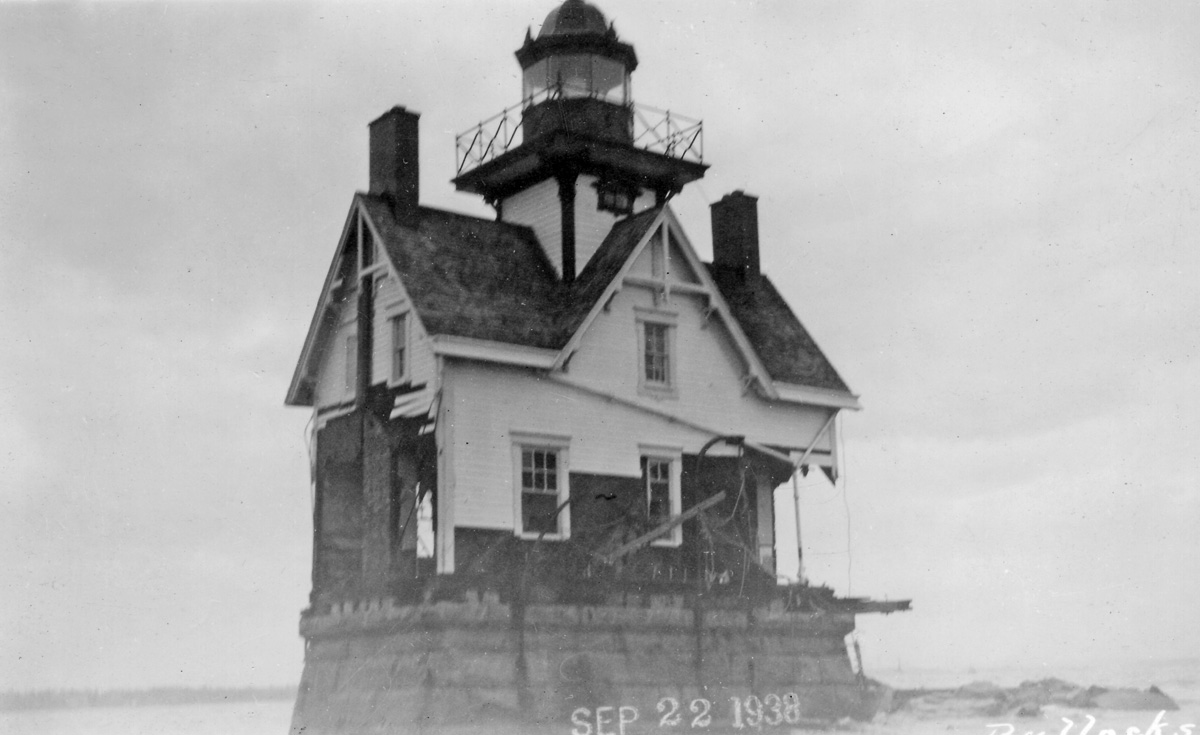
At Bullock Point, the hurricane struck with devastating force. Heavy seas undermined the granite pier and smashed against the dwelling. The fog bell was lost, the station’s boats were washed away, and large sections of the building were torn loose. Furniture and interior stairways were ripped from their places and carried off by the water.
Despite the chaos, Keeper Zuius managed to climb into the tower and keep the light burning throughout the storm. He remained inside the shaking structure through the night, believing that each incoming wave might sweep the building away. When daylight finally came, rescuers found the lighthouse badly damaged, with a wall partly gone and much of the interior destroyed.
The hurricane left Zuius deeply shaken. In correspondence with the Lighthouse Service the following year, he admitted that the experience had “wrecked my nerves” and made it so he could not “make long or rough boat trips without becoming nervous.”
Inspection after the hurricane revealed that the station’s foundation had been seriously undermined. Repairing the building was considered impractical, and the Lighthouse Service decided to discontinue the manned lighthouse. On April 16, 1939, Keeper Zuius extinguished the light at sunrise, locked up the station, and mailed the keys to the master of the tender Arbutus. Zuius was sent to Palmer Island Lighthouse to replace Keeper Arthur Small, who had lost his wife during the hurricane.
Just days after Keeper Zuius left, Bullock Point Lighthouse was razed, and replaced by a thirty-foot steel tower.
Today, only an automated light remains to mark the shoal where the lighthouse once stood. Yet the memory of the station lives on in the stories of the keepers and families who lived there, enduring storms, ice, and isolation while maintaining a small but vital beacon for mariners navigating the waters of Narragansett Bay.