Great Wicomico River, VA 
Select a photograph to view a photo gallery

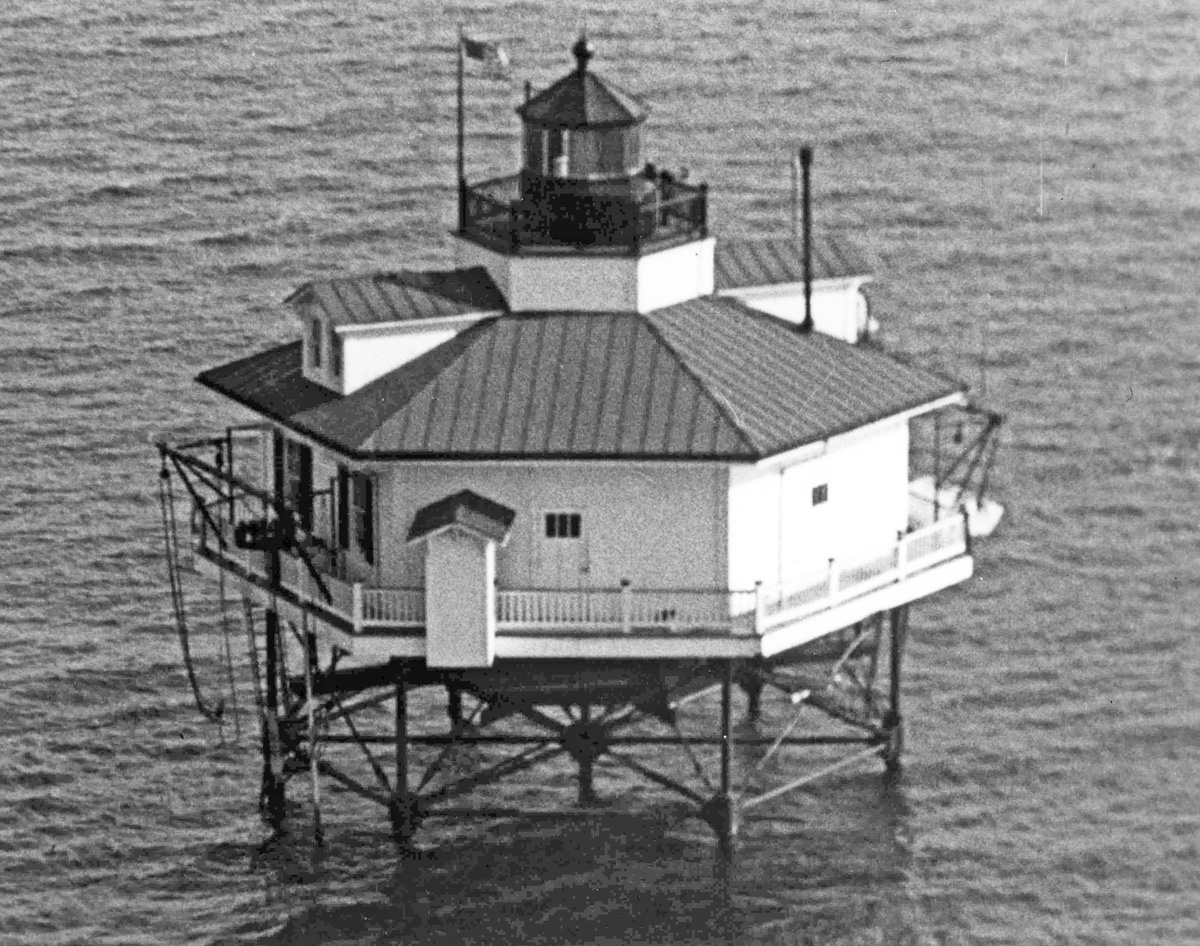

Photo Gallery


Photo Gallery
Photo Gallery
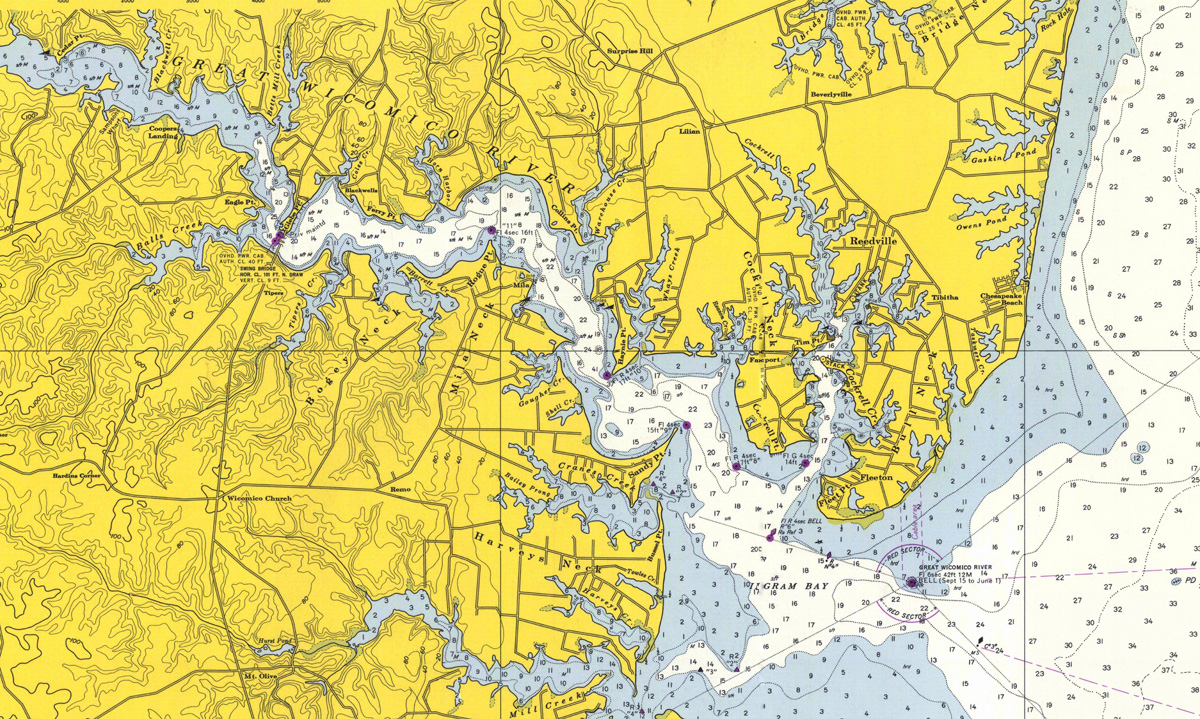
The entrance to Virginia’s Great Wicomico River has long been an important gateway for watermen, commercial fishing vessels, and other mariners navigating the western shore of Chesapeake Bay. Located just a few miles south of the Potomac River, the Great Wicomico is approximately fifteen miles long and empties into the bay near the communities of Fleeton, Reedville, and Fairport. Although the river provides an excellent natural harbor, its entrance was once difficult and potentially dangerous to navigate, particularly at night. Shoals extending from Fleet’s Point and Dameron’s Marsh created hazards for vessels attempting to reach the sheltered waters within the river.
|
The importance of the river was recognized during the Civil War, when one of the torpedo boats belonging to Admiral David Dixon Porter’s fleet entered the Great Wicomico and was captured. In the years that followed, the river became increasingly important to commercial navigation, and local mariners sought federal assistance in making its entrance safer.
In 1885, numerous petitions signed by Chesapeake Bay navigators were submitted requesting the construction of a lighthouse at the mouth of the Great Wicomico River. The request eventually gained the support of Congressman Thomas H. Bayly Browne of Virginia. In 1888, his bill providing for a lighthouse at the river’s entrance passed the House of Representatives. The news was welcomed by local maritime interests, including the Maryland Steamboat Company, whose secretary and treasurer, James E. Byrd, received word of the legislation.
An article published in the Baltimore Sun explained the importance of the proposed lighthouse. The structure was to be built near Horse Channel buoy, on the north side of the river’s entrance, and would guide vessels through the navigable channels past the dangerous shoals. The newspaper noted that the stretch of Chesapeake Bay between the Patuxent and Rappahannock rivers lacked a suitable harbor of refuge that could be safely entered at night. With a lighthouse marking the entrance, vessels drawing as much as thirteen feet of water would be able to enter the Great Wicomico safely. Congress appropriated $25,000 for the project, and the Lighthouse Board announced that construction would proceed as soon as practicable.
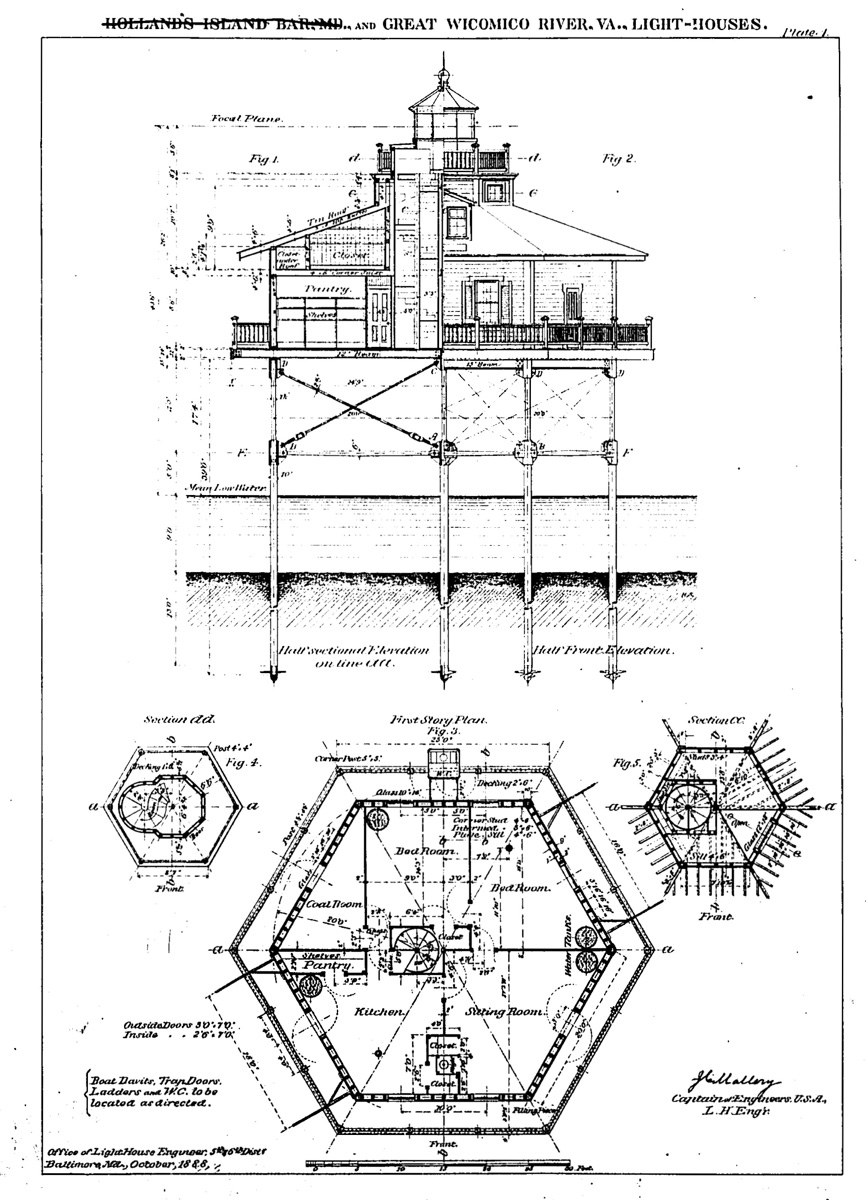
After the necessary plans were prepared, advertisements seeking bids for the metalwork were published in January 1889. The bids were opened on February 13, and a contract for $13,975 was awarded for the metalwork of both the Great Wicomico River Lighthouse and the similar Holland’s Island Bar Lighthouse in Maryland. The completed metal components were to be delivered to the Lazaretto Depot in Baltimore by August 18. Meanwhile, construction of the lighthouse’s superstructure was progressing at the depot, where it was expected to be ready for transportation to the site in early August.
On August 21, 1889, a working party departed Baltimore aboard the lighthouse tender Jessamine, which towed the launch Nettle and a scow loaded with construction materials. The party reached the Great Wicomico the following day and immediately began assembling a temporary working platform at the proposed location.
|
The lighthouse was to stand in approximately nine feet of water on a shoal extending southeasterly from Fleet’s Point. By September, the temporary platform was complete, and the workers had installed the hoisting engine, boilers, and shear poles needed for construction. Seven iron foundation piles were screwed into the shoal, and cast-iron sockets and horizontal braces were fitted into place. The lighthouse itself progressed rapidly, and by the end of September the building was substantially complete. Remaining work included finishing the second-story ceiling, installing doors and windows, setting up the fog-bell machinery, constructing a fuel platform beneath the house, and painting.
The new lighthouse first displayed its light on the night of November 10, 1889. It was a white, wooden, hexagonal dwelling supported by seven iron screw piles painted brown. Green blinds and a brown roof complemented the white exterior, while a black lantern topped the structure. The light was a fixed white fourth-order light, with two red sectors marking dangerous shoals in the vicinity.
The focal plane stood approximately 43½ feet above mean sea level, and the white light could be seen from a vessel’s deck 12 nautical miles away in clear weather. The northern red sector covered shoals extending southward and eastward from Fleet’s Point, while the southern red sector marked shoals extending northward and eastward from Dameron’s Marsh. Mariners entering or leaving the river were instructed to remain in the white sector, except when passing close to the south of the lighthouse through the southerly red sector.
A fog bell, operated by machinery, sounded a double blow every fifteen seconds when visibility required it. The combination of the light’s colored sectors and the fog signal made the new station a valuable aid to navigation at the entrance to the Great Wicomico River.
Samuel L. Nelson, who had previously served at Smith Point Lighthouse, became the first head keeper of Great Wicomico River Lighthouse. Nelson had entered lighthouse service in 1886 as a second assistant at Smith Point and advanced to first assistant the following year. He became head keeper there in 1889 but was transferred to Great Wicomico only eight months later to take charge of the newly established station. He remained in charge for nearly three decades, from 1889 until his retirement in 1918.
Joseph D. Farmer began his lighthouse career as assistant keeper at Great Wicomico in 1889. His initial annual salary was $420, compared with Nelson’s $560 as head keeper. Although Farmer served as assistant for many years, he was not immediately promoted when Nelson retired in 1918. Instead, James G. Williams, a veteran keeper who had entered lighthouse service in 1875, was transferred from Cape Charles Lighthouse to take charge of the station. Williams served until his retirement in 1920, when Farmer finally became head keeper.
Farmer became a familiar and highly regarded figure in the communities of Fleeton, Reedville, and Fairport. According to a 1968 newspaper account by John Frye, he took considerable pride in maintaining the station and was frequently awarded a pennant recognizing the best-kept lighthouse in the district. Captain Walter Biddlecomb of Fairport recalled hearing that Farmer had won the distinction so often that he never allowed anyone else to claim the flag.
Life at a Chesapeake Bay screwpile lighthouse could be demanding and isolated. Under the Lighthouse Establishment's regulations, a keeper who wanted time away from the station had to hire and pay for his own substitute.
Sunday afternoon visits to the lighthouse were something of a community tradition. Families would pack a picnic lunch, take a boat out to fish, and then stop at the lighthouse to visit the keeper and his assistant if one was aboard. These visits offered welcome companionship to the men stationed offshore.
The keeper’s duties included much more than ensuring that the light remained illuminated. The interior had to be kept clean, the building painted, and all brasswork polished. The oil lamps and their glass shades required careful attention. Because Great Wicomico displayed a fixed light, its keepers did not have to wind the heavy clockwork mechanisms used to rotate some lighthouse lenses. Instead, the keeper lit the lamp at sunset and replaced it with a fresh lamp at 10 p.m. and again at 2 a.m.
Winter could be particularly dangerous. During the severe winter of 1917–1918, moving ice threatened the lighthouse. Farmer’s son-in-law, Albert Conway Sisson, later recalled Farmer’s description of the experience. When a northeaster began breaking up the ice on the bay, Farmer climbed into the lantern room with an axe and a lantern, preparing to chop his way to safety if the building was swept away. The ice pushed the lighthouse approximately six inches out of plumb, and Farmer feared that the structure would collapse. Fortunately, it remained standing, and he survived the ordeal.
Farmer’s long career ended tragically. In February 1923, just a month before his scheduled retirement, he suffered a stroke while on duty. He was brought ashore in a skiff but died on February 25, just three days before his sixty-third birthday. His years of service had made him one of the most memorable keepers associated with the station.
In 1899, new-model fourth-order lamps were installed at Great Wicomico River Lighthouse, and repairs were made to the fog-bell machinery. The station continued to serve commercial and recreational vessels entering and leaving the river.
In August 1926, Head Keeper Andrew B. Sadler and Assistant Keeper Frank R. Lewis rendered assistance to the disabled yacht Red Wing, which had run aground near the lighthouse. Their response illustrated the continuing importance of lighthouse personnel beyond the maintenance of navigational aids.
The lighthouse also became part of an experimental effort to assist the growing number of aircraft navigating over Chesapeake Bay. In 1926, the Lighthouse Service, working with the Navy Department’s Hydrographic Office, began marking lighthouse roofs along designated aerial routes between Norfolk and Washington. Each lighthouse was assigned a serial number accompanied by the letters "WN," identifying the Washington-Norfolk airway. Large white block letters and numbers, together with an arrow pointing toward true north, were painted on suitable roofs. Great Wicomico River Lighthouse was among the stations selected for this experiment. The markings were intended to help seaplane pilots identify individual lighthouses, particularly in areas where numerous similar structures stood relatively close together.
By the 1930s, the station continued to be staffed by civilian keepers and assistants. Robert H. Matthews, who served as head keeper from 1936 to 1941, was among the keepers who helped maintain the light during this period. In 1939, responsibility for the nation’s lighthouses was transferred from the Lighthouse Service to the U.S. Coast Guard, bringing another change to the operation of the station.
In August 1939, a tornado struck Fleeton, Virginia, wrecking the home of Keeper Matthews. While attempting to recover some of his personal effects from the wreckage, he stepped on a nail that penetrated his shoe and foot. Assistant John W. Parks was left alone at the lighthouse for at least eleven days while Matthews recovered.
A 1952 newspaper article by Miriam Haynie, titled “Lighthouse Keeping, Like Light Housekeeping, Has Changed With the Times,” provides a particularly interesting glimpse of life at Great Wicomico near the end of its manned operation.
At that time, the station was under the charge of John R. Moore, an experienced lighthouse keeper who had served at Smith Point and Wolf Trap before arriving at Great Wicomico in 1950. Moore had entered government service in 1931 as a fireman aboard the lighthouse tender Mayflower. He later served aboard the tender Wisteria and the lightship Chesapeake. After beginning his lighthouse career at Smith Point in 1941, he advanced from second assistant to first assistant and then head keeper. Following four years in charge of Wolf Trap Lighthouse, he was transferred to Great Wicomico.
Moore was assisted by Coast Guardsmen J. W. Higgins and O. R. Keener, Jr. The station had changed considerably since the days of Samuel Nelson and Joseph Farmer. A gas stove, gas refrigerator, and oil burner provided modern conveniences, while rainwater was collected and stored in a large tank. Electricity was generated by a power plant at the lighthouse, and two tanks of compressed air supplied a diaphragm foghorn. An Aladdin lamp and the original fog bell, dated 1889, were retained for emergencies. The station also had a radio and ship-to-shore telephone, and a television was anticipated in the near future.
Two men remained aboard at all times, maintaining a continuous watch and conducting three half-hour radio watches daily. Their schedules rotated between six hours on duty and twelve hours off, or twelve hours on and six hours off. The catwalk surrounding the lighthouse was inspected every hour, and the men shared cooking and housekeeping responsibilities. The light was switched on a half-hour before sunset and extinguished a half-hour after sunrise. When visibility dropped below five miles, the foghorn was activated.
The men also maintained eight beacons and two buoys in the vicinity, servicing them monthly and painting the buoys annually. Despite the remote location, Moore and his fellow Coast Guardsmen found plenty to occupy their time. Fishing, crabbing, swimming, reading, playing cards, and building model airplanes were among their leisure activities.
The lighthouse stood in an important maritime corridor. Oystermen, crabbers, pound-net fishermen, and pleasure craft passed regularly. Buyboats from Crisfield, Maryland, and Tangier Island crossed the bay to reach the Reedville-Fleeton-Fairport harbor. Fishing vessels associated with the area’s enormous menhaden industry also passed the station on their way to the ship channel in Chesapeake Bay. In earlier years, keepers had watched passenger steamers traveling from Baltimore, as well as the colorful Floating Theater.
Moore’s tenure at Great Wicomico came to an end when the station was converted to automatic operation in July 1955. At the time, four men were assigned to the lighthouse, including Moore and three Coast Guardsmen. They were transferred to other assignments within the Fifth Coast Guard District. The light itself remained unchanged, but the fog signal was modified to a bell sounding two strokes every twenty seconds, operating seasonally from September 15 through June 1.
Moore, the last head keeper, was transferred to Old Plantation Flats Lighthouse. He retired from lighthouse service in 1958.
The conversion to automatic operation was part of a broader transformation taking place throughout Chesapeake Bay. Traditional screwpile lighthouses, with their distinctive white wooden dwellings, were increasingly being replaced by smaller, less expensive steel structures equipped with automatic lights. Although the old foundations were sometimes retained, the lighthouse houses themselves were frequently considered too costly to maintain.
Great Wicomico River Lighthouse was one of the last of these traditional structures to disappear. In 1967, the wooden dwelling was dismantled, and an automated light atop a skeletal steel tower was installed on the original screwpile foundation. The change marked the end of a familiar landmark that had stood at the river’s entrance for nearly eighty years.
The removal of the old lighthouse was particularly disappointing to residents of Fleeton, Reedville, and Fairport. Many people had fond memories of visiting the station and knew the keepers personally. The lighthouse was variously called Fleeton Point Light and Gough’s Bar Light, but it was most commonly known as Great Wicomico River Light. In his 1968 article, John Frye observed that the lighthouse seemed to hold a special place in the hearts of those who lived within its beams.
Some local residents hoped to save the building and have it reassembled ashore, as had been done with other Chesapeake Bay screwpile lighthouses. Unfortunately, the expense of moving and reconstructing the structure proved beyond their means. Stephen M. Pratt, the contractor responsible for dismantling the lighthouse, ultimately had to burn it. Unlike the nearby Hooper’s Strait Lighthouse, which was preserved at the Chesapeake Bay Maritime Museum in St. Michaels, Maryland, little of Great Wicomico’s historic structure survived.
The Coast Guard continued to maintain the replacement steel tower for several decades. However, by 2014, the structure had deteriorated to the point that it could no longer be safely accessed for maintenance. In a notice published that year, the Coast Guard announced its intention to discontinue Great Wicomico River Light, explaining that structural failure prevented personnel from safely reaching the aid. The agency solicited comments from mariners and other interested parties regarding the potential impact of discontinuing the light.
The proposal proceeded, and Great Wicomico River Light was officially discontinued in 2015. The old screwpile foundation was subsequently removed, bringing an end to more than 125 years of federal lighthouse service at the entrance to the river.