Bells Rock, VA 
Select a photograph to view a photo gallery
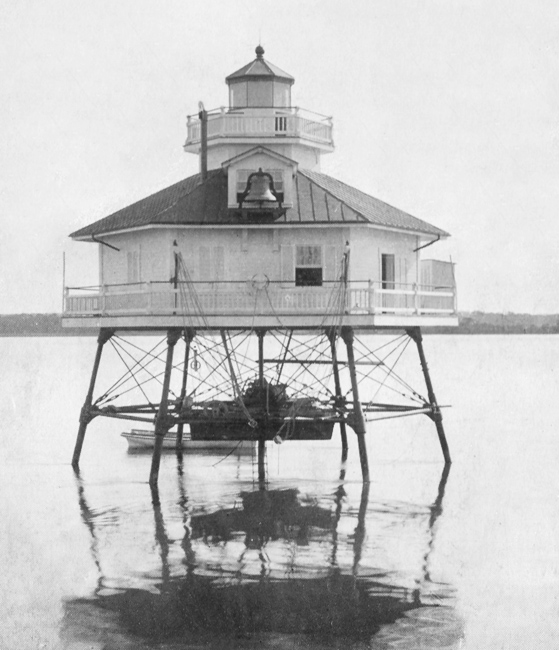
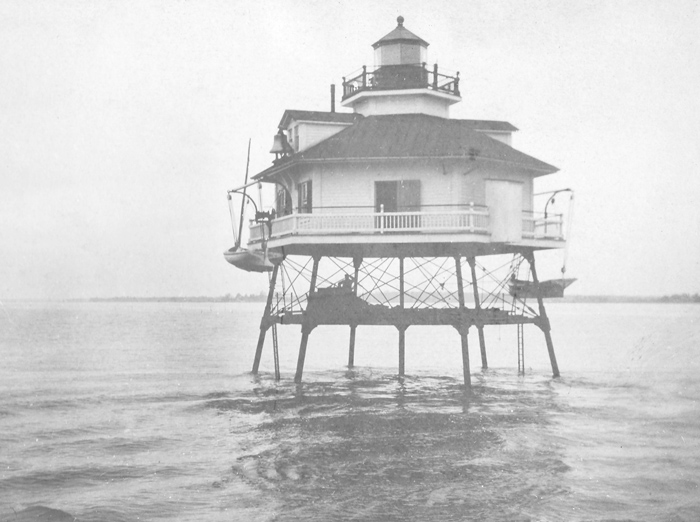
Photo Gallery
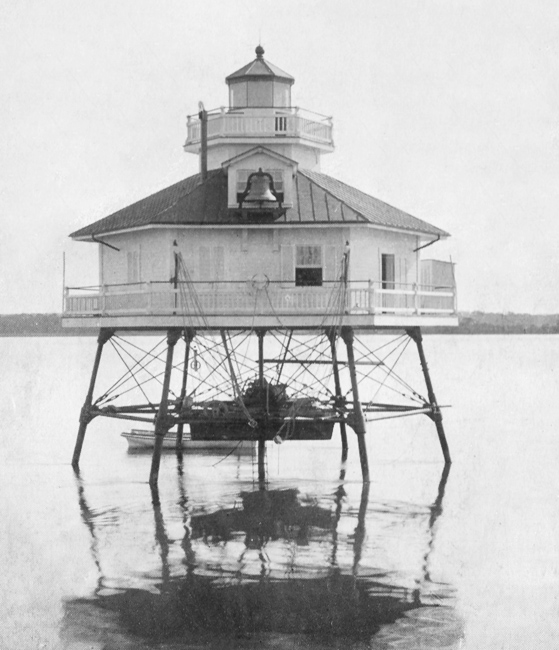
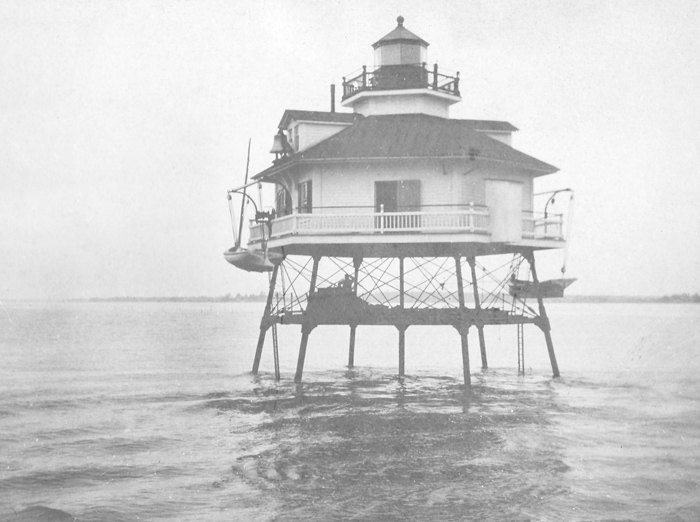
Photo Gallery
Photo Gallery
In the late nineteenth century, increasing commercial traffic on the York River made navigation to West Point, Virginia, increasingly important. Located at the head of the York River where the Pamunkey and Mattaponi Rivers meet, West Point was the terminus of the Richmond and York River Railroad and an important destination for vessels carrying passengers and freight. One of the hazards confronting vessels approaching West Point was Bells Rock, a shallow obstruction lying near the northern side of the river channel.
On August 28, 1879, Silas W. Terry, inspector of the Fifth Lighthouse District, reported to the Lighthouse Board after personally visiting the site. He considered a light at Bells Rock a necessary aid to navigation. The rock, he noted, was not shown on the existing chart and had only nine feet of water over it. Meanwhile, commerce on the York River had increased substantially. The Old Dominion Steamship Company was operating three steamers a week between the river and New York, the Merchants’ and Miners’ Transportation Company operated two weekly steamers to Providence, Rhode Island, and the Baltimore, Chesapeake and Richmond Company operated five steamers a week to Baltimore.
The importance of West Point was reflected in the depth of water available there. Vessels drawing as much as nineteen feet could reach the railroad terminus. Yet navigating the river near Bells Rock after dark was difficult. Terry explained that vessels ascending the river followed a course of roughly north-northwest and then northwest by west until passing the red buoy off Goff’s Point. In attempting to clear Bells Rock, vessels sometimes hugged Terrapin Point too closely and went ashore there. Terry believed that Terrapin Point itself would actually be the best location for the proposed light, since a light there would help vessels avoid Bells Rock when rounding the point in either direction.
|
The Lighthouse Board nevertheless determined that a lighthouse should be established on Bells Rock. The proposed structure was to be a screwpile lighthouse capable of indicating to steamers when they should alter their course. The estimated cost was $25,000. Congress appropriated $35,000 for the project on June 16, 1880, and borings were soon planned to determine the nature of the bottom and the type of foundation required.
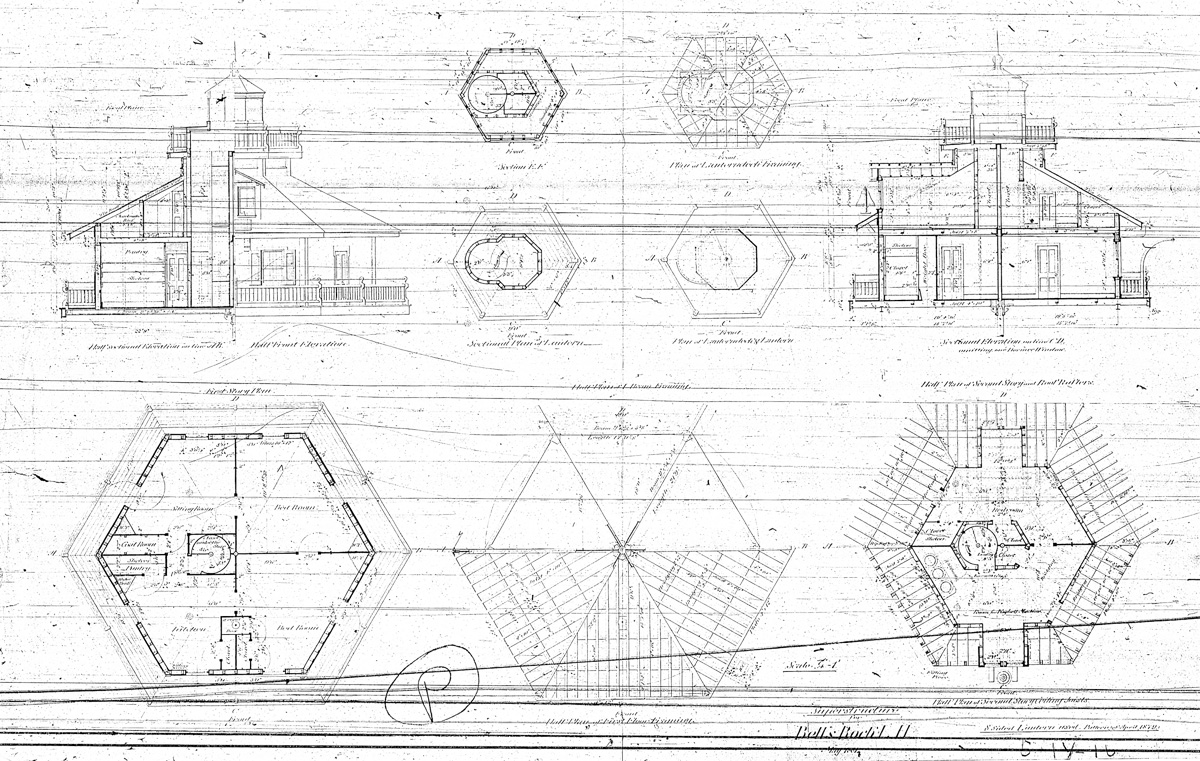
The lighthouse ultimately erected at Bells Rock was a characteristic nineteenth-century screwpile structure. Its iron piles were screwed into the river bottom, providing a foundation for a cottage-style dwelling and lantern. The Lighthouse Board initially assembled a superstructure for Bells Rock at the Lazaretto Lighthouse Depot in Maryland. That structure was completed in November 1880, but circumstances intervened before it could be sent to Virginia. The Thimble Shoal Lighthouse burned, and the newly completed Bells Rock structure was instead used in rebuilding that station. A replacement structure was consequently prepared for Bells Rock and completed at the depot in February 1881.
The ironwork for the replacement lighthouse was manufactured by Paulding, Kemble & Co. of Cold Spring, New York. Work on the iron began in August 1880 and was completed on November 15, with the contractors receiving an additional fifteen days to finish the work. The lighthouse was then transported to the York River.
Erection at Bells Rock began on April 22, 1881. By the end of the month the ironwork had been installed and workers had begun assembling the wooden superstructure. The cottage was soon completed, the fourth-order lens installed, and the light exhibited. Although one Lighthouse Board report gives May 30 as the date on which the light was first exhibited, the published Notice to Mariners announced that the new light would be placed in service on May 20.
The completed lighthouse was hexagonal in form and stood in approximately ten feet of water. It displayed a fixed white light of the fourth order, with the focal plane 45½ feet above mean low water. The light was visible over 270 degrees of the horizon. The roof and foundation were painted brown, the cottage was white, and the lantern was red. A mechanically operated fog bell was provided for periods of thick or foggy weather, when it struck once every fifteen seconds.
John W. Jennings was appointed the station’s first keeper in 1881 at an annual salary of $650. He served until his death in 1885 and was followed by William F. Blassenham, who remained at Bells Rock until resigning in 1891. That year James W. Washington became keeper. Washington had previously served for a little more than nine months as assistant keeper at nearby York Spit Lighthouse before receiving his promotion and transfer to Bells Rock.
The station’s exposed location in the river made its supporting structure vulnerable to passing vessels. In 1883, a foundation column was broken and arrangements were made to replace it. New water tanks were also manufactured, apparently replacing tanks that had originally been taken from Thimble Shoal.
The situation became considerably more serious the following year. In June 1884 a schooner collided with the lighthouse and broke three of its iron columns. The three columns damaged by the schooner were soon replaced, and the doors throughout the lighthouse were repaired.
The station also experienced controversy during the transition between Blassenham and Washington. On February 12, 1891, the Richmond Dispatch reported that two government steamers had arrived at Bells Rock with Lighthouse Inspector Captain Charles J. Train, Lieutenant S. W. Hourigan, and United States commissioners aboard. They were investigating charges against keeper William Blassenham, who had allegedly left the lighthouse unattended and returned intoxicated. The newspaper claimed that the witnesses had been paid or promised favors to assist in removing Blassenham. The evidence was forwarded to Washington, but the newspaper said the ultimate result was unknown. Blassenham left the station that year, and James W. Washington assumed the keepership.
Washington would become the most significant keeper in the history of Bells Rock Light. An African American and former waterman, he remained at the station for more than three decades, from 1891 until his retirement in 1922. Contemporary records provide an unusually detailed glimpse into the responsibilities and difficulties associated with his maintaining the isolated river station.
In 1892 the character of the light was modified by adding a red sector to the fixed white light. The change was made on March 10 and gave mariners additional information about their position relative to the channel and surrounding hazards. New model fourth-order lamps were installed in 1899, and in 1900 a storage platform was constructed beneath the lighthouse after the previous platform had been removed. The station also received various other repairs during these years.
Washington’s duties were demanding. Bells Rock was an isolated offshore station, and the keeper was expected to remain on duty because the light’s location and the nature of its fog signal made continuous attention particularly important. This responsibility became evident in December 1906.
On the night of December 30, 1906, Washington failed to operate the fog bell during a period of heavy fog. He later admitted the charge. When he changed the light between eleven o’clock and midnight, he could see the shore on both sides of the river and did not believe that the weather would deteriorate. He lay down to rest. When he awoke at 2:30 a.m., the fog had become heavy, and he immediately started the bell.
The Lighthouse Board took the circumstances into consideration. A memorandum dated March 9, 1907, noted that Washington’s offense appeared to be his only one during more than fifteen years of service. Nevertheless, because the charge had been established, his pay was reduced from $575 to $515 per year for three months beginning March 16. The incident illustrates both the strict expectations placed upon keepers and the unusual demands of a station where the keeper was expected to remain attentive around the clock.
Washington’s service continued for many more years. In 1917 the Lighthouse Service established a new light at Fillbates Creek Flats, approximately one and five-eighths miles northwest of Bells Rock. Rather than appointing another full-time keeper, the Fifth District recommended that Washington care for the new light in addition to Bells Rock. His existing $600 position was to be discontinued and replaced by a combined position paying $720 annually. The recommendation specifically cited the practicality of having Washington, already stationed nearby, maintain the new light.
A 1920 memorandum concerning Washington’s illness provides an important and troubling insight into the conditions under which he worked. Washington had been away from Bells Rock since December 9, 1919, because of illness, and a substitute had been assigned to the station. The superintendent noted that Bells Rock was technically a two-keeper station but explained that, because Washington was Black, the Lighthouse Service had considered it inexpedient to station a second keeper there.
By this time Washington had been at Bells Rock for twenty-nine years. His continued service despite the additional burdens imposed upon him is a notable part of the station’s history. The 1920 memorandum is also valuable historical evidence of the racial policies and attitudes that affected African American lighthouse keepers during the period.
By the early 1920s, the Lighthouse Service was moving steadily toward automation and the replacement of traditional manned stations with less expensive aids to navigation. Bells Rock was among the stations affected by this transition.
On December 1, 1922, the character of the Bells Rock light was changed from a fixed white light to a flashing white light showing a one-second flash followed by five seconds of darkness. The new characteristic was 580 candlepower. At the same time, the fog signal was discontinued. A bell buoy was established approximately 135 yards southeast of the lighthouse in three and a half fathoms of water, providing an additional warning of the shoal.
The station’s illuminant was also changed to acetylene, at a reported cost of $1,012. With the light automated, the need for a resident keeper disappeared.
Washington’s retirement came at the end of that same year. A November 9, 1922, Department of Commerce letter informed him that he had been retired from active duty effective December 4, with retired pay of $719.75 per year. The Baltimore Sun reported on November 14 that Washington had served as keeper of Bells Rock for thirty-one years. His retirement brought to a close the longest keepership in the station’s history.
Washington did not live long after his retirement. He died on April 21, 1924, at the age of sixty-three. The Lighthouse Service recorded his death as that of a retired keeper who had been out of active service since December 4, 1922.
The original Bells Rock Lighthouse survived for several years after Washington’s retirement, but its days were numbered. In 1928 the distinctive hexagonal screwpile dwelling was dismantled and replaced by a skeletal tower erected on the original foundation. The change marked the final disappearance of the lighthouse in which keepers had lived and worked for forty-seven years.
Although the cottage itself was lost, the foundation and automated light continued to serve the navigational purpose for which the station had been established. A modern light remains in operation at the site, preserving a physical connection with the Bells Rock Lighthouse that guided vessels toward West Point for nearly half a century.
Keepers: John W. Jennings (1881 – 1885), William F. Blassenham (1885 – 1891), James W. Washington (1891 – 1922).