Pamlico Point, NC 
Select a photograph to view a photo gallery
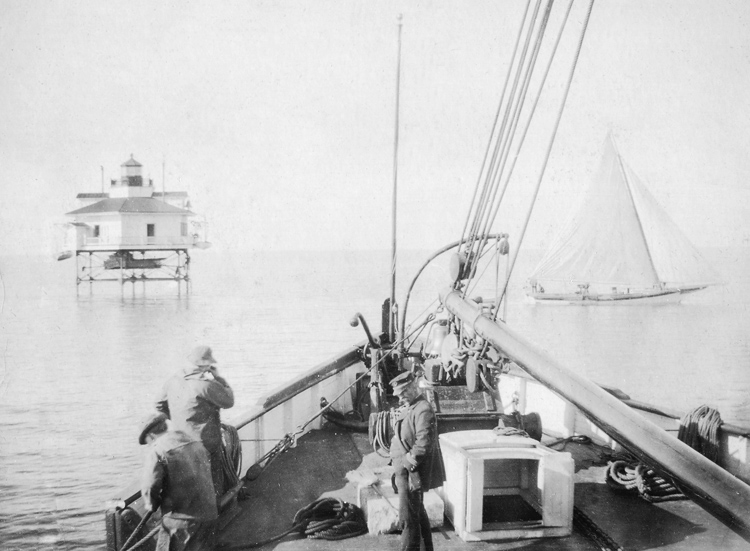
Photo Gallery
Photo Gallery
Photo Gallery
Standing on the southern side of the entrance to the Pamlico River, Pamlico Point Lighthouse guided mariners through the broad waters of Pamlico Sound for more than a century. Though never as tall or as famous as Cape Hatteras Lighthouse, the station occupied an equally important position for the countless fishing vessels, coastal schooners, steamers, naval craft, and local boats that depended upon its steady light to safely reach the ports along North Carolina's inland waters.
The history of Pamlico Point Lighthouse is really the story of two different lighthouses. The first, a modest brick tower completed in 1829, fought a losing battle against the relentless erosion of Pamlico Sound for nearly sixty years before finally succumbing to the sea. The second, an offshore screw-pile lighthouse completed in 1891, carried the station's mission well into the twentieth century. Interwoven with the story of both structures is the remarkable career of Captain Samuel Fulford, the station's first keeper, whose faithful service and repeated political dismissals illustrate the uncertain lives of lighthouse keepers before the Lighthouse Service became insulated from partisan politics.
On May 23, 1828, Congress appropriated $5,000 to establish a lighthouse at Pamlico Point. Within days, Fifth Auditor Stephen Pleasonton instructed Thomas H. Blount, Collector of Customs at Washington, North Carolina, to select a suitable site and oversee construction. Blount soon negotiated the purchase of ten acres of land from John Gray Blount for fifty dollars and advertised for proposals to build both a lighthouse and a keeper’s dwelling.
The government’s specifications left little to chance. The circular brick tower was to stand thirty feet high, with walls three feet thick at its base, tapering to twenty inches at the top. A substantial iron lantern would support Winslow Lewis’ patented lamps and reflectors, while a comfortable brick dwelling, kitchen, well, and outbuildings would accommodate the keeper and his family. Although modest in height, the station represented a significant federal investment in improving navigation on North Carolina’s sounds.
|
Only one proposal for constructing the station was received, and Benjamin Rungin was awarded the contract for $4,950. The work progressed more slowly than expected, however, forcing the Treasury Department to grant an extension until June 1829. Even after the buildings were substantially completed, additional delays occurred when the contractor responsible for installing the lighting apparatus failed to carry out his obligations.
Despite these setbacks, the Treasury Department moved ahead with appointing the station’s first keeper. On September 9, 1829, Stephen Pleasonton informed Thomas Blount that Samuel Fulford had been selected as keeper and emphasized “the necessity of his residing and being himself steadily in the house provided for the Keeper.”
That simple instruction began one of the longest and most interesting careers associated with any North Carolina lighthouse.
Captain Samuel Fulford was already an experienced mariner when he accepted responsibility for the new lighthouse. Although the unfinished lantern prevented him from displaying the light immediately, Fulford reported for duty as soon as he received his commission.
Recognizing that the delay resulted entirely from the government’s inability to complete the station, Pleasonton directed in February 1830 that Fulford’s salary begin on September 24, 1829, explaining that the keeper had been “ready to enter on his duties” from the day he received his appointment. The same letter authorized the purchase of a suitable boat for the station.
That boat was not a luxury. Pamlico Point was surrounded by marshes, creeks, and shallow waters that frequently made travel by land impossible. The keeper depended upon a boat to obtain provisions, transport supplies, and communicate with neighboring communities. Fifteen years later, government officials again authorized the purchase of a larger boat because the keeper remained “enclosed by waters and swamps” and had no practical means of obtaining supplies except by water.
Life at the station demanded constant attention. The lantern required cleaning every day, lamps had to be trimmed nightly, reflectors polished, and the buildings maintained despite the harsh marine environment. Annual inspections repeatedly mentioned whitewashing the tower, repainting the lantern, repairing the cistern, replacing shingles, rebuilding chimneys, and maintaining the breakwater protecting the station.
Inspectors found Fulford equal to the task. In 1846, Stephen Pleasonton wrote that he was “much gratified” with the condition of the station and “the conduct of the Keeper.” Such praise was not given lightly. Throughout the Lighthouse Establishment, Pleasonton expected strict discipline and careful maintenance, and his correspondence frequently criticized stations that failed to meet his standards.
While Fulford faithfully maintained the station, nature was quietly undermining it.
The lighthouse had been built on a narrow point of sand projecting into Pamlico Sound. Almost immediately, wind-driven waves began eating away the shoreline.
In 1837, Thomas Blount warned Washington that the water had advanced to the lighthouse foundation and threatened the safety of the buildings. Pleasonton initially considered surrounding the station with nearly three hundred perches (about 5,000 cubic feet) of stone but quickly abandoned the idea when he learned that suitable stone would have to be transported hundreds of miles at enormous expense.
Instead, engineers experimented. Winslow Lewis received a contract to strengthen the foundation. Wooden breakwaters were built and rebuilt. Piles were driven into the sand. Sheet piling was proposed. Shell embankments were considered. Ballast stone was deposited. Concrete was poured around the base of the tower.
Again and again, government engineers devised new methods to protect the lighthouse, and again and again the waters of Pamlico Sound defeated them.
The correspondence surrounding these efforts offers a fascinating glimpse into nineteenth-century coastal engineering. In 1850, Pleasonton proposed an innovative series of wooden groins extending thirty to fifty feet into the sound. The closely spaced piles, woven together with branches, would trap drifting sand and gradually rebuild the shoreline. Similar structures had succeeded elsewhere, and Pleasonton confidently predicted that “in a very short time” enough sand would accumulate for a person to walk to the end of each groin “on dry sand.”
The experiment failed.
Unlike the sandy beaches where groins had proven effective, Pamlico Point rested upon a thin layer of sand over mud. The sea simply continued carrying the shoreline away.
By 1852, officials once again debated whether it would be wiser to move the lighthouse rather than continue defending it. Stone seawalls, shell walls, sheet piling, and relocation were all carefully considered. Each proposal promised only temporary relief.
The sea always returned.
If the sea was the lighthouse’s greatest natural enemy, politics proved to be Samuel Fulford’s greatest personal adversary.
During the first half of the nineteenth century, lighthouse appointments often depended upon which political party controlled the White House. Every presidential election created uncertainty for hundreds of keepers across the nation.
After faithfully serving for sixteen years, Fulford lost his position in 1845 when Zion Flowers replaced him following a change in administration.
Four years later, the political winds shifted once again.
Following Zachary Taylor’s election, Fulford regained his position. An inspector visiting the station in 1850 noted simply, “The old keeper is now reinstated.” Those six words reveal little of the hardship Fulford had endured while waiting for another appointment.
Three years later, politics again intervened.
A North Carolina newspaper reported that Captain Fulford had been removed once more and replaced by William Brinn. The article passionately defended Fulford, describing him as an elderly sea captain who had faithfully performed his duties for many years without involving himself in politics.
According to the newspaper, Fulford had suffered severe frostbite while engaged in wrecking operations during his seafaring career, leaving him unable to perform heavy labor. His modest lighthouse salary had become his family’s principal support. When first removed from office in 1845, the small savings accumulated over years of faithful service gradually disappeared.
The article recounted that when Fulford received his reappointment in 1849, he remarked that only one dollar and fifty cents remained of his savings and that he intended to spend it on a pair of shoes.
Whether every detail of the newspaper account can be independently verified, its broader message is unmistakable. Samuel Fulford had become an unfortunate victim of the patronage system that dominated federal appointments before the establishment of the Lighthouse Board in 1852.
His repeated removals had nothing to do with the quality of his service.
Inspectors consistently praised both the condition of the station and the keeper’s performance.
Instead, changing presidential administrations repeatedly determined whether one of North Carolina’s most faithful lighthouse keepers would remain employed.
Despite the political turmoil surrounding its keepers, the station itself continued receiving improvements.
A new illuminating apparatus was installed in 1856, making Pamlico Point one of several stations modernized that year.
The Civil War temporarily interrupted lighthouse operations along the North Carolina coast. Confederate authorities extinguished the light, depriving Union vessels of an important navigational aid.
Following the war, the Lighthouse Board quickly restored the station. On July 20, 1867, the familiar light once again shone across Pamlico Sound from a fixed fifth-order Fresnel lens visible approximately eleven miles in clear weather.
|
Repairs continued throughout the following decades. The tower and dwelling were repeatedly whitewashed, lantern glass replaced, walkways repaired, and boats supplied. Yet every improvement merely postponed the inevitable.
By the early 1880s, engineers reluctantly acknowledged what decades of repairs had failed to prevent. The shoreline had nearly disappeared.
Annual reports painted an increasingly desperate picture. The keeper’s dwelling stood with water washing against its foundation. High tides surrounded the buildings. The tower itself was rapidly becoming isolated from the remaining land.
Rather than continue spending money protecting an obsolete shore lighthouse, the Lighthouse Board proposed building an offshore screw-pile lighthouse approximately one and five-eighths miles east-southeast of the point.
Congress eventually appropriated $25,000 for the project in early 1889. Before construction could begin, however, the original lighthouse reached the end of its remarkable career.
On October 10, 1887, officials discontinued the light because the tower and dwelling had become “in imminent danger of falling.” A temporary lighted buoy and later a stake light marked the point while the replacement station was being built.
The sea had finally won the battle.
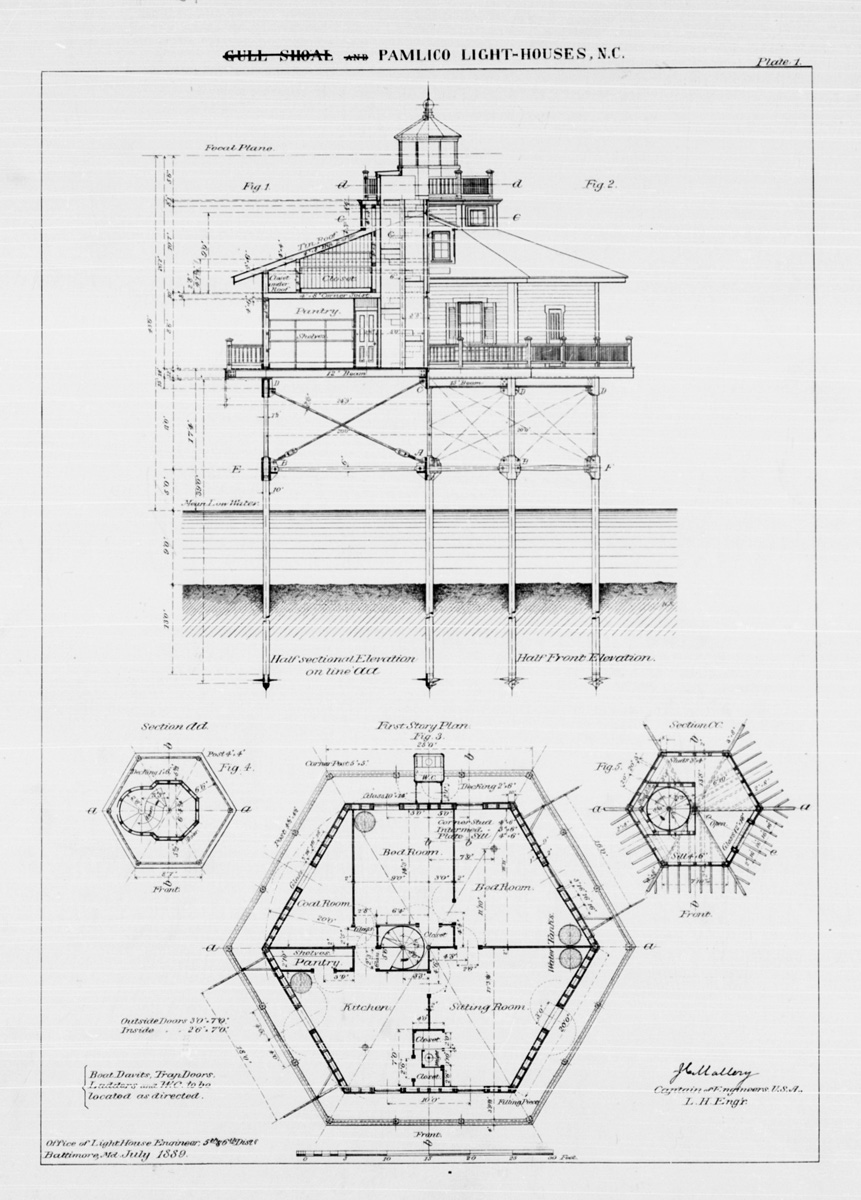
Construction of the new Pamlico Point Lighthouse began in 1890. Like nearby Gull Shoal Lighthouse, the new structure rested upon wrought-iron screw piles driven deeply into the shoal. Above the iron foundation rose a picturesque white hexagonal dwelling topped by a black lantern containing a fourth-order Fresnel lens.
Workers assembled much of the structure during January and February 1891. The piles were driven eleven feet into the bottom, iron braces secured, the prefabricated dwelling erected, lantern installed, and fog bell mounted.
After just twenty-three and one-half working days, the new lighthouse stood ready. On the evening of March 9, 1891, the fourth-order Fresnel lens was illuminated for the first time.
For the first time in more than sixty years, mariners entering the Pamlico River looked not toward the rapidly disappearing shoreline but to a lighthouse standing securely above eleven feet of water. The move offshore finally accomplished what decades of engineering had failed to do. By moving the lighthouse instead of attempting to hold back the shoreline, the Lighthouse Board finally solved a problem that had frustrated engineers for more than fifty years. Instead of fighting the sea, the lighthouse now embraced it.
Royal (Roberson) L. Ireland, formerly first assistant keeper at Brant Island Shoal Lighthouse, was transferred to become the first head keeper of the new Pamlico Point Shoal Lighthouse. Ireland, who had a wooden leg, was in charge of the light until his death in September 1901. His son then helped look after the light until a new head keeper was appointed.
Among the station’s most respected keepers was Mumford Guynn, who first served as assistant keeper before becoming head keeper in 1903. During a hurricane in September 1913, Guynn and Assistant Keeper James O. Casey succeeded in saving government property entrusted to their care, an accomplishment specifically noted in the annual report of the Lighthouse Service. These two keepers were again commended in 1914 for rendering assistance to a party in a disabled power boat.
William Newton, who assumed charge of the station in 1917, likewise earned an outstanding reputation. Official reports credited Newton and Assistant Keeper Martin B. Tolson with rendering assistance to several vessels in distress in 1923, 1924, and 1925. Although the reports provide few details, they demonstrate that Pamlico Point's keepers continued the long tradition of serving as unofficial lifesavers whenever storms or mechanical failures endangered mariners navigating the sound.
When Newton retired in 1925 after nearly a quarter century in the Lighthouse Service, he wrote a gracious letter thanking his superiors for the improvements that had been made in both the service and the treatment of its keepers. His career reflected the growing professionalism that characterized the Lighthouse Service during the twentieth century.
Technology eventually transformed the station once again. Pamlico Point Lighthouse was electrified in 1934, reducing the labor required to maintain the light. By 1936 the keeper's quarters had been abandoned, and within a few years the picturesque dwelling was removed altogether, leaving only a skeletal tower to support the light. Later keepers became responsible for the entire Pamlico Point group of navigational lights rather than residing at the station itself.
Few lighthouse stations illustrate the changing history of the American Lighthouse Establishment more completely than Pamlico Point.
Its first keeper, Samuel Fulford, faithfully tended one of North Carolina's most isolated lights while repeatedly falling victim to the patronage politics of his era. Engineers spent half a century attempting to preserve the station against the relentless advance of Pamlico Sound, experimenting with nearly every method of shoreline protection then available before finally conceding defeat. Rather than abandon the light, the Lighthouse Board responded with one of the elegant screw-pile lighthouses that came to characterize navigation on North Carolina's sounds.
Later keepers continued the tradition established by Fulford, maintaining the light through storms, rendering assistance to vessels in distress, and adapting to new technologies that gradually transformed lighthouse service. Although both the original brick tower and the handsome screw-pile dwelling have disappeared, the history of Pamlico Point Lighthouse remains a compelling story of perseverance, engineering ingenuity, and the quiet dedication of the men who faithfully kept its light burning for more than a century.