Southwest Point Royal Shoal, NC 
Select a photograph to view a photo gallery
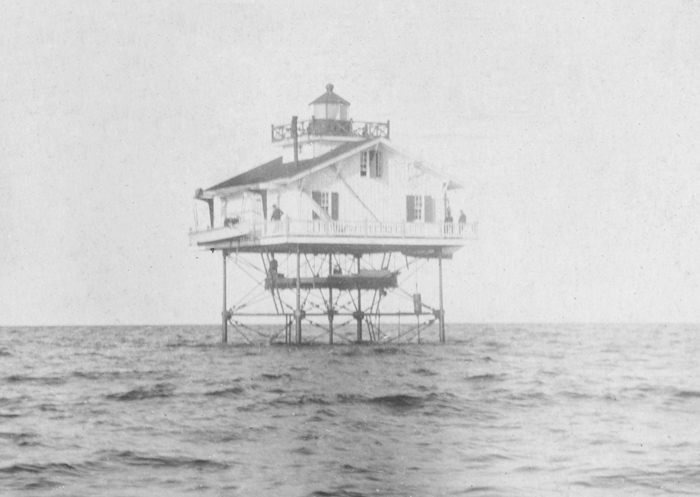
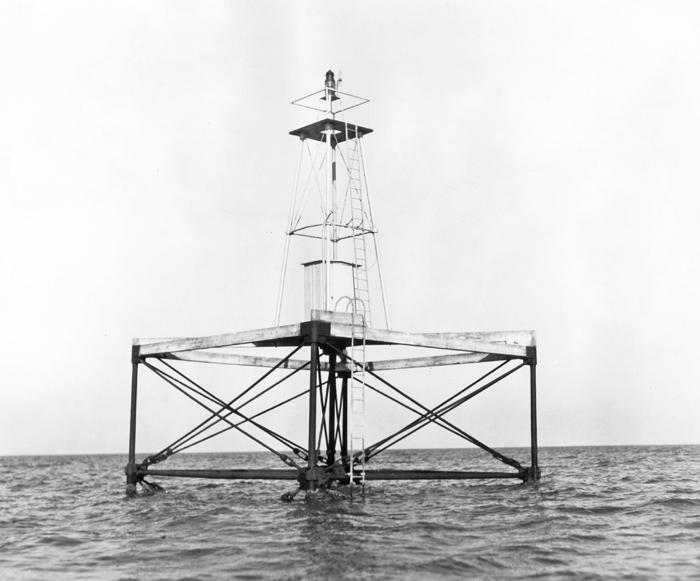
Photo Gallery
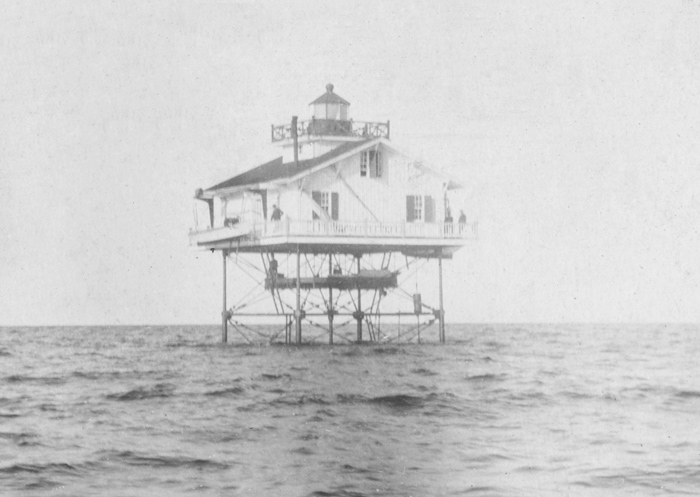

Photo Gallery
Photo Gallery
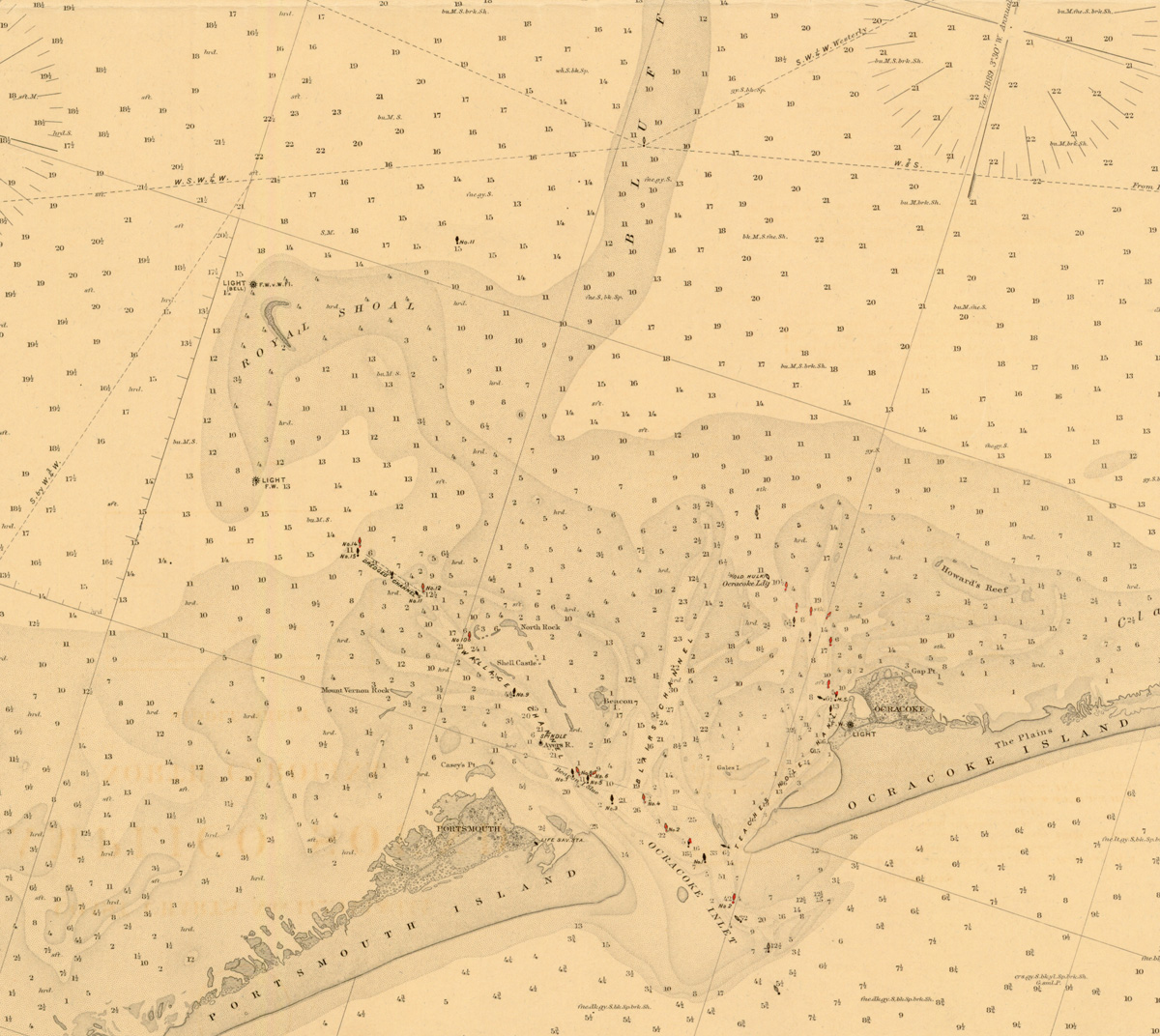
Royal Shoal is a well-known shallow-water sandbar in North Carolina’s Pamlico Sound, approximately eight to nine miles west-northwest of Ocracoke Island and north of Cedar Island. The shoal is large and somewhat horseshoe-shaped. It is connected with the southern end of Bluff Shoal and is continuous on the southeast with the shoals extending from the Outer Banks. The enclosed portion of the horseshoe, commonly known as the “Bight of Royal Shoal,” encompasses a broad area where the water reaches depths of approximately twelve feet or slightly more. The extensive shoals and shifting shallow water made the area a significant hazard to vessels navigating Pamlico Sound.
The first aid to navigation at Royal Shoal was a lightship. On November 15, 1826, the superintendent at Ocracoke announced that a “Floating Light” had been stationed at the southwest point of Royal Shoal, a location commonly known as the “S. W. Straddle.” The vessel was moored in three fathoms of water, with Ocracoke Lighthouse bearing due east. Mariners bound for the Swash could use the light as a navigational mark to cross the shoal in approximately eleven feet of water. A bell was to be tolled at intervals during foggy or otherwise thick weather. In 1857, a screw-pile lighthouse was completed on the northwest point of Royal Shoal, while the lightship continued to mark the southwest portion of the shoal.
The Royal Shoal Light Vessel continued to mark the dangerous shoal for decades. During the Civil War, however, the station was extinguished. On February 6, 1862, Royal Shoal Lightship was listed among the North Carolina lights extinguished by Confederate forces. The lightship was removed in 1861 and sunk as part of a barricade in the Neuse River. After the capture of New Bern by Union forces, the vessel was raised along with two others and eventually taken to Baltimore. After being thoroughly repaired, it was placed into service as a relief vessel in the Fifth Lighthouse District. Temporary vessels were subsequently used to mark several of the former lightship stations in North Carolina waters, including Royal Shoal, while plans were made to restore the permanent aids to navigation.
|
Even before the war, the Lighthouse Board had recognized that many of the lightship stations in the relatively sheltered waters of North Carolina’s sounds were suitable for permanent screw-pile lighthouses. The shallow water, soft bottoms, low-lying shores, and generally protected conditions made screw-pile construction particularly appropriate. After the war, the Board took the opportunity to replace many of the destroyed lightships with permanent structures.
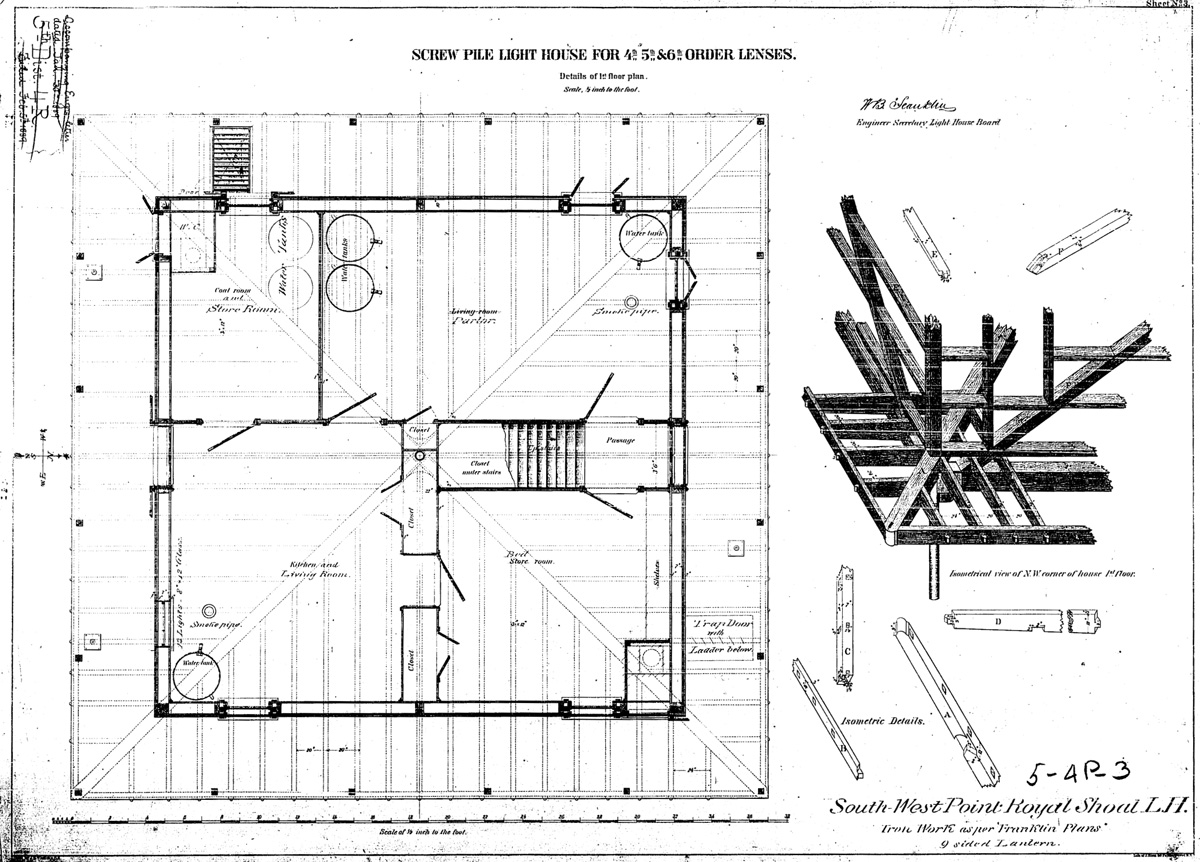
Royal Shoal was among the stations selected for conversion. A screw-pile lighthouse was erected on the shoal’s western side, at the point subsequently known as Southwest Point Royal Shoal. The new lighthouse stood in approximately seven-and-a-half feet of water at mean tide, about half a mile north of a buoy marking the former lightship’s position. Its iron foundation was painted red, while the wooden, hexagonal dwelling and central lantern were painted white. The focal plane of the light was thirty-five feet above the water, and a fourth-order Fresnel lens displayed a fixed white light visible for approximately eight miles in clear weather.
The light was first exhibited on April 30, 1867. Benjamin Lawrence was appointed the first head keeper on April 10, 1867, and Thomas S. Gaskill became the first assistant keeper. Lawrence initially received an annual salary of $460, soon increased to $600, while Gaskill's salary was initially $360 and later raised to $400. Maintenance work during the lighthouse’s early years included painting the iron foundation, repainting the wooden dwelling and lantern, replacing glass, cleaning rust from the ironwork, and maintaining the station’s boat and its equipment.
On July 7, 1880, the Lighthouse Board notified mariners that Southwest Point Royal Shoal Lighthouse would be discontinued less than a month later: on August 1, 1880. Mariners, however, continued to call for the return of the light, and their requests eventually led to its restoration. After repairs were made to the lighthouse, the light was re-exhibited on September 15, 1887. Additional repairs followed in May 1888. In December 1890, 425 cubic yards of riprap stone were placed beneath and around the lighthouse to strengthen the structure and combat considerable erosion of the site. In 1899, new fifth-order lamps were installed.
Life at a screw-pile lighthouse in the middle of Pamlico Sound could be exceptionally isolated and demanding. Three women served as assistant keepers at Southwest Point Royal Shoal while their husbands were keepers there: Mary J. Jones, wife of Thomas C. Jones Sr.; Martha A. Keeler, wife of Charles B. Keeler; and Susan D. Keeler, wife of Edward L. Keeler. Their service illustrates the important role that lighthouse keepers’ wives sometimes played at isolated stations, even when their official appointments were as assistants rather than head keepers.
Susan D. Keeler was particularly notable. She served at the Royal Shoal stations for approximately ten years. From 1895 to 1900 she was an assistant keeper at Northwest Point Royal Shoal, and from 1900 until 1905 she served as assistant keeper at Southwest Point Royal Shoal. Her husband, Edward L. Keeler, was a lighthouse keeper from 1876 until his death on March 20, 1905, while he was keeper of Southwest Point Royal Shoal. Susan submitted her resignation effective March 31, 1905.
A 1900 newspaper article described Susan’s appointment as assistant keeper at Southwest Point Royal Shoal and noted that the Fifth Lighthouse District then had five women serving as keepers or assistant keepers. The article explained that women were sometimes appointed at particularly isolated stations where a keeper could not easily leave the lighthouse because the station was too far from shore.
|
Susan’s experience was even more remarkable than the appointment itself. A 1903 newspaper article portrayed her as a woman who had spent years living at one of the most isolated lighthouse stations in the country. The lighthouse stood in the middle of Pamlico Sound, roughly ten miles from the nearest land, exposed to severe storms. During periods of bad weather, rain and wind could continue for days, with waves striking the lighthouse structure. Her daughter grew up in the lighthouse and helped care for the lamps and perform other duties while Susan’s husband was an invalid.
Susan described her unusual home life simply: she had “books, flowers, an organ and a dear little pug” to keep her company. Trips to the mainland were rare, particularly during the winter, when severe weather could cut off communication for months. The lighthouse dwelling itself had been partly damaged by a storm several years earlier.
Although newspaper accounts naturally emphasized the novelty of a woman serving at such an isolated station, Susan Keeler’s long service demonstrated that women could perform the demanding daily work of lighthouse keeping with competence and dedication. Her years at Royal Shoal form one of the more unusual chapters in the history of the station.
The keeper most closely associated with Southwest Point Royal Shoal in its later years was Amasa J. Simpson. Simpson had entered the Lighthouse Service in 1883 as an assistant keeper at Cape Hatteras Lighthouse. After more than two decades in the service, he became head keeper of Southwest Point Royal Shoal in 1905.
Simpson repeatedly demonstrated his willingness to assist mariners in trouble. On September 1, 1913, the schooner Grace G. Bennett, commanded by Captain S. H. Larmore, anchored approximately half a mile west of the light station while bound from South Creek, North Carolina, to Baltimore. During a severe gale the vessel dragged her anchor and eventually foundered about a mile west of the lighthouse.
The station was in an excellent position to observe the disaster, and Simpson reported the wreck. Portsmouth lifesavers reached the schooner at approximately 4:30 p.m. and rescued Captain Larmore, his wife, a female companion, and their three daughters, along with four members of the crew. The rescue was difficult, but all nine people aboard were ultimately brought safely ashore and cared for at the Portsmouth Life-Saving Station.
Simpson received official recognition for his role in the incident. A letter from the Lighthouse Service commended him for the assistance he rendered in connection with the wreck and the saving of the nine persons aboard the Grace G. Bennett. The commendation became part of his official record.
The following year Simpson again came to the aid of mariners. On July 31, 1914, he used the station sailboat to assist three boys whose motorboat had become disabled. The disabled boat was eventually towed to port by a powerboat, but the Lighthouse Service formally commended Simpson for the assistance he had provided.
It was while carrying out his duties at Southwest Point Royal Shoal that Simpson suffered the accident that permanently changed his life. On April 29, 1915, the station boat was blown underneath the frame supporting the lighthouse. While Simpson was attempting to free the boat, his right leg was crushed. The Lighthouse Service determined that the accident occurred in the line of duty and was not caused by negligence on his part.
The injury proved catastrophic. Simpson developed gangrene in his right foot, and physicians determined that his leg would have to be amputated, probably at or above the knee. He also suffered from diabetes and heart complications, making the operation particularly dangerous. A doctor informed the lighthouse inspector that should Simpson recover from the operation, which the doctor felt was doubtful, his life expectancy would be short. His right leg was ultimately amputated at the knee, and Simpson lived not just for a few more months, but nearly four more years.
While Simpson was away receiving treatment, his seventeen-year-old son, Paul L. Simpson, took over his duties at the lighthouse. Paul was already familiar with the work of a light station, and officials reported that the interests of the government had not suffered during his father’s absence. He performed the work with no additional expense to the government besides the regular wage his father continued to receive.
Simpson’s injury made working at the exposed screw-pile station impractical. About six months after the accident, he was transferred to Pooles Island Lighthouse, a station considered more suitable for a keeper with his disability. The change reflected the difficulty of maintaining a station such as Southwest Point Royal Shoal, which also had responsibility for several subsidiary lights in rough waters.
Simpson’s health continued to deteriorate. He was later transferred to Blakistone Island Lighthouse, where his family increasingly performed the duties he could no longer carry out personally. Lighthouse officials described his wife, grown son, and nearly grown daughter as performing the work that would ordinarily have been performed by the keeper. Simpson had more than thirty-five years of service but was not yet old enough to qualify for retirement under the existing age requirements. Lighthouse officials used his case as an example of the need for disability retirement provisions for keepers who became disabled while performing their duties.
In January 1919, Simpson was transferred again, this time to Jones Point Lighthouse in Virginia. The station was much more accessible to Washington, D.C., where he needed increasingly frequent hospital visits. Because Jones Point was a small station, members of his family could readily care for the light when Simpson was away receiving treatment.
Amasa J. Simpson died at Jones Point Lighthouse on July 12, 1919. His long career had begun at Cape Hatteras and included years at one of the most isolated stations on the North Carolina coast. His willingness to assist vessels in distress, the serious injury he suffered while performing his duties, and the extraordinary efforts of his family to keep the lights operating after his disability make his career an important part of the history of Southwest Point Royal Shoal.
Following Simpson’s departure in 1915, James O. Casey became keeper. In January 1919, Casey rendered valuable assistance to the keeper of Brant Island Shoal Light Station, who had run short of provisions and was without assistance. Casey supplied the needed provisions, continuing the tradition of service to fellow keepers and mariners that had characterized the station.
Charles H. Fulcher became head keeper in 1920, serving with William T. Midgett, who had been the station’s assistant since 1909. In 1922, the station’s illuminant was changed to acetylene gas at a cost of approximately $1,019. The light’s characteristic was thus changed to a flashing white light every five seconds, with a half-second flash followed by a four-and-a-half-second eclipse. Following the change to acetylene, Fulcher was transferred to Cape Charles, and Midgett was sent to Craney Island.
In 1926, a skeletal tower was installed atop the screw-pile foundation, replacing the cottage as the support for the flashing light.
Southwest Point Royal Shoal Lighthouse was one of the many screw-pile lighthouses that replaced lightships in the sheltered waters of the American coast after the Civil War. Its history reflects the challenges of navigating Pamlico Sound, the isolation of lighthouse life, the important contributions of women such as Susan D. Keeler, and the dedication of keepers such as Amasa J. Simpson. Standing far from shore on a shallow and storm-exposed shoal, the lighthouse provided an essential navigational guide to vessels crossing one of North Carolina's most difficult inland waterways.