Federal Point, NC 
Select a photograph to view a photo gallery
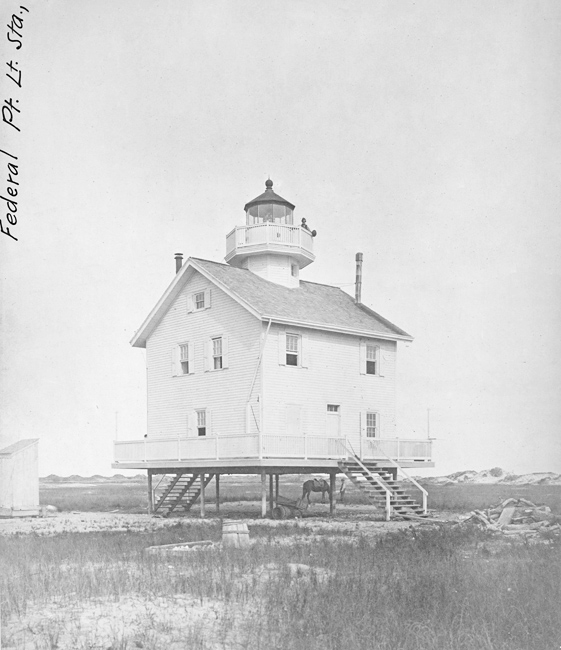
Photo Gallery
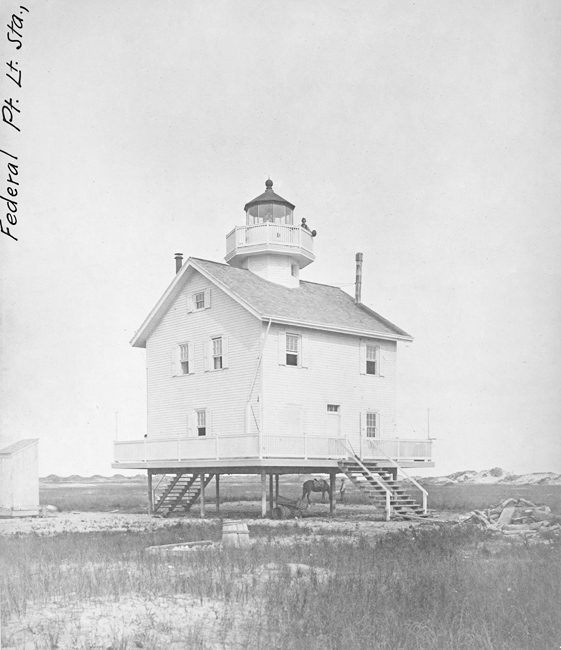
Photo Gallery
Photo Gallery
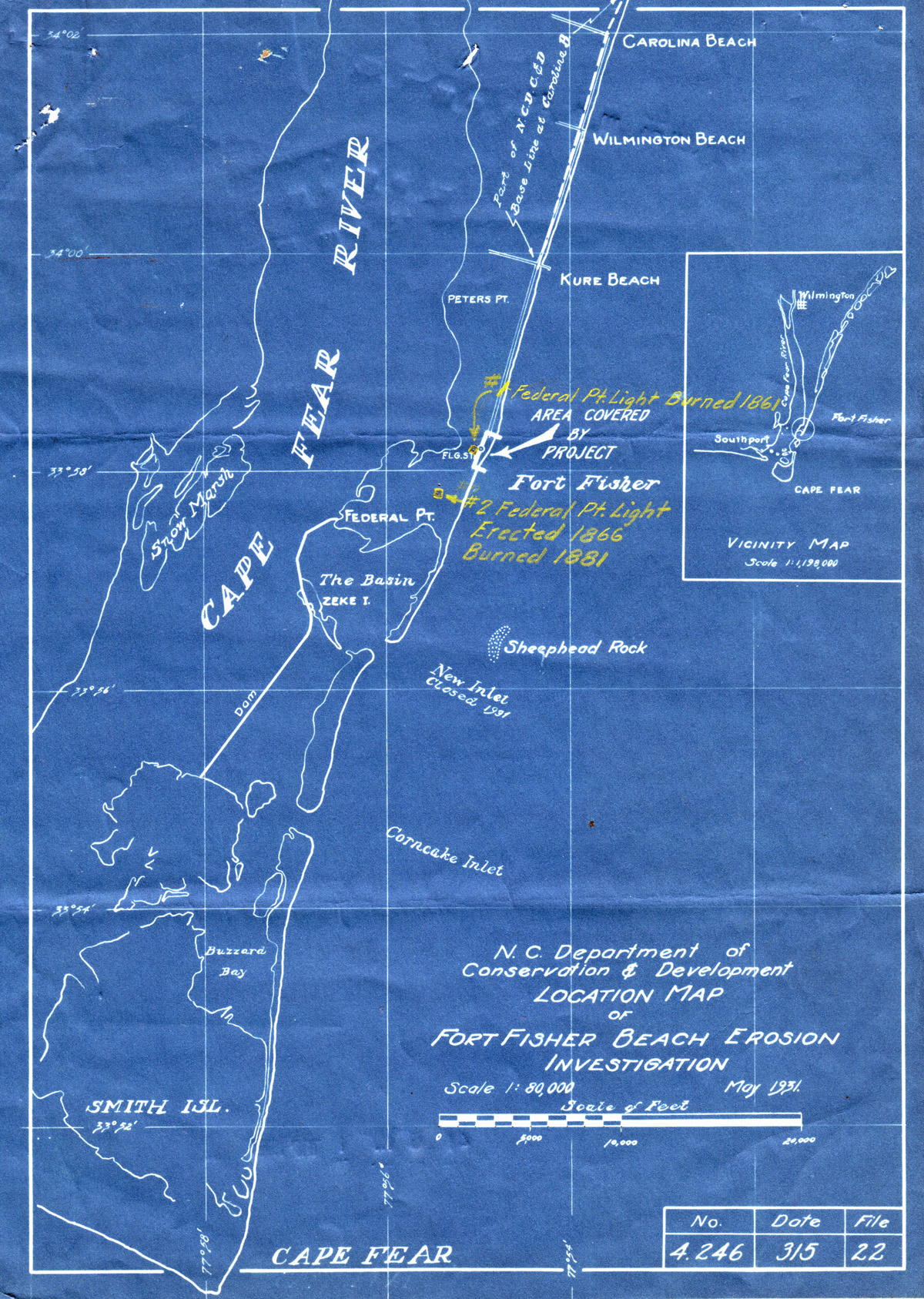
At the southern tip of North Carolina’s lower Cape Fear region, where shifting currents, dangerous shoals, and Atlantic storms long challenged mariners, stood a lighthouse whose history became inseparable from war, engineering, and profound geographic change. Federal Point Lighthouse, established near the entrance to New Inlet on the Cape Fear River, never achieved the fame of nearby Bald Head Lighthouse, yet for much of the nineteenth century it occupied one of the most strategically important locations on the North Carolina coast. Built to guide vessels through a newly formed passage into the Cape Fear River, the lighthouse witnessed the rise of Wilmington as a maritime center, the transformation of the coastline by hurricane and human engineering, the feverish activity of Civil War blockade runners, and the thunderous destruction of nearby Fort Fisher.
For generations, vessels entering the Cape Fear River relied upon the river’s original entrance near Bald Head Island, where mariners found guidance from Bald Head Lighthouse—later affectionately known as “Old Baldy.” During the colonial period, this channel served as the principal gateway to Wilmington, though navigation remained hazardous because of shifting shoals and shallow bars.
Everything changed in 1761. That September, a devastating hurricane struck the North Carolina coast and dramatically altered the geography of the lower Cape Fear. The storm cut a new opening between Bald Head Island and Federal Point, carving what became known as New Inlet. Approximately a mile wide and eighteen feet deep, the inlet immediately transformed maritime navigation. Water that once flowed through the Old Inlet diverted through the newly opened passage, reducing depths elsewhere in the river and frustrating commercial shipping.
|
The emergence of New Inlet fundamentally altered navigation along the Cape Fear. Over time, mariners increasingly favored the new opening near Federal Point, though the older channel near Bald Head continued in use for decades before gradually declining in importance. By the early nineteenth century, Federal Point—located just north of the inlet—had become an increasingly important navigational landmark.
Recognizing the growing importance of New Inlet, Congress appropriated $1,800 in 1814 for the construction of a beacon near Federal Point, though delays postponed the work. The appropriation was renewed in 1817, and soon afterward a forty-foot brick beacon rose on the sandy point overlooking the inlet.
Completed in 1817, the structure served initially as a daymark rather than an illuminated lighthouse. Mariners approaching the Cape Fear River relied upon its visibility to orient themselves among the shoals and uncertain channels. A published notice to mariners that year described the beacon as standing on “the main land, the north side of the entrance of Cape Fear river” and warned unfamiliar captains to proceed cautiously, as the channel across the bar constantly shifted. Even with the beacon visible, strangers were advised to employ pilots whenever possible.
In 1826, Congress appropriated another $2,000 to convert the beacon into a true lighthouse. Treasury officials contracted famed lighthouse builder and lighting contractor Winslow Lewis to install a lantern, lamps, and keeper’s dwelling. By early 1827, Federal Point Light officially entered service, becoming an increasingly valuable aid to navigation for vessels approaching Wilmington through New Inlet.
The isolated station required constant attention. Lighthouse keepers battled salt air, storms, leaking structures, and the perpetual deterioration brought by coastal weather. The first keeper was Edward Newton, who was paid an annual salary of $400 and served from 1827 until 1836, followed by several members of the Newton family, whose long association with the station reflected the often hereditary nature of lighthouse service.
Disaster struck on April 13, 1836, when the lighthouse was destroyed by fire. Newspapers quickly reported the loss, noting that “no portion of the building stands to aid the mariner in making the new inlet.” The destruction immediately renewed concern about navigation at one of the river’s most vital entrances.
Congress responded swiftly, appropriating funds in 1837 for reconstruction. The replacement lighthouse—a sturdier brick tower with improved accommodations for the keeper—was completed later that year after significant administrative frustration. Federal officials complained bitterly about difficulties obtaining affordable contractors in the South and ultimately awarded the contract to Henry Stowell from the Northeast. Though modest in size, the rebuilt tower once again provided guidance through New Inlet. The brick tower stood thirty feet tall, had a diameter of eighteen feet at its base and nine feet at its top, and was crowned by a wrought-iron, octagonal lantern room. The accompanying keeper’s dwelling, also built of brick, measured thirty-four feet by twenty.
Like many American lighthouses before the reforms of the 1850s, Federal Point suffered from outdated equipment and inconsistent maintenance. Reports from inspectors frequently painted an unflattering picture.
By 1851, an official inspection found the station in remarkably poor condition. The eleven-lamp reflector system leaked oil, the lantern interior was blackened with soot, reflectors were tarnished, and much of the apparatus stood badly adjusted. The inspector found the station dirty and observed that the keeper lacked proper instructions for maintaining the light. Mariners at nearby Smithville complained that Federal Point Light often appeared dim and unreliable, sometimes seeming like “two lights, one above the other” because of improperly aligned reflectors.
Federal authorities ordered repairs and modernization. By 1852, officials determined the station required a new lantern fitted with larger French plate glass and improved lighting apparatus. Although Federal Point remained less prominent than major coastal lights, its role in directing traffic into Wilmington ensured continued investment.
Yet even as engineers worked to improve the lighthouse, geography was already changing maritime priorities. Increasingly, mariners favored New Inlet over the Old Inlet near Bald Head. Between roughly 1839 and 1872, the old route declined so dramatically that some observers questioned whether Old Baldy remained useful at all. There were even discussions of demolishing the venerable lighthouse because shipping had shifted so decisively toward Federal Point.
The importance of Federal Point reached its height during the American Civil War. As Union forces tightened their blockade of Southern ports, Wilmington became one of the Confederacy’s last vital gateways to the outside world. The city’s strategic significance rested largely on geography. Ships approaching the Cape Fear could exploit the treacherous Frying Pan Shoals—dangerous enough to discourage Union warships from close pursuit—and then slip into New Inlet under cover of darkness.
To defend this crucial maritime corridor, Confederate engineers constructed Fort Fisher on Federal Point beginning in 1861. Situated on Federal Point beside New Inlet, the massive earthen fort guarded the approaches to Wilmington and quickly earned a reputation as one of the strongest fortifications in the Confederacy. Sometimes called the “Gibraltar of the South,” Fort Fisher mounted dozens of heavy guns facing both sea and land.
Federal Point Lighthouse found itself at the center of this wartime landscape. Existing navigational lights, including Federal Point and Bald Head, were extinguished early in the conflict to deny guidance to Union vessels. Meanwhile, blockade runners—sleek, shallow-draft steamers often painted gray to blend with the horizon—quietly used local pilots and intimate knowledge of New Inlet to evade capture.
The operation became enormously profitable. British-made arms, ammunition, clothing, medicines, and manufactured goods entered Wilmington while cotton flowed outward to European markets. Night after night, blockade runners threaded the waters around Federal Point, slipping beneath the looming guns of Fort Fisher before racing upriver toward Wilmington. For a time, New Inlet became one of the Confederacy’s most valuable maritime arteries.
Union leaders understood that as long as Fort Fisher stood, Wilmington remained open.
The first major attempt to capture the fort came in December 1864, when Union forces launched an unsuccessful assault. A second and far larger expedition followed in January 1865. After one of the war’s most devastating naval bombardments, Union troops stormed the fort on January 15. Fierce hand-to-hand combat raged for hours as Confederate defenders stubbornly resisted.
The Battle of Fort Fisher proved catastrophic for the Confederacy. With the fall of the fort, New Inlet and the lower Cape Fear passed into Union hands. Wilmington soon became inaccessible to blockade runners, severing one of the South’s final supply lines and hastening the Confederacy’s collapse.
After the war, navigational needs quickly returned. In 1866, the Lighthouse Board erected a new Federal Point Lighthouse near the site of its predecessor. Unlike the earlier brick tower, the new station reflected changing engineering preferences. Built on a screw-pile foundation, it consisted of a wooden two-story keeper’s dwelling with a lantern rising from the center of its roof. Produced by a fourth-order Fresnel lens, the station’s fixed white light had a focal plane of fifty feet above sea level and could reportedly be seen for twelve miles. The light was placed in operation on April 30, 1866.
Keeper John Taylor assumed responsibility for the station after the war and remained there through its final years. Life at the isolated outpost could be unexpectedly eventful. In January 1878, newspapers reported a curious incident when a duck, apparently blinded by the lantern, crashed through one of the lighthouse’s glass panes and landed dead inside the structure—providing Taylor with an unusual dinner.
Even as Federal Point Lighthouse resumed operation, debate intensified over New Inlet’s future. Since the eighteenth century, many residents had blamed the inlet for disrupting river depths and complicating navigation to Wilmington. By diverting water from the Cape Fear, New Inlet reduced depths in parts of the river system and threatened commercial access to the port.
After years of discussion, advocates for closing the inlet prevailed. Beginning in 1875, the U.S. Army Corps of Engineers, under Colonel William Price Craighill, undertook one of the most ambitious coastal engineering projects in North Carolina history.
Workers began constructing an immense stone barrier across New Inlet. The first phase involved sinking “a continuous line of mattresses” composed of logs, brushwood, and stone onto the sandy bottom before layering granite atop the foundation. Over time, the massive structure became known simply as The Rocks.
The undertaking was expensive, controversial, and slow. Yet supporters argued it was essential to preserving Wilmington’s future as a deep-water port. By redirecting flow back toward the original channel, engineers hoped to restore river depths and improve navigation through the Old Inlet.
As work progressed, Federal Point Lighthouse gradually lost its purpose. Officials recognized that once New Inlet disappeared, the light would no longer guide vessels anywhere of consequence. Annual reports repeatedly postponed expensive repairs because discontinuance seemed inevitable.
Finally, in September 1879, the Lighthouse Board announced that Federal Point Light would be extinguished after January 1, 1880. The closing of New Inlet rendered the station obsolete. Old Baldy regained its importance as navigation returned to the historic entrance
Federal Point Lighthouse officially went dark on December 31, 1879. The abandoned structure lingered for a short time before being destroyed by fire in August 1881, ending more than six decades of lighthouse service at the site.
Though the lighthouse disappeared, Federal Point itself remained deeply connected to the memory of war and coastal transformation. The nearby remains of Fort Fisher became increasingly recognized as a place of national significance, commemorating one of the Civil War’s decisive battles.
In 1928, Congress authorized the transfer of the former Federal Point Lighthouse Reservation to the city of Wilmington as a memorial dedicated to the Battle of Fort Fisher. The legislation carefully noted that in 1817 the original one-acre tract “whereon the beacon erected by the United States now stands” had been conveyed to the federal government by Charles B. Gause.
Today, little physical evidence remains of Federal Point Lighthouse. Yet its history survives in the story of New Inlet, the rise and fall of Fort Fisher, and the continual reshaping of the Cape Fear coast by storms, war, and engineering. For more than sixty years, the lighthouse stood where geography itself was in flux—guiding mariners through channels that nature created, war transformed, and engineers eventually erased.