Hog Island, VA 
Select a photograph to view a photo gallery
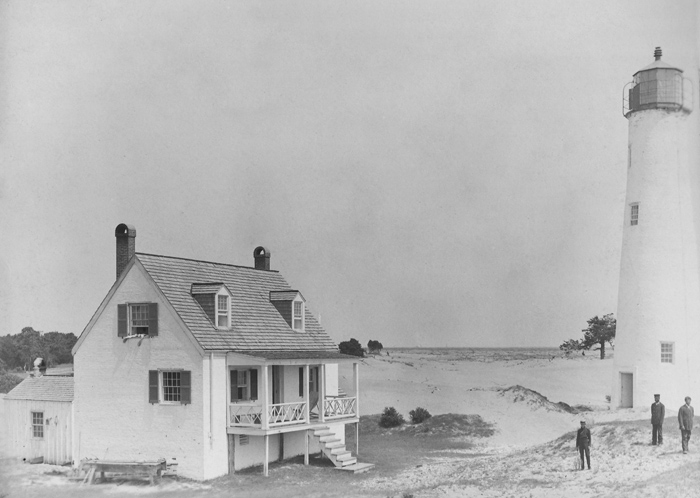
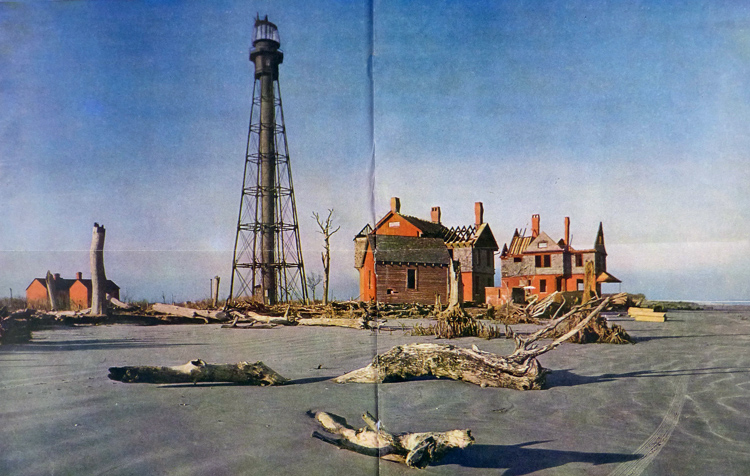
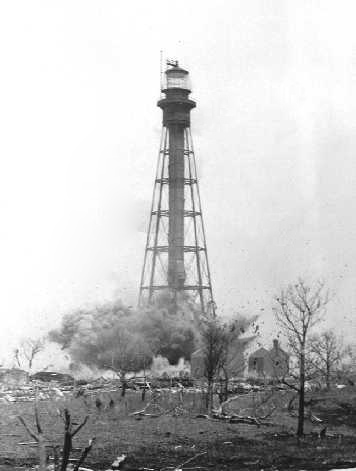
Photo Gallery
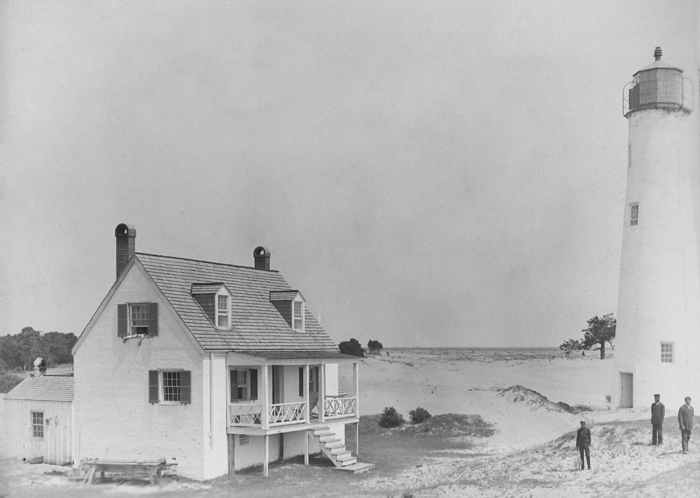
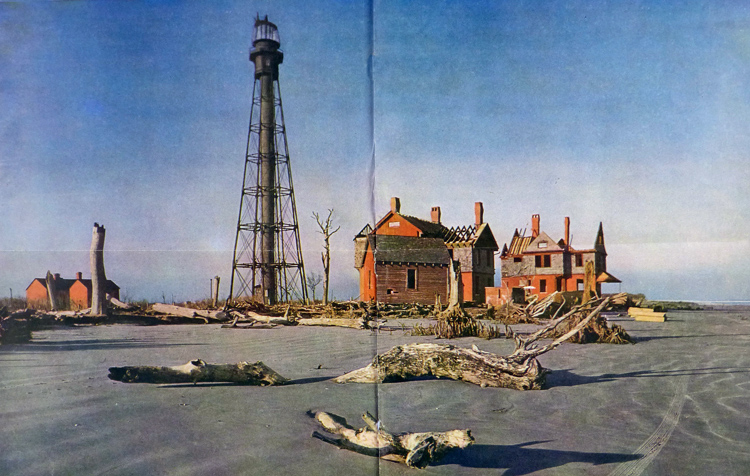
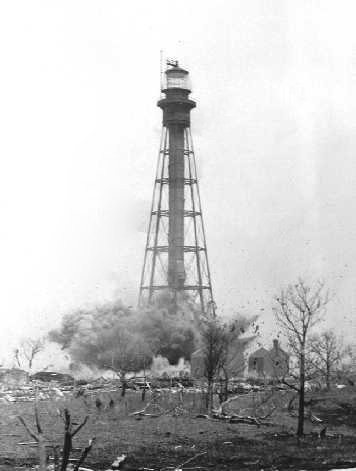
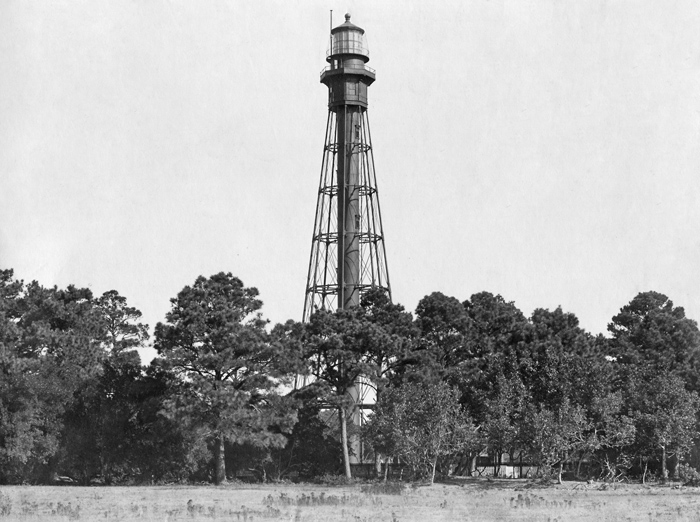
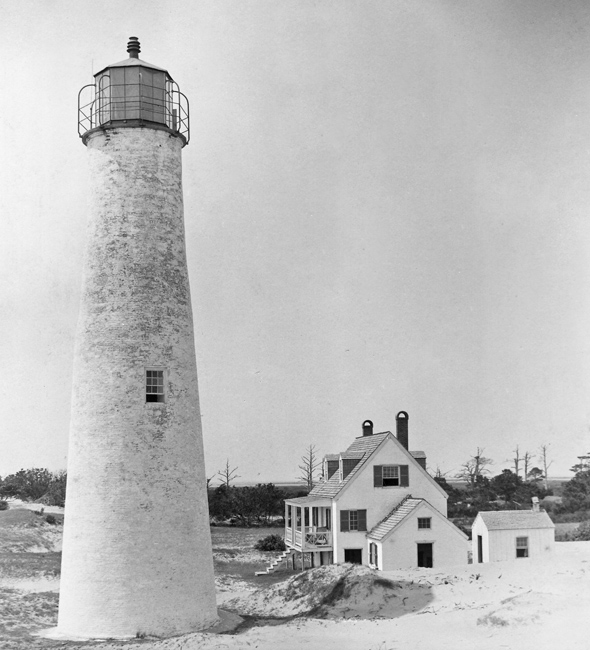
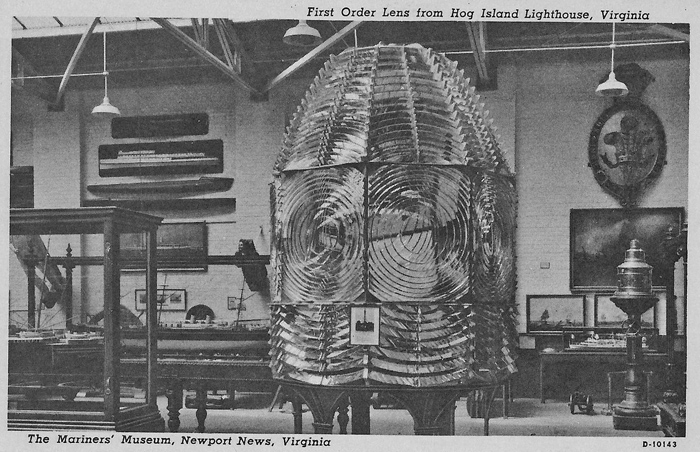
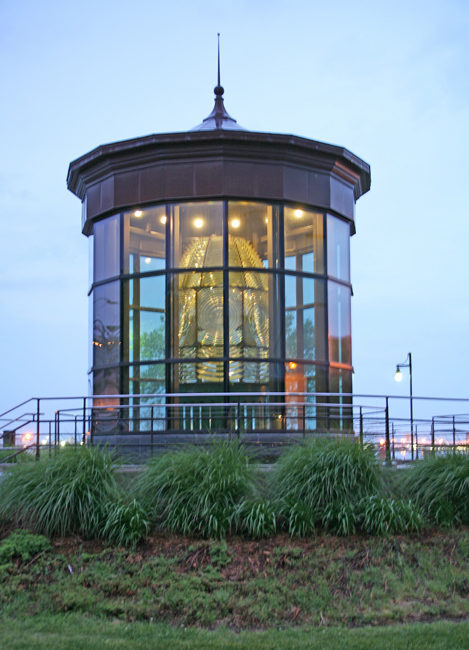
Photo Gallery
Photo Gallery
Hog Island lies along Virginia’s Eastern Shore, south of Assateague Island and north of Cape Charles. Today, little remains of the island that once supported a thriving community, but for nearly a century two successive lighthouses stood there, warning mariners away from the shoals extending seaward from the island. The first lighthouse, a substantial brick tower completed in 1852, was eventually claimed by the sea. Its replacement, an imposing 191-foot iron tower completed in 1895, survived for little more than fifty years before erosion once again undermined the site. The Coast Guard demolished the second tower in 1948, but an important part of the station survives: its magnificent first-order Fresnel lens is now displayed along the waterfront in Portsmouth, Virginia.
Congress first appropriated $5,000 on March 3, 1836, for a lighthouse on the south end of Hog Island. The proposal immediately encountered opposition. Captain Alexander Claxton of the Navy argued that a lighthouse would provide little benefit to navigation and might actually confuse mariners because it would lie on a coastline already marked by Cape Charles and Assateague lights. He also pointed out that Hog Island’s shoals extended three miles offshore and that the proposed lighthouse could not serve as a useful guide into the island’s harbor at night. In his opinion, a lightship would have been more useful, although he likewise believed that even that light in the area might create confusion.
Nothing was done with the original appropriation. In 1848, Congress appropriated $10,000 for two lighthouses on Sand Shoal Island to guide vessels into Matchapungo Inlet, but the government was unable to obtain satisfactory title to the land. In 1850, Congress redirected the funds toward two lights on the south end of Hog Island—or Sand Shoal, depending on the results of an actual survey—to serve as a range for the channel of Great Machipongo Inlet.
|
A suitable site was finally secured for not two but one light. On May 31, 1851, Arthur W. and Mary Downing and Richard B. Windsor conveyed six and a half acres on Hog Island to the United States for $500.
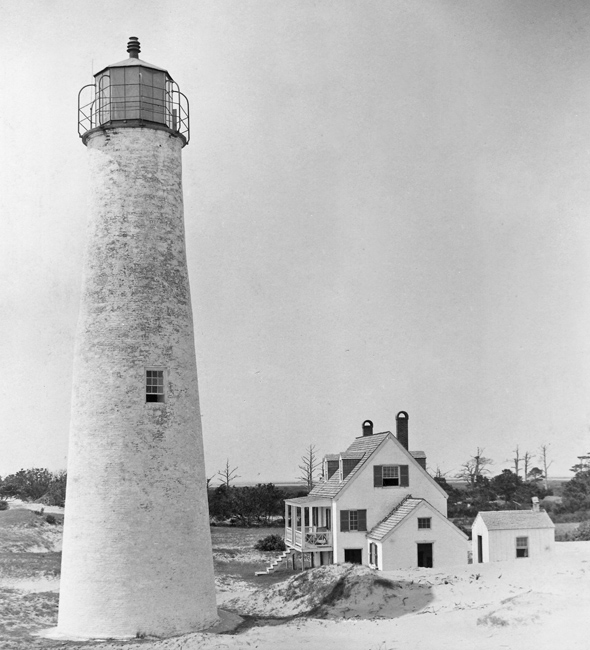
In February 1852, Superintendent of Lights William C. Chapman advertised for proposals for a lighthouse and dwelling. The plans called for a substantial round brick tower, forty-five feet high from ground level, with a base diameter of twenty-two feet. The brick walls were to be three and a half feet thick at the bottom and two and a half feet thick at the top. A brick dwelling accompanied the tower.
Fourteen bids were received. William T. Harrison submitted the lowest bid, $5,300, and Superintendent Chapman initially questioned whether the unusually low bid should be accepted. Stephen Pleasonton of the Treasury Department, however, reminded Chapman that federal law required the lowest responsible bid to be accepted and instructed him to award the contract to Harrison, provided Harrison could furnish the required security.
The surviving correspondence then becomes somewhat unclear. A June 3 letter from Pleasonton refers to “Mr. Grose, the Contractor,” who was in Washington seeking an interview concerning proposed alterations to the tower. In September, newspaper accounts stated explicitly that the work had been performed by Thomas B. Grose of Maine. Thus, Harrison was unquestionably the low bidder, but the surviving documents do not make clear whether Grose ultimately took over Harrison’s contract or whether Grose performed the work for Harrison. In either case, Grose was the man who actually built the lighthouse.
The construction proved more complicated than originally anticipated. The tower was initially designed to rise forty-five feet above the ground, but the contractor raised it to fifty-five feet after an engineer determined that the original height was inadequate. Another ten feet was then authorized, bringing the tower to sixty-five feet above ground. The ground itself stood about ten feet above sea level, placing the light approximately seventy-four feet above the sea. A brick wall was also ordered around the tower to protect it from wind and drifting sand.
A newspaper report published in September 1852 praised Grose’s workmanship and noted that he had made several improvements at his own expense. The lighthouse’s fixed white light was first exhibited on October 20 by Keeper Luther H. Read. By 1854, the light was described as being visible for thirteen miles. Fifteen lamps mounted in twenty-one-inch reflectors produced the light.
The station received a Fresnel lens in 1855–56. During the Civil War, the light was extinguished, but after Union forces regained control of Virginia’s Eastern Shore, Hog Island Lighthouse was among those promptly re-established. By 1862, it was again serving the greatly increased wartime navigation of Chesapeake Bay and its tributaries.
Repairs continued through the following decades. In 1868, the tower’s windows, door, woodwork, lantern, and lightning rod received attention, while the keeper’s dwelling underwent extensive repairs. Fences were built around both the tower and garden, the landing wharf was repaired, and the station’s cistern was restored. The following year a Franklin lamp replaced the older constant-level lamp.
|
Despite these improvements, the Lighthouse Board increasingly questioned the usefulness of the 1852 light as a major coastal aid. By the late 1880s, officials considered it inadequate for vessels navigating farther offshore. The Board repeatedly recommended replacing the fourth-order light with a first-order light mounted on a much taller tower. Such a light, they believed, could fill the gaps in illumination between Assateague and Cape Charles and could be seen more than eighteen miles at sea.
Congress finally acted. An appropriation approved March 3, 1893, provided $30,000 toward replacing the old fourth-order light with a first-order light and authorized a contract for as much as $125,000.
The new lighthouse would stand on a new site nearly half a mile north of the old station. Construction required an extensive infrastructure project. Congress also appropriated $5,000 for a wharf and roadway connecting the landing to the lighthouse and the nearby Life-Saving Service station. After difficulty securing the necessary property, the government finally obtained the land.
In April 1893, bids were requested for the new iron towers for Hog Island and nearby Cape Charles. The lowest bid for both structures was $78,209 from the Russell Wheel and Foundry Company of Detroit, Michigan, and the contract was awarded accordingly.
The new Hog Island Lighthouse was an extraordinary structure. It was an octagonal, pyramidal iron skeleton tower with a central cylindrical shaft containing the stairs. Its foundation consisted of massive concrete piers supported by piles and timber grillage.
Construction proceeded through 1894 and 1895. By early 1895, temporary quarters, a cistern, storehouses, a workshop, a tramway, and construction equipment had been established at the site. The tower’s eight foundation piers were completed in April. Three additional piers supported the outer stairs and platform.
The ironwork arrived on June 14, 1895, and erection began immediately. By the end of June, the central cylinder had risen twenty-seven feet. Three keeper’s dwellings and numerous outbuildings were also constructed. The tower itself was completed September 30, 1895, and the keepers moved into the new quarters in November.
The new first-order light was exhibited on January 31, 1896. Its eight-panel flashing lens produced a brilliant white flash lasting three seconds every forty-five seconds and had a focal plane 180 feet above mean high water. Under clear conditions, the light could be seen nearly twenty miles.
The lens was not entirely new. It had previously served at Cape Charles Lighthouse and was modified slightly for its new location. The apparatus was an older type of first-order lens originally mounted on chariot wheels. Those wheels were later replaced by a ball bearing, and the lens was driven by clockwork.
The new tower quickly became a prominent landmark. Unfortunately, it also became a hazard to migrating birds. On March 1, 1896, a storm pane was broken when ducks struck the tower.
The keepers of Hog Island lived in an isolated world. One of the most vivid accounts comes from Charles A. Sterling, who served as second assistant keeper from 1902 to 1905. Decades later, Sterling recalled that when he arrived, Hog Island seemed to him “the most beautiful spot in the world.”
The island was then approximately two and a half miles long and more than a mile and a half wide. It had wooded knolls covered with pine, oak, and red cedar, along with extensive marshes. About forty-two families lived there. Islanders raised cattle, sheep, and hogs, cultivated vegetables, melons, and flowers, and made their living from oysters, fish, crabs, clams, and other seafood. Wealthy visitors from the North also came to hunt the island’s abundant waterfowl. Among these was President Grover Cleveland.
|
Sterling remembered the residents as hospitable people who lived simply and had little need for money. He later wrote a history of Hog Island describing the community and its natural environment. His memories also preserved evidence of a problem that would eventually destroy the lighthouse: the sea was steadily consuming the island.
In October 1903, a severe storm lasted four days. Salt spray swept across even the island’s highest ground, and the entire community took refuge in the lighthouse. Although the lighthouse itself survived, portions of the island were washed away and never returned.
Allie L. Davis served as head keeper from 1914 to 1919. Davis appears to have taken his responsibilities seriously. In 1916, he received the Lighthouse Service efficiency pennant for the Fifth District after the station achieved the highest overall efficiency rating for the year.
Davis’s reports also reveal some of the difficulties of life on such an isolated station. In June 1917, he reported a serious incident involving a coast guardsman and the wife of one of the assistant keepers. Davis confronted the situation personally and reported it to both the Lighthouse and Coast Guard authorities. His strongly worded report reflects both his concern for the reputation of the station and the tensions that could arise within an isolated community.
Davis and his first assistant staked out either side of one dwelling, while the second assistant went in to confront his wife and the coast guardsman. Davis reported: “When Mr. Jarvis ordered his wife to open the door or he would brake in Carpenter jumped out of Mrs. Jarvis room winder with nothing on but [an] under shirt. I was so close on him he ran & jumped the fence. I gave Mrs. Jarvis until 10 o’clock to leave the station, which she did. Now sir these two has caused trouble and discredit to this station for the past six years, this is the second time I have caught them & had evidence enough to make a report of it.”
In October 1918, Keeper Davis was placed under extraordinary pressure when both assistant keepers and their families became ill, as did his own wife. For several days he operated the station without assistance while also caring for the sick. An assistant keeper from Assateague was eventually sent to Hog Island to help.
The lighthouse became famous for its encounters with wild birds. During a severe storm on February 22, 1900, huge numbers of geese, brant, and ducks were attracted to the powerful light. Birds crashed into the lantern, breaking glass and threatening the lens. The keepers responded with shotguns. They fought the birds for an hour and a half, and sixty-eight dead birds were found around the base of the tower.
Two days later, another enormous flock attacked. With their ammunition exhausted, the keepers resorted to sticks, capturing approximately 150 birds before thousands more descended upon the tower. The keepers were forced to retreat inside. The birds smashed additional windows and even extinguished the light.
A similar phenomenon occurred during a severe northeast storm in February 1908. The keeper and his assistants reportedly collected or captured approximately 450 ducks, while island residents gathered another 250 birds and several geese. Such incidents illustrate just how powerful the new first-order light was—and how attractive or blinding it could be to migrating birds on stormy nights.
The light’s illuminant was changed to incandescent oil vapor in 1912. In 1933, the station was electrified. The first-order lens continued to revolve, completing one revolution every six minutes and producing its characteristic white flash every forty-five seconds. Two electric motors and a speed-reduction mechanism replaced the old clockwork drive, but it remained in place as a backup. The strength of the electrified light was an amazing 1.5 million candlepower.
The island’s erosion, however, was becoming impossible to ignore. Hurricanes repeatedly swept across the low-lying island. In 1933 and again in 1936, powerful storms drove seawater across the island and drowned hundreds of cattle.
In 1938, Hog Island Lighthouse was automated and made unwatched. The light was thereafter operated without a resident keeper. A notice to mariners announced that it would show a three-second white flash every 30 seconds.
The automation marked the end of the lighthouse keeper era at Hog Island, but not the end of the station’s battle with the sea.
By the 1940s, erosion had transformed the island. The wooded knolls remembered by Charles Sterling had disappeared or been reduced to dead trees and stumps. The homes of the island’s families were gone, and even the lighthouse grounds were being eaten away.
The tall tower, once surrounded by land, increasingly stood near the water’s edge. Its foundations were eventually undermined by the sea and wind. The light was discontinued as an aid to navigation on March 17, 1948. Lighted and sound buoys had reduced the need for the tower, but the tall, dark tower presented a potential hazard to aircraft.
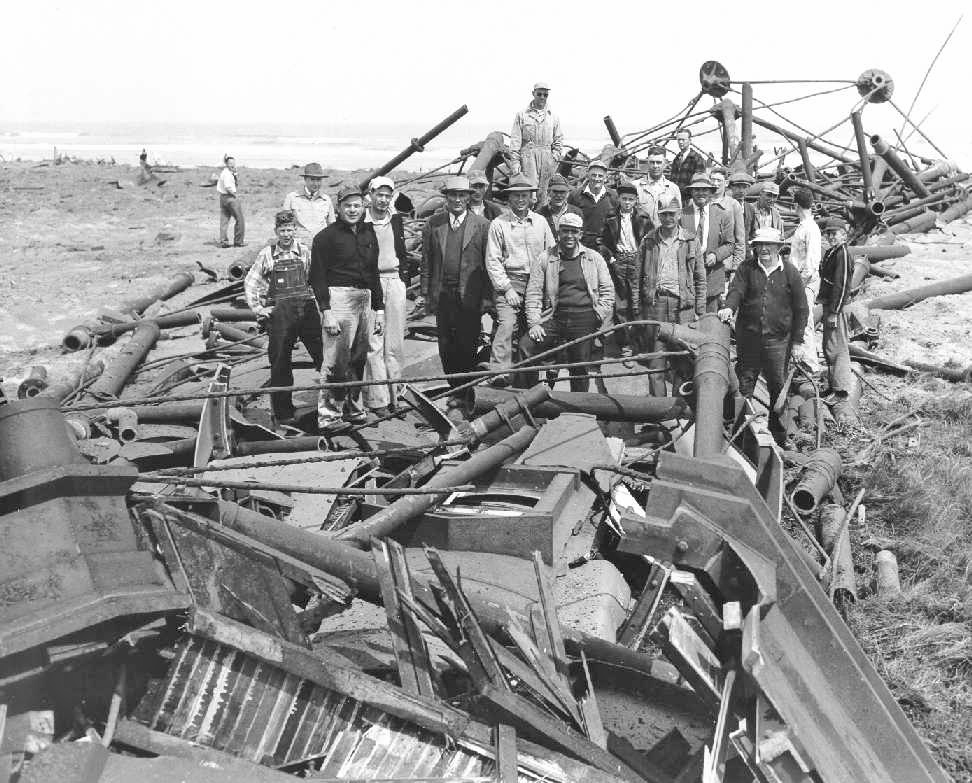
On April 24, 1948, a Coast Guard demolition crew destroyed the tower. Approximately 350 pounds of TNT were used. The powerful explosion and collapse of the tower sent fragments flying as much as half a mile and produced a column of smoke hundreds of feet high.
The destruction of the tower ended nearly a century of lighthouse service on Hog Island. The 1852 brick lighthouse had already succumbed to the sea, and now its replacement had been demolished because the sea was about to claim it as well. The station buildings disappeared with the island, leaving little physical evidence of the lighthouse community that had once occupied the site.
Yet one remarkable piece of Hog Island Lighthouse survived.
When the lighthouse was automated in 1938, the magnificent first-order Fresnel lens remained in service. In 1941, the lens was removed from the tower and placed on exhibit at the Mariners’ Museum in Newport News. There it remained on public display for approximately twenty-four years. After the museum acquired the first-order lens from Cape Charles Lighthouse, the Hog Island lens was loaned to the City of Portsmouth, Virginia. It subsequently spent decades in storage while Portsmouth sought an appropriate place to display it.
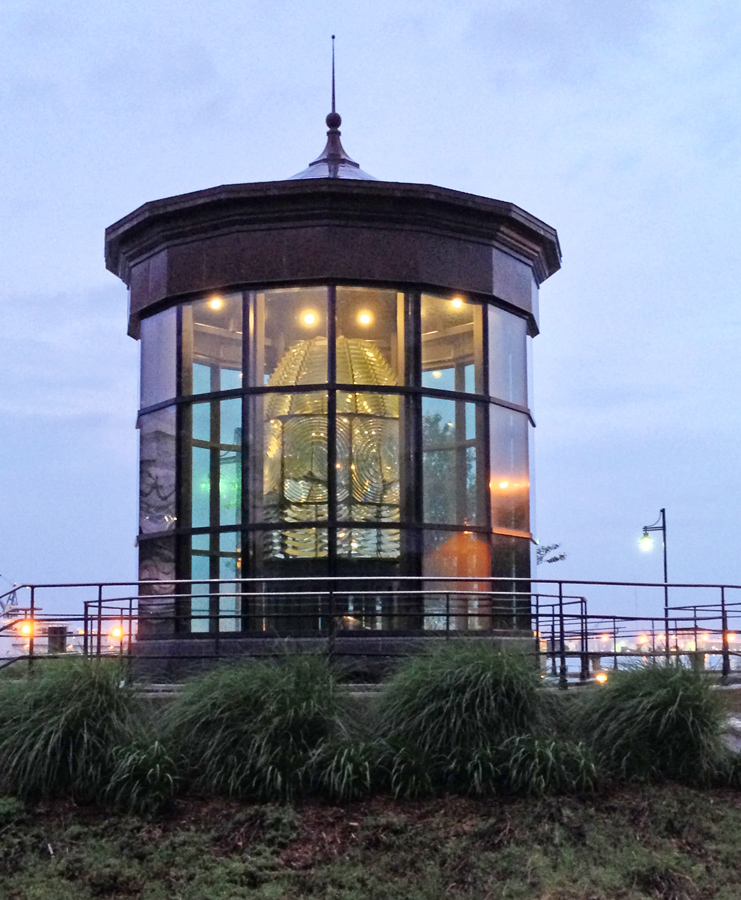
In 2003, it was placed on public display in a specially constructed pavilion on Portsmouth’s Elizabeth River waterfront, directly across from the Norfolk Naval Shipyard. Retired Coast Guard Rear Admiral William J. Ecker spearheaded the effort to find a permanent public setting for the historic apparatus. The pavilion was funded by the Portsmouth Museums Foundation in cooperation with the City of Portsmouth and the Fifth Coast Guard District.
The lens itself is an extraordinary object. Manufactured in France by Henry-Lepaute, it stands about ten feet tall, weighs approximately 2,500 pounds, and contains 368 prisms. Its estimated value has been placed at roughly $750,000 to $1 million.
Before it could be displayed, the lens required careful examination and restoration. Lighthouse lens specialist Jim Dunlap of the Lighthouse and Lens Restoration Corporation, assisted by Jim Woodward, Kurt Fosberg, and Mick Kipp, disassembled and examined the apparatus after it had spent decades in storage. They discovered that it had not been properly assembled before being stored. The upper portion was disconnected from the rest, one circular section was missing and had been replaced by a molded plastic substitute, two panels came from another lens, and one prism had broken into two pieces.
The broken prism was repaired using a metal band in the same basic manner that lighthouse lens technicians might have used more than a century earlier. More than thirty years of accumulated dust was also removed. Although a complete restoration, including reproducing missing glass components, was too expensive at the time, the lens was stabilized and prepared for public exhibition.
The pavilion was designed specifically to showcase the lens without competing with it. Its circular form evokes a lighthouse lantern room, while its glass walls allow visitors to see the lens from all directions. The lens is mounted on a slowly rotating turntable, recreating the movement it once made high above Hog Island. At night, spotlights illuminate the prisms, producing the same kind of dazzling spectacle that once made the lens a conspicuous landmark to ships at sea.
The public dedication took place in November 2003. The lens remains owned by the United States Coast Guard and was placed on loan to the City of Portsmouth.
Today, visitors along Portsmouth’s waterfront can see the very lens that once sent a brilliant white flash across the dangerous waters off Virginia’s Eastern Shore. Its survival provides a tangible connection to a lighthouse and an island that otherwise have nearly vanished. The lens that once warned mariners at Hog Island now serves a different purpose: it preserves the memory of the lighthouse, its keepers, and the remarkable island community that the sea ultimately reclaimed.