Avery Rock, ME 
Select a photograph to view a photo gallery
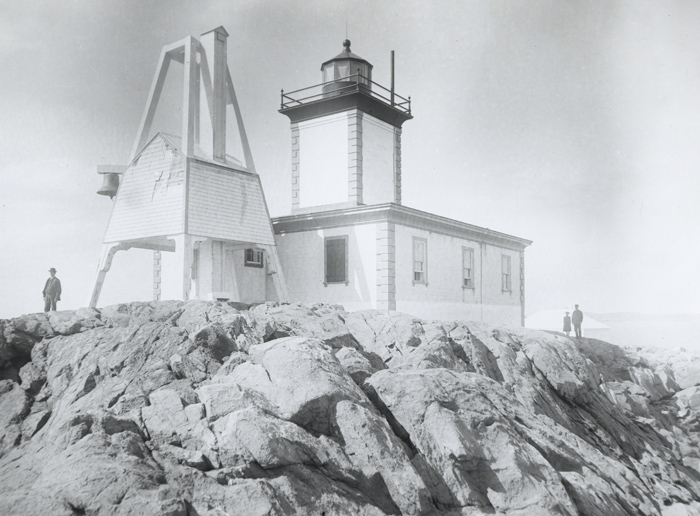

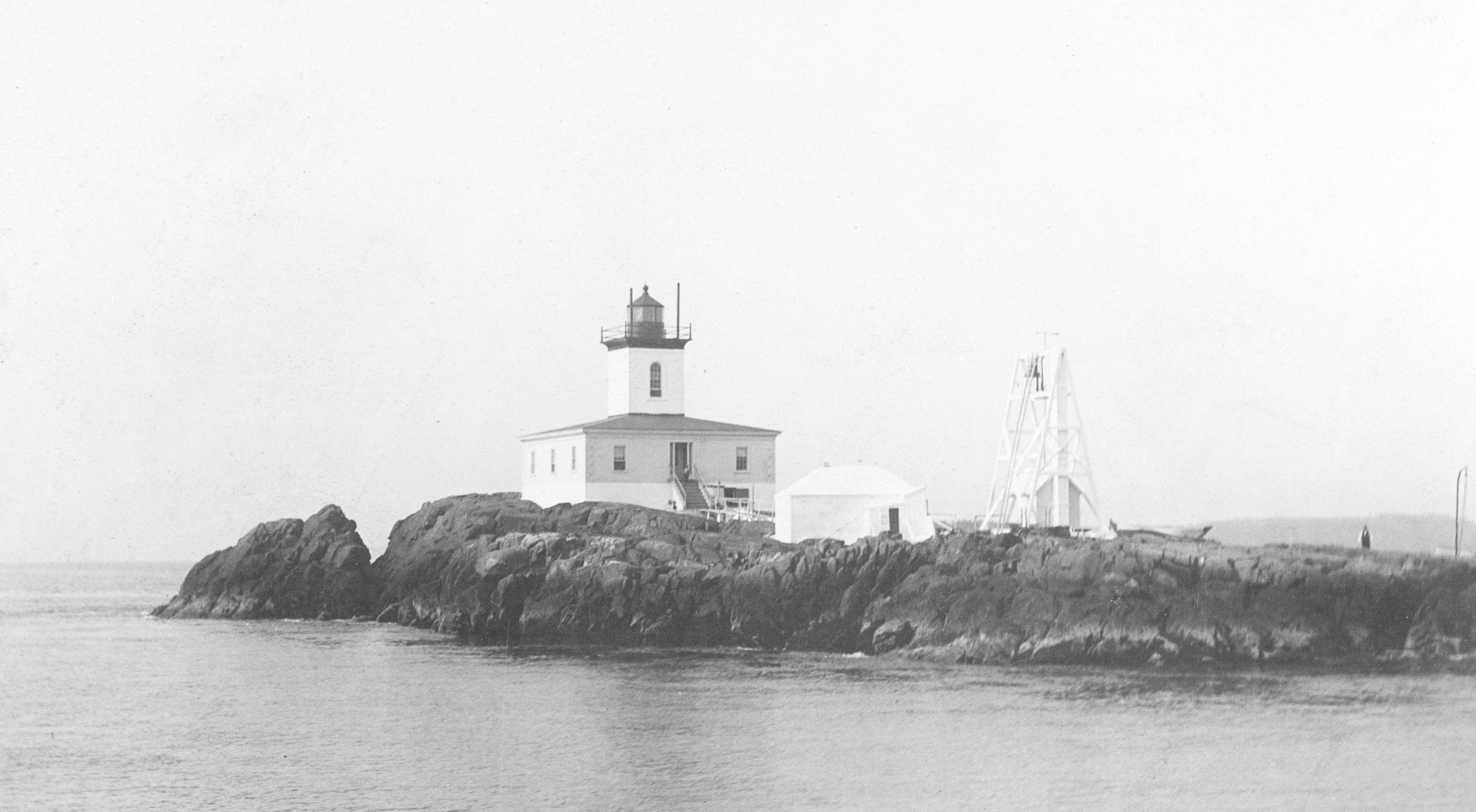
Photo Gallery
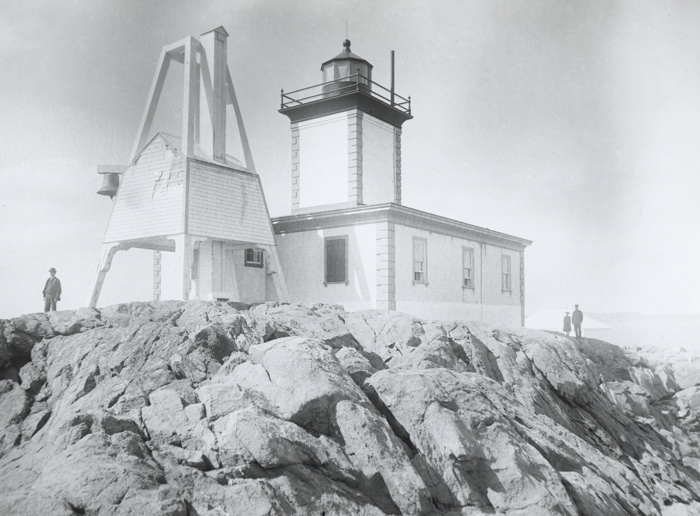
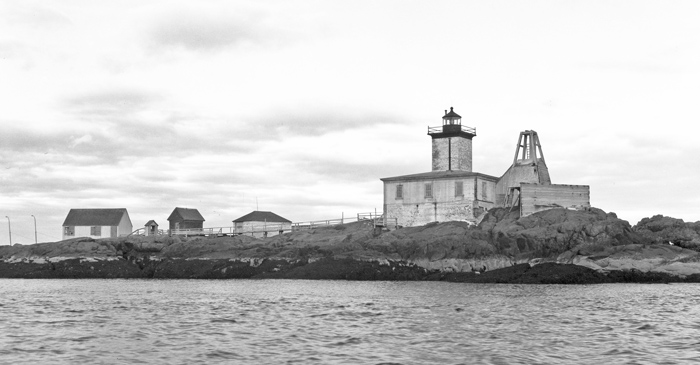
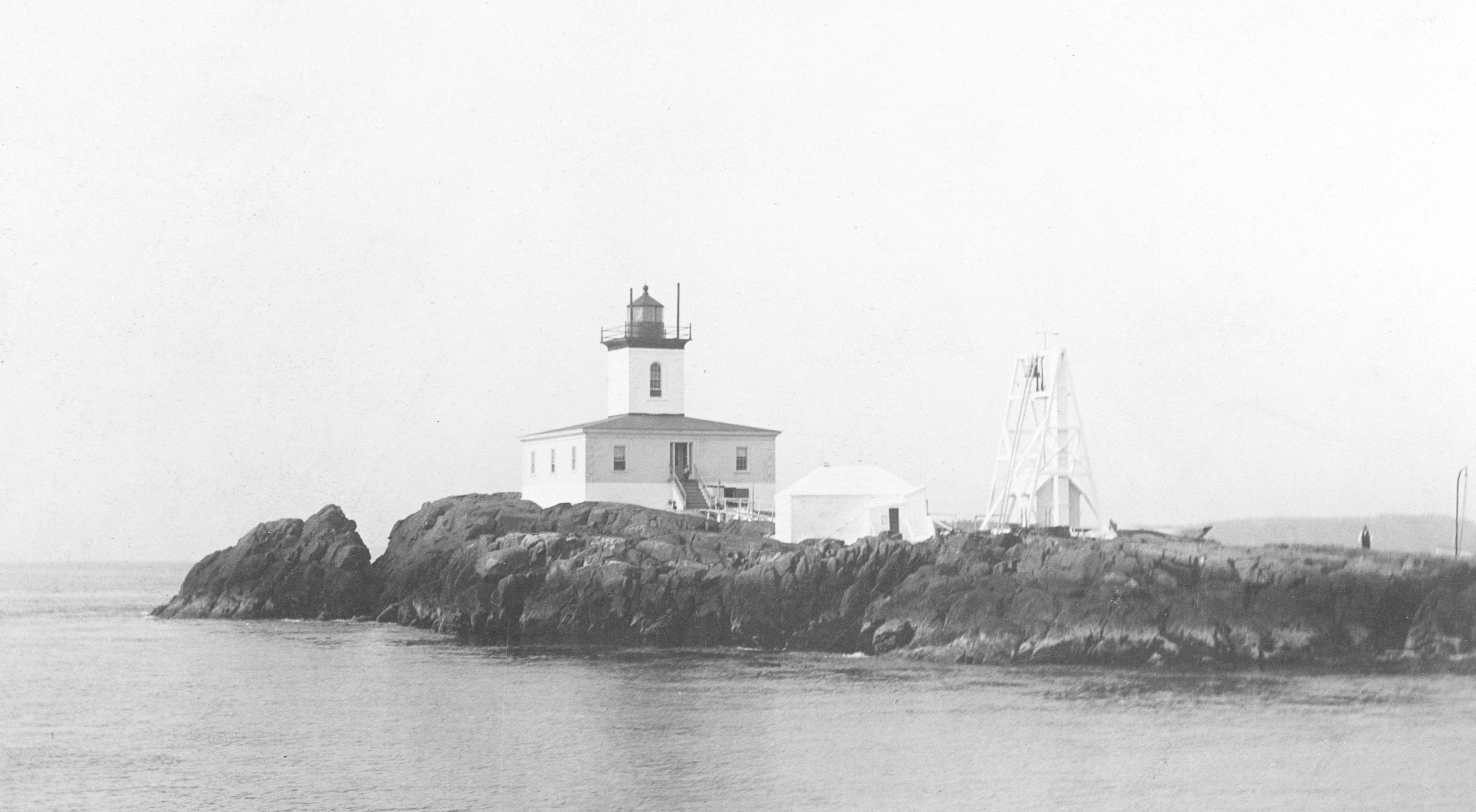
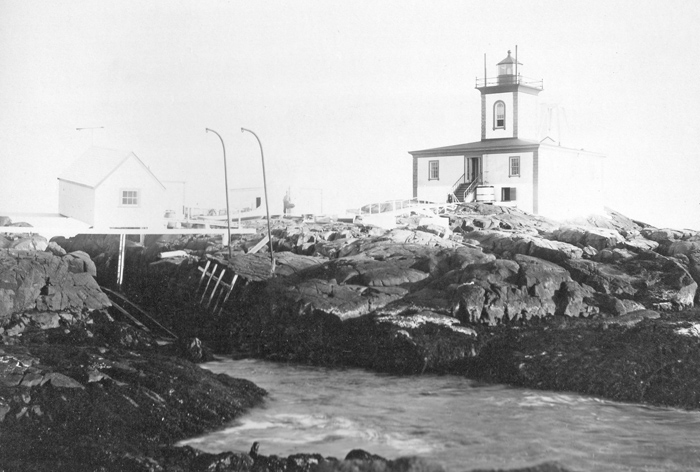
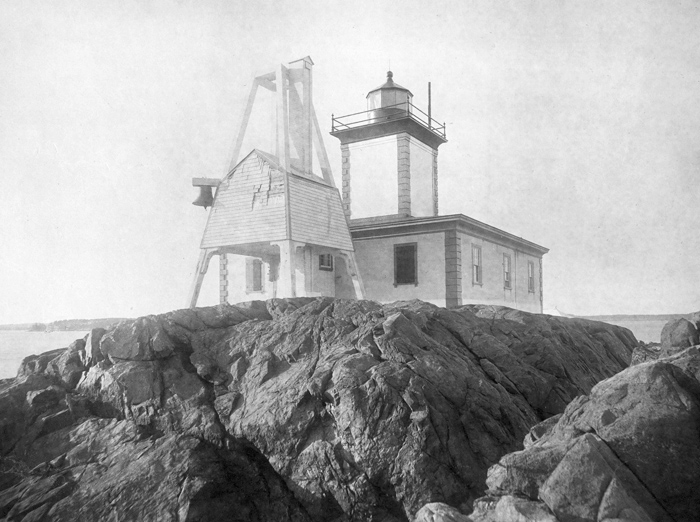
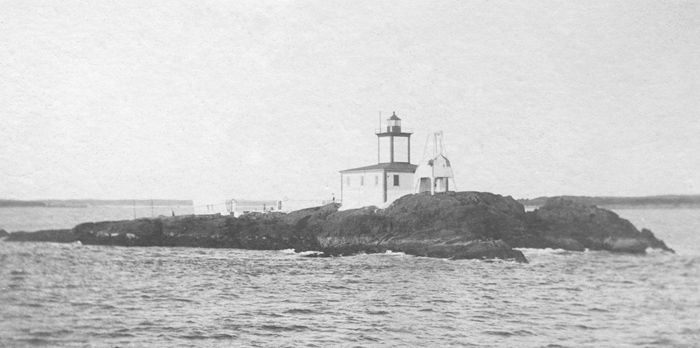
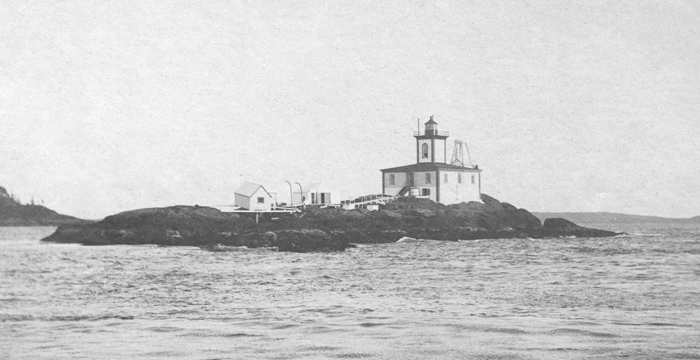
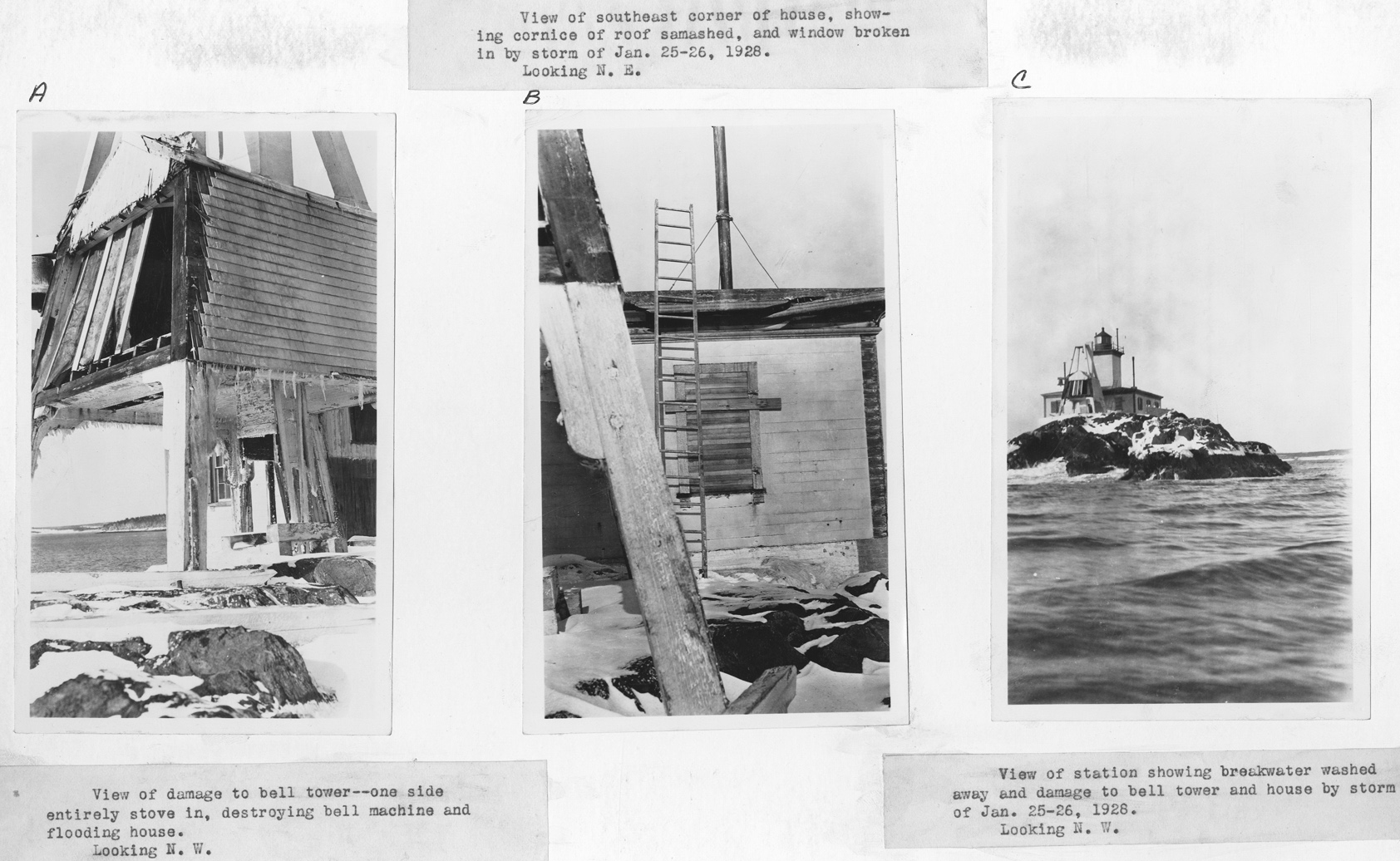
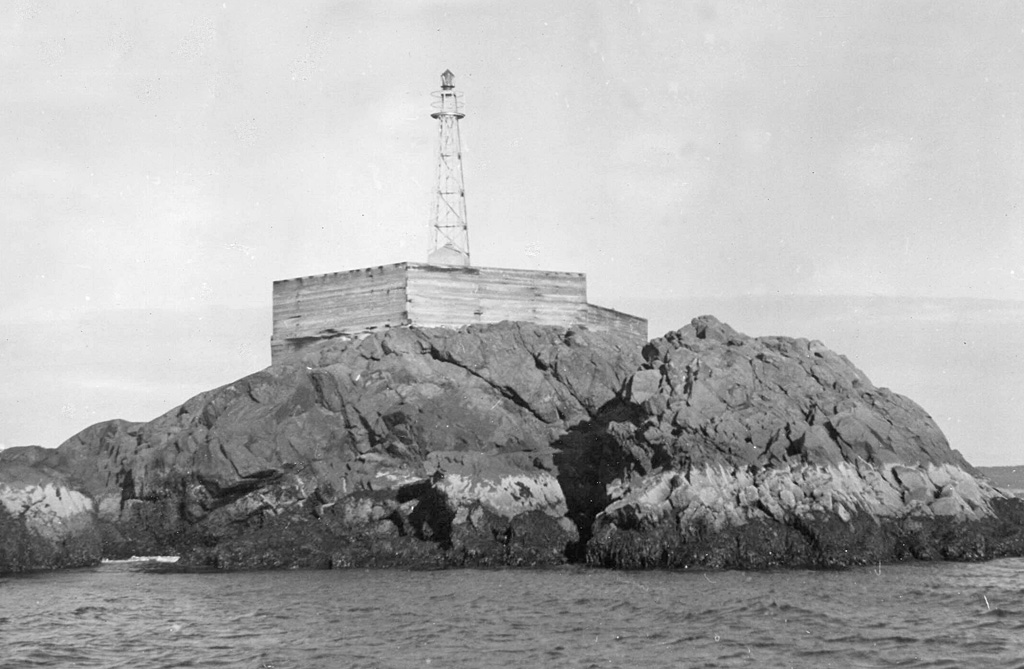
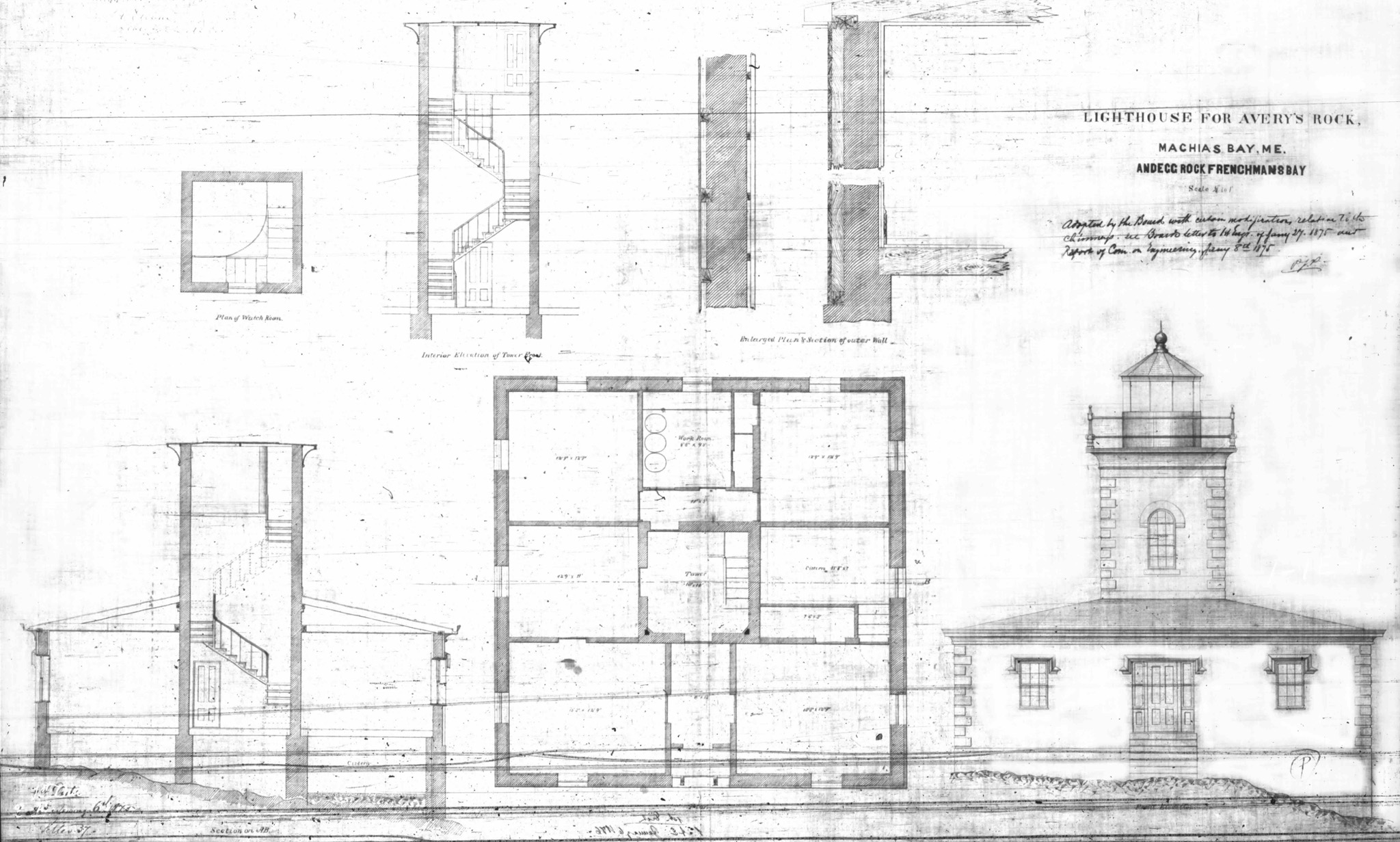
Photo Gallery
Photo Gallery
At the southern edge of Machias Bay, where the cold waters of the Gulf of Maine surge against a lonely granite outcrop, Avery Rock rises from the sea like a fortress of stone. Bare of soil, trees, or shelter, this quarter-acre ledge stood directly in the path of vessels bound for the thriving port of Machias and the lumber towns of eastern Maine. Long before modern navigation aids, Avery Rock was dreaded by mariners. Storm-driven seas broke across it and fog often concealed it. Out of this unforgiving setting grew one of Maine’s most dramatic light stations: Avery Rock Lighthouse.
|
The town of Machias had already established itself as an important center of trade by the mid-nineteenth century. Its sheltered harbor made it a favored refuge for ships, and its mills sent vast quantities of lumber downriver to the sea. As maritime traffic increased, so did the number of wrecks and near disasters in the bay’s approaches. Local mariners and federal officials agreed that a lighthouse and fog signal were urgently needed on Avery Rock, the most dangerous obstacle at the bay’s southern entrance.
Congress acted on June 23, 1874, when President Ulysses S. Grant approved an appropriation of $15,000 for a lighthouse and fog signal at or near Avery’s Rock. At the time, officials in Washington treated the site as if it were an ordinary parcel of land. One bureaucrat even noted that the deed should exclude any “burying ground, dwelling houses, or meeting house”—a statement that betrayed complete ignorance of the rock’s reality. Avery Rock was nothing more than raw granite rising from the sea, lashed by waves and ice.
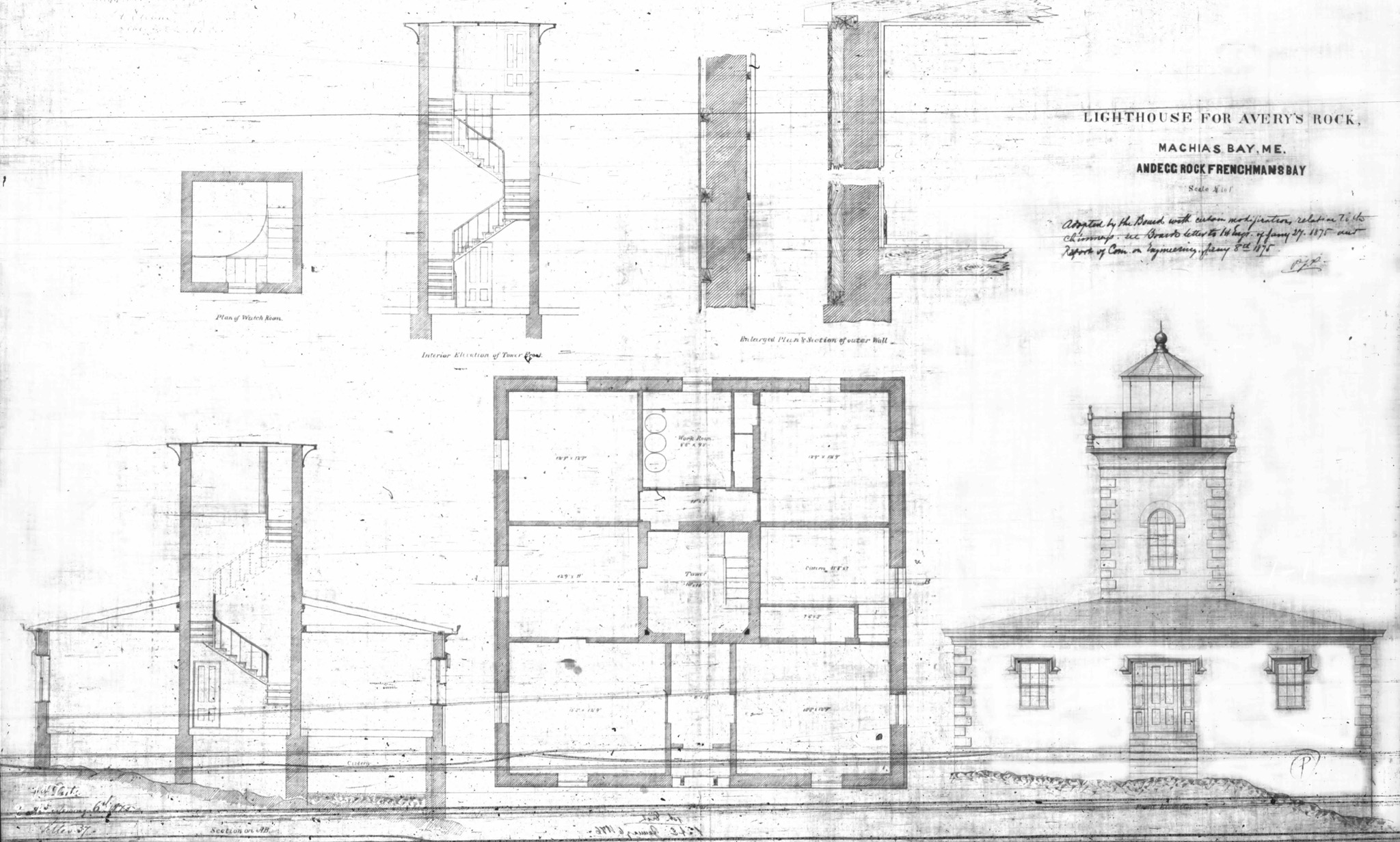
Work began early in 1875 after federal authorities finally secured title and jurisdiction from the State of Maine. Construction immediately proved difficult. Heavy seas made it dangerous to land materials, and the uneven surface of the rock complicated the laying of foundations. Lighthouse Board reports noted that “considerable difficulty was experienced in preparing the rock, which is very uneven, to receive the foundation.” With space at a premium, engineers designed a compact structure: a one-story brick dwelling with a square brick tower rising from its center. The tower was only twelve feet on a side, but it supported the lantern above the keeper’s living quarters, saving valuable space on the tiny ledge.
A separate wooden bell tower was erected nearby to hold a 1,200-pound fog bell, operated by clockwork machinery. The bell was originally programmed to sound two blows in quick succession, alternately with a single blow, at intervals of 30 seconds in fog or thick weather. The station was ready by the autumn of 1875, and on October 15 of that year, the light was first exhibited. It was a fixed red light produced by a fifth-order Fresnel lens, with a focal plane thirty-six feet above the rock and 68 feet above mean low water. In clear weather it could be seen for fourteen nautical miles. The new beacon greatly improved navigation in Machias Bay.
The first keeper, Charles F. Chase, received an annual salary of $620 and lived on the rock with his family. Like the eighteen keepers who followed him, Chase endured extreme isolation and constant danger. Yet visitors often remarked on the warmth inside the dwelling. Mary Bradford Crowninshield, writing in her 1886 book All Among the Light-houses, described the station as “redolent with the fragrance of flowers,” with pots and boxes crowding the windows—an astonishing contrast to the barren ledge outside.
|
The sea, however, was relentless. In 1880 a window on the southeast side of the dwelling was smashed by waves and had to be replaced. Over the years, repairs and improvements were constant. A brick cistern and water tank were installed in 1881, along with a concrete cellar floor and improved drainage. In 1882, the dwelling’s leaky tin roof was replaced with painted canvas, and a new house pump was added.
To make access safer, a replacement boathouse and a fifty-foot-long boat slip were constructed in 1888. These were bolted directly to the ledge. Lightning conductors were installed in 1889.
In January 1891, a violent gale tore away the boathouse. It was rebuilt the same year, along with a new bell tower of heavy yellow pine timbers and a covered passageway connecting it to the dwelling. Massive platforms and protective timbers were also bolted around the building to shield it from the waves.
Avery Rock was widely regarded as one of the harshest lighthouse postings in Maine. Edward T. Spurling became keeper in 1898, and his daughter Beatrice later recalled how seas would wash over the rock in gales, while the family sheltered behind heavy shutters. Once, during a severe storm, townspeople believed the light had been destroyed because it vanished from view—only to discover later that the station had survived intact.
In 1901, the intensity of the station’s fixed red light was increased by replacing the original fifth-order lens with a fourth-order lens. Around this time, a bulkhead of hard pine was bolted to the ledge to protect the boat slip and a brick oil house was built.
Charles W. Allen was transferred from Boon Island Lighthouse to Avery Rock in 1913. His daughter Beulah remembered arriving during a storm, sliding across the deck of the pitching boat. Fog bell duty could be especially dangerous. On one occasion, a cable snapped and the heavy weights crashed down the bell tower. For a week afterward, Keeper Allen rang the bell by hand for more than two hundred hours until repairs could be made.
In 1922, Elson L. Small became keeper. His wife Connie later became famous for her book The Lighthouse Keeper’s Wife, which chronicled life at isolated stations. At Avery Rock, she canned vegetables, planted flowers in boxes of imported soil, and learned to operate the light and fog bell. During one snowstorm, she rang the bell manually for ninety minutes when the machinery failed, blistering her hands before she finally fixed the mechanism. When her husband fell ill, Connie ran the station alone for fifteen days.
Vassar L. Quimby replaced Elson Small as keeper at Avery Rock in July 1926, but he sent in his resignation letter three months later, saying he could not “sit up all night and watch a Vapor (IOV) light.” Edwin A. Pettegrow was hurriedly brought in from Isles of Shoals Lighthouse to relieve Quimby.
|
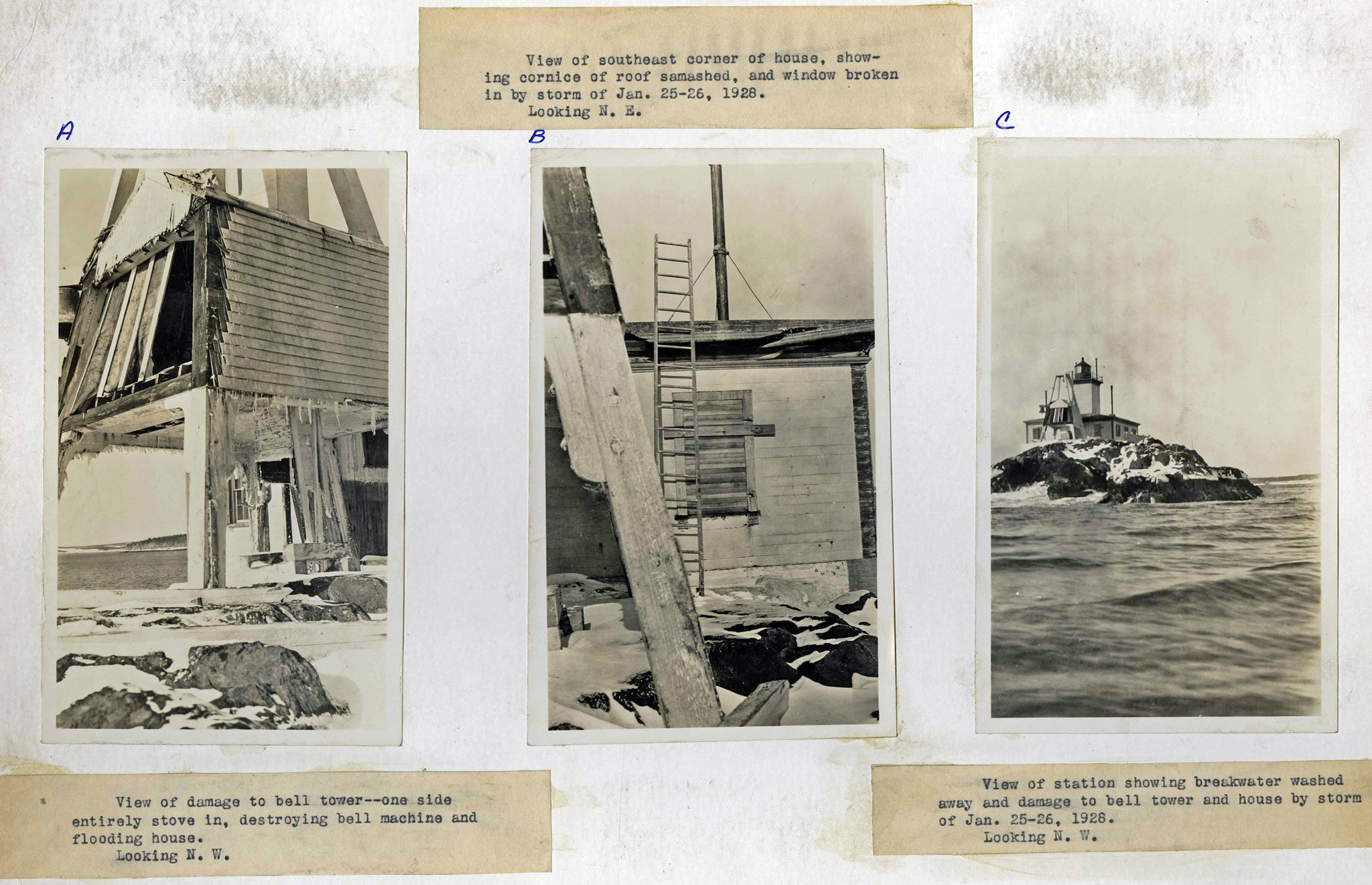
The worst recorded ordeal in the station’s history came in January 1928 during Keeper Pettegrow’s service, when a three-day storm nearly destroyed the lighthouse. Pettegrow later described how waves smashed through shuttered windows, flooded the house, twisted iron bedsteads, and forced him to bore holes in the floors to drain water. The fog bell hammer jammed, and he spent a night nudging it by hand so the signal would continue. “We saved the light out of the wreck,” he said afterward.
Despite this experience, Keeper Pettegrow remained at the lighthouse longer than any other keeper, leaving only when the light was automated in 1934. His transfer to take charge of Petit Manan Lighthouse ended more than half a century of family life on the rock.
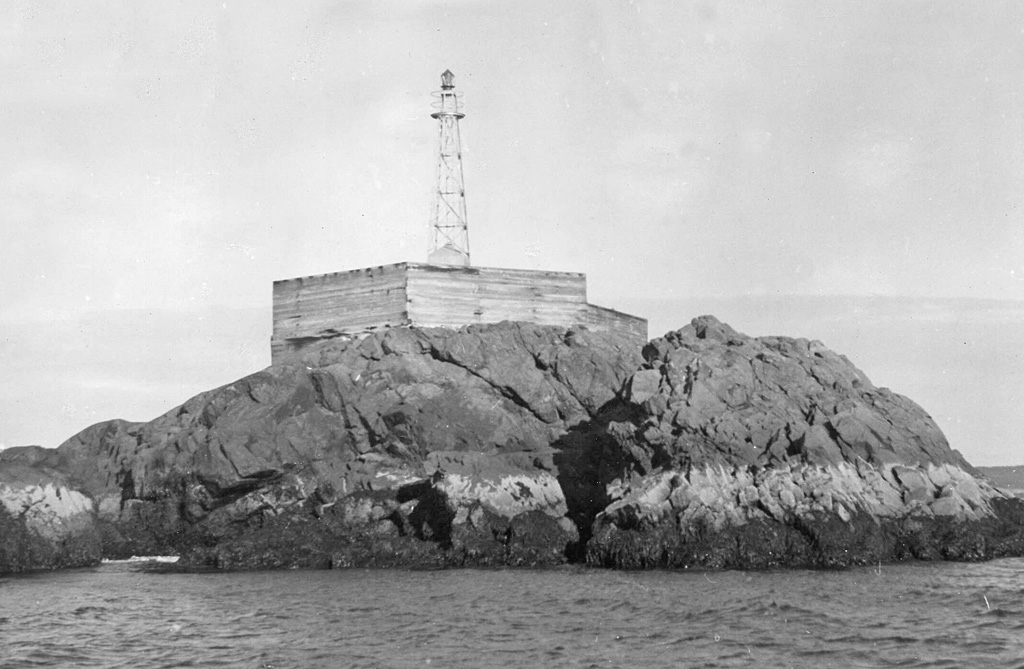
Despite regular maintenance, the station’s lack of resident keeper and its exposure gradually took their toll. In 1946, the Coast Guard concluded that the structures had “deteriorated beyond reasonable repair.” The old brick dwelling, tower, boathouse, oil house, privy, and fog bell frame were offered for sale in 1947 with the requirement that the successful bidder had to remove the structures, including their foundations, and leave Avery Rock in “a tidy condition.” When no buyer came forward, the Coast Guard erected a new steel skeleton tower where the fog bell tower had stood and demolished the other structures. The new 3,000-candlepower light commenced operation on October 7, 1947 at an elevation of fifty-two feet above the sea.
Keepers: Charles F. Chase (1875 – 1880), Thomas E. Dodge (1880 – 1883), Joseph M. Gordon (1883), John W. Guptill (1883 – 1890), John Connors (1890 – 1894), Warren A. Murch (1894 – 1899), John W. Guptill (1899), Edward T. Spurling (1899 – 1900), John B. Thurston (1900 – 1902), Herbert P. Richardson (1902), Walden B. Hodgkins (1902 – 1903), Josiah G. Larrabee (1903 – 1907), Leroy L. Myers (1907 – 1913), Charles W. Allen (1913 – 1919), Earle R. Mitchell (1919 – 1922), James W. Doran (1922), Elson L. Small (1922 – 1926), Vassar L. Quimby (1926), Edwin A. Pettegrow (1926 – 1934).
References