Castle Pinckney, SC 
Select a photograph to view a photo gallery
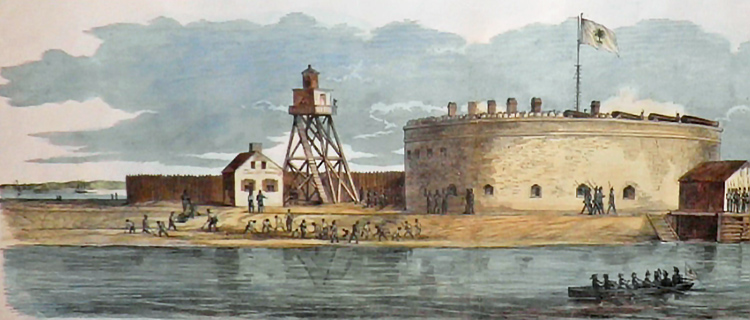
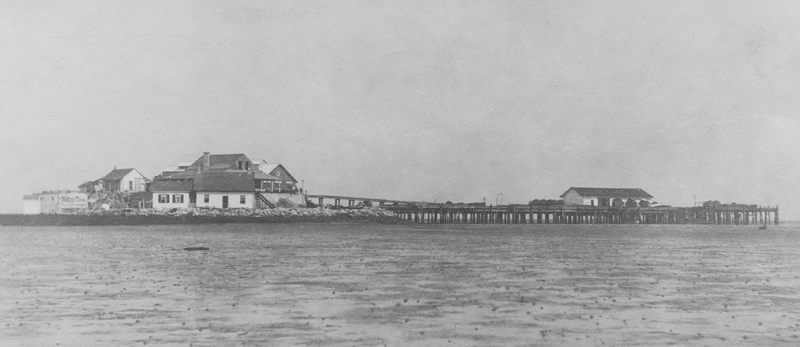
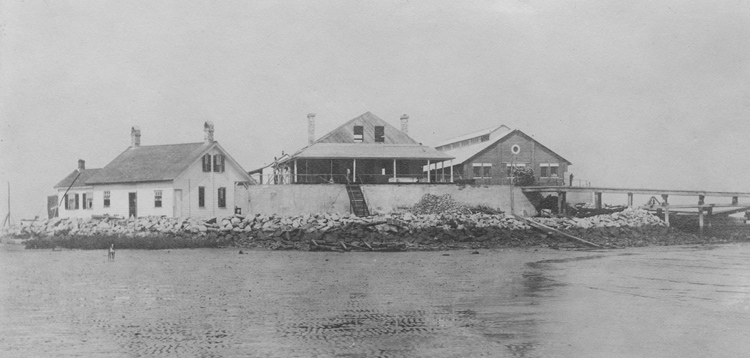
Photo Gallery
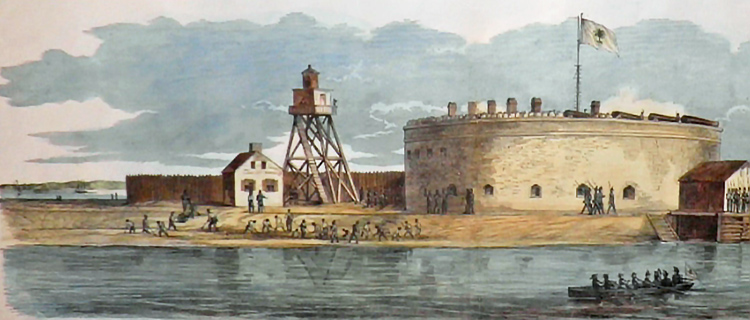
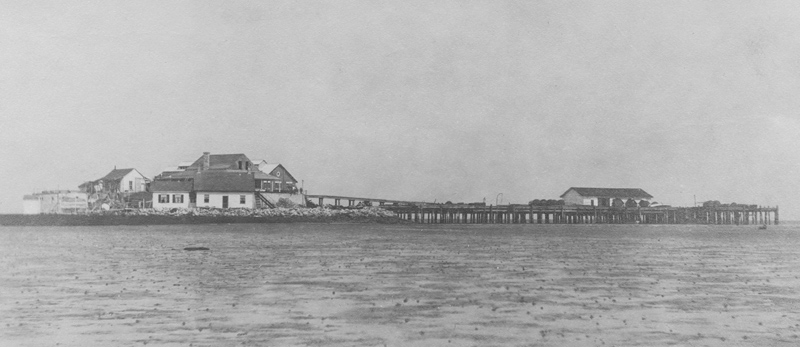
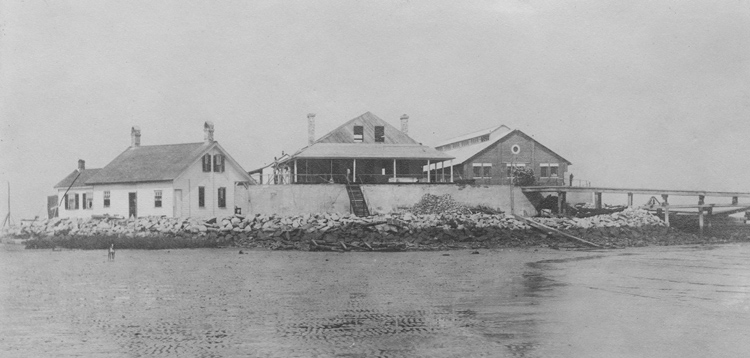
Photo Gallery
Photo Gallery
Rising from the shallow waters of Charleston Harbor on what was once known as Shute’s Folly Island, Castle Pinckney has lived several lives. First conceived as a defensive bulwark, later repurposed as a navigational beacon, and finally transformed into a vital supply depot for the Lighthouse Service, the small masonry fort has long stood at the crossroads of war, commerce, and maritime safety. Though today it is a quiet ruin, its walls once echoed with cannon fire, keeper’s footsteps, and the crash of hurricane waves.
Castle Pinckney was built as part of the United States’ coastal fortifications, upon the site of an older log and earthen fortification called Fort Pinckney. Construction began in 1809 and continued intermittently until about 1811, using brick and palmetto-log foundations to stabilize the structure on its marshy island base. The fort was named for Charles Cotesworth Pinckney, a South Carolina statesman, Revolutionary War veteran, and one of the state’s most prominent Federalist leaders.
Designed as a circular masonry fort with embrasures for cannon, Castle Pinckney was intended to protect the inner harbor approaches to Charleston, complementing other fortifications such as Fort Moultrie and, later, Fort Sumter. Although it saw little action in the War of 1812, it remained part of the city’s harbor defenses for decades.
By the time of the Civil War, Castle Pinckney had become a strategic prize. In December 1860, South Carolina forces seized it following the state’s secession. The fort was later used by Confederate authorities as a military prison, holding Union soldiers and political detainees. After the war, it was returned to federal control, but its military value was largely spent. Advances in artillery and the construction of newer fortifications rendered the small brick fort obsolete. Yet its prominent location in the harbor would soon give it a new purpose.
On August 3, 1854, Congress appropriated $1,500 for the construction of a small light at Castle Pinckney “to mark the channels from the bar to the city and up the Cooper River.” This light was part of a coordinated system for Charleston Harbor, which included a new lighthouse at Fort Sumter.
By 1856, both lights had been completed and prepared for service. According to the Charleston Daily Courier of May 20, 1856, the Castle Pinckney beacon was described as:
A fixed red light… exhibited for the first time on the evening of the 17th May, 1856, on Shute’s Folly Island, Charleston harbor… placed in a lantern on top of an open wooden frame 18 feet square at bottom, and 10 at top… situated 100 feet to the northwest of Castle Pinckney… The arc of illumination is 350°, and the height at the light 50 feet above low water.
The structure was painted yellow, with a dark brown cylindrical section beneath the lantern. The light used a fifth-order Fresnel lens—the same order installed at Fort Sumter—though it emitted a fixed red beam.
The Charleston Mercury of May 17, 1856, explained that the lighting had been delayed because the manufacturer in France failed to ship the Castle Pinckney lens on time. The structure itself had been nearly complete for a year.
The first keeper, Gilbert Dudley, was appointed on April 24, 1856, but served only until July of that year, when he was replaced by James Skillin. Both men earned an annual salary of $400. Skillin remained in charge until the outbreak of the Civil War in 1861, when the light was extinguished.
In 1865, after the war, temporary structures with steamer lenses were erected at both Fort Sumter and Castle Pinckney. The following year, these makeshift towers were replaced by more permanent framed structures carrying fifth-order lanterns. By 1867, Fort Sumter, Castle Pinckney, and Battery Beacon were all reported to be in good condition.
Keeper Skillin returned in 1865 and served until 1875, making him the longest-serving keeper in the station’s history.
By the 1870s, the wooden beacon at Castle Pinckney was deteriorating. In 1874, it was described as a “wood framed pyramidal beacon, 36 feet high to the focal plane,” built in 1866 and last repaired in 1872, but now “mostly rotten” and in need of rebuilding.
An appropriation of $2,000 was made in 1875 to rebuild the beacon after hurricane damage, but plans changed. With the proposed construction of Fort Ripley Shoal Light, Castle Pinckney’s light was deemed unnecessary. On December 1, 1878, the light was officially discontinued.
|
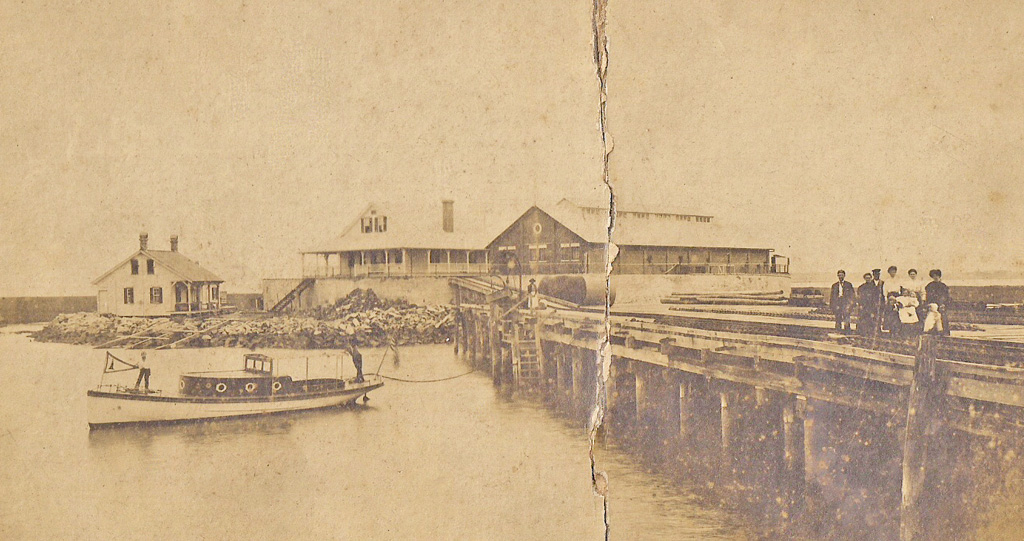
On March 3, 1879, Congress appropriated $10,000 to establish a depot for buoys and lighthouse supplies at Castle Pinckney. A new wharf was constructed in 1880, followed in 1881 by a custodian’s dwelling, a storehouse, and an enlarged wharf.
The depot became a critical hub for the Sixth Lighthouse District, storing buoys, anchors, chains, and supplies for distribution to light-stations throughout the region.
Disaster struck on August 26–27, 1893, when a powerful cyclone devastated Charleston Harbor. Castle Pinckney Depot was wrecked. The inspector and engineer reported that the storm undermined the storehouse, tore off its weather-boarding, scattered its contents, and damaged the 60-by-200-foot wharf so severely that anchors and buoys fell into the water.
The keeper’s dwelling was nearly swept away. Boats stored on land were washed off the island. The depot’s destruction came at the worst possible moment, as many lights and buoys had also been damaged by the storm, creating an urgent demand for supplies.
A newspaper account described the ordeal of Captain James W. Whiteley, his wife, and their ten children, who sheltered behind the fort as waves broke over them. Despite the devastation, Whiteley and his family remained, “holding the fort.”
Whiteley served as keeper of the depot from 1880 until his death in 1907. He was succeeded by Iver Larsen, who remained until the depot’s relocation to Tradd Street in Charleston in 1916.
A new, more substantial depot was completed at Castle Pinckney in 1902, and stores were moved in. That same year, a midnight fire broke out in the oil house, but Keeper Whiteley and his family—assisted by a laborer and boatman—extinguished the blaze using a Babcock fire extinguisher, hand grenades, and water from a force pump.
Between 1908 and 1909, a new keeper’s dwelling was constructed at the depot. Iver Larsen and assistant depot keeper Joel Hammett were later commended for rescuing mariners during storms in 1914 and 1916.
Finally, under an act of October 22, 1913, funds were provided for a new district depot on the mainland. The new facility was occupied on August 1, 1916, and Castle Pinckney’s long service as a lighthouse depot came to an end.
From cannon fort to beacon of light to storm-battered supply depot, Castle Pinckney’s history mirrors the changing needs of Charleston Harbor. Though its military purpose faded, its strategic position ensured its continued relevance. For more than half a century, it quietly guided ships and supported the vast network of lights that safeguarded the southeastern coast. Today, its crumbling walls stand as a reminder that even the smallest island can play a central role in the life of a great port.