Dog Island, FL 
Select a photograph to view a photo gallery
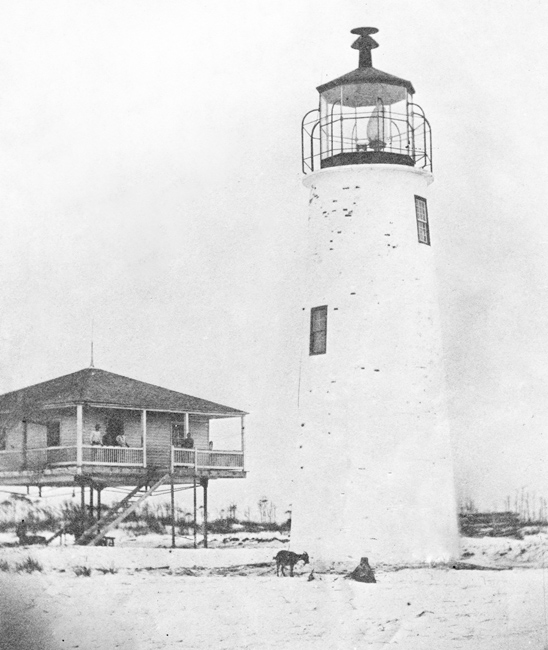
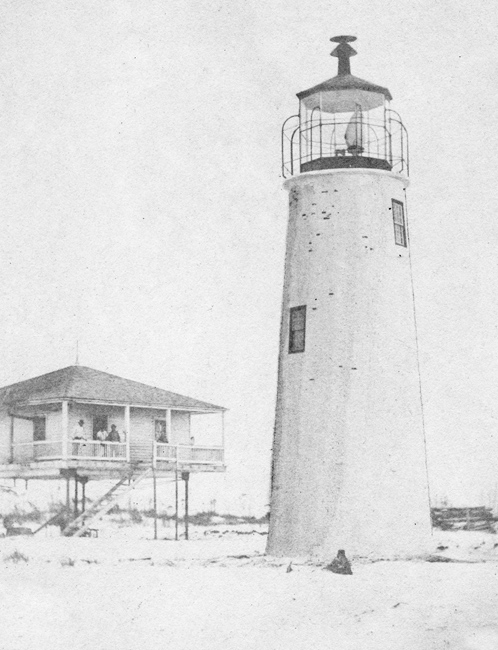
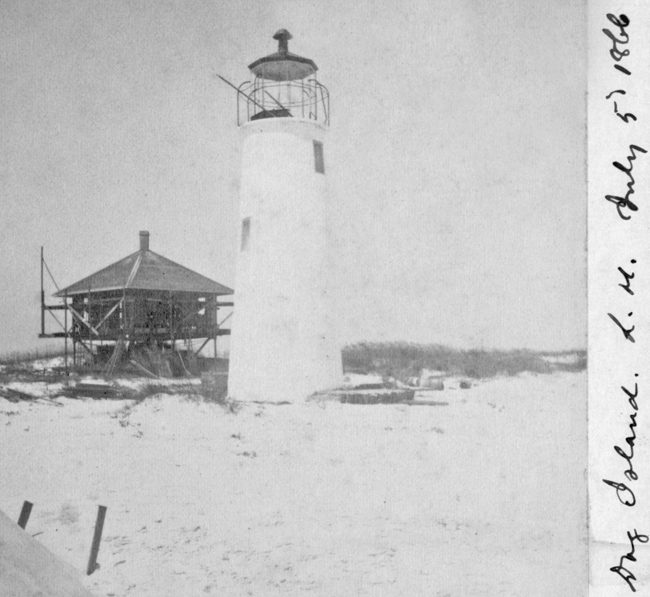
Photo Gallery
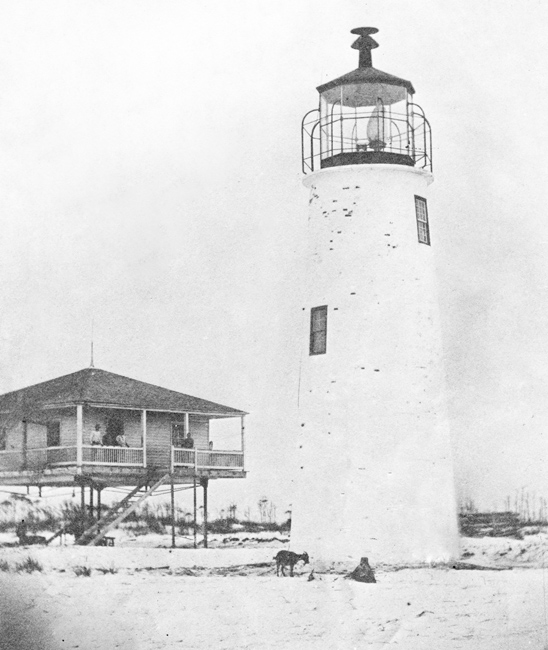
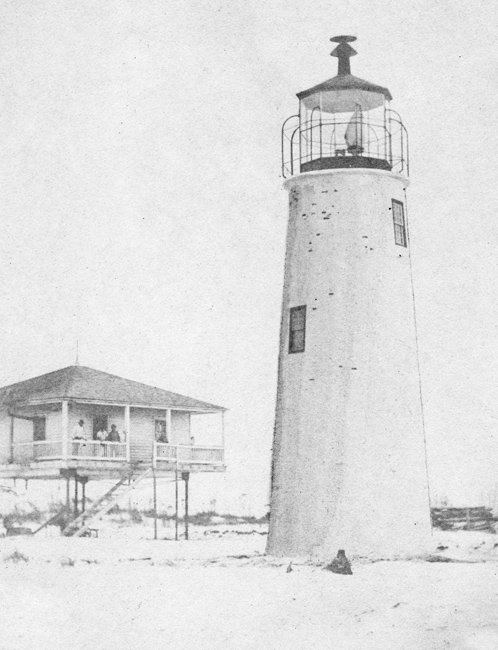
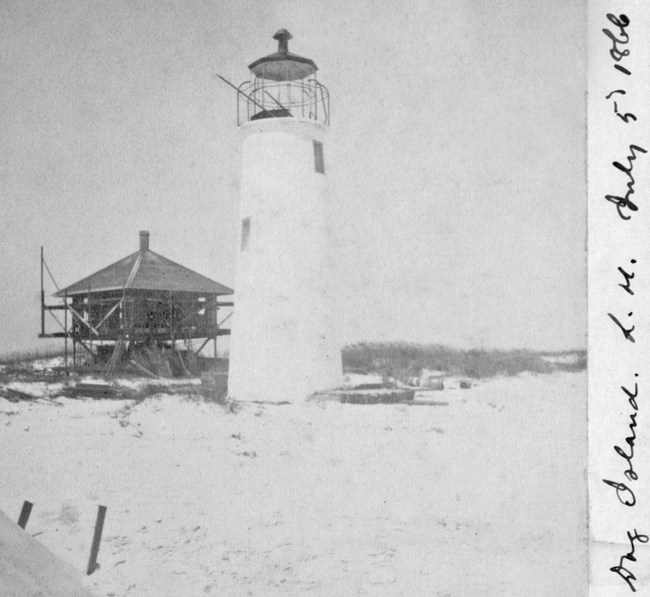
Photo Gallery
Photo Gallery
Dog Island Lighthouse stood at one of the most hazardous and changeable entrances on Florida’s Gulf Coast. Located on the eastern side of Middle Pass—between Dog Island and St. George Island—it guided vessels from the Gulf of Mexico into St. George Sound and the approaches to Apalachicola Bay. Though the pass itself was relatively young, appearing on charts only after the War of 1812, it quickly became vital to regional commerce. The lighthouse that guarded it would endure repeated destruction, reconstruction, and relocation, becoming one of the most storm-battered and impermanent light stations on the Gulf.
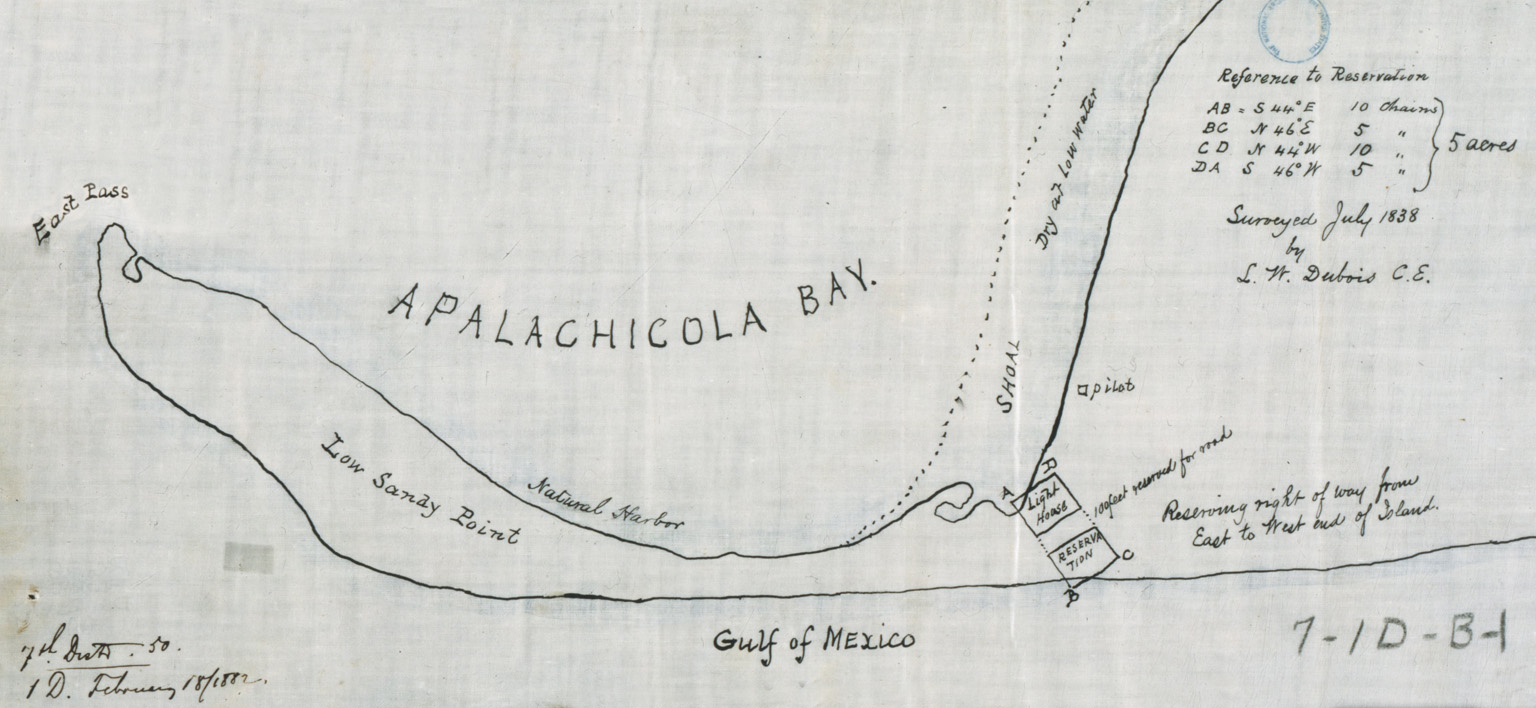
Congress first responded to appeals from local mariners and merchants with an appropriation of $10,000 on March 3, 1837, “for a lighthouse at or near the east entrance from the Gulf of Mexico into Apalachicola Bay.” The following year, on October 1, 1838, trustees of the Apalachicola Land Company deeded approximately five acres on Dog Island to the United States for lighthouse purposes, securing the site for construction.
|
Lewis completed a brick tower approximately fifty feet high, and the light was first exhibited on March 1, 1839, under keeper Jacob D. Myers. Because the fixed lights at nearby Cape St. George and St. Marks were so close, Dog Island was given a flashing characteristic—white flashes every three minutes—rather than a steady beam. During the day, Dog Island Lighthouse could be distinguished from its two neighboring lighthouses by a broad black band near its top.
The lighthouse served as a guide for deep-draft vessels entering a sheltered anchorage of nearly twenty feet, though navigation to Apalachicola itself remained blocked by the oyster bar known as the “Bulkhead.”
Almost immediately, the station revealed systemic weaknesses. In April 1840, Captain Howland, who supplied oil to Gulf Coast lights, reported that the new Dog Island Lighthouse was “almost as filthy as new,” with tarnished and smoked reflectors rendered nearly useless. The report astonished Treasury officials, as the lighthouse was barely a year old. Keeper Myers somehow managed to keep his job despite the obvious neglect.
Worse followed in October 1842. A severe gale on October 5 undermined the tower’s foundation. A large section of the brickwork collapsed, the remainder cracked extensively, and the structure leaned nearly eighteen inches eastward. The keeper’s dwelling, cistern, and associated buildings were completely destroyed.
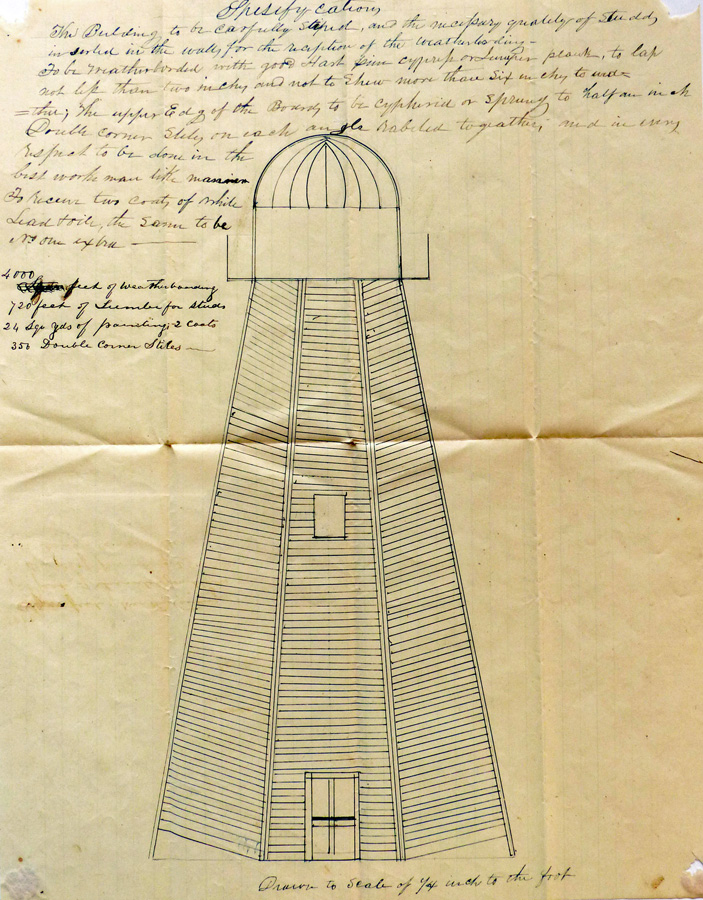
Pleasonton expressed shock that a brick lighthouse only four years old could suffer such damage, but soon accepted that erosion and undermining—rather than faulty masonry—were the principal causes. Although Winslow Lewis offered to rebuild the lighthouse and dwelling for $7,000, the Treasury rejected the proposal as too costly. Pleasonton instead determined that a wooden structure would be cheaper, quicker to erect, and capable of relocation if threatened by the sea.
|
The frame tower proved no more durable than its predecessor. A massive hurricane in August 1851 devastated the Gulf Coast, flattening Dog Island Lighthouse and damaging the keeper’s dwelling. Contemporary newspaper accounts reported extensive destruction in Apalachicola and the tragic loss of eight lives, including two children of Samuel Bray, keeper of Dog Island Lighthouse.
By December 1851, new contracts were authorized for replacement lighthouses at Dog Island and Cape St. George. A third Dog Island Lighthouse—a brick tower forty feet tall—was completed by Charles Emerson in 1852, and by 1856 it was equipped with a fourth-order Fresnel lens, changing its characteristic to a white flash every sixty seconds. A new, twenty-five-foot-square keeper’s dwelling, resting on five wrought-iron piles screwed eight feet into the sand, was finished in 1855. A stratum of concrete was also placed around the base of the tower to prevent undermining by wind and water.
The outbreak of the Civil War brought further hardship. In 1861, Confederate authorities removed and safeguarded federal lighthouse property, and shortly thereafter Union sailors occupied Dog Island. The station was vandalized: lantern glass was shot out, portions of the dwelling and stairway were burned, and the lighthouse grounds were used as a recreational retreat for blockade sailors.
By 1866, inspectors reported extensive damage. The keeper’s dwelling had burned, the lantern bore shot holes, and parts of the stairway were destroyed. Nevertheless, the light was re-exhibited on August 4, 1866, using a newly installed fourth-order lens.
Despite repeated repairs, the fundamental problem at Dog Island remained erosion. By 1868, engineers warned that the lighthouse stood on a low, exposed spit and would inevitably be washed away. A new keeper’s dwelling on iron screw piles was erected on higher ground to afford secure refuge to the keepers and their families should the tower be lost.
By 1872, the tower leaned nearly a foot out of plumb despite attempts to stabilize it by encircling its base with a triple row of piles and concrete. Engineers soon concluded that further repairs were futile. Instead, the lantern and lens were transferred to the roof of the keeper’s dwelling, and the old tower was left standing, stripped of its equipment.
A formal Notice to Mariners issued in January 1873 announced the change. The light—still fourth order, fixed with white flashes every sixty seconds—now shone from 45 feet above mean tide, supported by a white dwelling on five black iron screw piles located thirty yards from the masonry tower.
The temporary solution proved short-lived. In September 1873, a hurricane swept away both the abandoned brick tower and the keeper’s dwelling, extinguishing the light entirely. The keeper and his wife managed to survive by seeking refuge on a neighboring sand bluff according to a newspaper account of the storm. Although Congress appropriated $20,000 in 1874 for reconstruction, maritime traffic through Middle Pass had declined sharply, and the funds were never used. By 1875, officials recommended indefinite postponement of any rebuilding.
Dog Island Lighthouse was never re-established. The changing channels of St. George Sound, combined with the collapse of postwar cotton trade, rendered the station obsolete. Navigation through the pass was eventually served by a new mainland light erected west of the mouth of Crooked River in 1895.