Choctaw Point, AL 
Select a photograph to view a photo gallery
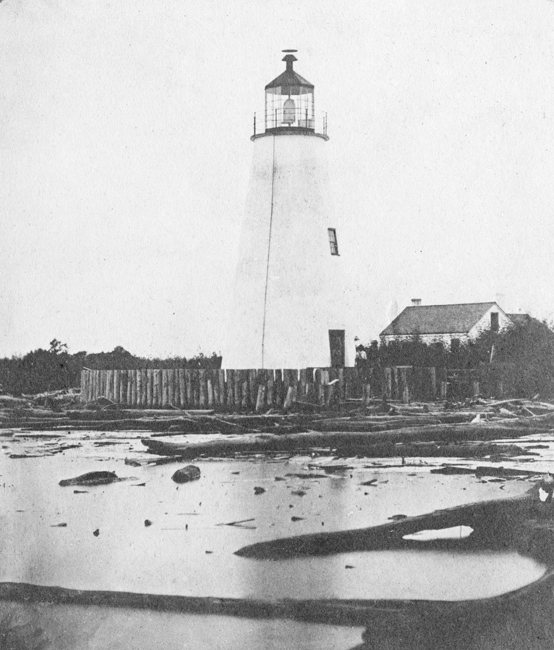
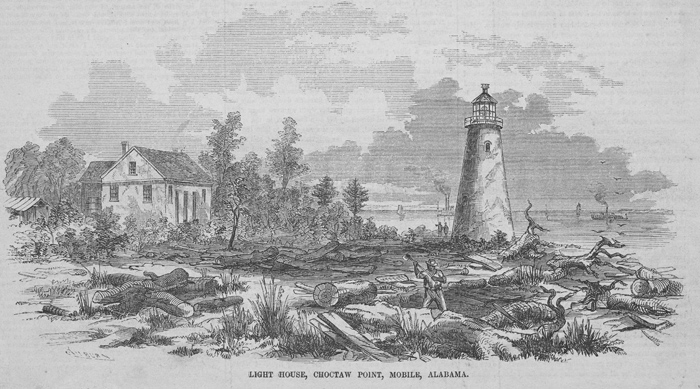
Photo Gallery
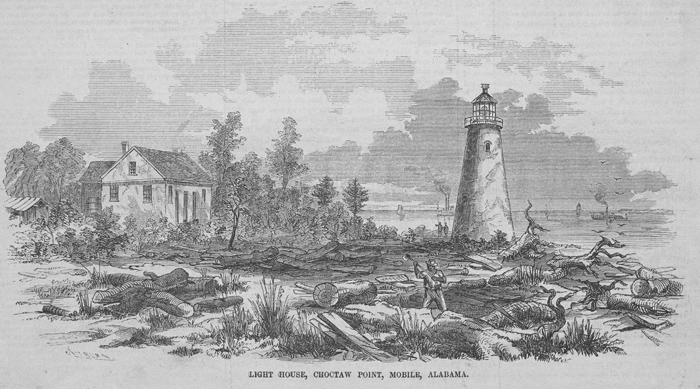
Photo Gallery
Photo Gallery
In the early decades of the nineteenth century, the young United States was rapidly expanding its trade networks along the Gulf Coast. A critical focus was Mobile Bay—the sweeping, shallow estuary where the Mobile River meets the Gulf of Mexico. This confluence formed one of the region’s most vital commercial gateways, carrying cotton, lumber, and other staples from the interior to global markets. However, its shifting channels, shallow bars, and tidal influences made navigation treacherous, especially for the larger vessels entering or leaving Mobile Harbor.
Recognizing the growing importance of this port, Congress on May 23, 1828, passed an act empowering the Treasury Department to build a lighthouse at or near Choctaw Point in Mobile Bay, appropriating $6,500 for its construction. This special legislative authorization reflected both the economic promise of Mobile and the navigational challenges posed by its waters.
|
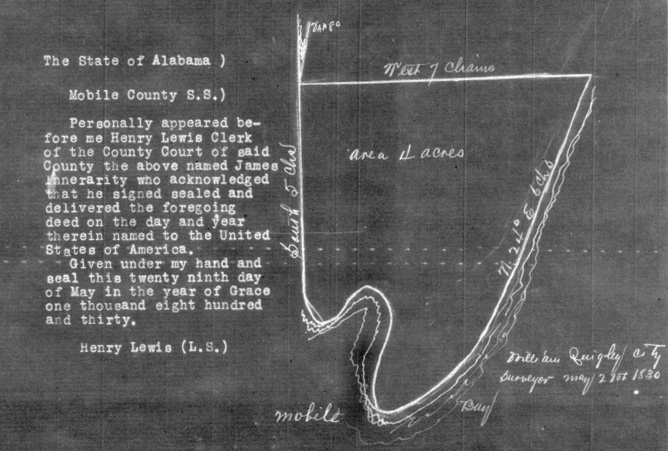
On May 29, 1830, local landholder James Innerarity sold four acres at Choctaw Point to the United States for $800 to accommodate the new lighthouse station. This parcel was part of a larger real estate holding once tied to the influential firm “John Forbes & Co.” and situated on the west shore where the bay broadens just before the entrance of the Mobile River—the strategic but difficult intersection of inland and maritime trade routes.
Stephen Pleasonton, the U.S. Treasury Department’s Fifth Auditor, engaged in careful oversight of the project, as shown in correspondence from July 1830. Initially, bids for the lighthouse exceeded the government’s appropriation, prompting officials to negotiate revised terms with the contractor Winslow Lewis, a prominent federal lighthouse builder of the era. Lewis agreed to construct the brick tower and keeper’s dwelling without a cellar for the original $6,500 allocation, with a deadline of December 31, 1830.
Work progressed through the latter part of 1830, and in January 1831, Choctaw Point Lighthouse was formally first lit, its lantern casting a guiding glow over the shallow waters. Standing approximately forty feet tall, the circular brick tower held its eleven lamps, set in fourteen-inch reflectors, above the bay, intended to help vessels steer toward the mouth of the Mobile River and away from shoals that could strand even able seamen.
Yet, from virtually the moment it began operation, the lighthouse faced serious obstacles. Although Choctaw Point marked a geographic landmark at the confluence of bay and river, the channels ships actually used were narrow, shifting, and often poorly aligned with the light’s position. Mariners frequently could not see the Choctaw Point beacon until they had already entered shallow water, limiting its usefulness as a navigational aid. Many continued to anchor in deeper waters well inside the bay, relying on local knowledge of stakes and buoys to guide them to Mobile.
Throughout the 1830s and 1840s, Choctaw Point Lighthouse suffered from neglect and structural issues. An inspector in 1834 noted that Sterling Thrower, the light’s first keeper, had left the station in disrepair and failed to present himself for inspection, resulting in his removal from the role. Meanwhile, mariners continued to question the utility of the location, and official surveys recommended abandoning the light in favor of better-placed beacons along improved channels leading up Mobile Bay.
Despite these critiques, the station persisted. Routine maintenance and occasional renovations were carried out. In 1854, federal records note that the tower had been whitewashed and its cistern renewed. In 1856, Congress appropriated an additional $2,000 for repairs and for enlarging and fencing the grounds, followed by thorough repairs in 1858. Yet, the underlying problem—its poor alignment with navigable waters—rarely improved.
The summer of 1852 brought a stark reminder of nature’s power to the entire Mobile Bay region. The Great Mobile Hurricane of August 1852 made landfall in the northern Gulf and drove sustained winds and storm surge into the bay. Mobile city streets were inundated with ten to twelve feet of water, and heavy winds flattened buildings and infrastructure. Carmelite Philibert was in charge of Choctaw Point Lighthouse at the time, having replaced her husband as keeper upon his death in 1842. Carmelite’s daughter, son-in-law, two grandchildren, Oscar Philibert, and a “negro boy” were at the lighthouse when the hurricane struck.
The keeper’s dwelling collapsed under the stress of the storm. Carmelite and her two grandchildren, aged five and seven, procured a raft and were driven about by the winds for some time before being washed off and drowned. Carmelite’s daughter and son-in-law were rescued from a floating log. A newspaper account of the tragedy stated that Oscar and the negro boy doubtlessly drowned, bringing the death toll at Choctaw Point to five.
As the decade closed, officials recognized that recurring damage and the reality of shifting channels meant the original masonry structure would never be effective. After extensive repairs at Choctaw Point in 1860, the Lighthouse Board believed that nothing but a screwpile lighthouse built in a more advantageous position would do, and funds for its construction were requested.
The outbreak of the American Civil War interrupted these plans.
With the onset of secession, the Confederate government took control of coastal defenses and navigation aids. On November 3, 1862, Confederate forces extinguished Choctaw Point Light to deny its use by the Union Navy and blockading squadrons—a common wartime practice. Obstructions were placed in the channel, and local pilots used distinctive beacons understood only to them. The second female keeper and final keeper of the lighthouse was Elizabeth Michold, who had been appointed around the time Alabama joined the Confederacy.
After the war, federal lighthouse officials reported in 1867 that changes in the channel at the entrance to the Mobile River—made worse by wartime obstructions—had rendered the old Choctaw Point site unsuitable without the addition of new range lights. It was understood that the light, as once placed, could no longer reliably guide ships into the altered waterways. By 1869, plans were underway to re-establish the station on Battery Gladden Island, a location closer to the actual ship channel and better aligned with navigational needs.
In 1898, the Lighthouse Board recommended that Choctaw Point, “formerly the site of a lighthouse, but…at present unoccupied”, be used as a depot for general service and in connection with the numerous aids to navigation in Mobile Bay. Choctaw Point thus became home to a buoy depot and later a Coast Guard rescue and aids-to-navigation base. A sprawling container terminal now occupies the site.