Merrill’s Shell Bank, MS 
Select a photograph to view a photo gallery
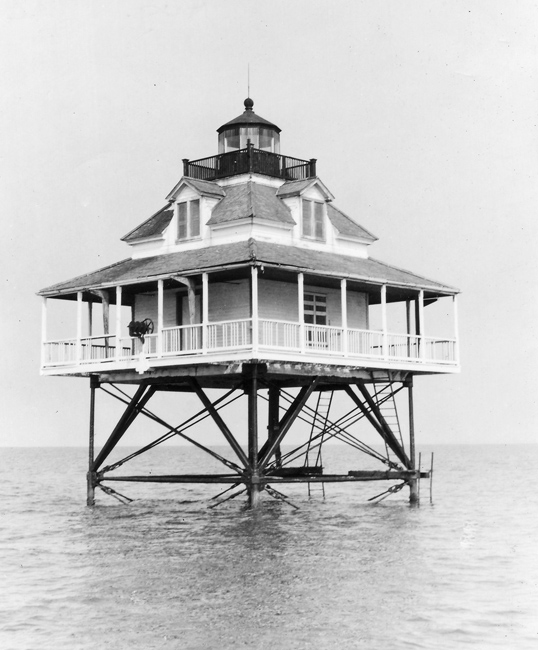
Photo Gallery
Photo Gallery
Photo Gallery
As early as the 1820s, federal inspectors recognized the need for a navigational aid marking the western approaches of Mississippi Sound. Merrill’s Shell Bank itself was a dynamic formation, composed of broken clam shells continually rearranged by tides and gales. George B. Bowditch described it in the 1840s as an oblong reef rising only a few feet above water and changing shape with every storm. Bowditch doubted that any permanent masonry structure could survive there, recommending instead a floating light-vessel anchored at the north end of the bank, protected by surrounding islands and shoals.
Despite these warnings, Congress formally authorized a lighthouse on Merrill’s Shell Bank on March 3, 1847, appropriating $12,000. The authorization reflected the increasing volume of commerce moving through the Sound and the inadequacy of buoys alone to mark the hazardous shoal. Engineering assessments soon confirmed Bowditch’s concerns: the unstable shell foundation could not support a traditional tower. As a result, the funds were applied instead to the establishment of a light-vessel, an approach that aligned with earlier proposals and could be implemented more quickly.
America’s first iron lightship was soon anchored on the bank, marking Pass Marianne—named for Marianne l’Andier, a sibling of Pass Christian’s namesake. While effective, the light-vessel was costly to maintain, vulnerable to storms, and less reliable than a fixed structure.
By the mid-1850s, advances in coastal engineering offered a solution. The Lighthouse Board, increasingly confident in iron screw-pile foundations for shallow waters, proposed replacing many Gulf Coast light-vessels with permanent structures. In 1857, the Board reported that the Merrill’s Shell Bank light-vessel occupied a vital position on major steamer and sailing routes but was aging rapidly and required frequent repairs. It argued that replacing the vessel with a small screw-pile lighthouse would be both more reliable and more economical, estimating the cost at approximately $12,000.
Although initial funding was delayed, the Board ultimately received authority in 1859 to replace shallow-water light-vessels throughout the Gulf. Merrill’s Shell Bank was among the first to benefit. In 1860, a screw-pile lighthouse was erected on the shoal, directly marking the position formerly occupied by the light-vessel.
Official notice from the Lighthouse Board dated July 9, 1860, described the new structure in detail. The foundation consisted of iron screw piles arranged in a square plan, supporting a wooden superstructure with an iron lantern centered above. The focal plane stood approximately forty-five feet above mean sea level. The lighthouse was equipped with a fourth-order Fresnel lens showing a fixed white light, visible from about eleven nautical miles under ordinary conditions.
The light was first exhibited at sundown on August 10, 1860. On that same day, the Merrill Shell Bank light-vessel was removed and never replaced. The station became part of a broader modernization effort that year, joining other newly established screw-pile lights across the nation.
The outbreak of the Civil War soon disrupted operations. Confederate authorities removed the fourth-order lens in 1861, and the station’s role diminished during the conflict. Nevertheless, Union engineers later found the structure in “measurably good condition.” In 1862, at the urging of General Benjamin Butler, a temporary sixth-order lens was installed, allowing the light to be re-exhibited.
The wartime years were marked by tension and controversy. In 1863, keeper James Burroughs was arrested for supplying Confederate forces, having cached nearly a quarter ton of bacon at the station. His assistant was dismissed for chronic intoxication. Despite these incidents, repairs were made, and by 1866 the original fourth-order Fresnel lens—captured earlier at Bay St. Louis—was repaired and reinstalled, restoring the lighthouse to its intended strength, “the wants of navigation of the locality rendering the change advisable.”
By 1868, the station was reported to be in good condition. A year later, a fog-bell was installed, along with practical improvements such as a cooking stove and rope for hoisting boats, reflecting the Lighthouse Board’s growing attention to keeper safety and station self-sufficiency.
Throughout the 1870s, Merrill’s Shell Bank Lighthouse remained an essential aid to navigation. Repairs were made in 1871, and in 1878 a mechanically struck fog-bell was placed in operation, improving audibility during frequent periods of fog and low visibility in the Sound.
Life at the station was isolated and often harsh. Among the keepers was Henry Theodore Korner, who served from 1874 to 1881. Korner’s personal history reflected both the hardship and tragedy associated with lighthouse service. His family suffered lead poisoning from cistern-collected rainwater, and in 1875 his young daughter Hattie drowned at the station, her body washing ashore days later in Pass Christian. The emotional toll ultimately drove the family away.
In 1881, the station was painted throughout, woodwork repaired, and the iron piles scaled, scraped, and coated with coal tar. In 1882, mineral-oil lamps replaced earlier lighting equipment, placing the station in “fair order” by official assessment.
Fire proved to be the station’s greatest enemy. In June 1880, sparks from a stovepipe ignited the shingle roof, causing minor damage. Repairs were ordered, but the fundamental vulnerability remained.
On the morning of September 6, 1883, disaster struck. While keeper George Caldwell was ashore posting official returns, a spark again ignited the shingle roof. With no means to fight the fire and no escape except the surrounding water, Caldwell’s son was forced to leap into the Sound, clinging to a floating door until rescued by the tug Leo. The lighthouse burned completely, leaving only the iron screwpiles standing.
Recognizing the station’s importance, the Lighthouse Board moved swiftly. Within weeks, a new superstructure was erected on the existing piles, modeled after the Northwest Passage Lighthouse but modified to fit the foundation. The rebuilt lighthouse featured a fireproof slate roof, a 1,360-gallon cistern, and a Luckey boat hoister. The light was re-exhibited on November 20, 1883, only forty-four days after construction began. The station was reported complete and in good order, its design reflecting lessons learned from earlier fires.
Routine maintenance continued into the late nineteenth century. In 1892, ladders and gutters were renewed, and storm damage from October 1893 was repaired the following year. The lighthouse survived severe hurricanes in both 1893 and 1906, with water reportedly washing over the gallery fifteen feet above normal tide levels.
Among the most notable keepers of the later period was Captain Gustavus Foster, a veteran mariner and former Confederate naval officer who served at Merrill’s Shell Bank near the end of his career. In 1908, Foster died shortly after sustaining injuries in a fall at the lighthouse, underscoring the physical dangers of the profession even in peacetime.
In 1929, keeper Charles H. Carlson rendered assistance to two stranded mariners, towing their disabled skiff to Pass Christian—an act emblematic of the humanitarian role lighthouse keepers often played.
The lighthouse was automated in 1932, ending nearly a century of continuous keeper presence. In 1945, the original structure was demolished and replaced with a small tower mounted atop the existing foundation. Today, the site is marked by a modern aid to navigation, but the legacy of Merrill’s Shell Bank Lighthouse endures as a testament to engineering adaptation, maritime necessity, and the human stories bound to the shifting waters of the Mississippi Sound.
Keepers
References