Lake Borgne, MS 
Select a photograph to view a photo gallery
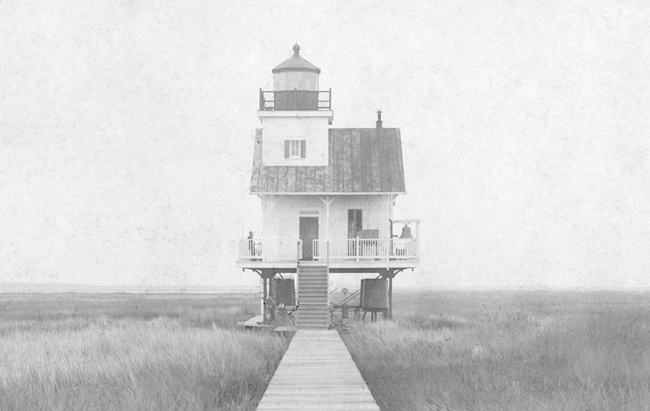
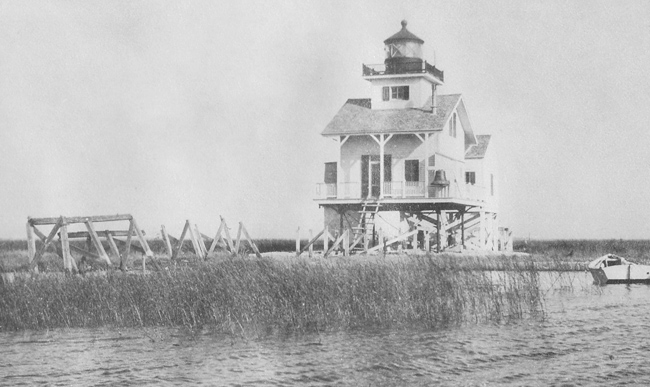
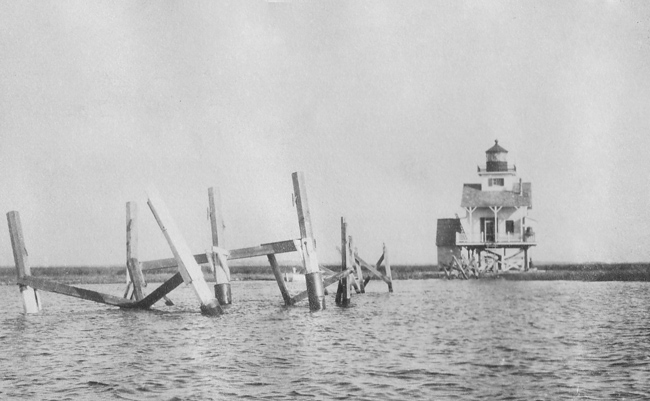
Photo Gallery
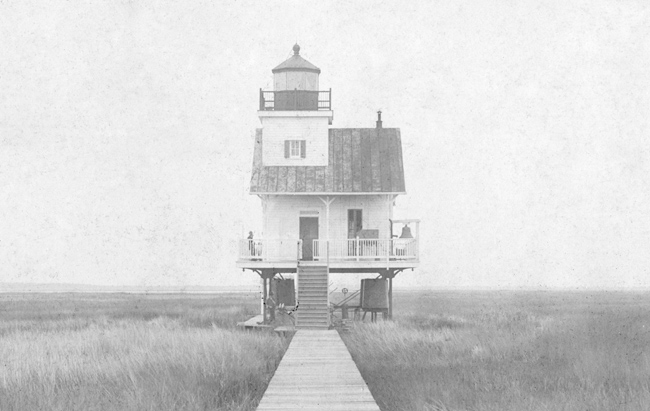
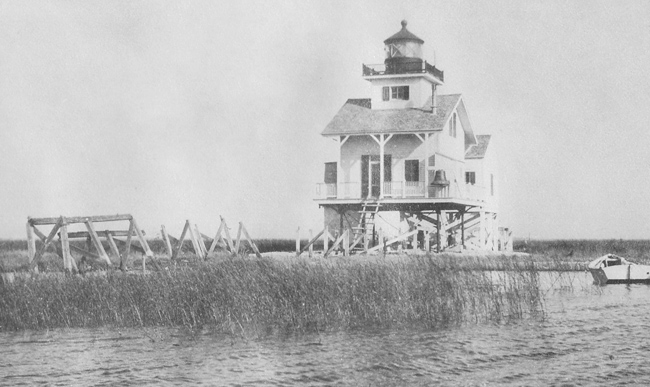
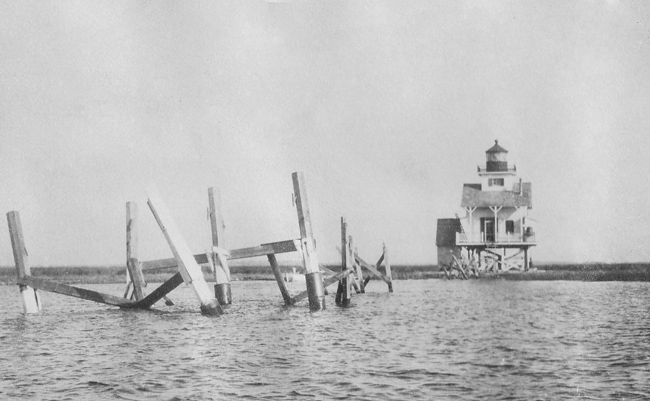
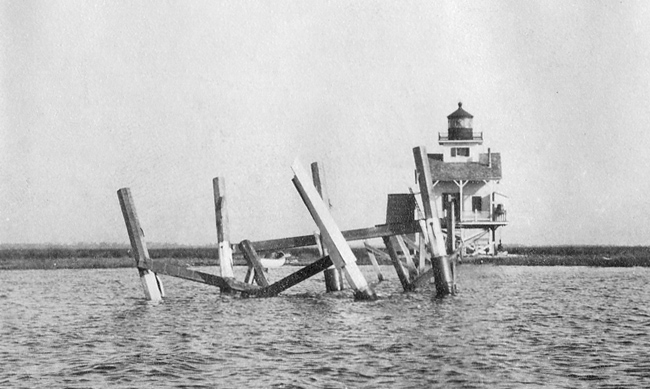
Photo Gallery
Photo Gallery
|
On March 30, 1888, Congress authorized $8,000 for a light and fog signal to guide vessels into Lake Borgne, Louisiana, in place of St. Joseph’s Island Lighthouse. The chosen site lay at the southern end of Lower Point Clear, in the Mississippi Sound, a broad marshland approximately 500 yards north of Grand Island Pass, the principal entrance into Lake Borgne. Though marshy and remote, the location offered superior alignment with the navigational channel and greater stability than the light on the exposed barrier island it replaced. An acre of land was purchased to accommodate the station.
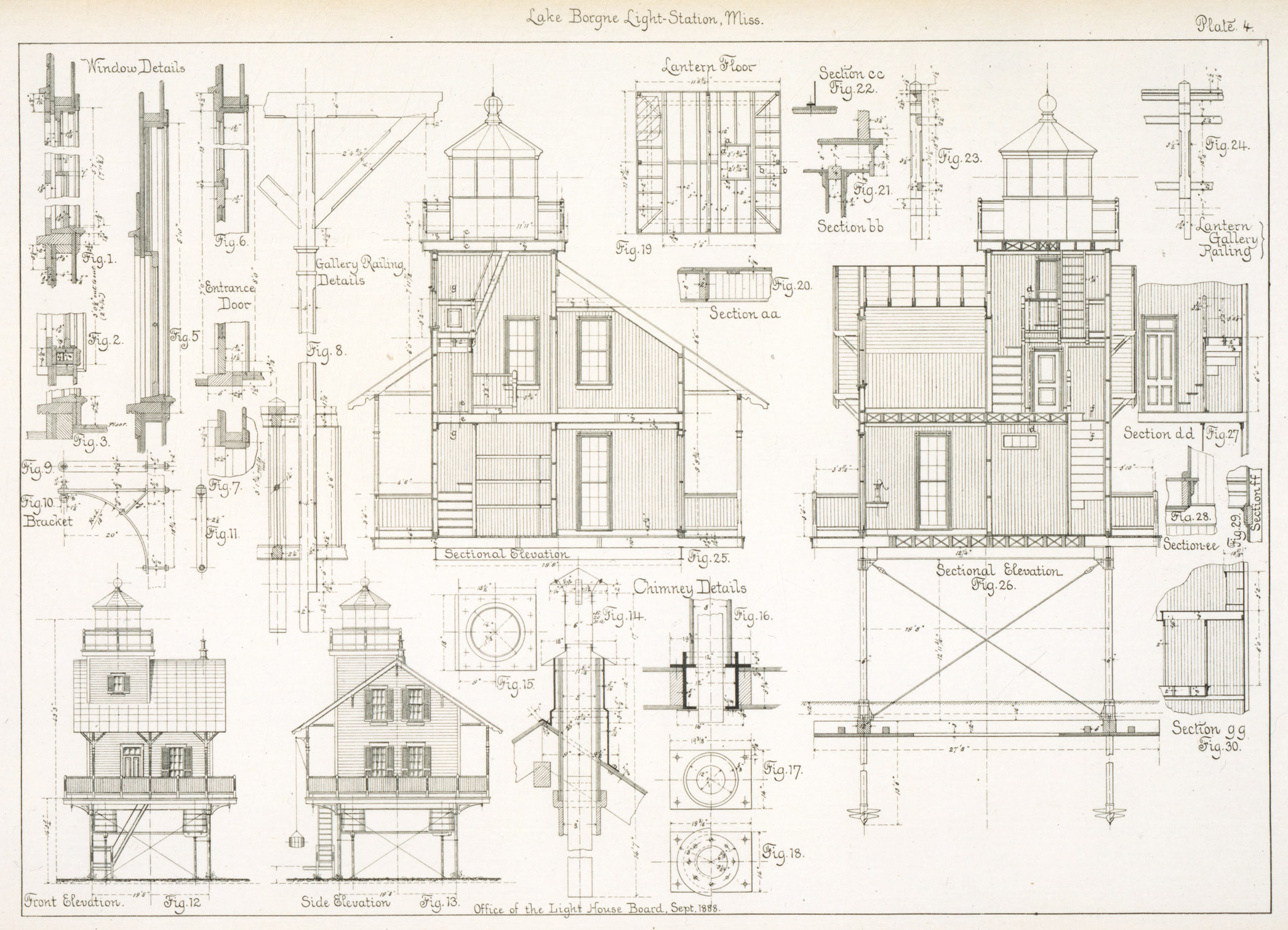
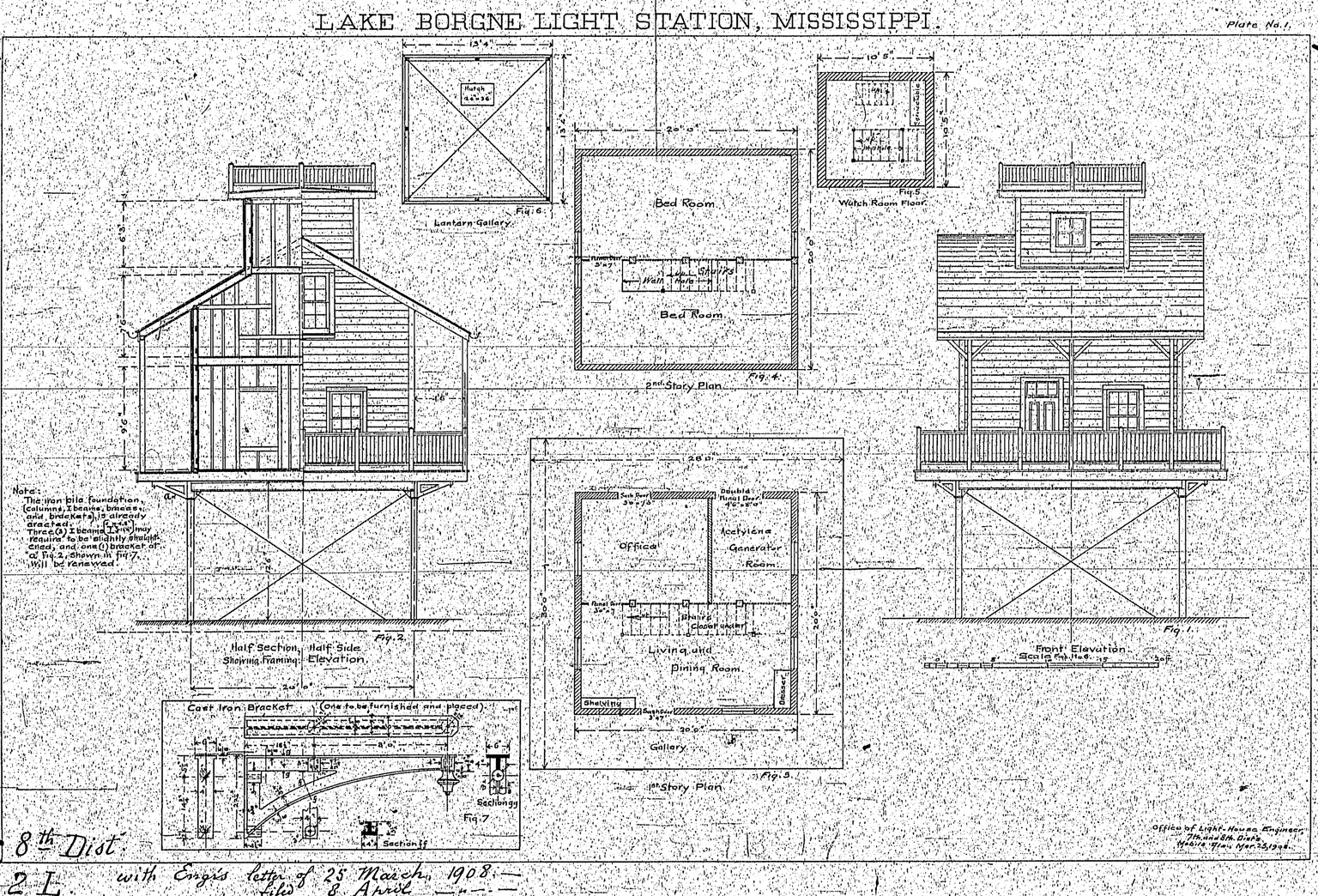
Construction began in 1889. By midyear, the foundation was complete and the frame of the building erected, with officials anticipating completion within two months. The design reflected the Lighthouse Board’s standardized approach to shallow-water Gulf stations: a screw-pile foundation supporting a square, seven-room wooden dwelling, elevated above the marsh to protect it from storm surge and tides.
On or about September 1, 1889, the light was officially exhibited, as announced in a Notice to Mariners. The station displayed a fixed white fifth-order light, illuminating 270 degrees of the horizon, from south-by-west through eastward to east-southeast. The focal plane stood approximately 42½ feet above mean low water, and the light was visible nearly 11¾ nautical miles in clear weather from a vessel’s deck.
The lantern, painted black, sat atop a short tower at the south end of the dwelling’s roof. The dwelling itself was painted white with green blinds and a brown roof, while the iron foundation piles and cisterns were also painted brown. A fog bell weighing 800 pounds, mounted on the gallery, was struck by Stevens clockwork machinery, initially sounding one blow every 30 seconds and later adjusted to one blow every 20 seconds during foggy conditions.
At the same time Lake Borgne Light was established, the light at St. Joseph’s Island was discontinued, though its dwelling was retained as a daymark. Locally, however, mariners continued to refer to the new station as “St. Joe Light” for decades.
Lake Borgne Lighthouse was almost immediately tested by the harsh Gulf environment. In October 1893, a powerful hurricane tore the tin roof from the dwelling, carrying it into the marsh where it was never recovered. The boathouse and wharf were destroyed, and the station required extensive repairs. Despite the damage, the light remained a vital aid to navigation and was promptly restored.
Throughout the late 1890s and early 1900s, the Lighthouse Service undertook continuous improvements. Platforms were built beneath the dwelling, foundations were cleaned and repainted, and wharves were rebuilt using creosoted piles. Walkways connecting the dwelling, boathouse, and bayou were lengthened and strengthened. New cisterns were constructed, oyster shells and earth were used to stabilize the surrounding marsh, and additional piles were driven beneath the wharf for reinforcement.
The human story of Lake Borgne Lighthouse is inseparable from the Munch family, particularly Mrs. Emma Munch, whose courage during the great August storm of 1901 became legendary within the Lighthouse Service. While her husband, keeper John A. Munch, and their eldest son were ashore and unable to return, Mrs. Munch remained at the station alone with two young children for three days during the storm.
As wind and water swept away steps and outbuildings, she worked tirelessly to save government property, domestic animals, and the light itself. She managed to move chickens, hogs, and even the family dog into the upper part of the dwelling before access was lost. Only after her husband returned and the danger had passed did she finally break down in tears. She was later described as “a brave and courageous woman,” and her actions exemplified the quiet heroism common among lighthouse families.
|
On the night of July 31, 1907, while Keeper John A. Munch was on the mainland, a fire broke out in the attic of the dwelling, ignited by overheated rafters near a defective stove flue. Mrs. Munch and her five children were asleep when dense smoke filled the bedrooms. She awakened the children and managed to evacuate them safely as the building burned. All personal belongings were lost, and both the light tower and keeper’s dwelling were completely destroyed.
From six miles away, Munch saw the reflection of the fire and rushed by boat to the station, finding his family safe near the boathouse. A temporary fixed white light was quickly rigged atop the boathouse to maintain navigation through Grand Island Pass. Notices to Mariners formally announced the destruction of the lighthouse and the establishment of the temporary light.
Congress responded promptly. On February 15, 1908, $7,000 was appropriated to rebuild the lighthouse, fog signal, wharf, and keeper’s quarters. Construction began on June 21, 1908, and the station was rebuilt by the end of September. Initially, the new structure displayed an acetylene lens lantern, a weaker light typically reserved for minor aids.
In 1911, a fifth-order circular iron lantern was installed, replacing the acetylene system with a traditional oil light. The project was completed in 1912 at a total cost of $6,899.49, bringing the station back to full operational status.
Tragedy struck again in January 1909, when Keeper Munch died of typhoid malaria at age forty, leaving Emma and six children. She briefly tended the light until Jacob M. Hansen was appointed keeper. The Munch legacy continued when John A. Munch, Jr., who had grown up at the station, entered the Lighthouse Service in 1912 and later served as head keeper of Lake Borgne Lighthouse from 1915 to 1918.
Lake Borgne Lighthouse continued to face hurricanes, notably in 1915, when Keeper Frederick A. Schrieber maintained the light under extreme conditions. Federal appropriations following the storms of 1916 allowed for rebuilding of the boathouses, wharf, and walks, completed by 1918.
In the 1930s, Keeper Sullivan R. White earned commendation for personally encasing creosoted piles between the dwelling and boathouse, completing the work over two years without outside assistance. He also rescued two shipwrecked sailors during a gale in July 1931, further underscoring the station’s role as both navigational aid and refuge.
George J. Fath replaced Sullivan White as keeper of Lake Borgne Lighthouse in late 1933. Just a few months later, fifty-six-year-old Keeper Fath applied for disability retirement. A physician with the U.S. Public Health Service examined the keeper and found him not disabled for useful and efficient service. After being advised of the findings, Keeper Fath immediately proceeded to his private physician who found he was physically unable to perform his duties due to a dilated heart. To settle the matter, Fath was sent to the Marine Hospital in Mobile, Alabama, where a physician found no disability.
When he was notified in April 1938 that Lake Borgne Lighthouse would shortly be discontinued and offered the position of keeper at Tchefuncte River Lighthouse, Keeper Fath advised the Superintendent of Lighthouses at New Orleans that he suffered from heart trouble and that his wife had to do most of the work at the station. Fath informed the Superintendent that “medical statistics show that the greatest death rate in the United States is from heart ailments.” Regardless, Keeper Fath had to pack up his belongings and relocate to another lighthouse.
When the Superintendent inspected Tchefuncte River Lighthouse in November 1938, he found that Mrs. Fath, who performed all the arduous tasks at the lighthouse, was under the influence of intoxicating liquor. The Superintendent informed Keeper Fath that if he was unable to control his wife’s actions or habits, she would need to reside elsewhere. Keeper Fath notified the Superintendent the following month that he would speak to his wife about her condition when the station was inspected and also perform all work at the station, regardless of his condition.
Realizing the situation at the lighthouse was problematic, the Superintendent directed Fath to again visit the Public Health Service to determine his physical condition. This time, a physician found him to be suffering from shortness of breath, swelling of ankles, and pain in heart on exertion and unfit to climb a fifty-foot lighthouse twice a day. Keeper Fath was finally allowed to retire on disability in April 1939.
After Lake Borgne Lighthouse was discontinued in 1938, the property fell into disrepair and was heavily vandalized. In 1950, the lighthouse reservation was sold at sealed bid as surplus property.
Though long gone, Lake Borgne Lighthouse remains an important chapter in Gulf Coast maritime history. Built to correct the failures of its predecessor, it served faithfully through storms, fires, and personal sacrifice. Lighthouse Bayou remains marked on charts, a quiet reminder of the light that once guided vessels safely through Grand Island Pass and into Lake Borgne.
Keepers: Frank Mart (1889 – 1890), Henry Wilkinson (1890 – 1892), John A. Munch (1892 – 1909), Emma P. Munch (1909), Jacob M. Hansen (1909 – 1913), Jacob Hansen (1913 – 1915), Joseph P. Hansen (1915), Frederick A. Schrieber (1915), John A. Munch (1915 – 1918), Leonidas B. Charlton (1918 – 1925), Joseph F. Stark (1925), John Lettich (1925), James R. Linton (1925), Sullivan R. White (1925 – 1933), George J. Fath (1933 – 1938).
References