Frank’s Island, LA 
Select a photograph to view a photo gallery
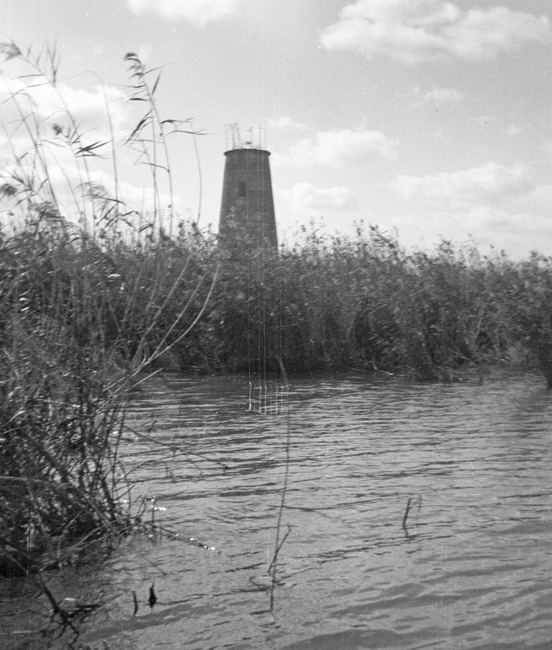
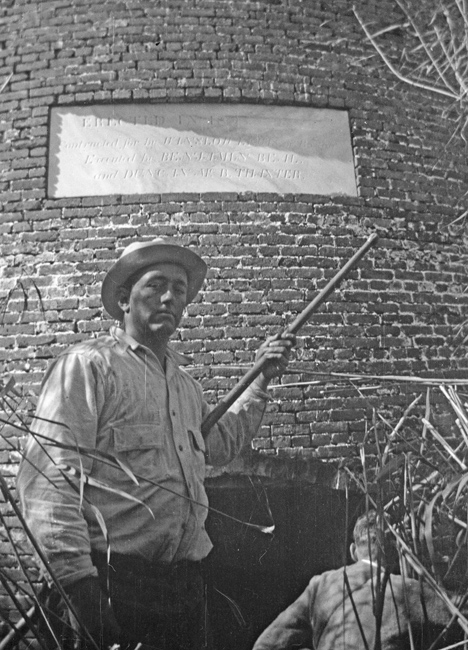
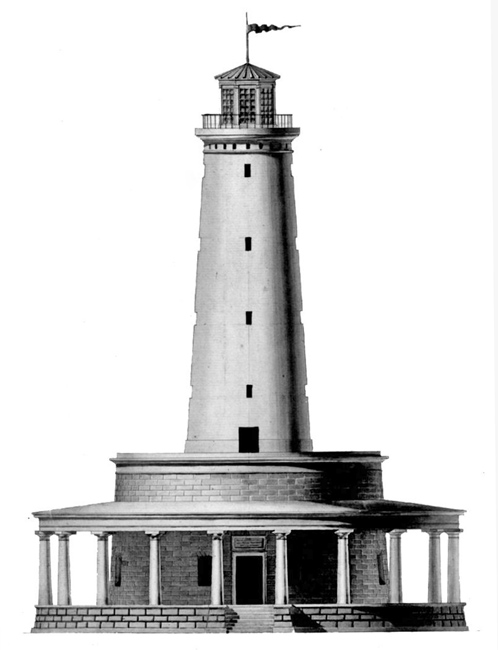
Photo Gallery
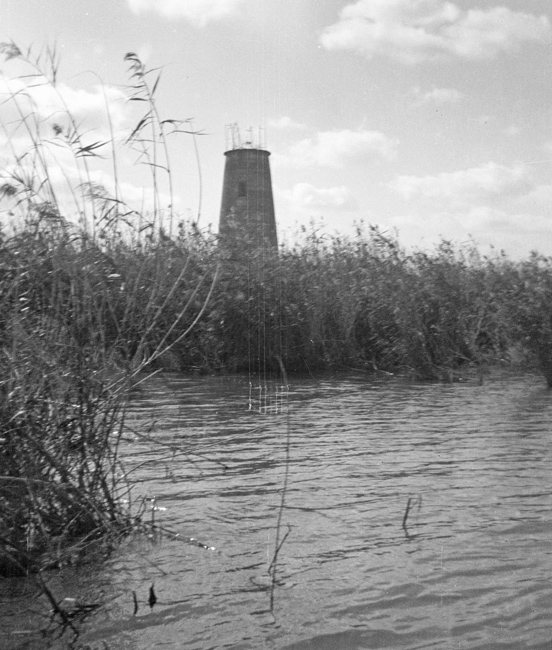
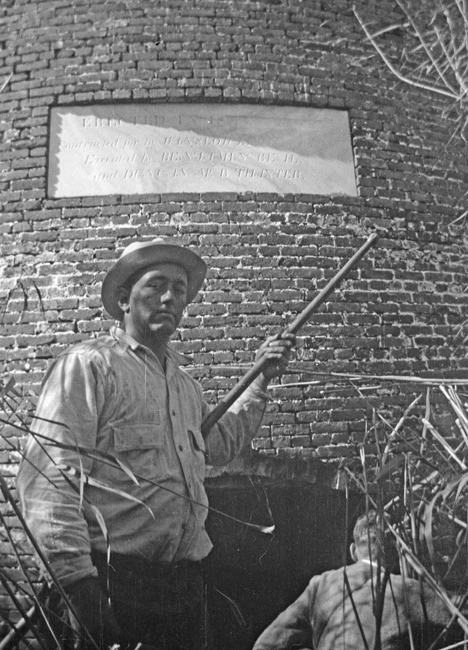
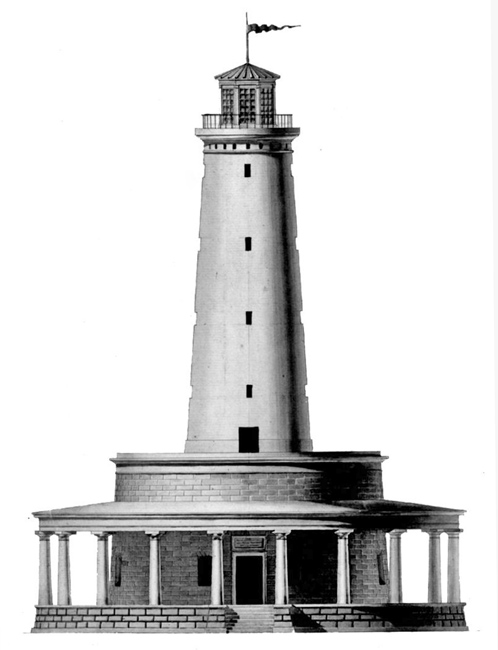
Photo Gallery
Photo Gallery
|
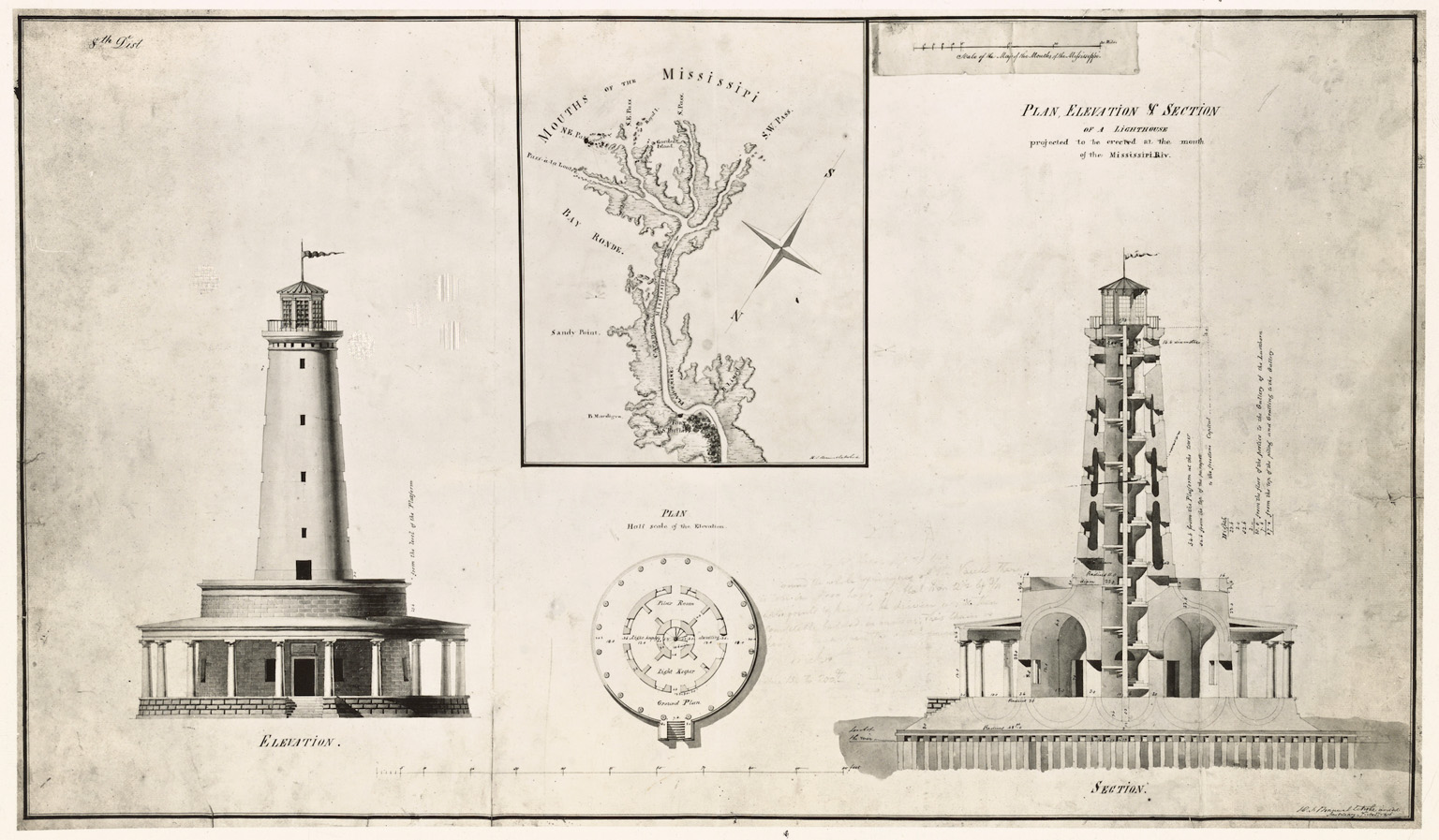
Local architect Barthelemy Lafon sent Washington a plan in 1805 for a square wooden tower reinforced with a truncated pyramid of interlocking timber meant to withstand hurricanes. His design reflected Louisiana’s vernacular engineering and avoided the massive weight of brick or stone. But Gallatin also consulted his close friend Benjamin Henry Latrobe, the celebrated architect of the U.S. Capitol. Latrobe proposed something altogether different: a monumental Gothic Revival lighthouse surrounded by an ornate Doric customs complex—a structure more suitable to a European capital than a desolate mud island.
The government chose Latrobe’s elegant but impractical plan and advertised for construction bids in 1807. Contractors recoiled. The advertisement described the building in minute, bewildering detail: a giant stone tower perched on an experimental foundation of inverted arches, flying buttresses, and radiating walls; a grand marble staircase within; and a circular colonnaded dwelling encircling the lighthouse itself. The proposed palace would rise from a bank populated by snakes, alligators, and clouds of mosquitoes on an island inelegantly named Frank’s Island.
Eventually, Robert Alexander of Washington agreed to attempt the project, but tensions with Britain and the War of 1812 halted the effort before any substantial work began. By the time peace returned, the principal figures—Trist, Lafon, and Latrobe—had all been carried off by yellow fever. Yet New Orleans had now become a true American metropolis. Andrew Jackson’s victory over the British at the Battle of New Orleans in 1815 had catapulted the city into national prominence, and river traffic increased rapidly. The need for a lighthouse remained urgent.
In November 1816, Latrobe’s son Henry arrived in New Orleans to simplify his father’s design. He eliminated some architectural flourishes, but retained the circular dwelling, stone piazza, and the extraordinary inverted-arch foundation. Congress increased the project’s budget to $55,000, hoping to lure contractors. None came.
|
Lewis accepted the project only after securing three conditions: that he be absolved of responsibility if the experimental foundation failed; that the government appoint an inspector to ensure he followed the plans precisely; and that the full contract price be set at an astonishing $79,000. Even this sum proved insufficient—the final cost reached $85,507.56, far beyond any other American lighthouse for decades. In the twenty years following its construction, thirty other U.S. lighthouses were built for an average cost of less than $10,000.
Construction began in 1818. By late that year the brickwork rose confidently from the mud. But in January 1819, only eight days before completion, disaster struck. One side of the experimental foundation settled, causing cracks in the walls. A survey was planned to determine whether the cause for the failure was in the foundation or the workmanship. Stephen Pleasonton communicated the findings: “it is much to be regretted that the foundation of this light house, contrary to the calculations and expectations of experienced engineers, … should have given away and that not only deprived navigation of a useful and necessary guide into the Mississippi, but imposed upon the United States a heavy loss.” Because Lewis had followed the government’s plans exactly, the U.S. attorney general ruled that he must be paid his full amount. Lewis received his final payment in June 1820, and Henry Latrobe died of yellow fever three months later.
Lewis saw an opportunity in the failure. In late 1821, he proposed to rebuild the lighthouse entirely on a foundation of his own design—one he would personally guarantee for several years—for the modest cost of $9,750. Pleasonton forwarded the offer to Congress, and in 1822 both houses appropriated the full amount. Lewis dismantled the remains of the original tower, salvaged usable materials, and began anew.
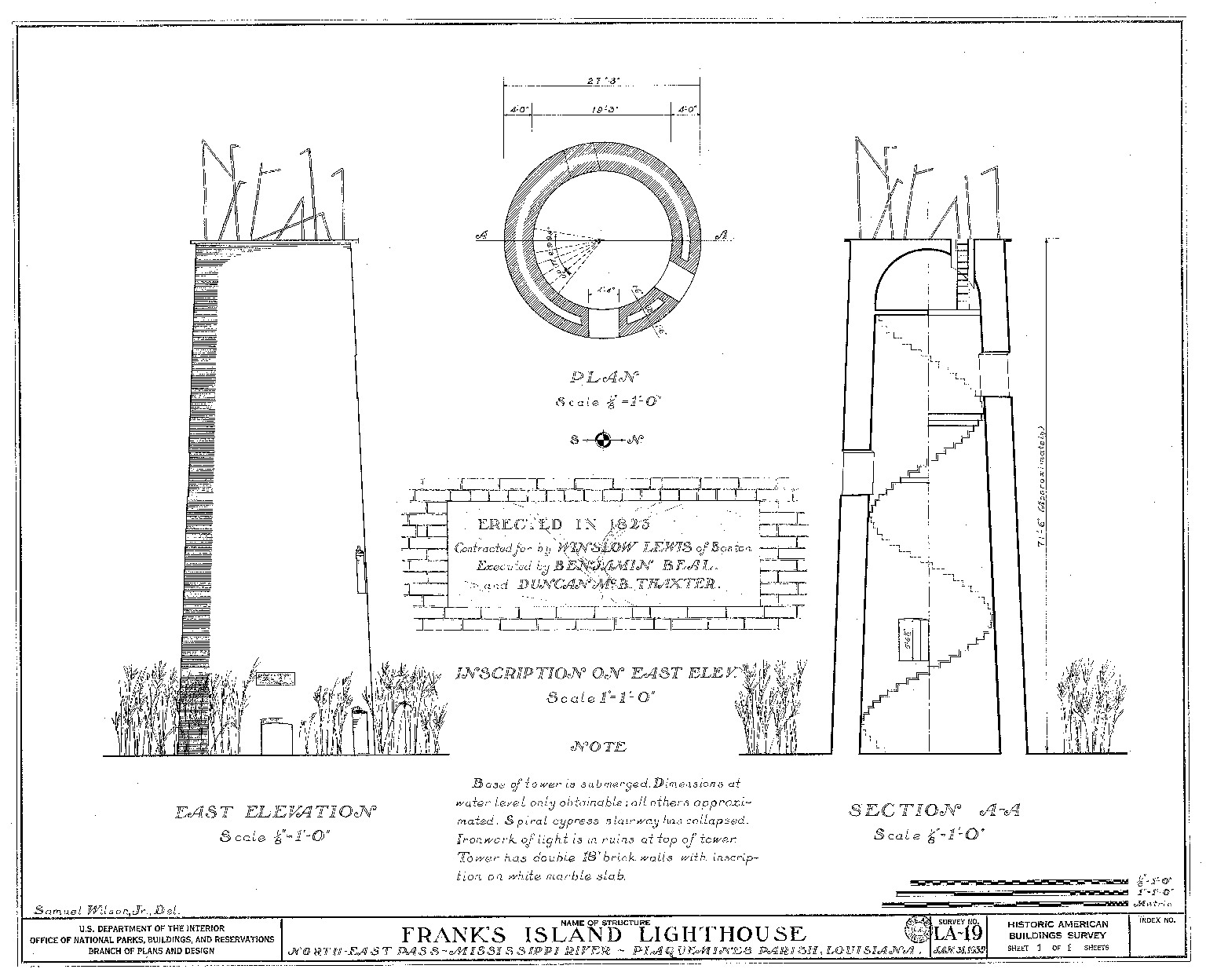
The second tower—completed and lit in March 1823—was a first-order masonry lighthouse, eighty-two feet above sea level, equipped with thirty lamps. It was the tallest and most powerful lighthouse on the Gulf Coast until 1858. Lewis claimed it could be seen twenty-seven miles at sea, though a practical horizon calculation suggested nineteen miles.
Ironically, almost as soon as the lighthouse was completed, the navigation of the Mississippi began to change. Northeast Pass, long the principal entrance to the river, rapidly shoaled. Mariners approaching from the Gulf used Frank’s Island Light as an offshore reference point but then proceeded toward the deeper Southwest Pass. In 1831, the government built shorter entrance lights at Southwest and South Passes—both erected by Lewis.
In its Annual Report of 1854, the Lighthouse Board noted that the tower at Frank’s Island was whitewashed inside and out, its dome painted, the wharf repaired, and various woodwork replaced, but that the “repairs were made as small as possible, in the expectation that the place will not be occupied much longer.”
In 1855, federal officials concluded that once the tower at Pass a L’Outre was activated, Frank’s Island Light “will be of no further service and should be dispensed with.” The tower was to be left standing and serve as a daymark in case it could be used again after future change in the channels. The dwelling had no value, but the island could likely be used as a garden by the keepers at Pass a L’Outre.
Over the next century, Frank’s Island gradually disappeared as Blind Bay expanded. Marsh gave way to open water, and the lighthouse—once built on dry mud and surrounded by cane—came to stand in water at least a fathom deep.
The long-abandoned tower stood remarkably true despite sinking nearly twenty feet. Winslow Lewis’s practical design, mocked in its day for its lack of architectural elegance, proved unexpectedly resilient. His blunt remark during an 1842 congressional inquiry—“So much for engineering and architectural science in building lighthouses”—captured his contempt for the failed theories that had guided the original attempt.
In 2002, nearly 180 years after its lantern was first lighted, the Frank’s Island Lighthouse finally collapsed. The failure of the original Latrobe design cost the federal government more than $85,000—an extraordinary figure for its era—while the successful Lewis tower cost roughly one-tenth as much.
A marble plaque inscribed with the names of the contractor and builders of Frank’s Island Lighthouse along with the year of completion was prepared for the original structure. After the year was updated, the marble slab was embedded in the brick walls of the 1823 tower.
Captain Mark Delesdernier, Jr., who had visited the abandoned lighthouse since he was a boy, retrieved the plaque after it had fallen from the tower, and later donated it to Plaquemines Parish. The marble stone was placed in Fort Jackson, situated about forty miles upstream from the mouths of the Mississippi River, and serves as a reminder of the early efforts to mark the river.
Keepers:
References