Amite River, LA 
Select a photograph to view a photo gallery
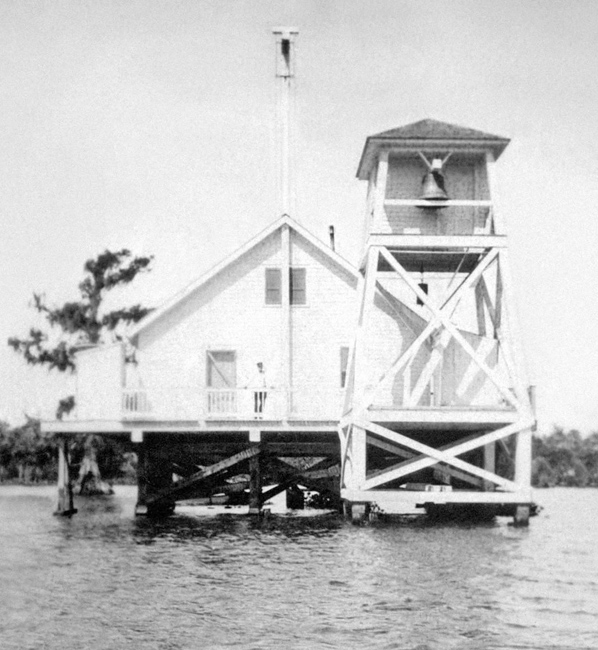
Photo Gallery
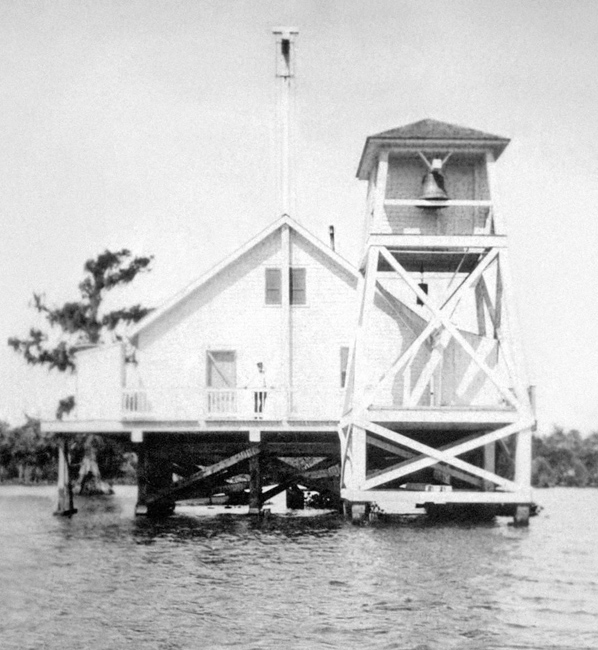
Photo Gallery
Photo Gallery
But night navigation was nearly impossible. The narrow river entrance blended almost invisibly into the marshy shoreline of Lake Maurepas. Seasonal fogs could blanket the entire lake, and even slight variations in weather made it difficult for mariners to locate the mouth of the Amite without running aground or wandering dangerously off course. A fixed light at the river entrance, visible from Pass Manchac to the east, became essential.
Congress first responded in 1856, appropriating $6,000 “for a lighthouse at or near the mouth of Amite River on Lake Maurepas.” Yet years passed without progress. In 1857, the Lighthouse Board reported that no site titles had been obtained, not only for the Amite River station but for several new Gulf and coastal lights authorized in the same era. The outbreak of the Civil War, reconstruction struggles, and bureaucratic delays kept the idea dormant for more than two decades.
In 1880, momentum finally returned with Congress appropriating $3,000 that year. By spring 1882, a small but sturdy lighthouse—built by contract using Lighthouse Board designs—rose above the shallow lake waters. The station consisted of a one-story frame dwelling set on four wooden piles, with a fixed white light hung from a pole at about forty-five feet above the lake surface. The white dwelling, green blinds, and brown piles were intended to give the structure both visibility and durability.
Though newly constructed, the station immediately sank into the soft lake bottom by two and a half feet, requiring workers to raise the building and shore up its foundation. The light was finally exhibited on May 1, 1882, with Rear Admiral John Rodgers, Chairman of the Lighthouse Board, announcing its establishment in a formal Notice to Mariners.
From the beginning, Amite River Lighthouse served not merely as a beacon but as an essential navigational tool for a heavily traveled interior route. Its light, visible across the lake in clear weather, allowed steamers, produce boats, mail carriers, and local fishermen to locate the river mouth even in marginal visibility. Captain Julius Lange, the first keeper, served only one year, but in 1883 the station passed to James M. Crawford, who would maintain the light for roughly four decades and become a fixture in local maritime life.
The lighthouse stood in a dynamic and often unforgiving setting. Each year brought storms, floodwaters, or gradual subsidence that forced the Board to undertake repairs:
Yet visibility remained the greatest challenge. Fog was so common on Lake Maurepas—and the shoreline so uniform—that “a thin fog stops vessels” entirely, the Board reported. The situation was identical to that at New Canal Light on Lake Pontchartrain: without a sound signal, mariners simply could not proceed. Thus, in 1894, the Board formally recommended installing a fog bell struck by machinery, estimated at a cost of $1,200.
The long-needed fog signal was finally installed in 1898, along with similar bells at New Canal and Pass Manchac. Notices to mariners dated June 23 announced that on July 7, 1898, a mechanically struck fog bell—one blow every thirty seconds—would begin sounding at Amite River Light. The apparatus stood in a square, white, pyramidal tower immediately east of the dwelling.
The fog bell proved indispensable for navigation. When the lake disappeared under blankets of mist, steamboat captains listened for the slow, regular tolling that allowed them to maintain course toward the river entrance.
Infrastructure improvements continued into the new century: a new cistern (1902) and a small oil house built on the fog-signal platform (1904).
By the 1930s, advances in illumination and automation began to render many small Gulf and inland stations obsolete. In 1934, after more than fifty years of service, Amite River Lighthouse was finally discontinued and replaced with an automated acetylene lamp. The keeper’s dwelling, fog bell tower, and other structures soon disappeared, either dismantled or destroyed by storms and decay.
Keepers: Julius Lange (1882 – 1883), James M. Crawford (1883 – 1926), George J. Fath (1926 – 1933).
References: