Swash, TX 
Select a photograph to view a photo gallery
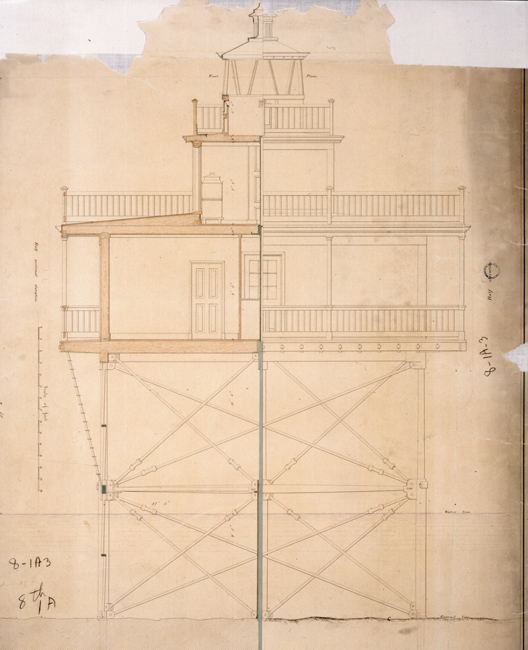
Photo Gallery
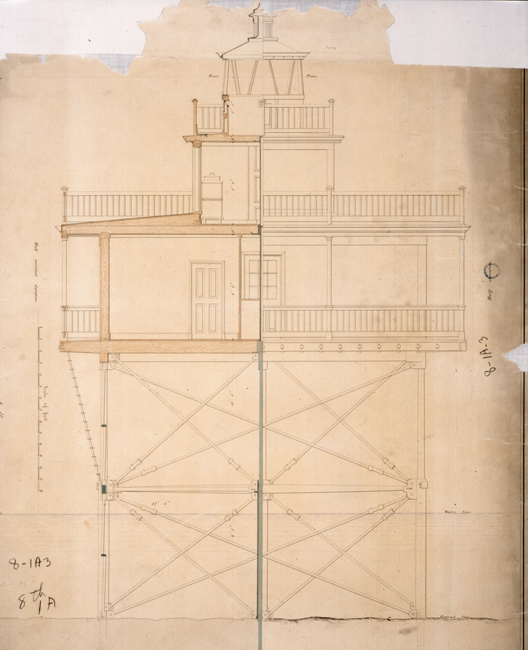
Photo Gallery
Photo Gallery
Although the Lighthouse Service established a seacoast light on Matagorda Island at the entrance to Matagorda Bay in the early 1850s, that towering beacon was of limited help once vessels passed over the outer bar. Local mariners quickly complained that the inner bay remained dangerously unmarked. The editor of the Indianola Bulletin expressed the frustration of many when he wrote that federal officials seemed to have “erased [Matagorda Bay] from their maps of Texas,” providing aids “in abundance for other points, of far less importance” while ignoring the region’s economic needs. He argued that no part of the country required navigational aids more urgently than Matagorda Bay.
These appeals found a receptive audience. In 1854, Congress approved $10,000 to build a lighthouse on Halfmoon Reef, a shell and mud shoal on the bay’s eastern side. The following year Lieutenant DeHaven of the U.S. Coast Survey recommended a second light—this one at the head of the Swash Channel, abreast of Alligator Head—replacing a previously proposed beacon for Gallinipper Bar, which he deemed unnecessary. For the Swash light, Congress approved an appropriation of $10,000 on August 18, 1856.
Despite congressional appropriations in 1854 for Halfmoon Reef Lighthouse, the Lighthouse Board moved slowly. The Service was occupied with other projects along the Texas coast, and it was not until 1856 that officers conducted detailed inspections at Matagorda Bay. On August 14 of that year, District Lighthouse Inspector Walter H. Stevens recommended that both the Halfmoon Reef and Swash lights be erected as screw-pile lighthouses, a relatively new style recently introduced on Chesapeake Bay.
Screw-pile lights were ideal for the soft bottoms of the Gulf Coast. Each station rested on a cluster of wrought-iron piles tipped with broad helical plates—“screws”—that could be twisted deep into mud and shells to form a stable foundation. For the Matagorda Bay lights, Stevens proposed piles twenty-five feet long and six inches in diameter, with two-foot-wide screws intended to penetrate the bay floor nine feet. Above these piles would rise a compact, hexagonal keeper’s dwelling topped by a lantern. Such stations were economical, resilient, and well suited for shallow, shifting waterways like the Swash.
Bids for the ironwork were received in 1857, and Hayward, Bartlett & Company of Baltimore won the contract. By mid-December, the screw piles and structural iron were loaded onto a vessel bound for Galveston, along with materials for other lighthouse projects. At the end of 1857, the Lighthouse Board ordered construction to begin “as soon as possible.” In March 1858, the schooner Harriet transferred the piles from Galveston to Matagorda Bay, and work proceeded rapidly.
By August 1858, the Swash Lighthouse stood complete on its seven iron screw-piles, its hexagonal frame painted white with contrasting black ironwork. Mariners were advised that the light would first be exhibited on August 15 and “every night thereafter, from sunset to sunrise.”
The lantern housed a fifth-order fixed Fresnel lens, set thirty-eight feet above mean bay level. Though modest in size, the beacon was invaluable for vessels entering the upper portion of the Swash Channel. Mariners could align the new light with a mid-channel buoy and the small beacon at Saluria to guide them safely through the crooked, current-swept passage. This was especially important because, even into the twentieth century, no licensed pilots were available to assist ships through the pass; in good weather the keeper of the local Life-Saving (later Coast Guard) Station would sometimes perform the duty when summoned.
Alfred Coffin, a native of Massachusetts, was hired as the first head keeper of the lighthouse at an annual salary of $400. After his first assistant resigned, his wife Lelia was hired as his assistant.
The outbreak of the Civil War interrupted the operation of nearly all Gulf Coast lighthouses, and the Swash light was no exception. Confederate forces extinguished, dismantled, or destroyed coastal beacons to impede Union navigation. By 1864, Swash Lighthouse had been entirely destroyed, leaving only its seven iron piles projecting above the water. After the war, federal engineers found the lens in 1866, but little else remained. In 1868, officials reported that the iron foundation piles were still sound and could support a new superstructure, and an estimate for reconstruction was prepared.
Congress provided funding to rebuild the light, but circumstances intervened. In 1869, the Lighthouse Board noted that, as an “interior navigation light,” the Swash was of lesser urgency than major seacoast beacons needed to restore Gulf commerce. The $15,000 appropriation was allowed to lapse into the surplus fund when the Act of July 12, 1870 returned unspent balances to the Treasury. The site remained dark.
Even though the original station was not rebuilt immediately, the need for a light near the Swash was not forgotten. In 1871, the Board reported that a new screw-pile lighthouse for the point was under construction “at the North.” Yet before it could be erected on Matagorda Bay, priorities shifted again. Instead of re-establishing the Swash light, the Board built two small lights—East Shoal and West Shoal—near Decros Point. These twin lights served both as replacements for the destroyed Saluria Lighthouse and as functional substitutes for the earlier Swash Channel Light. With their completion, the original Swash Lighthouse project quietly ended.
Keepers:
References: