West Shoal, TX 
Select a photograph to view a photo gallery
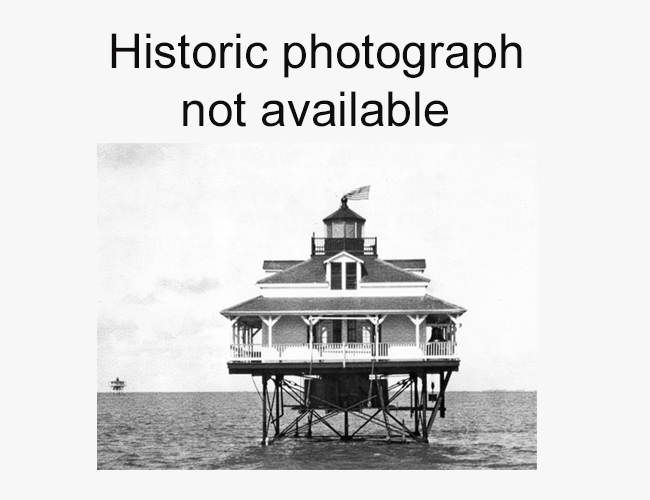
Photo Gallery
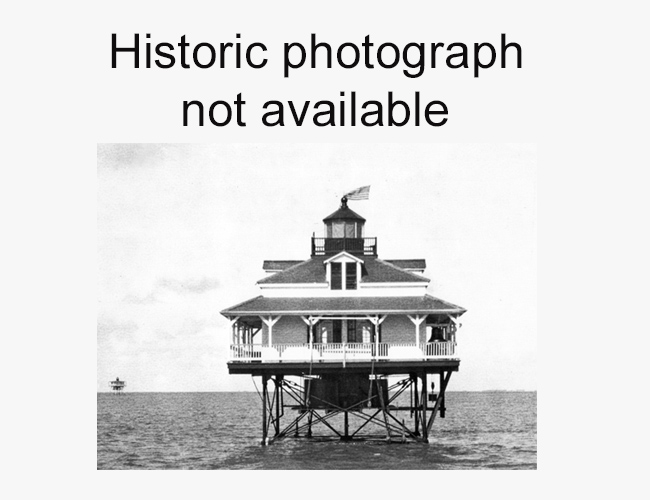
Photo Gallery
Photo Gallery
In 1870, Congress appropriated $15,000 for a pair of range lights at Decrow’s Point, on the east side of Pass Cavallo. The plan was straightforward: two inexpensive, land-based range beacons would mark the channel leading through the shoals into the bay. Preliminary steps were taken at once, including site selection, land procurement, and jurisdictional arrangements with the State of Texas. Everything appeared to be progressing smoothly until the Lighthouse Board encountered an unexpected obstacle—the landowner at Matagorda Peninsula refused to sell any portion of his property to the government.
By 1871, this refusal forced the Board to abandon the original plan entirely. Instead of land-based range beacons, engineers turned to a more complex but ultimately more versatile solution: offshore screw-pile lighthouses placed directly beside the channel. This approach required no private land purchase and offered additional advantages. Two screw-pile structures could simultaneously serve as range lights, channel markers, and harbor guides, fulfilling the functions once provided by the Swash Channel and Saluria lighthouses destroyed during the war. The Lighthouse Board concluded that a matched pair of offshore towers would be “inexpensive and easily tended,” while also addressing multiple navigational needs along Pass Cavallo.
By early 1872, both stations—East Shoal and West Shoal—were fabricated and shipped to the Gulf. A construction crew from the Fifth Lighthouse District assembled in Baltimore and sailed for Texas to erect the structures simultaneously.
The lighthouses were completed in March 1872. Each rested on iron screw-piles driven into the sandy bottom inside Decrow’s Point. Identical in form, they were painted white, stood thirty-five feet above sea level, and housed fourth-order Fresnel lenses. Their distinguishing feature was color:
Keepers assigned to the twin stations lived isolated lives, perched above the restless waters of Pass Cavallo. Over their short span of service, the stations were staffed by multiple head keepers. Both lighthouses had a husband-wife pair that served together. Charles Crossman and his wife Ada looked after West Shoal Lighthouse, and Thomas H. Mayne and his wife Eliza were responsible for East Shoal Lighthouse. The Crossmans resigned in early 1875, and Eliza resigned a few months later and was replaced by Edward Finck, Jr.
In 1875, the Lighthouse Board announced that West Shoal would receive a machinery-struck fog bell, giving single blows every ten seconds during thick weather. The bell was mounted on the east gallery of the lighthouse and was placed in operation on August 1.
On September 17, 1875, the second-worst lighthouse disaster in Gulf history struck without mercy. A catastrophic hurricane—a cyclone in contemporary accounts—swept across the Texas coast, ravaging Pass Cavallo, Indianola, and the surrounding settlements. Three days later, David P. Kane, the keeper of Matagorda Island Lighthouse wrote the following letter to his parents in Maine.
Dear Parents:—On the 16th and 17th insts., we were visited by the most terrific cyclone ever known in this part of the country. The water of the gulf was raised fifteen feet above its ordinary high water mark, sweeping away all the pilots with their families, the Postmaster and family, the health officer, and many more. Capt. Simeon K. Brown, formerly of Maine, was the only pilot saved.The town of Indianola was about half swept away, and as near as I can learn, 200 persons were drowned. The shore of the Bay for fifty miles is covered with cattle, lying so close together that it is impossible to ride on horseback among them. There were several Maine men lost at this place, among them Capt. Joshua S. Billings, formerly of Orland, and his whole family. Capt. William Nichols and family, with the exception of two, were swept away. He came from Searsport, I think. Mr. Thomas Decrow, of Decrow Point, with his family, formerly from Bristol, were all swept away with their houses and everything else into the gulf.
The two Screw-pile Lighthouses, the East and West Shoal Lights, only three years old, were also swept away and their Keepers drowned.
Please send this to the Ellsworth American for publication, as friends and relatives of the lost may thus obtain some information of their sad fate. In many cases not a single member of a family survives to give a word of information. Should this meet the eye of any friend or relative of the above families, I should be happy to answer any inquiry they may wish to make.
The keepers who perished were:
The Lighthouse Board quickly determined that rebuilding at the same locations was unwise. The hurricane had demonstrated the vulnerability of offshore screw-pile towers in the open channel. Annual reports in 1876 and 1877 concluded that the needs of navigation could be better met by returning to the Board’s original concept: range lights on Decrow’s Point. Congress had appropriated $20,000 in July 1876 for rebuilding Texas coast lights destroyed by hurricanes, and the Board recommended applying part of that sum to new Matagorda Bay range lights rather than reconstructing the offshore stations. By 1880, the appropriation was officially designated for constructing these replacement range lights, which eventually took over the duties once held by the twin shoal lighthouses.
Keepers
References: