Clopper’s Bar, TX 
Select a photograph to view a photo gallery
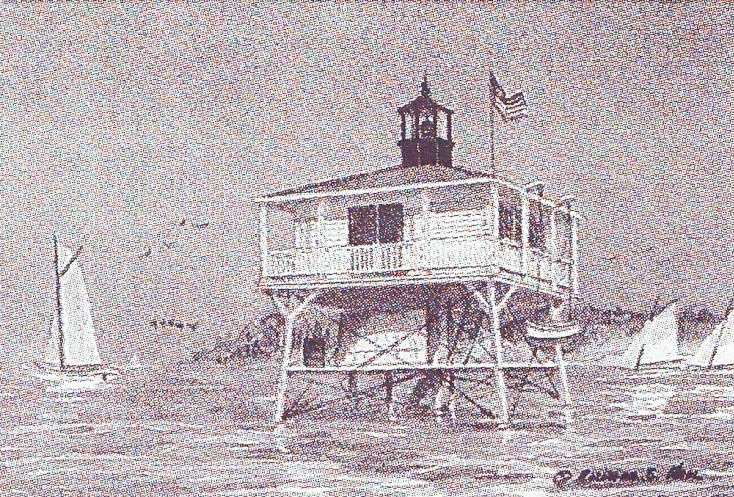
Photo Gallery
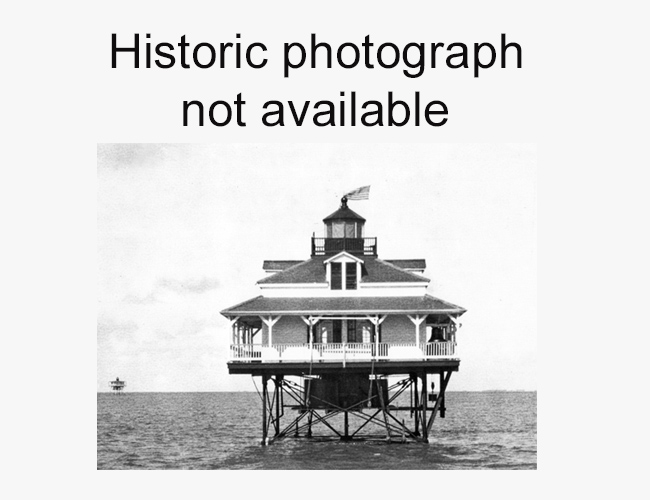
Photo Gallery
Photo Gallery
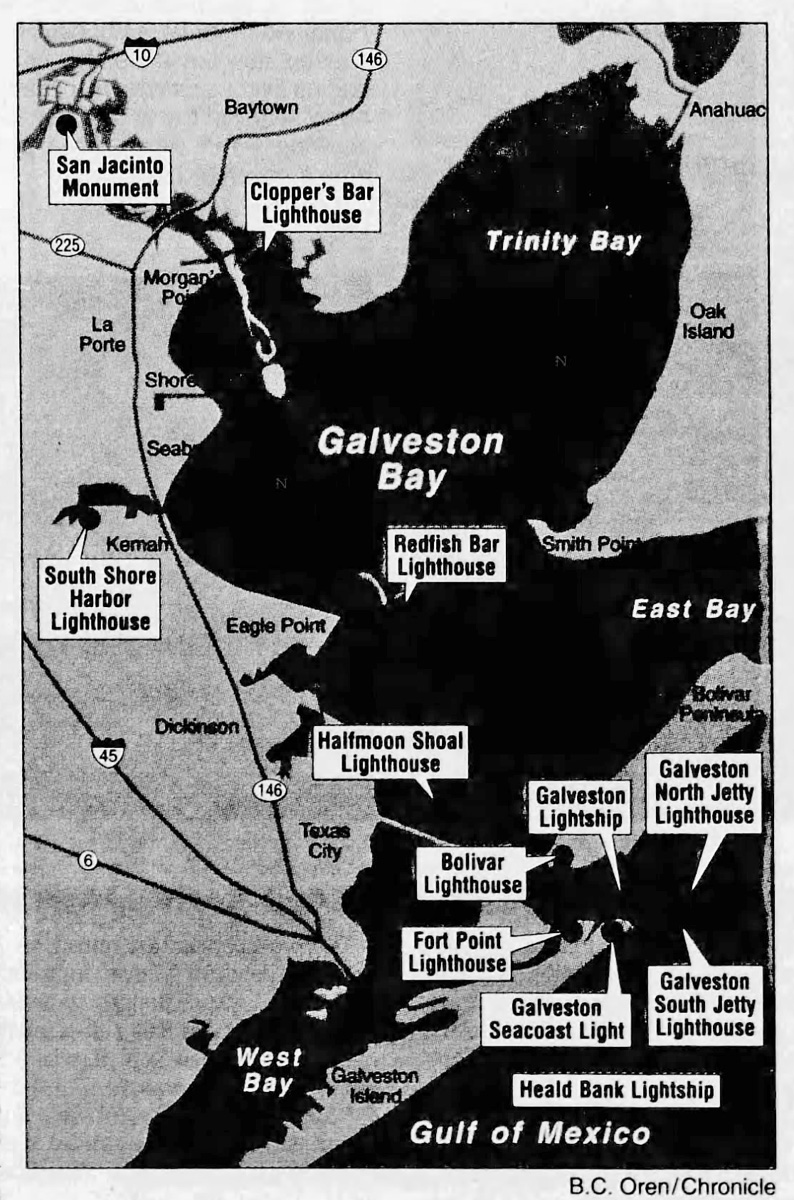
Prior to the 1850s, navigating Galveston Bay was a difficult and often dangerous undertaking, especially for larger vessels making the run up to the San Jacinto River. The bay was plagued by shifting sandbars and shell reefs, including the notorious Red Fish and Clopper’s Bars.
|
Construction of the three lighthouses was done utilizing an innovative technique known as the “screwpile” system. As detailed in The Galveston News, this principle allowed for permanent foundations to be established easily and at a moderate cost in the bay’s soft seabed.
The foundation consisted of heavy hammered scrap iron piles, five inches in diameter and about seventeen feet long. Crucially, on the lower end of each pile was a cast-iron helix, or screw, two feet in diameter. These screws were essentially bored thirteen to fifteen feet into the bay floor. Clopper’s Bar Lighthouse, like its two sisters, used a foundation of five piles, four placed on the angles of a twenty-five-foot square and one in the center.
The superstructure was built upon this iron base. Yellow pine columns, twenty feet high, were set into cast-iron sockets and framed with wrought-iron girts and ties. This supported a twenty-eight-foot-square platform upon which the keeper’s house was built. The residence measured twenty feet square and ten feet high and was divided into four well-lighted and ventilated rooms.
The lighthouses were capped with a cast-iron lantern room fitted with a fourth-order Fresnel that produced a light with a focal plane of thirty-nine feet above the level of the sea and visible for fifteen miles.
The construction proved successful, and the lighthouse inspector was able to formally receive the three completed screw-pile beacons on February 9, 1854.
Once operational, Clopper’s Bar Lighthouse marked the deepest natural channel over the bar that ran between Morgan’s Point on the west and Cedar Point on the east. It also served as an important landmark for traffic headed to the bay’s secondary ports, such as Anahuac.
In the years leading up to the Civil War, the station saw steady service under keepers like John Alfsson and his assistant, Thomas Chubb. The outbreak of the Civil War in 1861 brought an abrupt halt to federal light services across much of the South. While Clopper’s Bar Lighthouse escaped destruction—a fate not shared by other lights like Red Fish Bar Lighthouse—it was discontinued during the conflict.
Following the end of the war and the resumption of federal authority, efforts were made to restore the aids to navigation. A temporary light was re-established and exhibited on May 8, 1868, using a steamer’s lens under the care of new Head Keeper John Smith. The station was deemed to be in a “satisfactory condition” at the time, though in need of painting. By 1869, the station had been thoroughly repaired and was reported to be in good condition, ready to resume its full duties. John Smith’s wife, Katharine Smith, would later serve as the assistant keeper from 1871 until the light was discontinued. In 1874, a fog bell was added to the station to aid navigation during periods of poor visibility.
Clopper’s Bar, near the mouth of the San Jacinto River, only had eighteen inches of water on it before the state provided funds for dredging the bar. A Mr. Bradbury completed the dredging of the bar to a depth of five feet in 1853. Though helpful, the channel through the bar was circuitous and greatly lengthened the route between Galveston and Houston.
In the 1870s, the Ship Channel Company dredged a 2,200-foot-long canal through Morgan’s Point. Although it greatly improved navigation, Morgan’s Point Canal was private, and vessels other than those of Morgan Line ships had to pay a toll to use it.
Due to changes in the route vessels used to reach the San Jacinto River and Houston, the Lighthouse Board determined that the light was “of no further use to the navigation of the bay.” Consequently, Clopper’s Bar Lighthouse was officially discontinued on April 1, 1880, ending its nearly thirty years of active service.
The lighthouse continued to be listed as a daymark until at least 1888, but today nothing remains of the structure save a few underwater pilings.
Keepers:
References