Red Fish Bar, TX 
Select a photograph to view a photo gallery
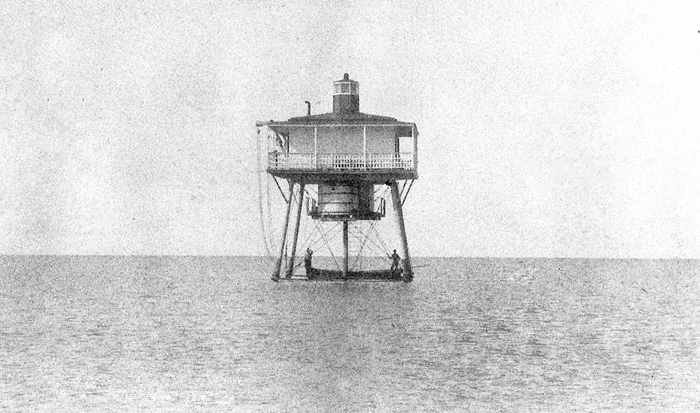
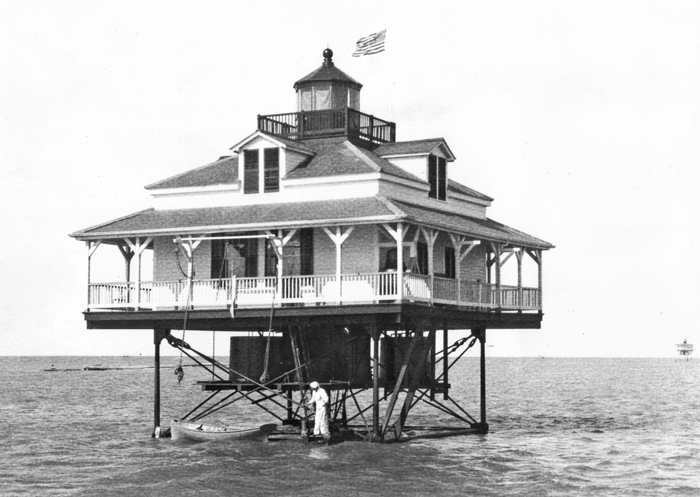
Photo Gallery
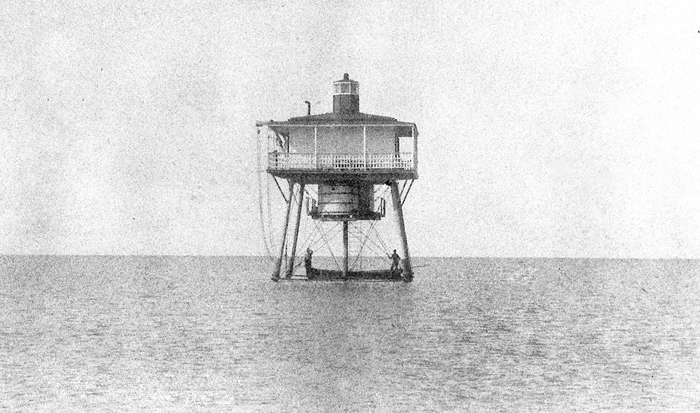
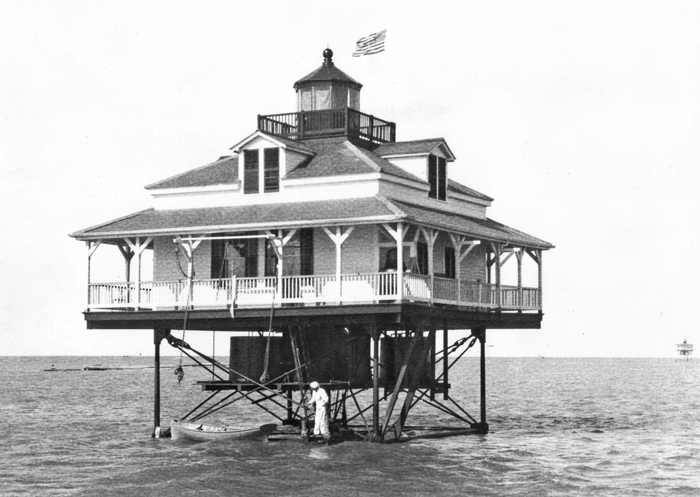
Photo Gallery
Photo Gallery
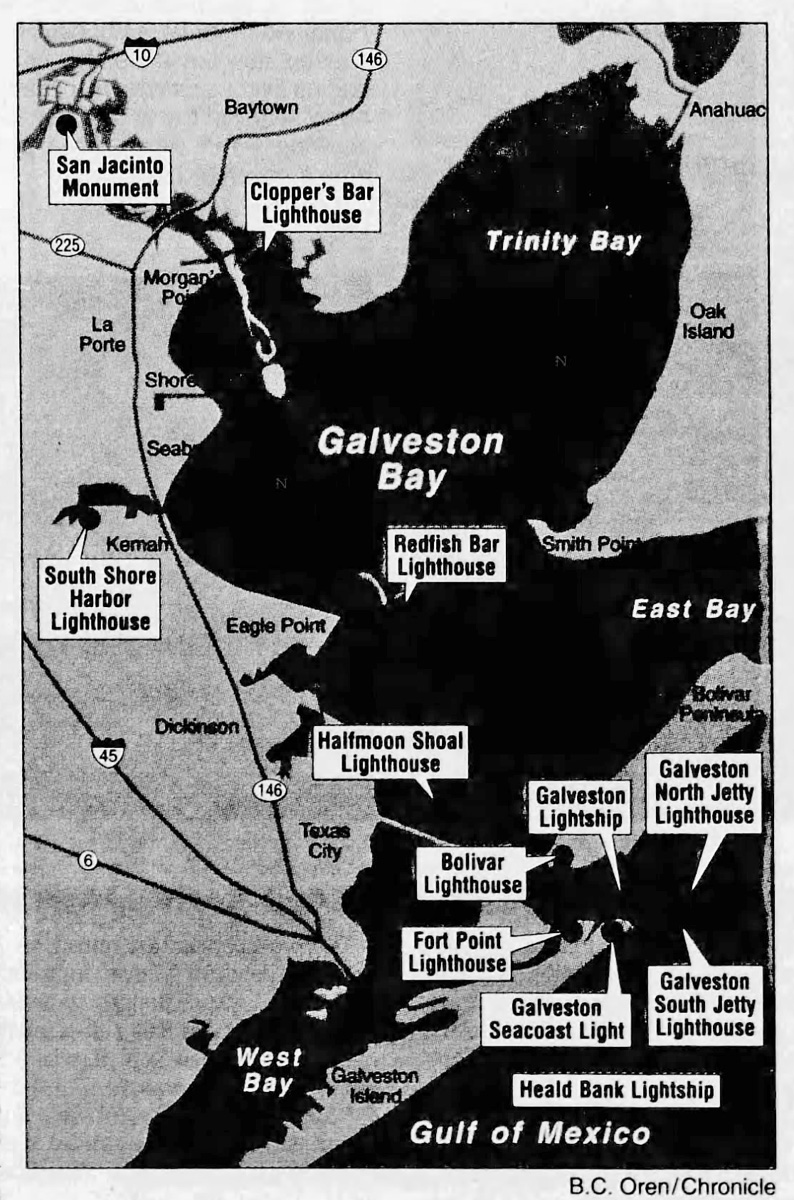
Yet navigation within the bay was fraught with danger. Natural features such as oyster-shell reefs, shoals, and shifting sandbars created a constantly shifting labyrinth beneath the surface. One of these obstacles was a prominent hazard known as Red Fish Bar (or Redfish Bar) that ran across the bay at the place where it was nearly pinched in two by Smith Point on the east and Eagle Point on the west.
Recognizing the critical need for reliable navigational aids, Congress appropriated $15,000 on March 3, 1851, for the construction of three lighthouses in Galveston Bay—one each at Halfmoon Shoal, Red Fish Bar, and Clopper’s Bar. An additional $10,000 was added in 1852 to complete the lighthouses.
|
The original Red Fish Bar Lighthouse was a square cottage-style dwelling mounted on five screw piles. The structure featured a red and white pattern—a white house with horizontal red stripes—to stand out against bay waters. On February 9, 1854, the lighthouse inspector formally inspected and accepted the three completed screw-pile beacons.
As the Fresnel lenses ordered from France had not yet arrived, the Lighthouse Board ordered that the best hand lanterns should be used at once so the lights could be activated. The Board also had three pressed glass lens lanterns sent from New York to be used until the Fresnel lenses were received.
The outbreak of the American Civil War disrupted normal lighthouse operations throughout the South. Red Fish Bar Lighthouse did not escape unscathed. Reports indicated that while the original iron screw piles remained, the rest of the structure had been burned—presumably destroyed by Confederate forces.
Recognizing the navigational hazard that a missing light posed, crews were dispatched in July 1867 with materials to rebuild. A temporary light was established on May 8, 1868, while reconstruction progressed. By 1869, the station had been thoroughly repaired and returned to full operation.
Throughout the late 19th century, Red Fish Bar Lighthouse underwent periodic maintenance and upgrades—evidence of both continued use and structural wear typical of offshore screw-pile lighthouses.
David B. Ahern was placed in charge of Red Fish Bar Lighthouse in 1886, after having served at a pair of lighthouses in Louisiana. In July 1889, Lillian Ahern was waiting for her husband to return to the lighthouse from Galveston. “The boat came in,” Lillian recalled, “but as I helped pull up the skiff we used to meet passing ships, a sailor called out, ‘Your husband drowned last night.’” A search was made for Keeper Ahern’s body, but it was never found. Lillian was grief-stricken, but looked after the light and kept scanning the surrounding waters with a spyglass for any sign of her husband.
A few days later, Inspector William W. Mead called at the lighthouse and told Lillian that he had received numerous applicants to replace her husband, but that the job was hers if she wanted it. Lillian took the job, and would tie her two children, who were four and nearly two at the time of their father’s death, to her waist to keep them from falling off the lighthouse and into the bay. “After two years, I got tired of not having neighbors to keep pace with,” Lillian said, “and I went to Galveston where I remarried.”
By the mid-1890s, the usefulness of the original lighthouse location had diminished. With a new dredged channel cut through Red Fish Bar in the 1890s, the old structure was no longer ideally placed. In 1895, the inspector noted that the old lighthouse “was almost useless as an aid to navigation in its present location.” The lighthouse had decayed to such an extent that it was impractical to move it. Building a lighthouse on the edge of the channel would cost about $8,000, and an appropriation for this amount was requested.
On July 1, 1898, Congress approved the $8,000 appropriation, paving the way for a new light station better aligned with evolving shipping routes. This new light station—known as Red Fish Bar Cut Light—was constructed in shallow water on the easterly side of the dredged channel through Red Fish Bar. On February 26, 1900, a fixed white lens-lantern light replaced the fifth-order light at Red Fish Bar Lighthouse, and its fog bell was discontinued. The new structure was then placed into service as publicized in the following Notice to Mariners:
Notice is hereby given that on or about March 20, 1900, a fixed white light of the fifth order will be established in the structure recently erected, in 2 feet of water (mean low water), on Red Fish Bar, Galveston Bay, close to the easterly side of the dredged cut through the bar, and 2,250 feet (? mile) SW. ½ S. from the old Red Fish Bar Lighthouse.A fog bell, located on the gallery of the dwelling nearest the cut, was established on April 3, 1900. Two days earlier, the light of Red Fish Bar Lighthouse was changed from white to red. Red Fish Bar Light was permanently discontinued in November 1911.The light will illuminate the entire horizon; its focal plane will be 39 feet above mean high water, and the light may be seen 11½ miles in clear weather, the observer’s eye 15 feet above the water.
The structure consists of a square, iron, pile foundation, painted brown, surmounted by a square, white dwelling with green door and window blinds, from the roof of which there rises a black lantern.
The same year the new light was established, the catastrophic Storm of September 8, 1900—which devastated much of Galveston—struck. A large steamer, driven out of control by the hurricane, passed extremely close to the new station but—according to reports—missed it by just a few feet.
Over the next decades, the keepers of Red Fish Bar Cut Lighthouse continued their duties under challenging conditions. Records show numerous rescues and assistance efforts: stranded launches, shipwrecked crews, and vessels grounded on reefs—all helped by the keepers of the station, notably Keeper George R. Smith and his brother/assistant Leon R. Smith. The Smith brothers were sons of Keeper John L. Smith, who served as keeper of Clopper’s Bar Lighthouse from 1868 until it was discontinued in 1880 and then as keeper of Halfmoon Shoal Lighthouse until he resigned in 1898. John L. Smith was living with his son George at Red Fish Bar Cut, when he died in 1903.
John was alone at the lighthouse during the hurricane of 1900 and put in a new pane of glass in the lantern room when one blew out. Keeper Smith was again alone and taking care of the lighthouse when he died. A captain grew suspicious when the light was dark and after going to investigate found John lying on the floor dead. George R. Smith was given an assistant after the death of his father.
One example of the many rescues George and Leon made happened in October 1921, when the brothers rendered assistance to the five occupants of a small launch that had run aground and sank after it struck a shell dump near the station. Besides being known for his numerous rescues, George also got to fly the efficiency flag in 1921 for having the best-kept lighthouse in the district.
The screw-pile cottage-style light station, increasingly expensive to maintain, was gradually rendered obsolete by newer navigational technology and changes in shipping patterns. In 1936, a skeleton steel tower replaced the wooden portion of the lighthouse, and the station was automated. The change to the light marked the end of an era—one in which small, manned screw-pile cottages provided vital guidance to vessels crossing the shallow, treacherous bay.
References: