Fairway Island, AK 

Select a photograph to view a photo gallery
Photo Gallery
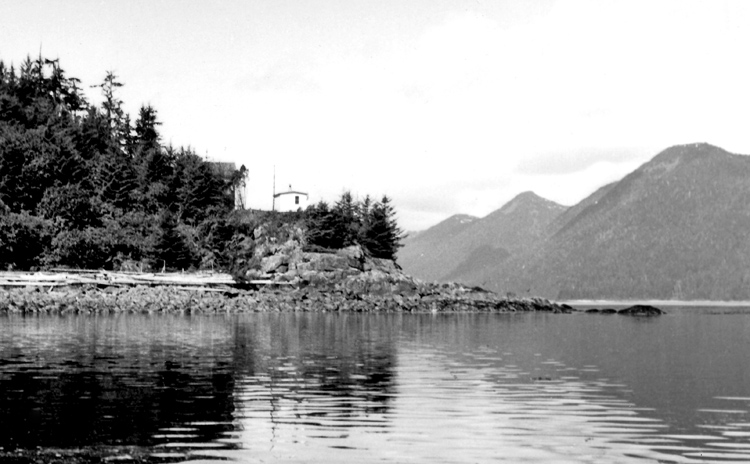
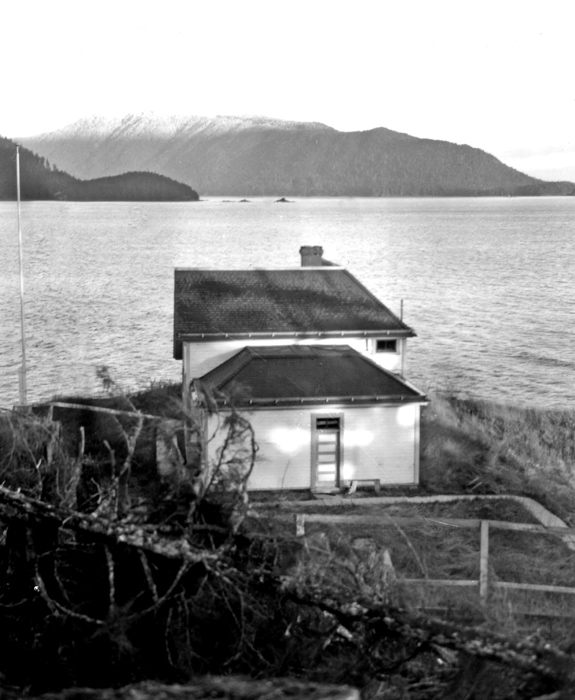
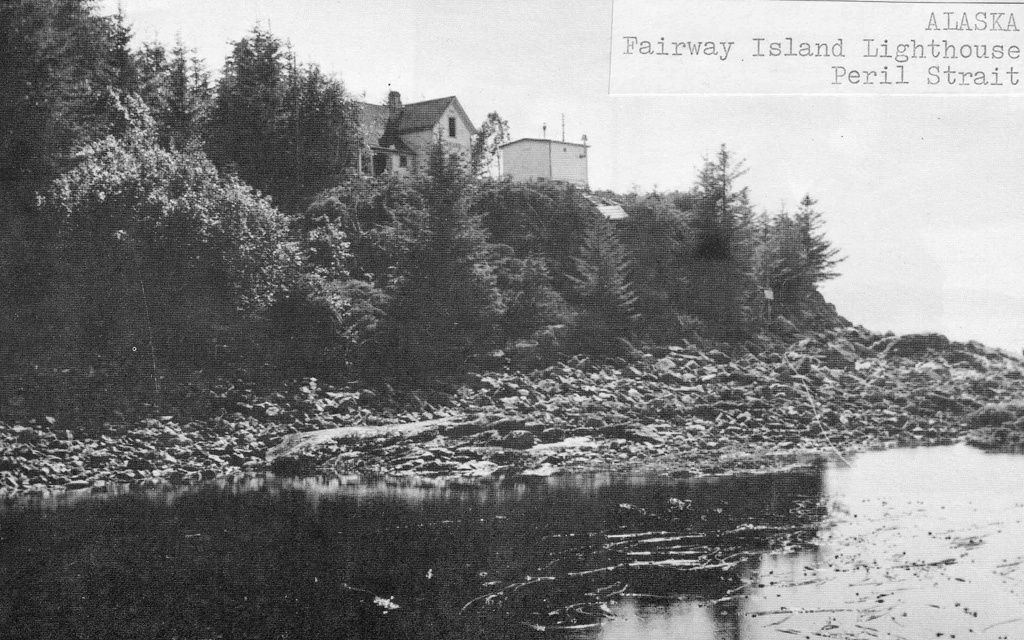
Photo Gallery
Photo Gallery
At the time, Alaskans were frustrated that the government was building just a few costly lighthouses instead of numerous less expensive lights that could mark more of the state’s lengthy coastline. Because of the lack of lights, supply ships were typically delayed between three days and a week on each trip. One prominent Alaskan remarked, “We would be thankful for a post with a lantern hung on it at the present time, instead of [the] magnificent structures the board is building.” He continued: “We have a coast of thousands of miles, and the board has opened two for use and has two in course of construction. With the money already appropriated by Congress, 200 lights could have been put in operation, thus affording protection to the thousands of travelers and hundreds of vessels traveling along the coast.”
|
Alaska was still part of a lighthouse district that also included Oregon and Washington, and it lacked a dedicated tender and buoy depot for its waters. Until these issues were addressed, navigational aids in Alaska would remain at a severe disadvantage.
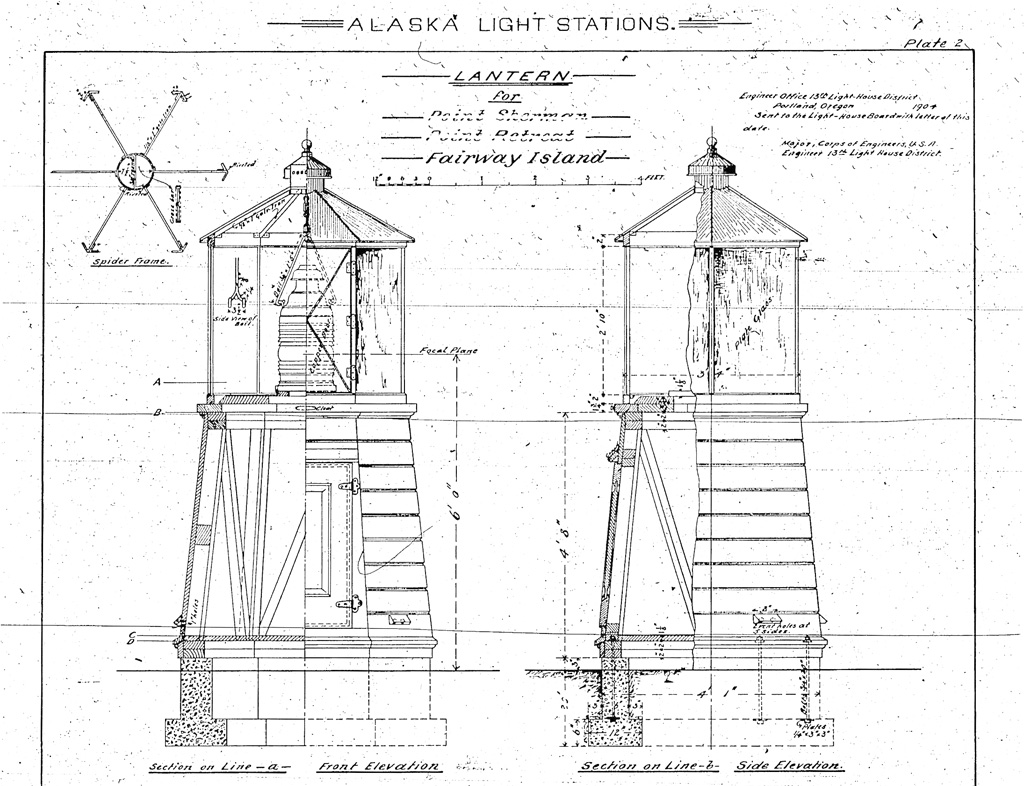
German-born Carl W. Leik designed a set of identical plans for the beacon, keeper’s dwelling, and boathouse to be used at Point Retreat, Fairway Island, and Point Sherman from the district’s offices in Portland. Work on the three stations was carried out in 1904, and on September 1 of that year, a fixed white lens-lantern light was established on the northeasterly point of Fairway Island, on the west side of Chatham Strait, and in the easterly entrance to Peril Strait. Point Retreat was activated on September 15, and Point Sherman followed suit on October 18.
Although the three lights were placed in operation in 1904, the Register of Lighthouse Keepers only lists keepers being appointed to these stations in April 1905. In June 1905, the steam schooner Homer, under charter to the government to take supplies to Alaskan lighthouses, stopped at Friday Harbor in Washington to take Frank Dennison and his family and their household goods and goats on board. Frank Dennison had spent many years on Smith Island Lighthouse in Washington, but he was now being transferred to the new light station at Fairway Island.
Keeper Dennison looked after the Fairway Island Light for two years, and then resigned to take up boat building and fishing. He disappeared from a boat in 1911. Elling J.M. Arentsen became the next head keeper at Fairway Island, transferring in from Guard Island Lighthouse, where he had been an assistant. Arentsen served for one year, and then Charles B. Bohm was brought in from Sentinel Island to take charge of Fairway Island Light until it was automated in 1911.
A Notice to Mariners publicized the fact that on August 31, 1911, the characteristic of Fairway Island Light was changed from fixed white to flashing white every three seconds. The illuminant was changed from oil to acetylene gas as part of the automation process.
The script for Point Retreat, Fairway Island, and Point Sherman remained nearly identical up to this point as Point Retreat and Point Sherman were both automated on September 1, 1911. Point Retreat was staffed again about a decade later, but Fairway Island and Point Sherman have remained automated ever since.
Keepers: Benjamin F. Dennison (1905 – 1907), Elling J.M. Arentsen (1907 – 1908), Charles B. Bohm (1908 – 1911).
References