Bloody Point Front Range, SC 


Select a photograph to view a photo gallery
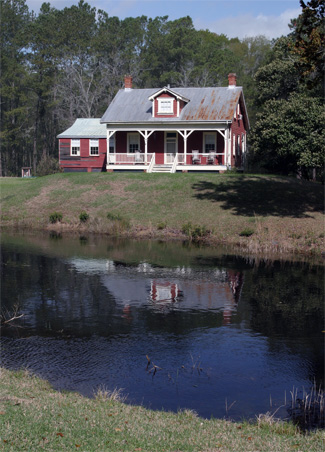
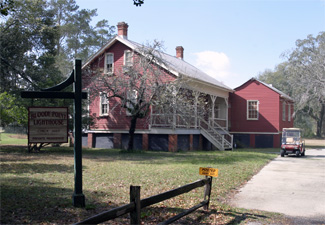
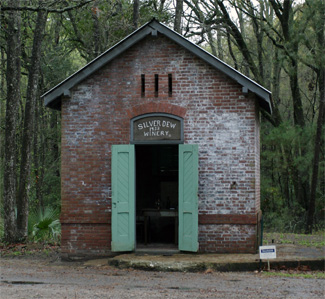
Photo Gallery
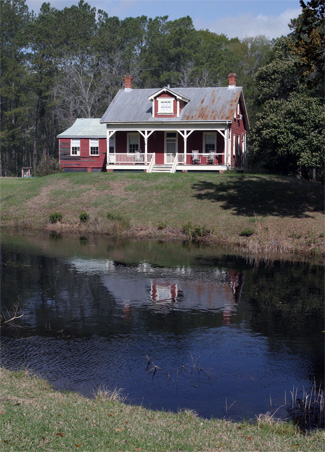
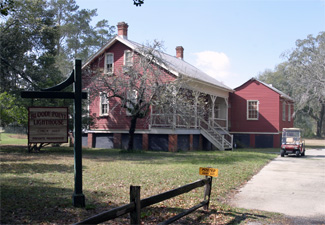
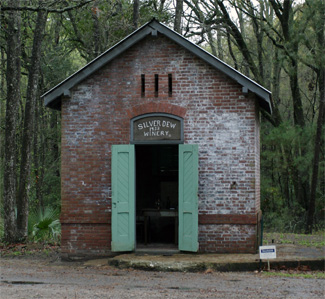
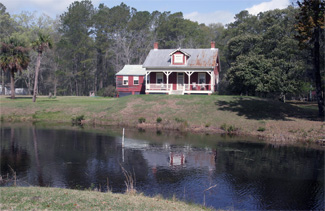
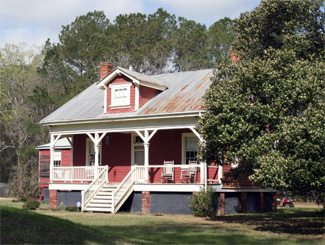
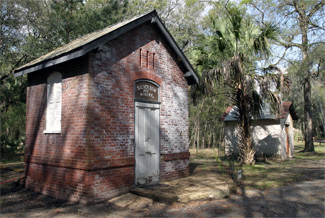
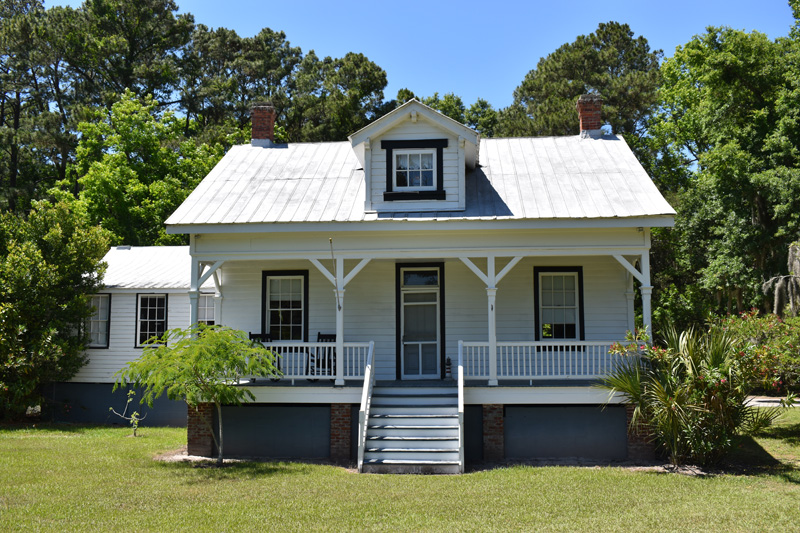
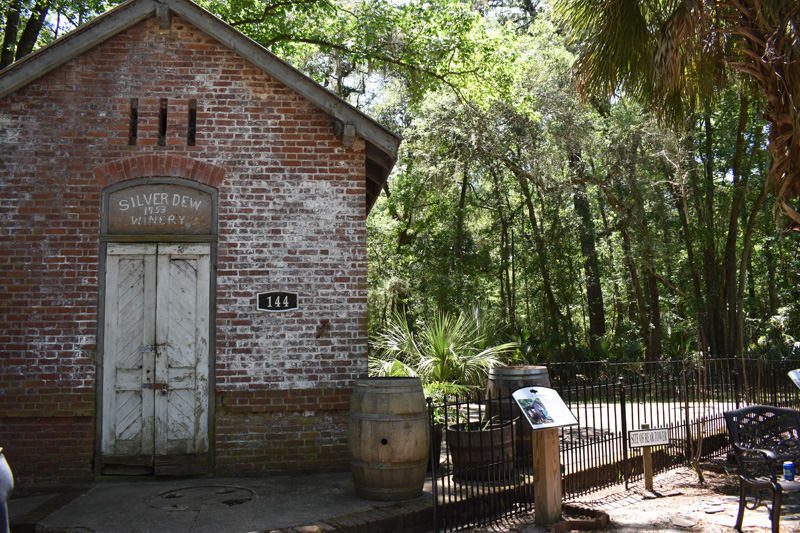
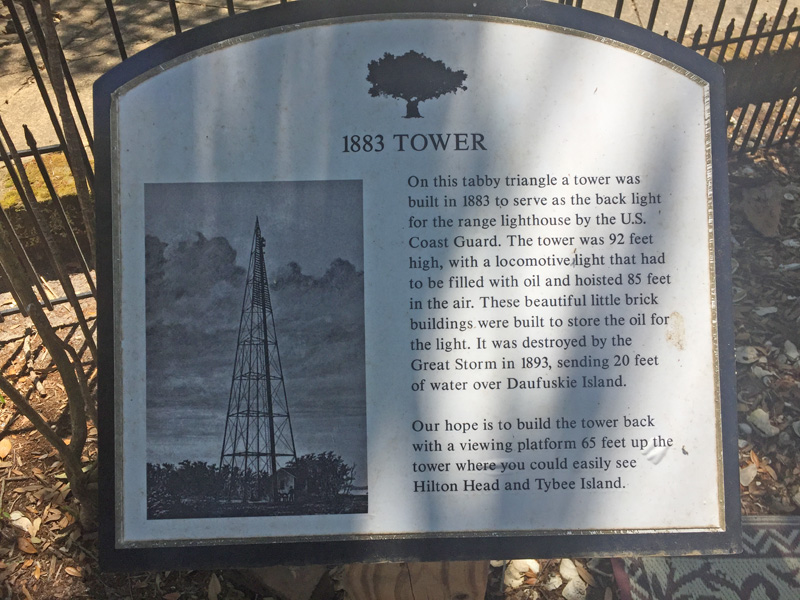
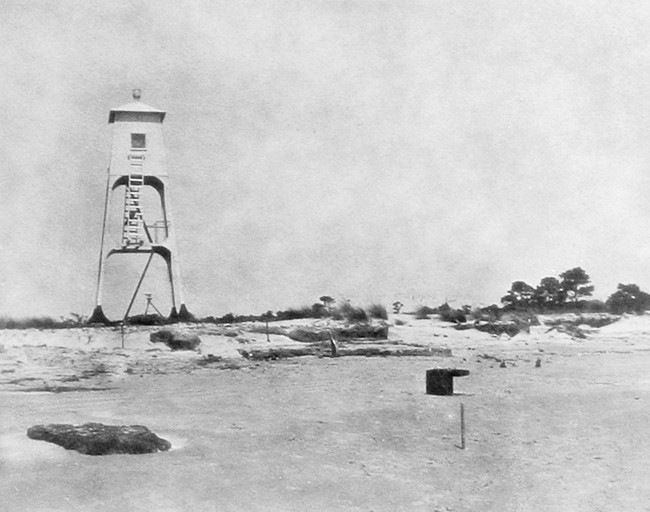
Photo Gallery
Photo Gallery
The English started settling South Carolina in the early 1700s, when the land was still claimed by Spain. Indians, who had befriended the Spanish, often raided Carolina’s seaboard plantations, and while returning to St. Augustine with their spoils, they frequently used the southern point of Daufuskie Island as a stopover. On two occasions, the English surprised a party of Indian raiders on the point and killed all but a lucky few who managed to escape. Since the first skirmish in 1715, the southern end of Daufuskie Island has been called Bloody Point.
Henry Mongin Stoddard inherited Bloody Point Plantation following the War Between the States and was later contacted by the lighthouse service to obtain land for constructing a pair of range lights to aid ships entering the Savannah River. Stoddard agreed to part with some of his land as shown in the following excerpt from a letter between Peter C. Hains, Major of Light House Engineers and the Office of Lighthouse Engineers for the Sixth District, located in Charleston:
I propose that the Board purchase from him (Henry Stoddard) five acres as the site for the rear beacon at his price, $25 per acre, and three hundred feet on the beach for the front light at his price, $1 per foot: that will make $425.00 for both sites. I enclose tracings which will show the tracts selected.
|
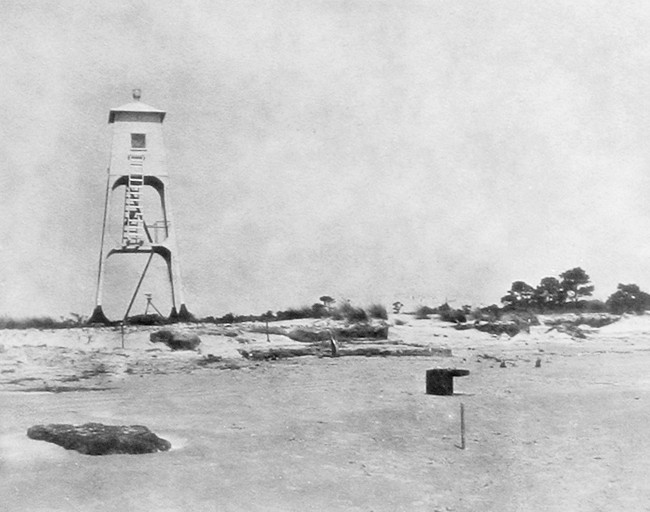
Cooper Manufacturing Company of Mt. Vernon, Ohio was contracted to supply the metal tower, designed by Julius E. Rettig, that would serve as the rear range light. The company’s chief machinist, John Michael Doyle, was tasked with seeing that “each foundation plate, column, rail casting, tension rod, strut, slat, and everything needed was meticulously measured, formed or made, so that each piece of the tower would fit perfectly.” Doyle, who had been as far south as Savannah with the Union Army, was sent to Daufuskie Island to oversee the erection of the tower and lamp house. The previous year, Doyle had successfully erected a similar tower on Parris Island, just a few miles north of Daufuskie.
Doyle arrived on Daufuskie on November 13, 1882, after traveling on a boat from Savannah with James LaCoste, who was responsible for the front light and dwelling. Doyle started with a concrete foundation in which were set circular iron disks for anchoring the skeletal tower. The light, which consisted of a locomotive headlight fronted by a powerful parabolic reflector, was stored in a brick lamp house located at the base of the tower during the day. At night, the light was hoisted up the ninety-one-foot tower on rails to its place at the apex of the triangle using machinery located in the lamp house.
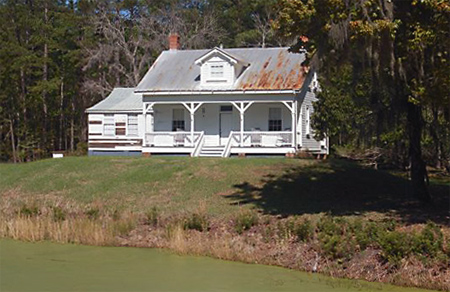
The dwelling for the keeper was a one-and-a-half-story, frame house with porches across the front and back. The dwelling was positioned on the beach, and the front light of the range was exhibited from a dormer window in its upper story. A brass stand supported the light, which was rotated by a clockwork mechanism. The fumes produced from the burning oil escaped the lamp room through a small vent in the roof.
On February 22, 1883 Mr. Gowers, the officer in charge of the Sixth Light House District, held the final inspection for the range lights. Doyle and LaCoste wasted no time admiring their work as they boarded the Crouch that afternoon and sailed for Savannah. Doyle must have enjoyed his sojourn on Daufuskie as he quickly applied for the position of keeper, and on April 4, 1883, he was appointed the first caretaker of the range lights at Bloody Point at an annual salary of $620. The lights were exhibited for the first time on April 20, 1883 and were the first of the group of twelve to be established.
The following is a description of the effects of the Charleston earthquake on the station on the night of August 31, 1886:
The first noise was as of a great wave of water swashing up against the back of the house. ...This was immediately followed by a rattling noise as of a great number of heavy men with big boots on tramping to and fro on the back piazza. In an instant the same sort of crowd seemed to have taken possession of the front piazza, and each platoon was trying to outmarch the other. Just here a cow, some distance back of the house and directly in the line of approach of the quake, bellowed long and loud. The dog, also on that side of the house, at first set to bark bravely enough, then howled, ran around and took refuge on the front piazza, as if to get away from something. He was found later shivering and moaning with fright. Now these heavy shod feet seemed to have reached the roof and the upper floors. Then a roaring noise came, booming underground as of heavy cannonading. During this time the house lamp was jumping like it was lifted and let to drop by a string, the house shivered, then seemed to be shoved in a horizontal plane, then the motion, noise, and altogether, were as of riding in a car which had left the rails and was bumping over the ties, and this on a bridge or trestle; loose things on all sides were tumbling about, adding no little to the frightful effect. The keeper went to the beacon light in the upper story to turn that out, if the house left its foundations.Though the occupants of the dwelling were traumatized by the earthquake and its numerous aftershocks, little damage was done to the structures at the station.
During Doyle’s service, a twelve-by-twenty-foot kitchen, built off the west end of the dwelling, and a boathouse were added to the station. Doyle tendered his resignation on August 15, 1890 and became a fireman in Savannah.
On August 27 and 28 of 1893, a cyclone cut across Daufuskie Island causing extensive damage to lighthouse property. Robert A. Sisson, having succeeded Doyle as keeper, sent a letter to the sixth district lighthouse inspector requesting reimbursement for five pairs of shoes, horse feed, a dining table and chairs, a safe, and various food items all lost to the cyclone. Sisson’s damages totaled $74.68, plus forty-six head of chicken for which he did not seek remuneration, a sizable sum given his salary. Keeper Sisson did receive money from the government for his losses, but the payment was not approved until 1911!
|
In 1908, the U.S. engineer at Savannah reported that the Bloody Point Range Lights no longer marked the best water at the entrance to the Savannah River. As the owners of the land on Daufuskie Island that was needed for lights to mark the proper channel set the purchase price at $10,000, the Lighthouse Board requested $4,500 to establish range lights offshore. Congress approved the project in 1910 but didn’t immediately supply the necessary funds.
The old Bloody Point Range Lights were discontinued on November 15, 1912, and on that same date, the new offshore range, which kept the name Bloody Point, was activated. Iron skeletal towers, spaced one-and-a-quarter miles apart and fitted with white horizontally-slatted daymarks, were used to display flashing white lights for the new range. The seaward face of the front tower of the former range was painted black on November 30 so it wouldn’t be confused with the new towers.
The government sold the keeper’s dwelling associated with the original Bloody Point Range at a public auction on January 9, 1922 to Francis Keenan for $525.15. It seems that former keepers had an affinity for the structure. Gustaf Ohman, who had served at Cockspur Lighthouse and Jones Island Range, bought it from Francis Keenan in 1924. Arthur Burn, who served as an assistant at Tybee Range, considers the day he bought the lighthouse from Ohman in November 1926 as the happiest day of his life, and he is quoted as having said that he would not trade a teaspoon of Daufuskie for the whole state of South Carolina.
Arthur “Papy” Burn lived at the lighthouse until his health forced him to move to the mainland. Papy was quite involved in island life serving as a substitute teacher, a Sunday School teacher, a magistrate, and taxidermist. Papy was known for the beautiful flowerbeds that surrounded the lighthouse each spring, but he is probably remembered most for his winemaking. They say Papy never drank, but in 1953, for some reason he started making wine in the old lamp house, which he christened the Silver Dew Winery. Papy would make wine out of anything he could get his hands on, including blackberries, bananas, elderberries, scuppernongs, and oranges. Papy passed away on Sullivan’s Island in 1968, having outlived three of his four wives. Papy’s body was returned to the island for burial, and more than one person has since felt or seen his presence at his beloved lighthouse.
Papy Burn sold the lighthouse to the Kehoe family, who used the dwelling as a vacation home until 1981, when it was sold to Jim Batey. Batey spent much effort and money restoring the lighthouse and painted it a Cape Cod red with ivory trimmings. Batey made good progress until the IRS came calling, and the lighthouse had to be auctioned off to pay back taxes. James Black was the highest bidder for the lighthouse and continued the restoration, eventually renting the dwelling out as the Daufuskie Lighthouse Inn. Business was not too brisk, and Black ended up selling the lighthouse to Beach Road associates in 1988 for $284,000.
When the Bloody Point Golf Course, designed by Tom Weiskopf and Jay Morrish, was opened in 1991 the old lighthouse served as the golf pro shop. A new pro shop was eventually constructed, and Bloody Point Lighthouse was placed on the market. Joe and Mary Yocius purchased the lighthouse in 1999 and seem to have come under the spell that bonded the lighthouses keepers to the property. Joe worked passionately at maintaining the lighthouse and even revived Papy’s tradition of winemaking. Joe’s vintage was sold on the island, and people often caught a glimpse of Joe in the Silver Dew Winery. The fine wine was not actually brewed in the lamp house anymore, but Joe and his harmonica produced some mighty fine blues there on occasion.
In early 2009, Joe Yocius made the emotional decision to sell his beloved home and travel the world with his wife. The dwelling and surrounding 2.7 acres were initially offered at $875,000, but the dwelling, now painted white, was still on the market in 2014. Wick Scurry, captain and operator of Calibogue Cruises, purchased the lighthouse in 2015, and after sprucing it up, opened it as a gift shop and museum. Scurry has planted Sea Island cotton, Carolina Gold rice, indigo, and grapes on the property and will use the grapes each fall to carry on Pappy Burn’s tradition of making scuppernong wine on the island.
Head Keepers: John M. Doyle (1883 – 1890), Robert A. Sisson (1890 – 1908), Charles L. Sisson (1908 – 1910), Robert A. Sisson (1910 – 1912).
References