Four Mile Crib, IL 
Select a photograph to view a photo gallery
Photo Gallery
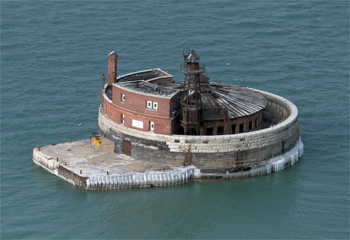
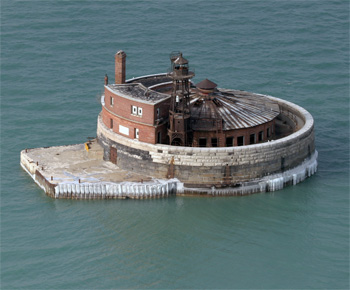
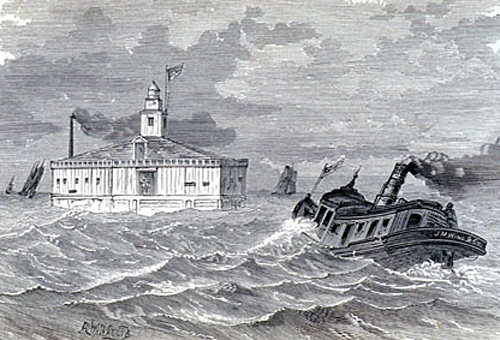
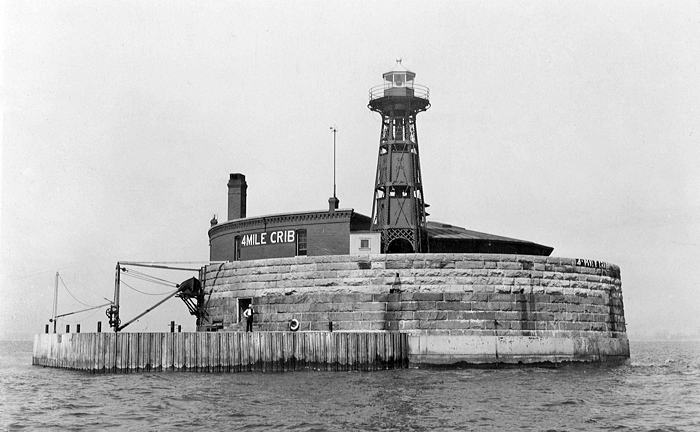
Photo Gallery
Photo Gallery
|
By 1860, the city’s population had burgeoned to over 100,000, and the Chicago River had become a veritable cesspool as raw sewage and waste from the numerous slaughter houses and other industries flowed freely into it. With a significant number of its citizens dying from cholera and typhoid fever, the city hired Ellis Chesbrough in 1861 to serve as the Chief Engineer of the newly formed Board of Sewage Commissioners and tasked him with improving the city’s water supply and sanitary systems.
Chesbrough’s plan called for the excavation of a supply tunnel to connect a pumping station situated five miles inland to an intake crib located two miles out in Lake Michigan, well beyond the increasingly polluted shoreline. Dull & Gowan of Harrisburg, Pennsylvania signed a contract for the massive project on October 28, 1863, and work got underway the following May.
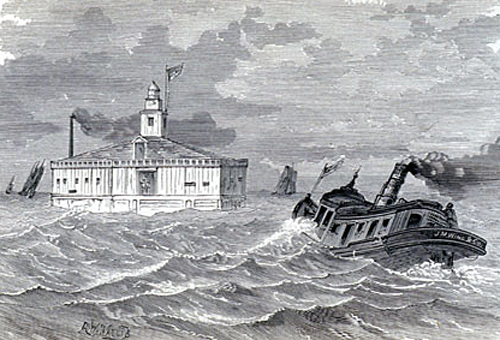
A wooden, double-walled crib, pentagonal in shape and with a height of forty feet, was built on shore and then towed into the lake by steam tugs and sunk in position by filling its hollow walls with stone. A cast-iron caisson was lowered inside the intake crib, appropriately named Two Mile Crib, and then driven into the lake floor. After the water was evacuated from the caisson, workers entered and excavated a vertical shaft to the prescribed depth before tunneling horizontally to meet the passageway being extended from shore.
Centered atop the crib was a rectangular building that contained a kitchen and bedrooms for the crib keepers along with storage space. Above this structure was a square tower that supported a birdcage lantern for displaying a light to warn mariners away from the manmade navigational hazard. The crib was also equipped with a fog bell that was struck once every minute during periods of poor visibility. Keepers lived on the crib year-round to tend the light and fog bell, and to operate the intake doors in the crib and keep ice from forming inside the crib.
The tunnel was completed on November 30, 1866, and the water system commenced operation the following year. Although the City of Chicago was responsible for maintaining the light and fog bell on the crib, these navigational aids did appear on the Lighthouse Service’s official List of Lights. In 1877, the Lighthouse Board noted that a proper light should “be placed upon the crib at the outer end of the tunnel of the Chicago water-works, to replace the present inefficient one, not under the control of the Light-house Establishment.” Four years later, the Board noted that they had reached an agreement with the City of Chicago to furnish the crib “with a third-order lens, lamps, &c, and set them in working order when the city builds the tower and lantern.”
|
To thwart terrorist activity, security systems were installed on all the intake cribs in 2002. These systems include motion detectors, video cameras, and door sensors, and are linked to the Chicago Police through a microwave link. Vessels are prohibited from entering a buoyed zone around each crib.
To thwart terrorist activity, security systems were installed on all the intake cribs in 2002. These systems include motion detectors, video cameras, and door sensors, and are linked to the Chicago Police through a microwave link. Vessels are prohibited from entering a buoyed zone around each crib.
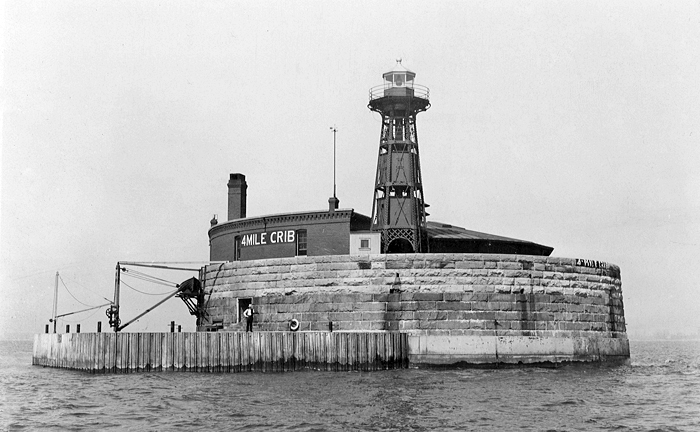
Four Mile Crib
This crib, the second built to supply water for Chicago, was built farther out in the lake to avoid contaminants fed into Lake Michigan by the Chicago River. Completed in 1891, the stone and brick crib alone cost $472,890.93, but the total cost of the system, which included two six-foot-diameter tunnels connected to pumping stations at Park arrow and Indiana Avenue, came to $1,526,143.68.Four Mile Crib was equipped with a steam heating plant in 1898 that kept the temperature inside the crib’s well room at 70° and eliminated the need for extra keepers during the winter to keep the formation of ice in check. A red skeletal iron tower topped by a silver lantern was mounted atop the crib, where it displayed a white flash every three seconds at a focal plane of sixty-six feet. In 1932, the Bureau of Lighthouses noted that a submarine cable had been laid from Chicago Harbor Lighthouse to Four Mile Crib to power its light, and a two-room addition had been constructed on the crib.
References