Halfway Rock, ME 

Select a photograph to view a photo gallery
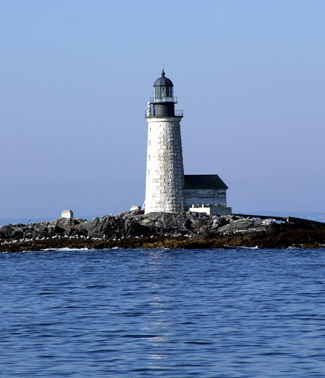
Photo Gallery
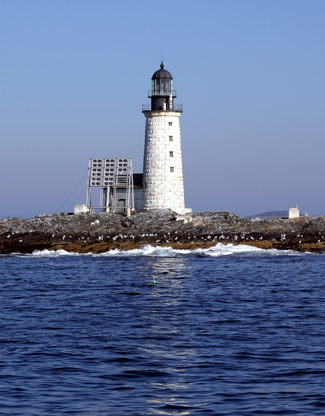
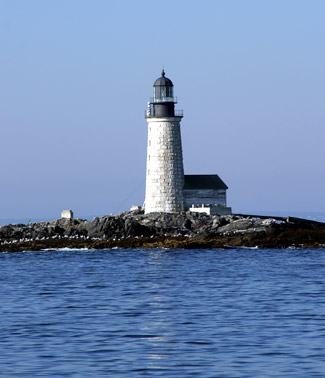
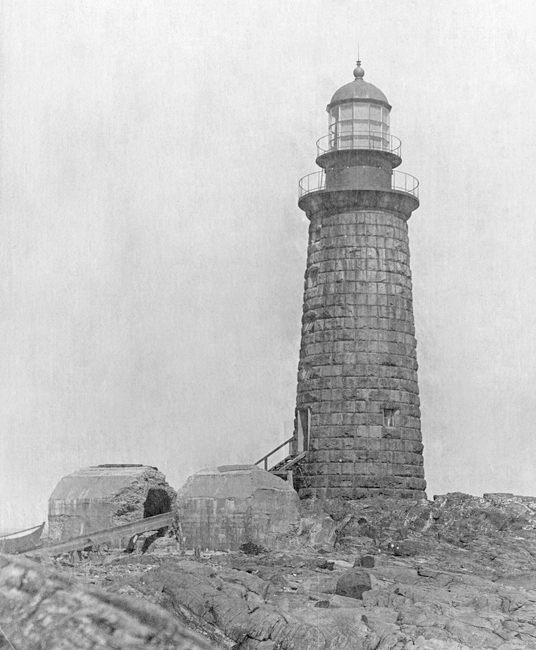
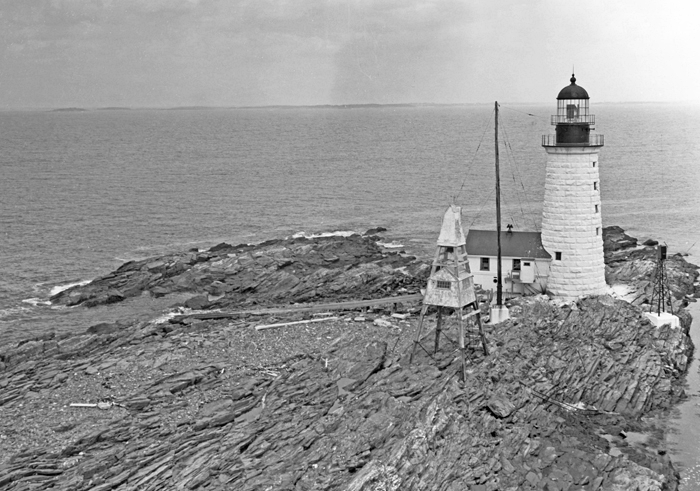
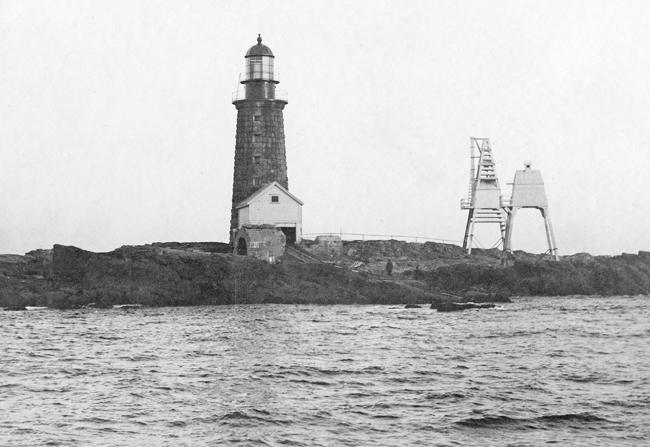
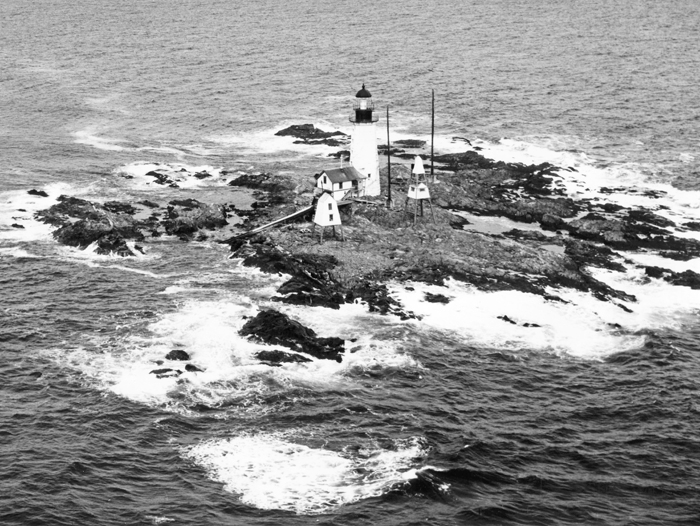
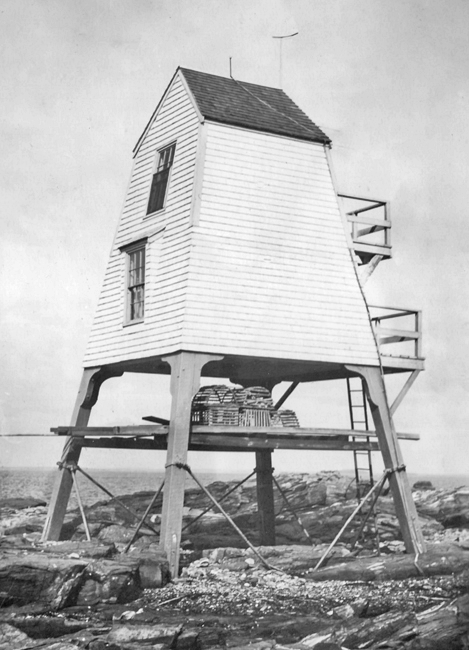
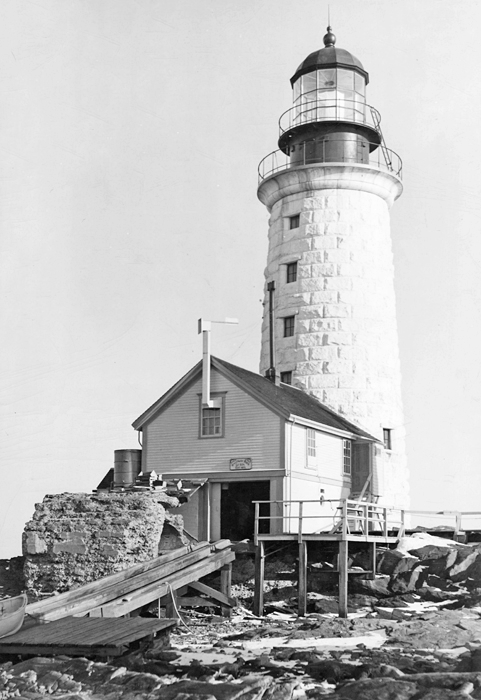
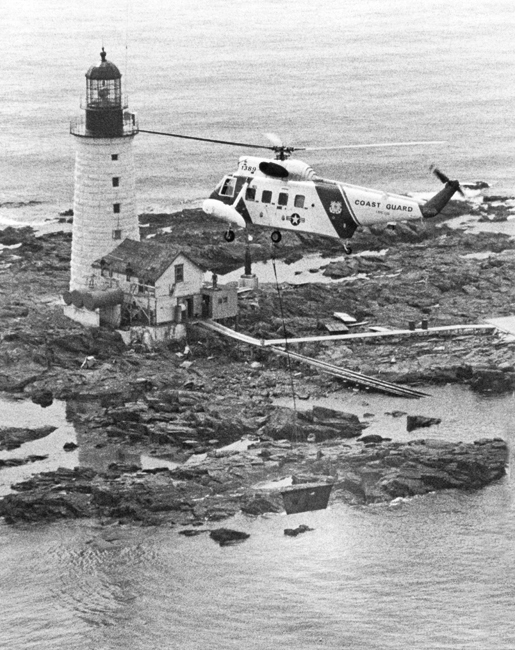
Photo Gallery
Photo Gallery
|
Despite this precaution, the ship hit ground hard on Halfway Rock at 10 p.m. that evening. Captain Small and a crewman were washed overboard by a rogue wave and lost. The surviving crewmembers managed to climb onto the rock and take cover behind protective ledges until they were rescued the next morning. Shortly after this incident, Captain Joseph Smith of the U.S. Navy wrote to his superiors in Washington: “Half-way rock is situated nearly equally distant from Portland and Seguin lights. It is a landmark much used by coasters and others, and when made there is no difficulty in shaping a course for a safe harbor. It is surrounded by deep water, and in the common passage of coasting vessel. In hazy or foggy weather, other rocks are sometimes mistaken for this, and when that is the case disaster is the probably consequence. …Upon this rock I respectfully recommend the erection of a stone monument, and the cost of it I estimate at three thousand dollars.”
Smith’s request was ignored and no action was taken for the next twenty-six years. On February 12, 1861, the British bark Boadicea, headed for Glasgow, Scotland, crashed into Halfway Rock so unexpectedly and hard that all aboard drowned. This incident caused a slight stirring in Washington, but an additional eight years passed before Congress finally authorized $50,000 to build a lighthouse at Halfway Rock.
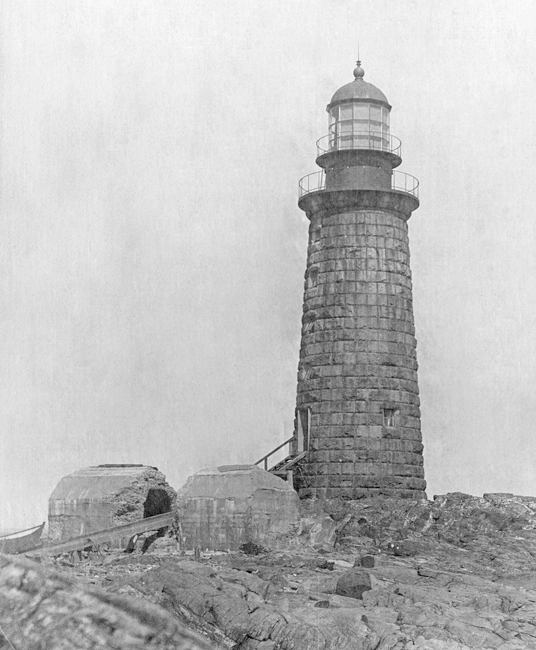
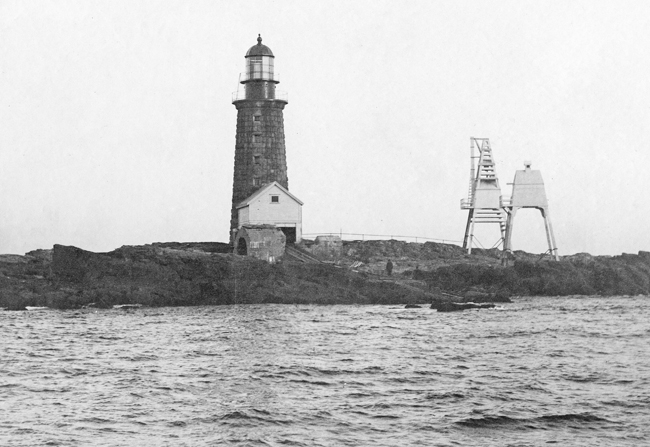
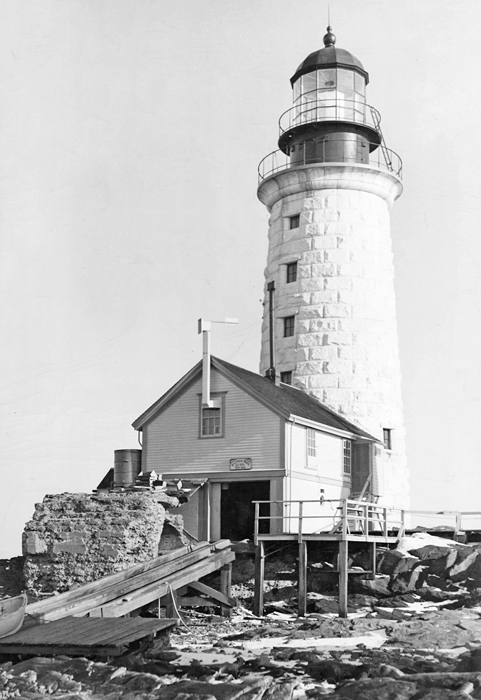
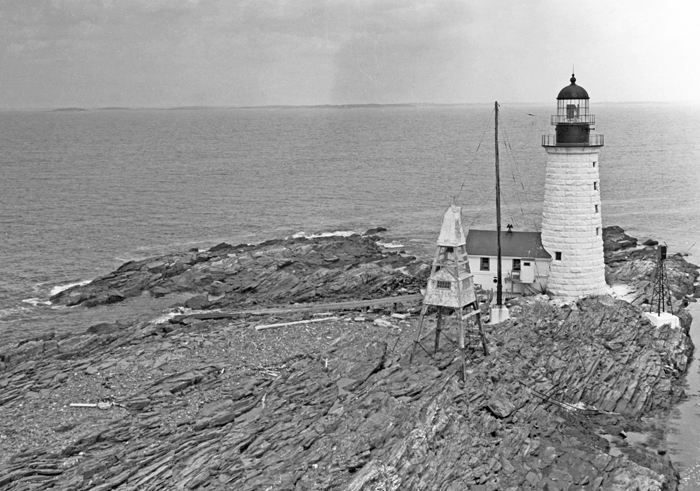
Huge granite blocks were brought from other Maine islands by boat and unloaded on Halfway Rock, where the surface of the rock had been cut to the proper level. On June 30, 1870, the balance of funds for completing the lighthouse reverted to the Treasury, and construction at the site had to be suspended. Congress approved an allocation of $10,000 on March 3, 1871 for the completion of the lighthouse, and work on the rock soon resumed. On August 15, 1871, the light at Halfway Rock was lit for the first time, thirty-six years after the wreck of the Samuel. The conical tower was originally outfitted with a revolving third-order Fresnel lens, showing a white light punctuated every minute by a red flash. To provide access to the station, a substantial masonry boathouse was built on the rock with a lengthy boat slip. In 1883, mineral oil replaced lard oil as the illuminant for the lamp used inside the Fresnel lens.
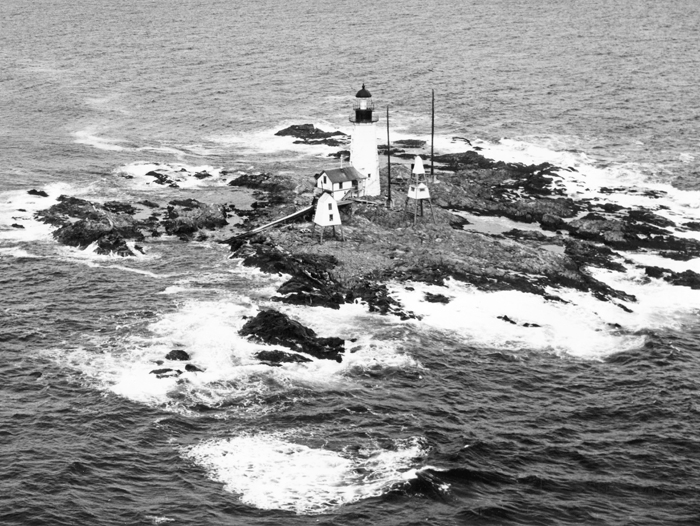
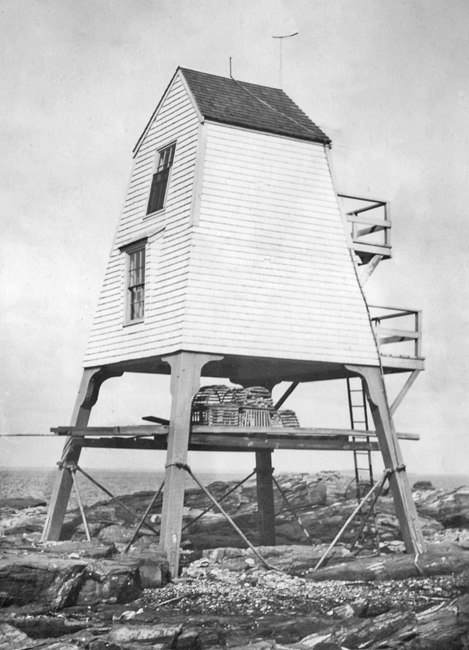
A pyramidal, skeleton bell tower, standing forty-three feet high and constructed of ten-inch-square yellow pine timbers, was bolted to the ledge eighty feet from the lighthouse in 1887. A striking mechanism delivered regular blows to a 1,000-pound bell suspended in the tower. During the bell tower’s first winter, a sea with a depth of eight feet swept over the ledge beneath the tower. In 1905, a diesel-powered Daboll fog trumpet replaced the fog bell as the station’s primary fog signal. A radiobeacon was added to the station around 1945, as another aid for mariners to use for navigating during periods of limited visibility.
|
There were three keepers employed at Halfway Rock, with two always on duty and the third usually on shore leave. Due to the tight living conditions, no families or spouses were allowed at the station. Sometimes, the isolation and lonely nature of the work exacerbated personality conflicts between keepers. An inspector from the Lighthouse Board investigated a problem between two keepers at Halfway Rock and explained the matter in a report to his bosses in October 1885:
Some 18 months ago Mr. Holbrook, then 1st Asst. Keeper…came to my office and reported to me that when he and Mr. Toothaker were alone on the Rock (the 3rd Keeper being absent), Mr. Toothaker would often refuse to speak to him for a week or 10 days at a time without any apparent reason whatsoever. The place was lonely enough of itself, and to be deprived of the company of the only other person there seemed, unless good reasons existed, an improper state of affairs…I called upon Mr. Toothaker for an explanation, and he admitted that while he had nothing against Mr. Holbrook, or any cause to complain of his conduct, still there were times when he, Mr. Toothaker, was moody and did not care to speak to any person. I informed him that this could not go on…and he promised that in the future he would not refrain from speaking to Mr. Holbrook, etc. but nevertheless he did continue to refuse to speak to Mr. Holbrook, until last spring Mr. Holbrook reported to me that Mr. Toothaker, he believed, was at times out of his mind, or on the verge of so being…Finally, Mr. Holbrook informed me that he was afraid to remain longer at the station with Mr. Toothaker, as he believed Mr. Toothaker, while in an excited state, might attack him, and that he ought to resign. I at once visited the station…Mr. Toothaker admitted that he did get into a queer state of mind at times, due he believed to his residence of 13 years on that lonely station; and he also admitted to me that his grandmother died insane.
I then informed him that he had without a doubt a natural tendency to insanity, which his lonely life on the Rock had aggravated – that if he lived on shore where he could associate and live among his neighbors & friends, he might overcome it; but I thought he certainly would go crazy if he remained there longer, as I believed he was on the verge of insanity. I then informed him that I could not take the responsibility of him remaining there longer – that if he did, there might be a tragedy, and that if he did not resign, I would be obliged to ask the Board to remove him. Thereupon Mr. Toothaker resigned.
|
In 1890, a framed and shingled oil house, eight feet square, was built and secured twenty feet above the rock on a pyramidal skeleton frame of ten-inch-square yellow pine that was bolted to the ledge.
Arthur S. Strout started as a second assistant keeper at Halfway Rock Lighthouse in 1929, was quickly promoted to first assistant keeper, and then took charge of the station in 1934. Keeper Strout happened to be on leave during a storm in late 1935 that severed the telephone cable linking the station to shore. Recalling that John Pendell, his assistant, often chatted via radio with Perley Swasey, a nineteen-year-old amateur operator, Strout asked Swasey to radio the lighthouse and ascertain conditions there. Swasey learned that waves had broken over the rock for eighteen hours straight and had partially destroyed the boat slip. With this information, Keeper Strout was able to procure supplies while on shore to make repairs at the lighthouse.
Landing at the station in heavy seas could be tricky. Kenneth Rouleau, who arrived at the lighthouse in 1960, recalled that one day John Cluff, a fellow coastguardsman, was returning to the lighthouse with the station’s repaired television set, when the boat flipped as Cluff tried to land. Rouleau remembers a sinking feeling as he thought about another three-week stretch without TV, but he was quick to forgive, as Cluff often treated his fellow keepers with such specialties as asparagus on toast and peach pies.
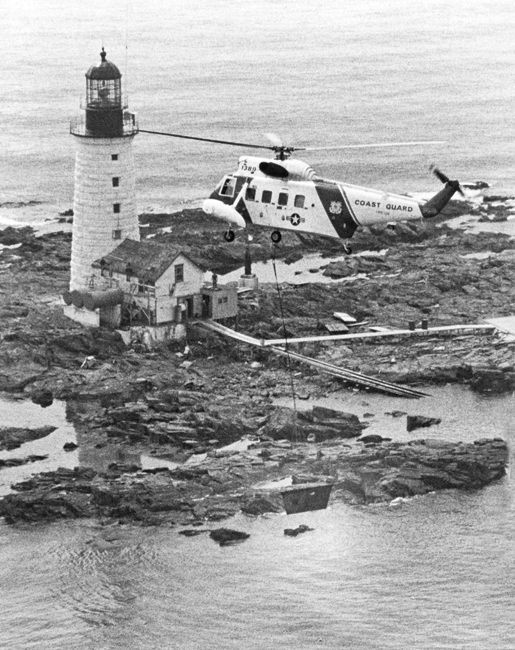
In October 1962, a nor’easter and a hurricane combined to pummel New England with sixty hours of torrential rains. The storm led to over two dozen deaths and swept away a porch, thirty feet of the track of the boat ramp, and half of the recently installed helicopter landing pad at Halfway Rock. At the height of the storm, the James E. Murray and Danny L. Harris abandoned their quarters atop the boathouse for the safer confines of the granite tower, but not before taking with them the television set. James E. Murray told a reporter, “I believe that the entire house – our living quarters, but not the tower – would have been washed away if the storm had peaked at high tide. “ The land telephone and radio continued to operated throughout the storm. When asked if the storm was the worst one Murray had seen in his more than four years at Halfway Rock, he replied, “You know, while you are in them every one is the worst on. But even now that it’s over, I think I can still safely say that I’ve never been in any worse ones.”
A storm in February 1972 damaged the Fresnel lens in the lantern room and led to the decision to automate Halfway Rock Lighthouse. Some were sad to see the era of staffed lighthouses coming to a close, but not Stephen Krikorian, the last Officer in Charge of Halfway Rock. “People think it’s real good duty,” Krikorian said. “They say we have it made, but they oughta be out here. It gets to you after a while, trying to find something to do.” When a basketball washed up on the rocks one day, Krikorian took a ball point pen and outlined each of the pimples on the ball as he counted them. Every wonder how many there are? There were 2,248 on that ball.
|
On May 16, 2012, Halfway Rock Lighthouse was made available under the National Historic Lighthouse Preservation Act of 2000 to eligible federal, state, and local agencies, non-profit corporations, educational agencies, and community development organizations to be used for educational, recreational, cultural, or historic preservation purposes. Interested entities were given two months to submit a letter of interest expressing their desire to submit an application for ownership.
When no qualified custodian was found, an online auction for the lighthouse was initiated on May 14, 2014. Six bidders participated in the auction, which saw the lighthouse sell for $283,000 on September 20, 2014. The lighthouse’s new private owner is Ford Reiche, who ran Safe Handling, a rail-to-truck transfer business in Auburn, and is passionate about historic preservation. Reiche’s winning bid is the most ever paid for a Maine lighthouse, and he has since invested a significant amount in restoring the lighthouse. To make the ten-mile trip to the lighthouse, Reiche purchased a twenty-five-foot Safe Boats International Defender-class vessel at a Coast Guard auction, and then spent a summer building a 150-foot dock and ramp at the wave-swept lighthouse. Reiche has stripped the interior walls down to their Douglas fir paneling and created a cozy living space that is warmed by a Queen Atlantic wood range. “Ford was its last hope, really,” said Bob Trapani, executive director of the American Lighthouse Foundation. “No one would do what he’s doing. Thirty years from now, this will be seen as a historic moment.” In 2017, the American Lighthouse Foundation honored Reiche with its Keeper of the Light Award for his successful restoration of Halfway Rock Lighthouse.
Keepers:
References