Mount Desert Rock, ME 
Select a photograph to view a photo gallery
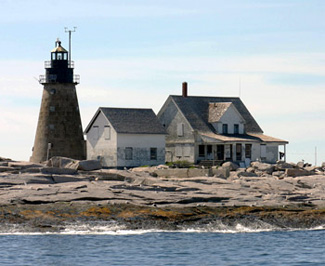
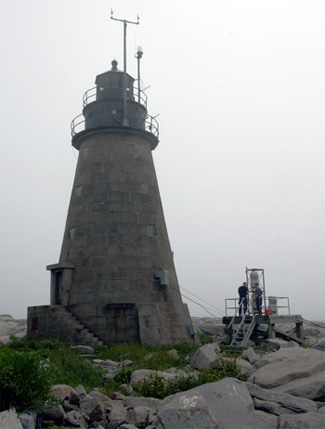
Photo Gallery
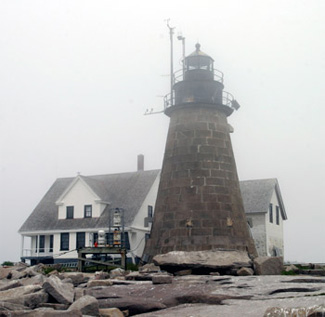
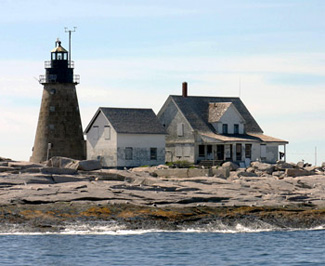
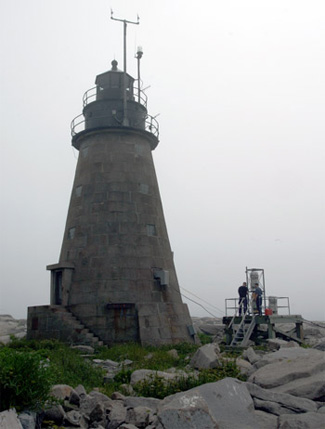
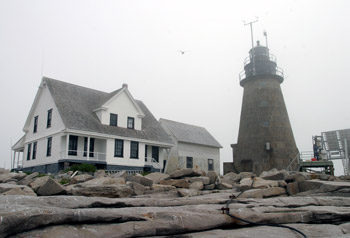
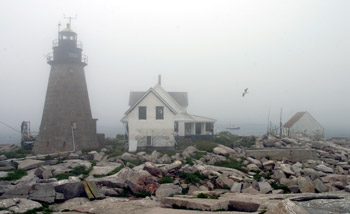
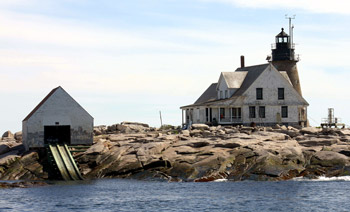
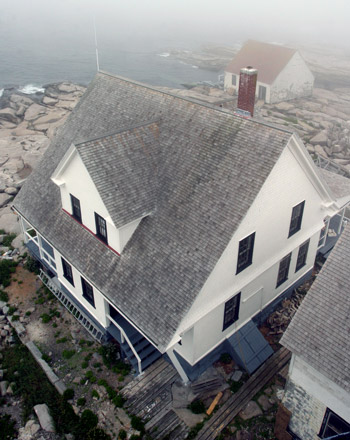
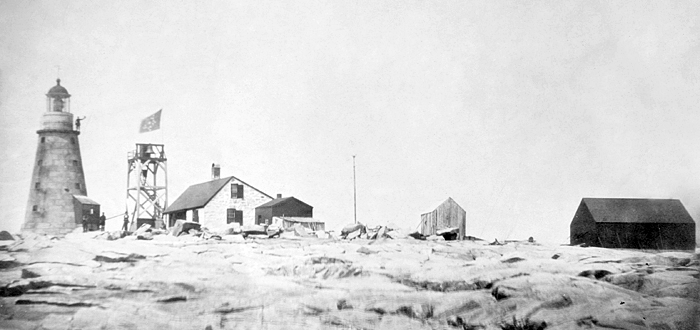
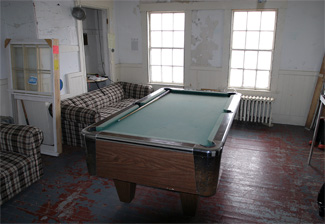
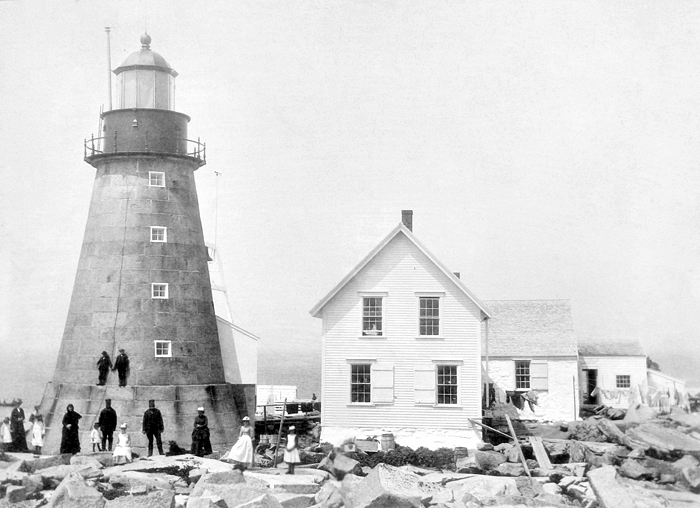
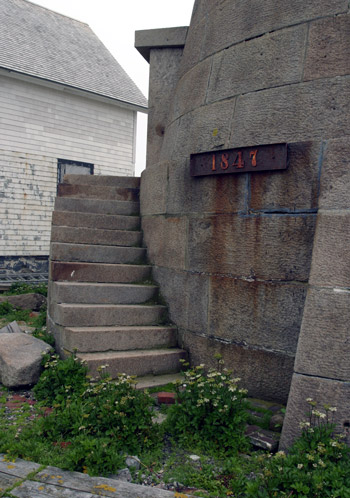
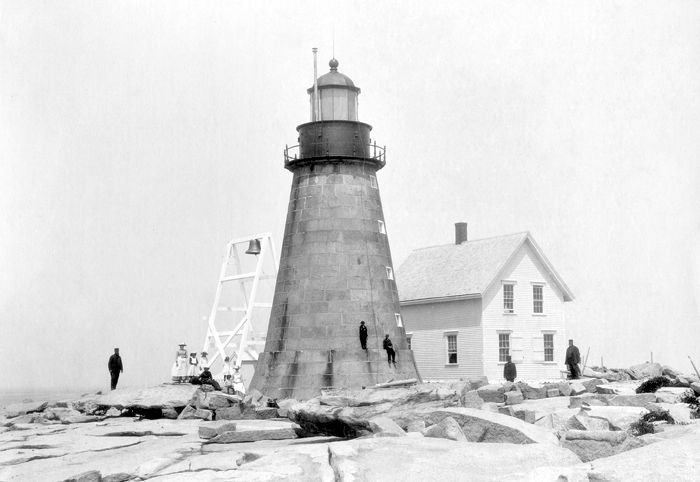
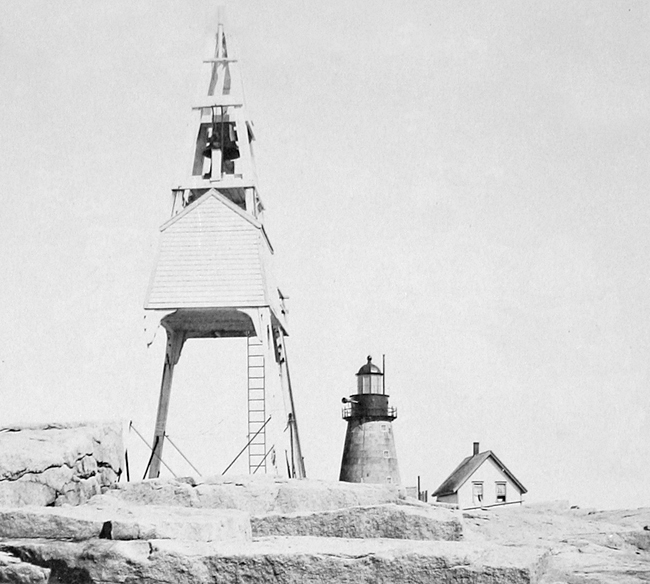
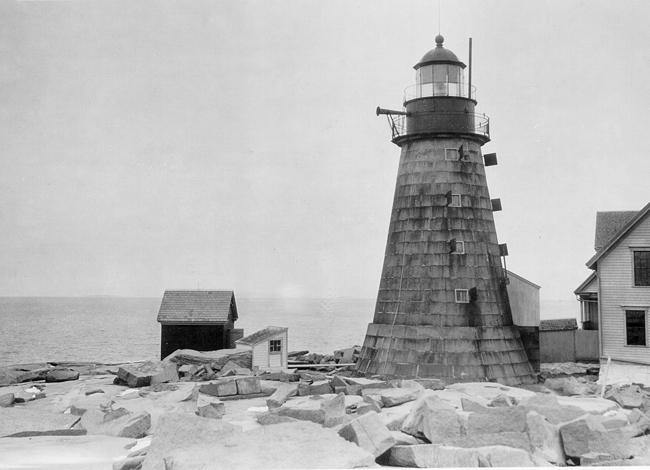
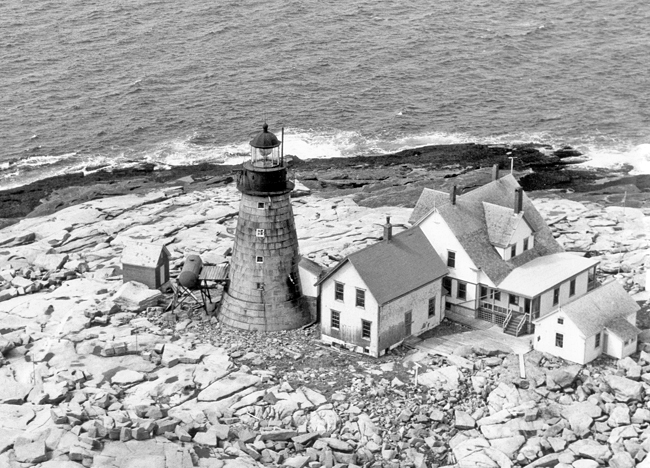
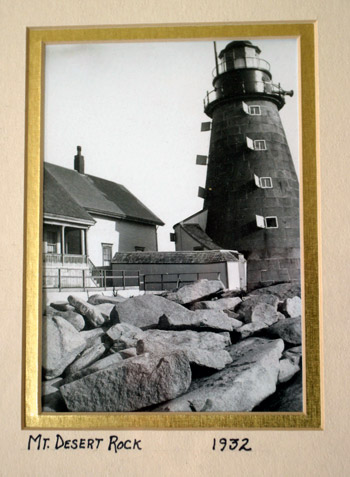
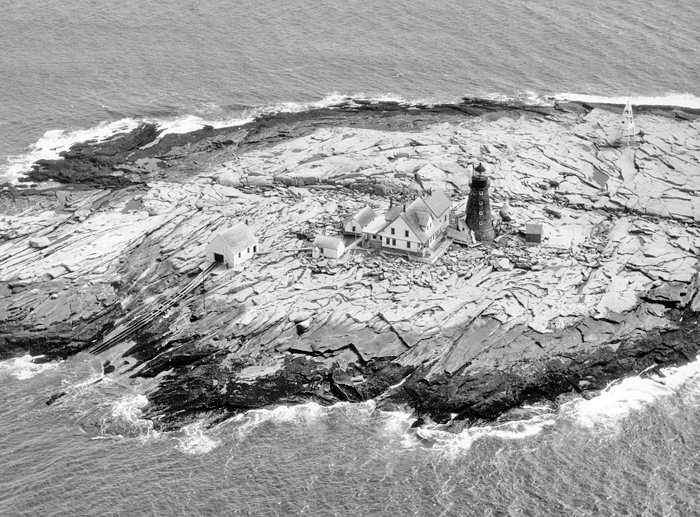
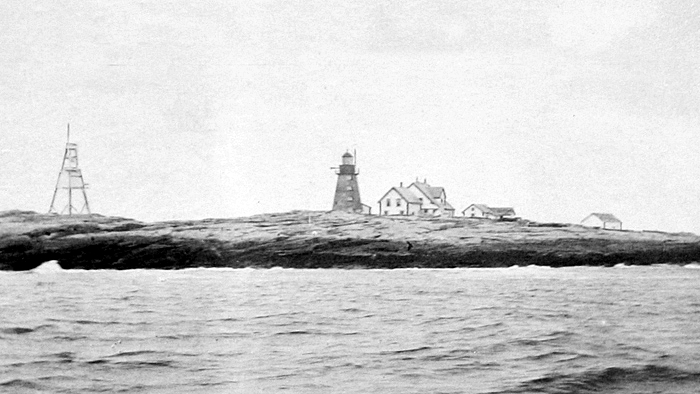
Photo Gallery
Photo Gallery
Almost a century-and-a-half later, just before Christmas in 1977, a helicopter landed on the rock and took away the last two keepers, after the lighthouse had been automated. Twenty-year-old coastguardsman Douglas Nute, from St. Louis, was one of those last two keepers. Nute said that after his first twenty-four hours on duty at the rock, he was ready to scream. He had previously been on duty for eighteen months at Great Duck Island Lighthouse, about halfway between Mount Desert Rock and the mainland, so he was familiar with duty on isolated islands, but being stationed on the Rock was different.
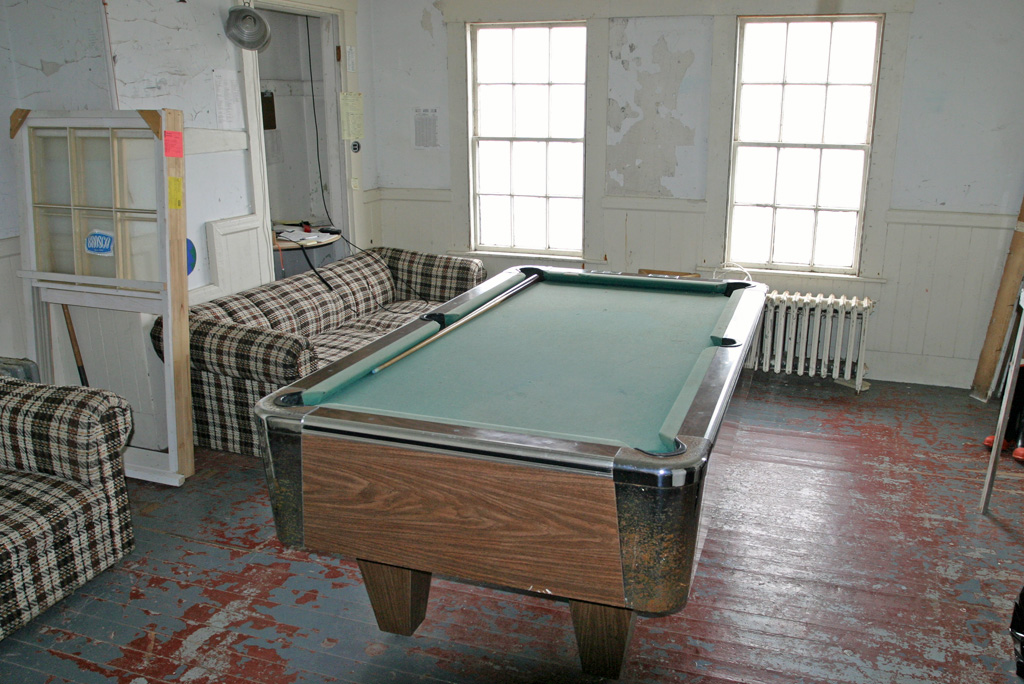
Mount Desert Rock had almost no vegetation and could be thoroughly explored in just a few minutes. “At least on Great Duck,” he said, “you had a mile and a half circumference you could walk, and trees, and grass, and birds and people over on the other side you could talk to. But on this Rock, there was nothing but the noise of the foghorn day and night.” The Coast Guard tried to make life more bearable on the Rock by supplying the keepers with books, radios, television sets, video games, and even a pool table. Even so, after every twenty-two days or so of duty, each coastguardsman went ashore for eight days of leave.
Only one year after the lighthouse had been built, a Captain Derby wrote: “…found the lighthouse in a state of rapid decay. It must have been rapidly built. The material is all bad. The mortar in particular is made with salt water sand & mixed with salt water. If you analyze it, you can see no Lime whatever. The Lantern & its apparatus in good order, and at a distance of 20 miles, it was plain to be seen. The dwelling House in bad order; leaks much & smoaks [sic] badly. Unless something is done, the Lighthouse will be down.”
When I.W.P. Lewis visited the station in 1842, he reported:
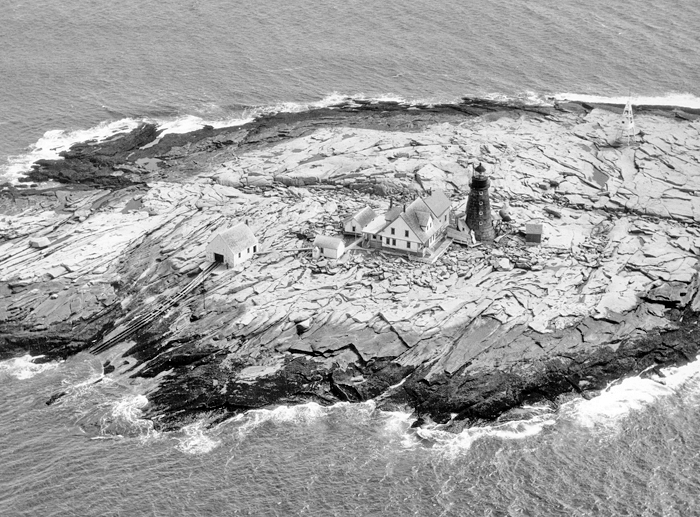
The location is the most dangerous of the whole light-house establishment – a line rock in the open ocean, only fifteen feet above tide level, and its entire surface swept over by the surf in storms; the force of which may be estimated by the fact of large masses of rock being moved from place to place by the fury of the sea dashing against them; a pile of these are heaped up in front of the keeper’s house, and were it not for protection afforded by this natural breakwater, the house and its inmates would have long since been swept away. The light is a very important one. The rock on which it stands is 12 miles from the nearest land, and has been the scene of many fearful disasters. The feebleness of the light may be imagined when it is known that the brig Billow, of Boston, was wrecked there a few years since. Mount Desert Rock, as one of the exterior coast lights, is of great value to warn vessels of their approach to the shore or Maine, and should therefore be distinguished, by its intense brilliancy and peculiar character, from all others. In its present state it is of little utility; twenty-four lamps are required here for a fixed light.
|
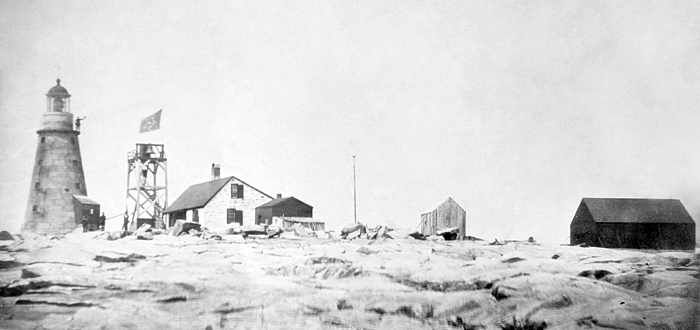
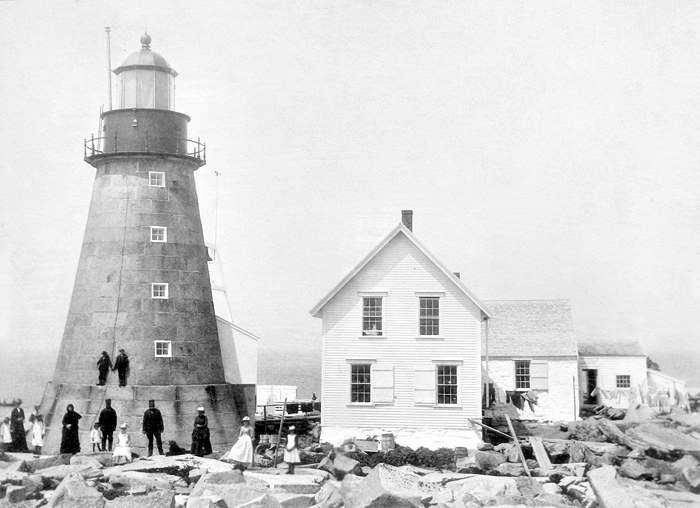
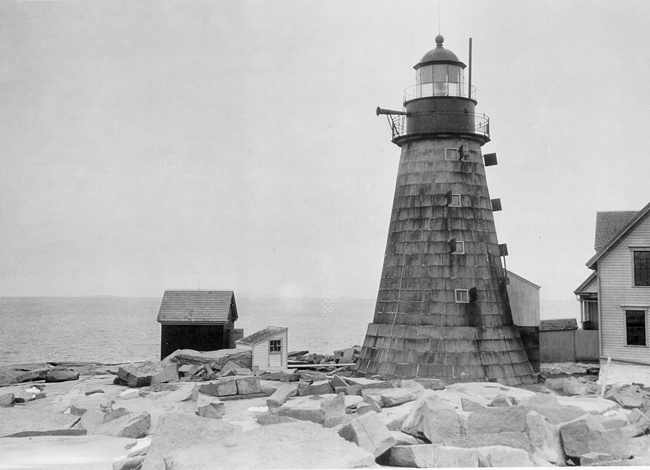
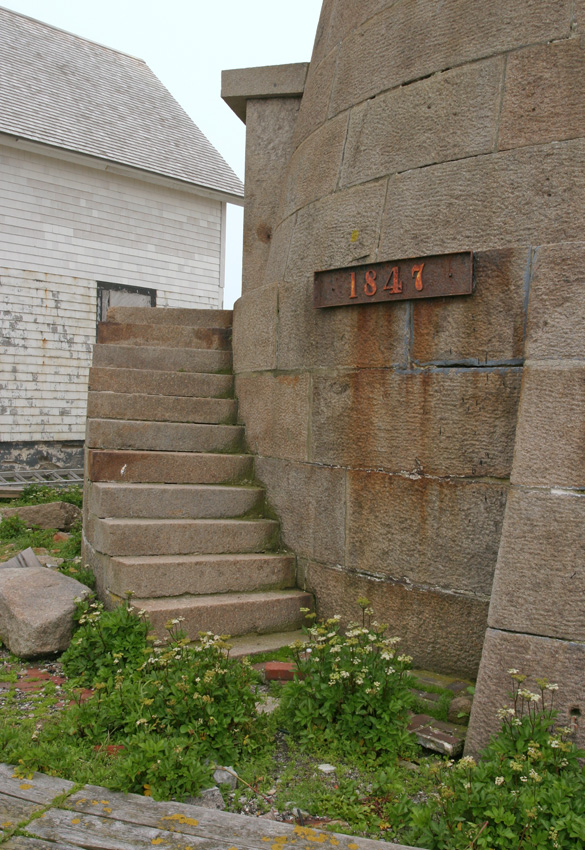
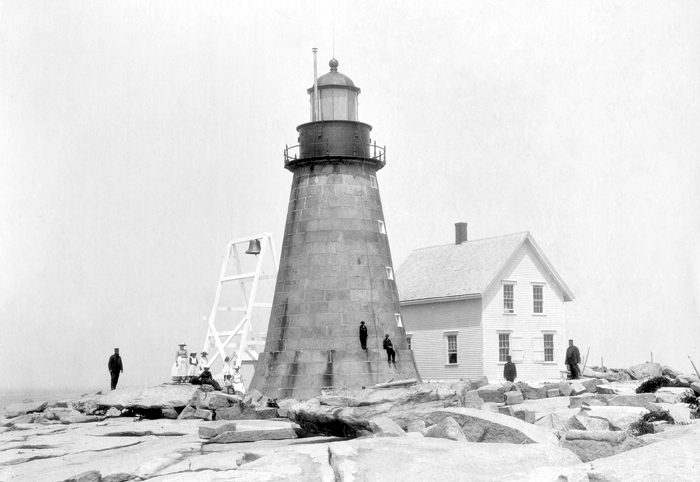
The original 1830 optic consisted of a chandelier of ten Argand lamps backed by fourteen-inch reflectors displayed at a focal plane of fifty-six feet above sea level. This was not good enough to be an effective aid to navigation, and in 1847 Congress authorized $15,000 for the “rebuilding” of the lighthouse on Mount Desert Rock. The new lighthouse, which was separate from the dwelling, was described in an 1850 report as “a beautiful tower, built of heavy granite stone, and just such a building as the locality needed, to stand the furry of the elements.” The keeper and his family still lived in the old stone dwelling, as it was more “convenient for the family to do their work in,” but it was felt that if a kitchen was built onto the lighthouse, it would be a “very suitable place” for their work, if the keeper decided to abandon the dwelling and move into the granite tower. In 1857, the newly formed Lighthouse Board supplied a new lantern room and third-order Fresnel lens for the tower.
In 1853, mariners requested that a fog bell be established on Mount Desert Rock, which was situated in the track of vessels sailing between Boston and the Bay of Fundy. This addition would permit navigators to get within hearing distance of the bell on the rock and then set a new course, rather than trying to avoid the rock. A bell, run by machinery, was soon placed on the rock, and an assistant keeper was assigned to the station in 1855 to help with the extra work created by the bell.
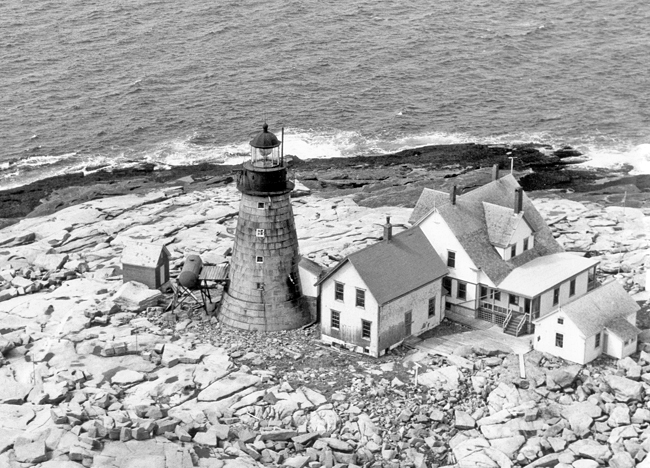
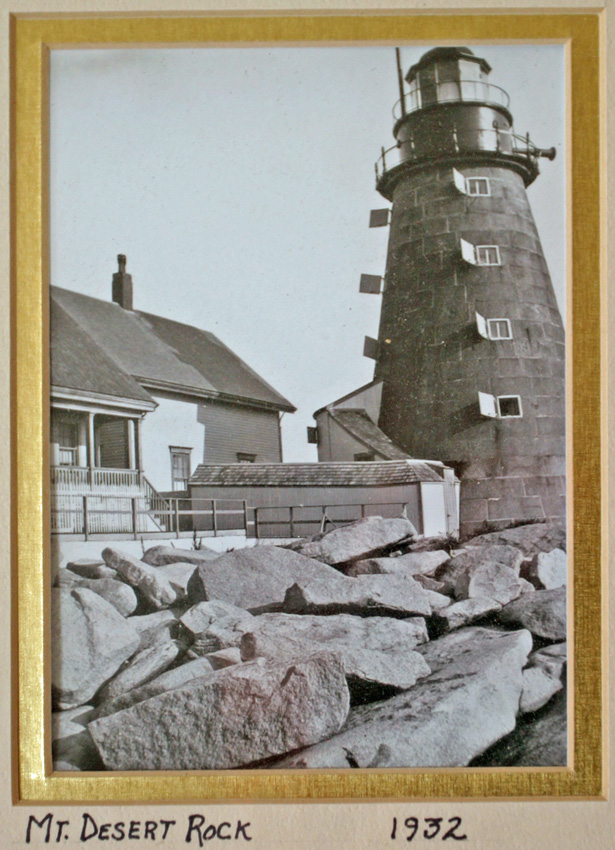
In 1876, a one-and-a-half-story frame dwelling was built on the rock just south of the old stone dwelling that was still being used by the keepers. As the top of the lighthouse was leaky, making the structure uninhabitable, its stone parapet was removed in 1880, and a cast-iron lantern deck and gallery were installed. At this time, new window frames were put in and the exterior walls of the tower were repointed.
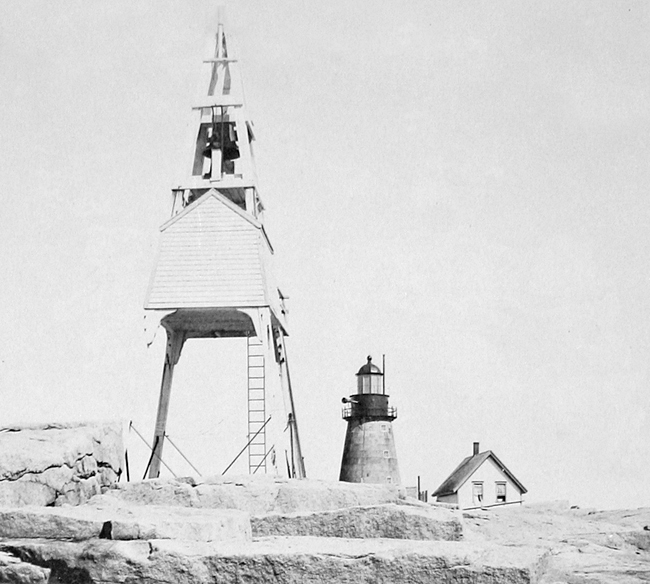
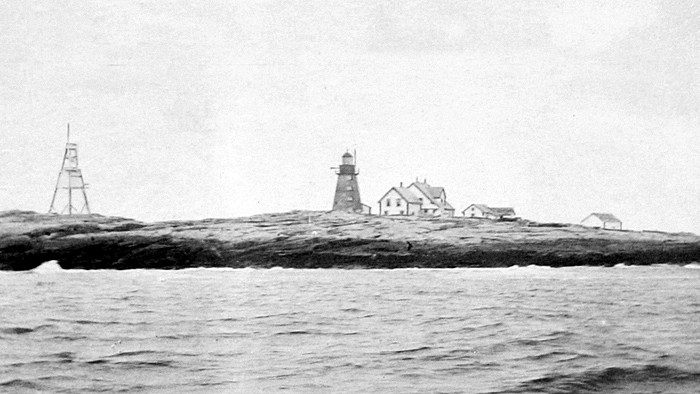
A forty-five-foot-tall bell tower, with ten-inch-square pine legs securely bolted to the rock, was erected in 1887. The floor of the enclosed portion of the tower was twenty feet above the rock and contained the striking machine for a 1,000-pound bell. No matter how hard this large bell was struck, it still wasn’t loud enough to be heard too far over the noise of the crashing waves. Finally, a more powerful fog signal added to the station in the form of a third-class Daboll trumpet, which commenced operation on November 30, 1891.
|
A revolving fourth-order Fresnel lens was installed atop the lighthouse in 1898, changing the light’s characteristic from fixed white to a white flash every fifteen seconds.
Few keepers lasted very long at this inhospitable station. Rufus King endured almost six years, from 1853 to 1859, when he was terminated for an unknown reason. His replacement, George Booth, resigned after seventeen months, and Booth’s replacement lasted less than eight months. As an incentive, keepers at Mount Desert Rock were at one point paid a salary of $840 a year, compared to around $600 for most other lighthouses. One keeper, Thomas Milan, did manage to last almost twenty years, from 1882 to 1902.
Not surprisingly, the keepers’ logs at Mount Desert Rock contain records of numerous shipwrecks and rescues. One such notable event occurred at 5 a.m. on December 9, 1902, when the tug Astral, with a crew of eighteen aboard and towing a barge, crashed into the northeast ledge of the rock. A young assistant keeper heard a ship’s distress signal and woke the head keeper, who recounted the events of the day:
The vapor was flying so densely one could hardly see ten feet ahead. It was inky dark and blowing one of the worst gales I have ever seen. It was high tide and we could make out some kind of steamer ashore on the northeast point, but the big seas were running so mountain-high that it would have been suicide for us to try to get out to her. …Not being able to see or hear anything or get any answer to our shouts, we stayed until we nearly froze to death….As soon as our fingers worked again, we got down ropes and life preservers as near the wreck as we could, but we were compelled to wait until the tide went down and we could cross the point and get a line to the craft. We succeeded in rescuing seventeen men. There were eighteen in the crew, but one was frozen to death.
Other assistance rendered by the keepers include First Assistant Wilbert F. Lurvey rescuing Lafayette Carter in October 1912, and First Assistant Arthur E. Ginn towing a disabled powerboat with two fishermen in it to the station in 1923. A son of Keeper Vinal O. Beal aided Keeper Lurvey in rescuing Mr. Carter, who was from Bass Harbor and had been without food for multiple days. Mr. Carter wrote the following about the incident:
It was the first of October that my engine was disabled about 16 miles south of Isle au Haut on Sunday. There was nothing for me to do but go to sea in the strong gale, wind about North, too strong for any fishing boats to be out to search of me. I had nothing to eat for 6 days and no water for four days. However, in that time the wind changed to South and westward and after quite a hard time I came in sight of Mount Desert Rock, and it was blowing so hard then that I couldn’t get ashore with the tide setting to the East. After a while I saw the station men preparing to rescue me, although with all chances against them. I didn’t expect them to come out, but stormy weather could not disturb their courage, for in their small boat they took me from the disabled power boat and saved my life, for my chances of living until morning was one change in a thousand, for when I got ashore I hadn’t strength enough to walk.
Sometimes, it was the keepers themselves that needed to be rescued. Forty-three-year-old Henry C. Ray drowned in 1920, when he and Maurice R. Beal, the other assistant keeper, were thrown from the lighthouse dory during an attempted landing. Keeper Harry E. Freeman managed to rescue Beal, but Henry Ray was swept away and drowned in full view of his wife.
A radiobeacon was added to Mount Desert Rock in 1932, and its power plant was used to electrify the entire station, which increased the candlepower of the light from 24,000 to 70,000.
Keeper George W. York of Mount Desert Rock was one of four keepers on offshore stations in Maine to report bird kills to employees of Acadia National Park in 1934. The first snow of the winter fell on October 12 that year, prompting a heavy flight of migrating birds. During the next three nights, Keeper York collected thirty-nine dead birds of sixteen different species that had dashed against the lantern room’s glass panes. York kindly mailed the birds to park personnel so they could be identified. Helen York suffered a miscarriage in 1935 and almost died since she was so far from medical help. When Helen was expecting again the next year, Keeper York applied for a mainland station, but as no openings were available, he decided to resign from the service.Mount Desert Rock was a desolate place, with practically nothing growing there. Fishermen would show their thanks for the light by bringing grain bags of dirt to the rock each spring. The American Weekly reported in 1934 how the rock had developed a reputation of being a “floral paradise” for a few months each summer:
The dirt the fishermen bring off is carefully packed in between the crevices and seeds of many varieties are sown and carefully tended. Strangely enough they nearly all thrive in the cold moist atmosphere. Visitors approaching the rock during the summer and early fall are amazed at the kaleidoscope of color that greets the eye on the barren ledge.With the first fall frosts, the garden disappears, and long before the winter is over, the raging storms that literally throw huge waves across the rock area wash every vestige of soil from the offshore rock garden. Long before spring comes around again not even a spoonful of soil is left on the rock.
Not long after the lighthouse was destaffed in 1977, the College of the Atlantic began using the light station as a whale research outpost. The station was transferred to the college under the Maine Lights Program in 1998 and remains an active aid to navigation. The lighthouse, equipped with an LED solar-powered beacon, is listed on the National Register of Historic Places.
The keeper’s house serves as an ecology research facility known as the Edward McC. Blair Marine Research Station. The college replaced the roof of the keeper’s house in 2000, and the following year, the generator house was expanded by the addition of a second floor. The first floor is now a marine lab, and the second floor is a classroom. In August 2009, Hurricane Bill damaged several of the station buildings and nearly destroyed the boathouse, but the lighthouse was not damaged.
Sometimes whale watch cruises leaving from Bar Harbor may pass Mount Desert Rock, but only if the whales happen to be passing that way, too.
In 2014, Jacomien and Forrest Mars, whose company sees over $30 billion in annual sales of candy bars, donated $425,000 to upgrade the facilities at Mount Desert Rock. The Mars family met Sean Todd, chairman of the marine studies program at the College of the Atlantic, while he was serving as a tour guide aboard a vessel off Antarctica and took an interest in the college’s experiential outpost on Mount Desert Rock.
Keepers
References