West Bank, NY 

Select a photograph to view a photo gallery
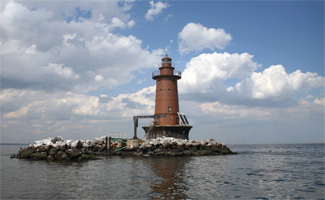
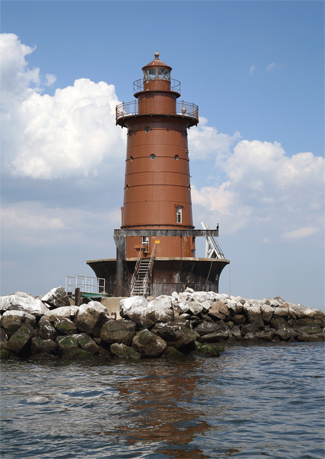
Photo Gallery
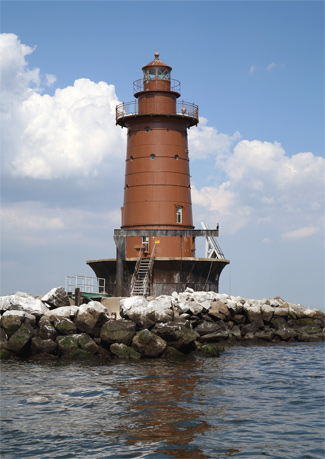
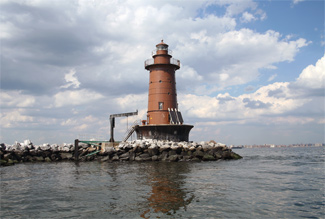
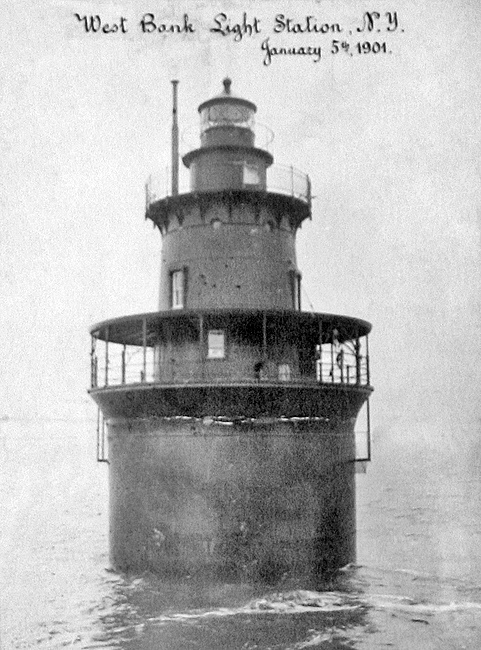
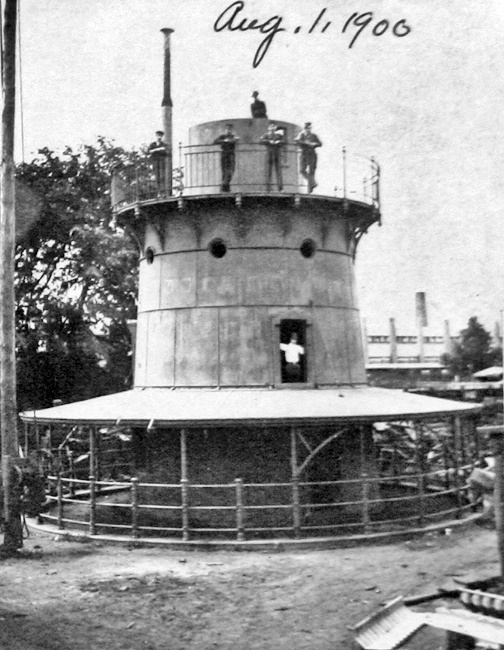
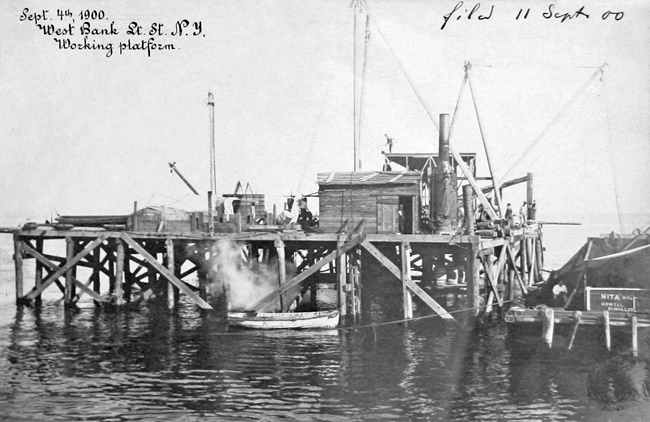
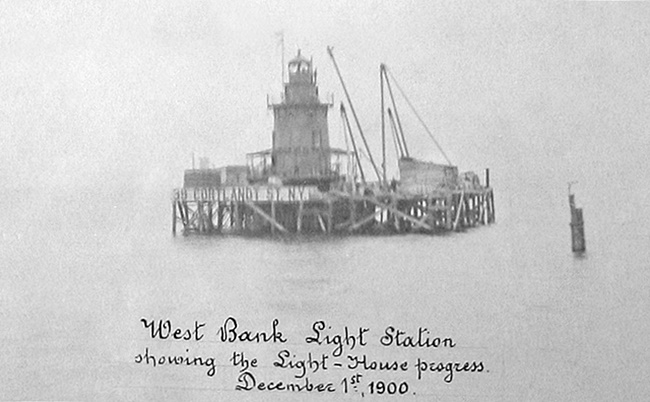
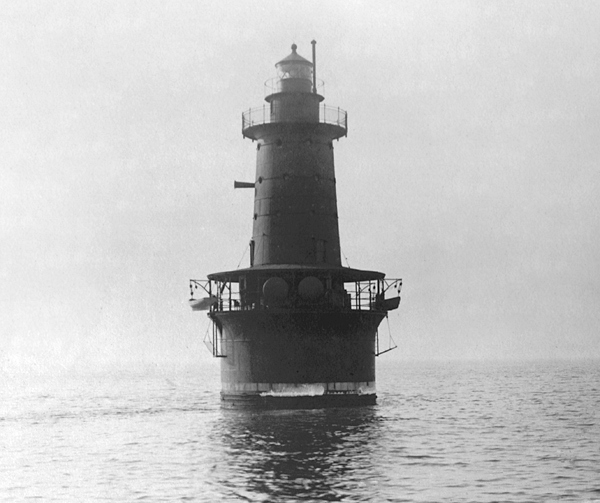
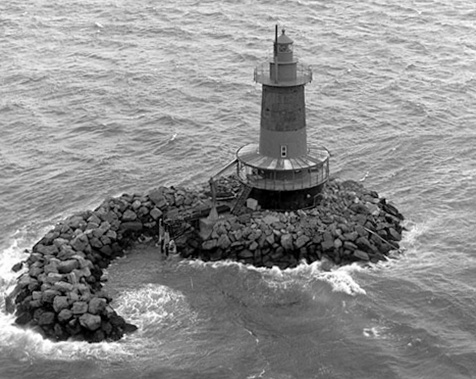
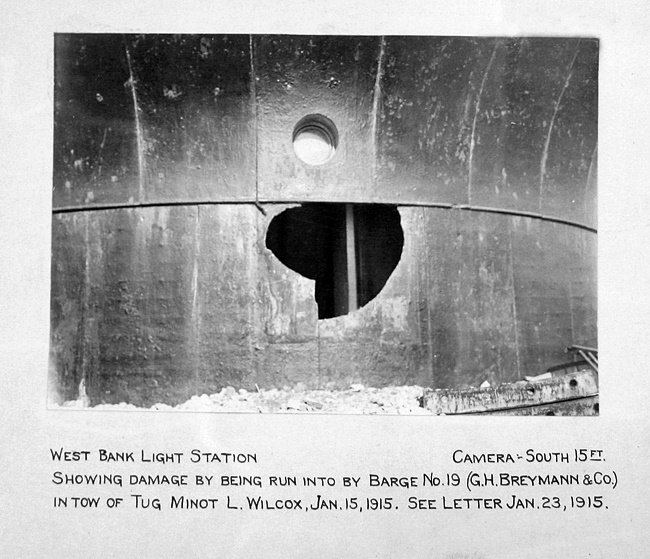
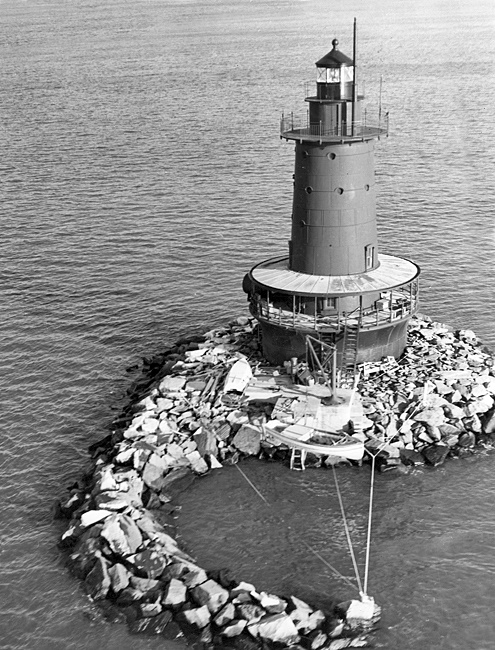
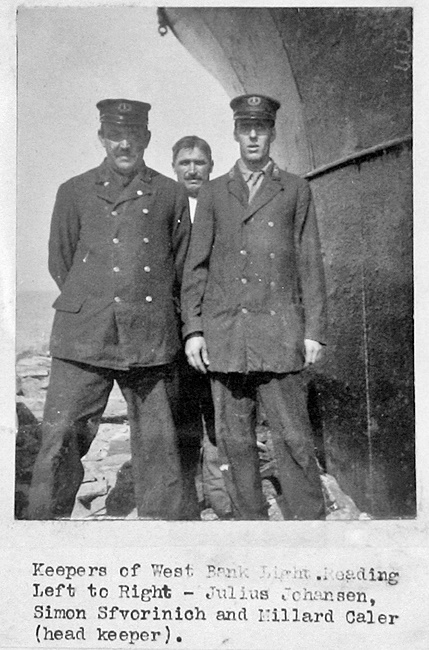
Photo Gallery
Photo Gallery
|
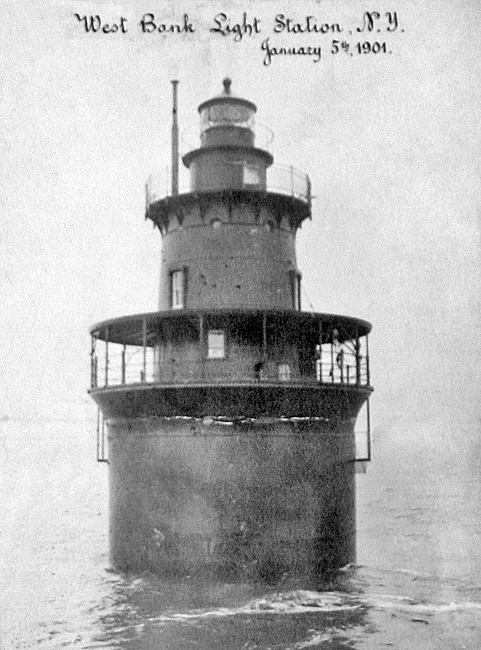
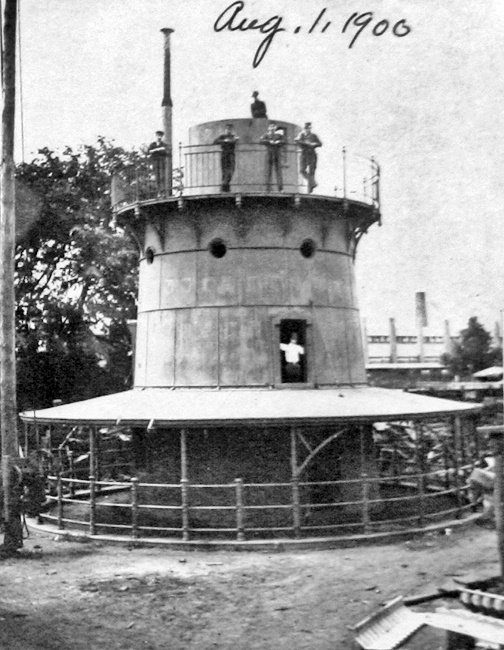
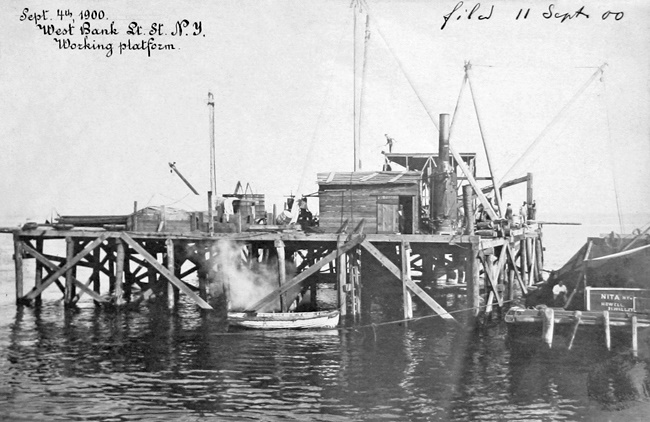
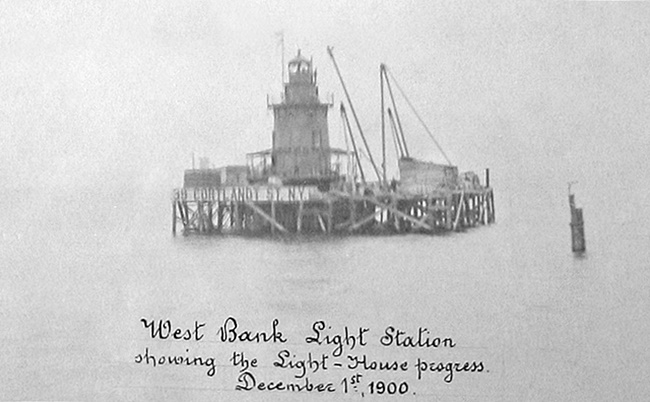
In July, 1900, the benchmark was established and the site was excavated to a depth varying from 8 to 10 feet below the bottom. In August the first, second, third, and fourth sections of the foundation cylinder plates were sunk in position. The entire metal work of the superstructure, weighing 135,000 pounds, was delivered at the depot. In September the concrete filling of the first, second, third, and fourth sections of the cylinder was completed. The excavation of the exterior was filled with gravel. Some 250 tons of riprap were deposited, and the fifth, sixth, and seventh courses of foundation cylinder plates were prepared for lowering into position. In October the fifth, sixth, seventh, and eighth courses of foundation cylinder plates were fitted into position, and the ninth course was in progress; concrete filling was brought up to the level of the cellar floor. In November the ninth and last course of foundation cylinder was completed, the erection of superstructure was begun and completed, and the lantern deck and watershed begun. In December the erection of the station was completed. On January 1, 1901, a fixed white light of the fourth order, with red sector, was established. On June 1, a blower siren signal was established consisting of 2 oil-burning engines, each of 2 horsepower with No. 2 blower, 1 blower, 1 blower siren, 1 copper horn, 1 blast device, and 1 blast gate to sound blasts of 2 seconds duration, separated by alternate silent intervals of 2 and 5 seconds. On June 12 the eighth load of riprap was delivered, making a total of 1,528 tons, furnished and placed under contract for the protection of the station.
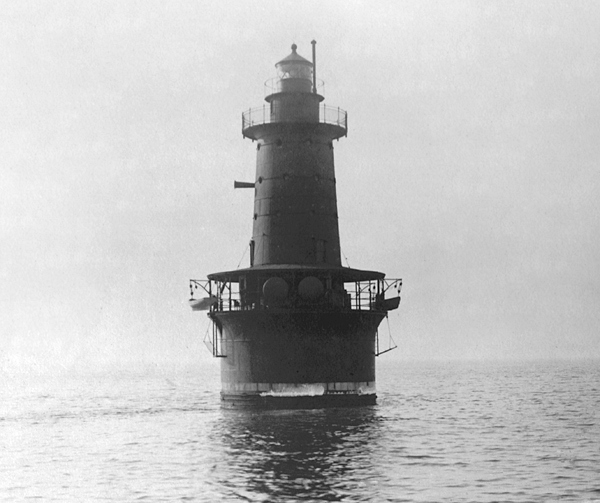
In 1906, as the nearby Ambrose Channel neared completion, Congress approved funding for a number of lights for the new waterway. Besides the establishment of Ambrose Lightship and the relocation of North Hook Beacon, West Bank Lighthouse was raised to a height of seventy feet to bring it into range with the newly proposed Staten Island Lighthouse. A temporary structure was erected on West Bank in late 1907 to display a light while two stories were added to West Bank Lighthouse between its watchroom and the deck below it. This work was finished on January 8, 1908 at a cost of $9,198, but the companion rear tower on Staten Island was placed in operation until April 5, 1912. The extension on West Bank Lighthouse is obvious today, being bounded by the two rows of porthole windows that ring the tower.
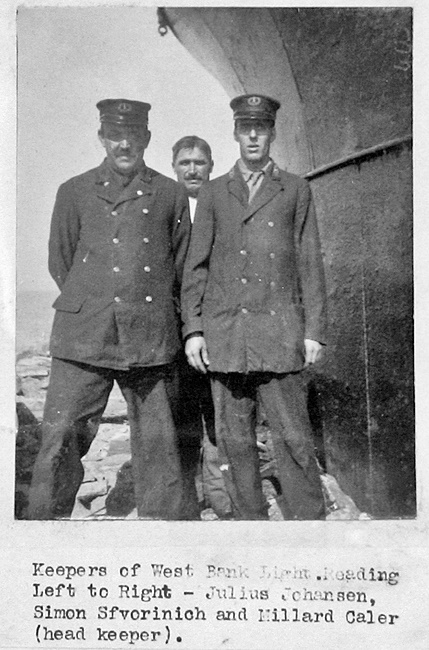
The first head keeper at West Bank was a lighthouse legend named Ed Burdge, who for a period of thirty-four years, stretching from 1886 to 1920, manned a number of lights around New York’s Lower Bay. Burdge’s lighthouse career began with stints as keeper at Twin Lights at Navesink and then Great Beds and Old Orchard Shoal before spending six years at West Bank. Following that, he was keeper at Elm Tree Light on the Swash Channel Range for fourteen years.
|
You couldn’t get that dog to live ashore. Sometimes when I took him with me after supplies, he’d run down to the edge of the water and look out toward the light, and whine. If the light dimmed at night, or the fog signals stopped, he’d bark and tear around. He recognized a lot of boats, too, and would bark to the tugs he knew. I used to tie a flag to his tail, and he’d run out onto the gallery and wave signals. He always slept outside on the gallery, no matter how stormy it was, and watched the light and the boats. He was a lot of company. When I was transferred to Elm Tree I brought him ashore with me, but he wouldn’t live here. He was homesick, so I had to take him out and give him to the new keeper on the West Bank. He lived on the offshore lights for eleven years. Then the keeper brought him ashore, and he died in three days.
After watching the lights glow at night from Coney Island and New York, Burdge would occasionally entertain thoughts about being over where the action was, but he knew the life wasn’t for him. “If I had been ashore I wouldn’t have had the money to go to those places, and if I had gone the chances were that I wouldn’t have fitted in,” he said. Burdge destroyed any romantic illusions that readers may have had about the exciting adventures keepers witness, saying, “No lighthouse keeper sees much, because when big things are happening it is mostly when you can’t see a thing. There have been wrecks, and sinkings, and rescues, and all that sort of thing right near; but on nights when such things happen, when the gale is howling, and the waves are going over the light, when you can’t hear yourself think, usually a keeper can’t see twenty feet beyond the tower.”
Burdge also destroyed any notions people may have had about lighthouses being places for quiet contemplation:
I met a lady once who was all filled up with what she called the romance of the lighthouse. She said she often longed to be a keeper and live alone in a tower on a rock far out in the sea, and have peace and quiet. She couldn’t understand why I snorted. Peace and quiet! A lighthouse is about the noisiest place in the world. Out there on West Bank, for instance, with a gale blowing. When I was there the tower rose right out of the water, with no footing at all around it, so the waves crashed against the whole tower; shook it until sometimes the mantles over the burners in the light broke. Sometimes the waves went clear over the gallery, and the spray over the light itself.Forty or sixty tons of water, driven by a fifty-mile gale, racing in with the tide and slamming against a solid tower of stone and iron makes it about as quiet as when two railroad trains butt each other head on. Down at the floor level, there is a gas engine pounding away, with the exhaust exploding outside, the iron plates in the tower groaning, the fog siren screaming, and the bell ringing, and up in the light a stream of kerosene burning under a hundred pound pressure, and roaring louder than the gale. Nice, romantic spot – so quiet that the keeper can scarcely hear the whistles of steamers and tugs in the channel.
On December 28, 1904, Assistant Keeper Frederick Nielson was serving at the lighthouse along with Ed Burdge. It was a cold, but crystal-clear evening, and a nor’east gale was ripping through the channel, blowing the tops off the seas. Suddenly, Nielson felt the tower shudder and heard the sound of glass breaking and metal scraping. The vessel Carrie Winslow, being towed by a tug, had hit the lighthouse and torn its railings off.
|
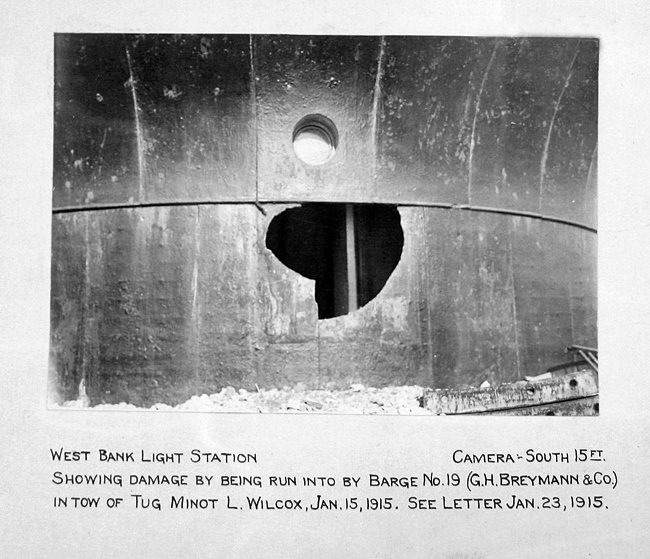
The lighthouse received over $1,200 in damage, and the ship had a large hole in its bow. The tugboat company was assigned all blame for the accident. In January 1915, barge No. 19, in tow of the tug Minot L. Wilcox, crashed into the lighthouse, tearing a section of cast iron from the tower’s base.
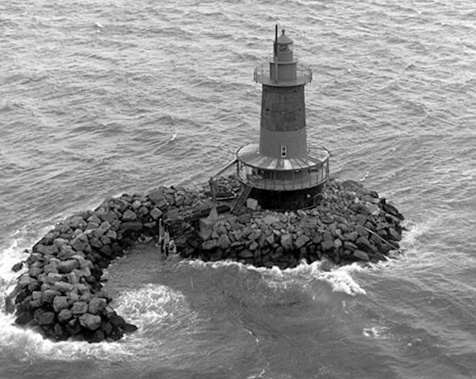
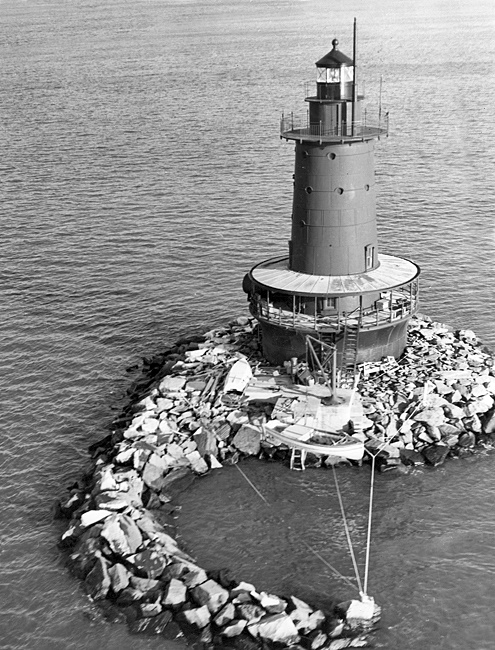
A third-class daboll trumpet replaced the station compressed-air siren in 1909. In July 1916, a riprap bulkhead was placed around the base of the tower at a cost of $10,913 to reinforce the foundation, which was badly broken and deteriorated below low water. Additional riprap was placed around the lighthouse and used to construct a breakwater for the protection of the boat landing in 1934.
The three keepers stationed at West Bank Lighthouse during the summer of 1914 sent the following to the crew of the steamer Sandy Hook, which passed by the lighthouse on its daily run between Atlantic Highlands and Manhattan:
It is with great pleasure we write these few lines to thank you one and all for your kindness in dropping the daily papers…as we are very glad to get the news without having to kill ourselves rowing for it.Each morning, around 7:45, the crew of the Sandy Hook would toss a bundle of papers to one of the keepers, who rowed out from the lighthouse. This practice came about when a keeper was expecting an important family letter and asked if the Sandy Hook couldn’t toss it to him as the boat passed the lighthouse. The letter was wrapped in a newspaper to protect it, and the idea was born to deliver papers to the keepers each day. This service cost nothing as the papers were gathered up from the connecting trains at Atlantic Highlands, and several good-natured commuters often contributed magazines and periodicals to the bundle. Most of the time the bundle would land directly in the keeper’s rowboat, but other times, the keeper would have to fish them out of the bay before they became waterlogged.
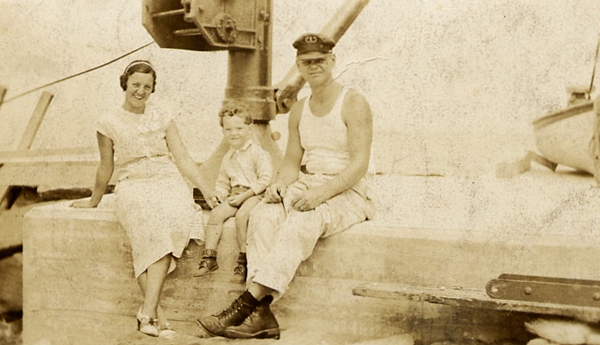
Robert Lyons was stationed at West Bank Lighthouse in 1973 along with two other coastguardsmen. Every Tuesday night, the men would call Sandy Hook and give them a food list. The cooks at Group Sandy Hook would do the shopping and send the provisions out on Wednesday with the forty-foot boat that performed the crew rotation. Two men were always on station, with the third in port on one-week liberty. In rough seas, the Coast Guard boat was unable to dock at the little slip adjacent to the lighthouse and had to return to Sandy Hook. In those instances, Lyons recalls that all his “dreams and hopes” faded as the ship retreated back to port.
|
West Bank Lighthouse was automated in the early 1980s, at which time it was one of only six manned stations remaining in the Third Coast Guard District. In 1998, the tower’s Fresnel lens was removed, and the light was converted to solar power. In May 2007, the lighthouse was excessed by the Coast Guard and offered at no cost to eligible entities. After no qualified owner for the lighthouse was found, the General Services Administration (GSA) auctioned off the lighthouse during the summer of 2008, with a winning bid of $245,000 being placed by “kswiss1” on August 27.
On June 30, 2010, West Bank Lighthouse was back on the auction block. According to the auction rules of the GSA, during a “soft close date,” if no increased bid is received by 3:00 p.m. Eastern Daylight Time, then bidding will close at 3:00 p.m. on that day. The bid of “kswiss1” was made on August 27 around 6 a.m., but did not extend the auction by a day, as the GSA computer system would only do so for bids placed between 9 a.m. and 3 p.m. Shocked by the closure of the auction, Michael Gabriel, an attorney from Nevada who had bid $230,000 on August 26, filed a lawsuit against GSA. The lawsuit apparently resulted in the lighthouse being auctioned off again, but in the Invitation for Bids (IFB), it was stated that the property was still the subject of litigation. The new IFB clearly stated that bids must be made between 9 a.m. and 3 p.m. in order to advance the soft close date to the next calendar day.
Michael Gabriel won auctions for Maryland’s Bloody Point Bar Lighthouse and Delaware’s Fourteen Foot Bank in Delaware in 2006 and 2007, respectively, but defaulted on the closure of Borden Flats Lighthouse, which he won in September 2008.
The second GSA auction for West Bank Lighthouse closed on September 28 with a winning bid of $195,000 placed by “cedalt.” Six bidders, who had paid a refundable deposit of $20,000, participated in the auction, which saw twenty-four bids placed.
The auction winner was revealed to be Sheridan Reilly, who has had a lifelong fascination with historic buildings. An avid boater, Reilly has sailed past West Bank Lighthouse numerous times, and after visiting the lighthouse, felt that in exchange for West Bank saving so many ships it was his duty to save it. Reilly estimates he will need to spend $50,000 and roughly a year just to clean up the interior of the lighthouse, which due to broken windows in its basement has been open to birds and the elements.
Sheridan Reilly decided to donate West Bank Lighthouse to the group responsible for Romer Shoal Lighthouse with the hope that they could fufill his mission to restore the light.
Keepers:
References