Fowey Rocks, FL 
Select a photograph to view a photo gallery
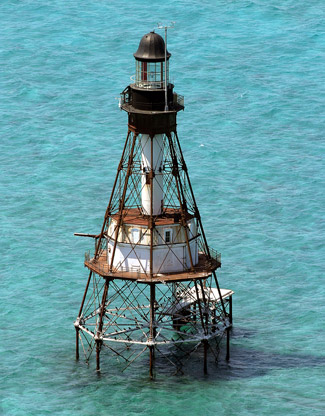
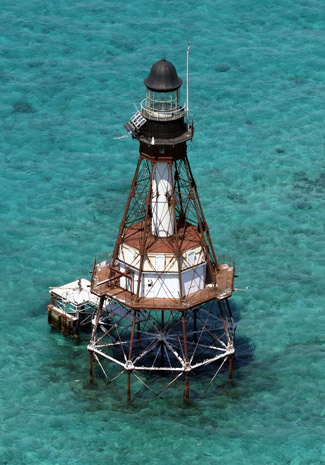
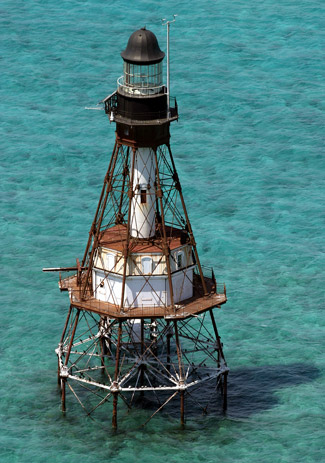
Photo Gallery
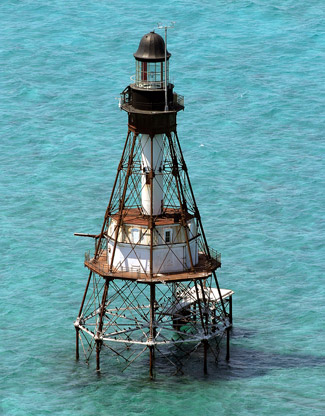
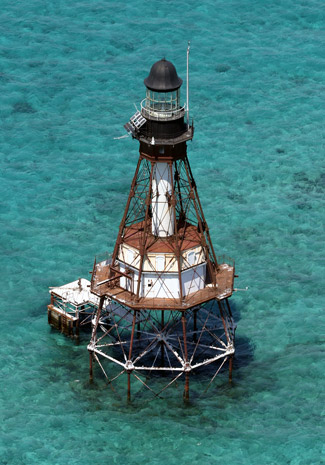
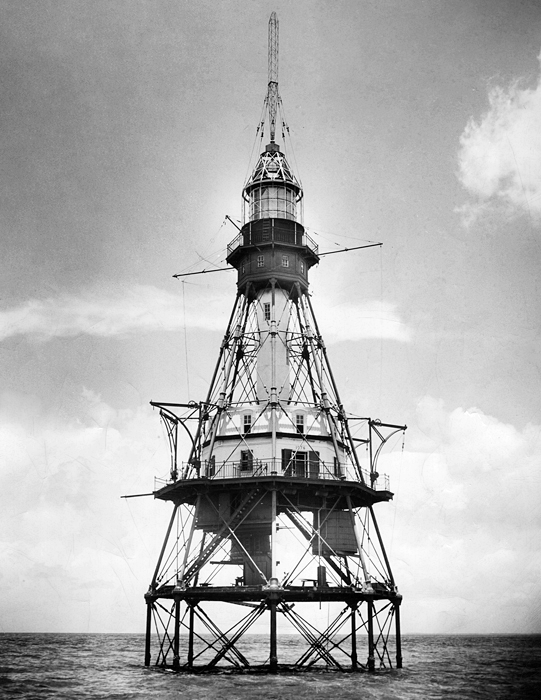
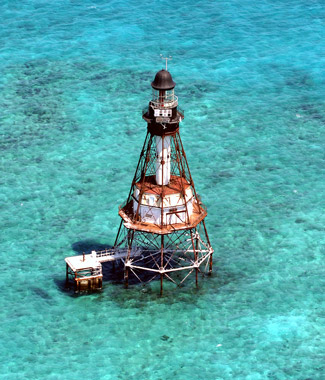
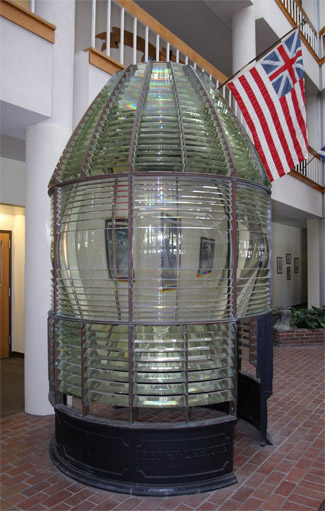
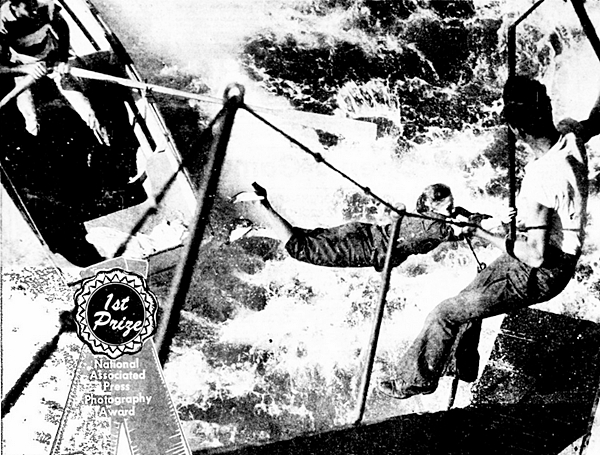
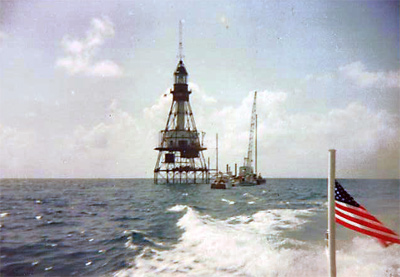


Photo Gallery
Photo Gallery
The court case prompted an in-depth investigation into the identity of the sunken vessel. Based on British admiralty records, the Park Service’s Submerged Resources Center and experts from Florida State University suspected that the ship was likely the H.M.S. Fowey. Recovery of several artifacts from the site in the summer of 1983 confirmed their hunch. The salvaged artifacts, including a nine-pounder cannon, are now displayed at the National Park Service’s Southeast Archaeological Center in Tallahassee.
|
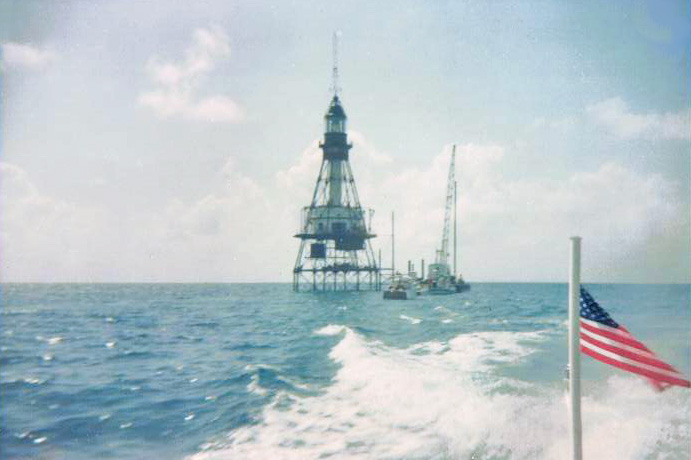
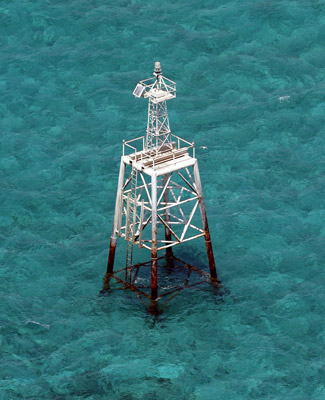
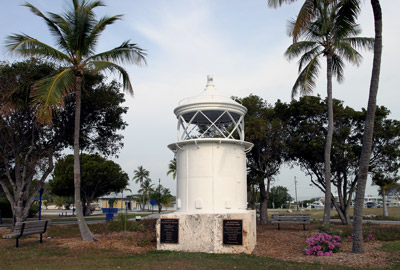
Cape Florida Lighthouse was built at the southern end of Key Biscayne in 1825 to mark the northern end of the Florida reefs. After the construction of offshore lighthouses had been successfully demonstrated at several locations along the Florida Keys, the Lighthouse Board decided to replace Cape Florida Lighthouse with one positioned directly on the reefs it was to mark. Accordingly, a circular area on Fowey Rocks with a radius of 235 ½ feet was deeded by the State of Florida to the federal government on January 6, 1875. Congress allocated $100,000 for the lighthouse on June 23, 1874, and added another $75,000 the following year to complete the work. A contract for the foundation was awarded to Paulding and Kemble of Cold Spring, New York, while the material for the superstructure was to be supplied by Brown & Co. of Hellertown, Pennsylvania. When Brown & Co. failed to complete the work, the contract was taken over by Pusey, Jones & Company of Wilmington, Delaware.
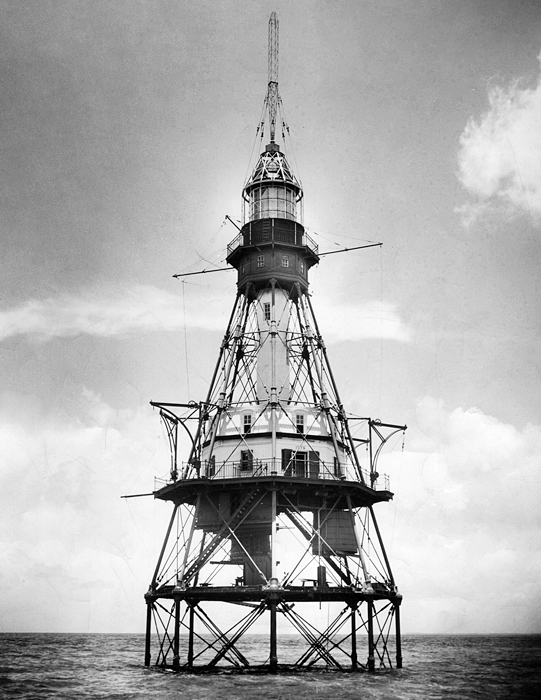
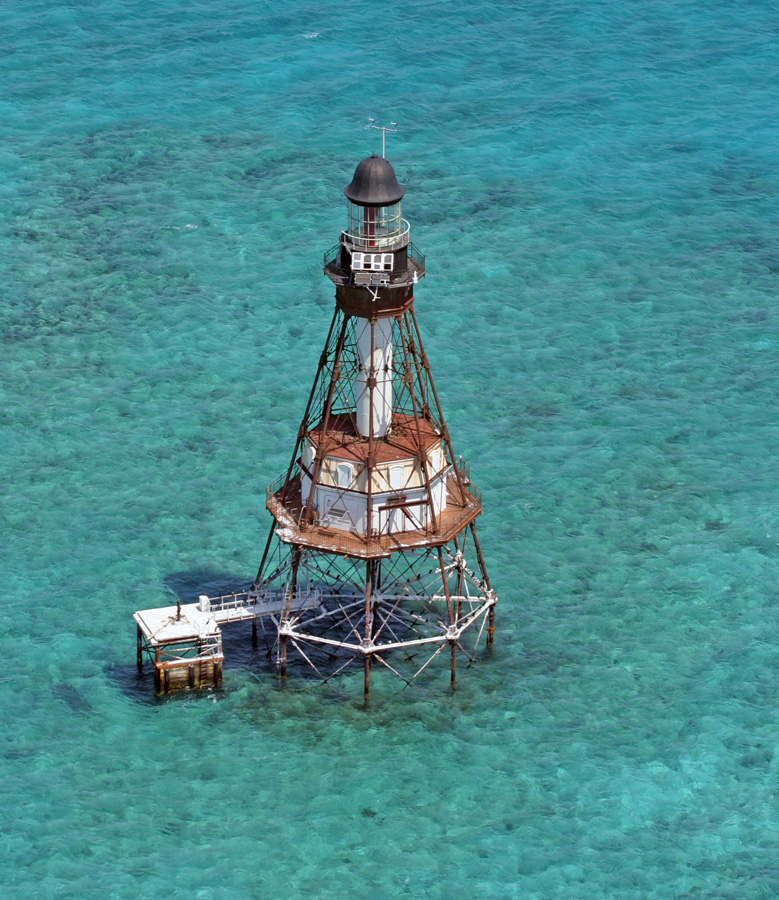
Solider Key, a small island four miles due east of the construction site, served as project headquarters. From there, workers and materials were lightered to the reef, where the first task was to build an eighty-foot-square platform, which would rest twelve feet above the water on iron-shod mangrove piles driven into the reef. Next, divers leveled off the reef before nine foundation piles, eight forming an octagon and one in the center, were passed through large disks and sunk ten feet into the coral. Horizontal girders and diagonal tension-rods tied the foundation together. The wharf and foundation were completed in just two months during the summer of 1876, but delays in receiving the superstructure followed by inclement weather pushed back additional work at the site until March 1878.
While the tower was being constructed on the foundation, the crew lived atop the wooden platform or on the incomplete lighthouse so that rough seas wouldn’t prevent them from accessing the site. During this time, the workers witnessed two dramatic demonstrations of why a lighthouse was needed on the reef. One evening, the men had a near-death experience when the steamer Arakanapka rammed the reef just a few yards from the tower. The remains of this misguided steamer can still be seen in the shallows northwest of the lighthouse. Several weeks later, a second vessel, the Carondelet paid an unannounced nocturnal visit to the construction site. The Carondelet was more fortunate than the Arakanapka, for after jettisoning the majority of its cargo, it was able to float off the reef.
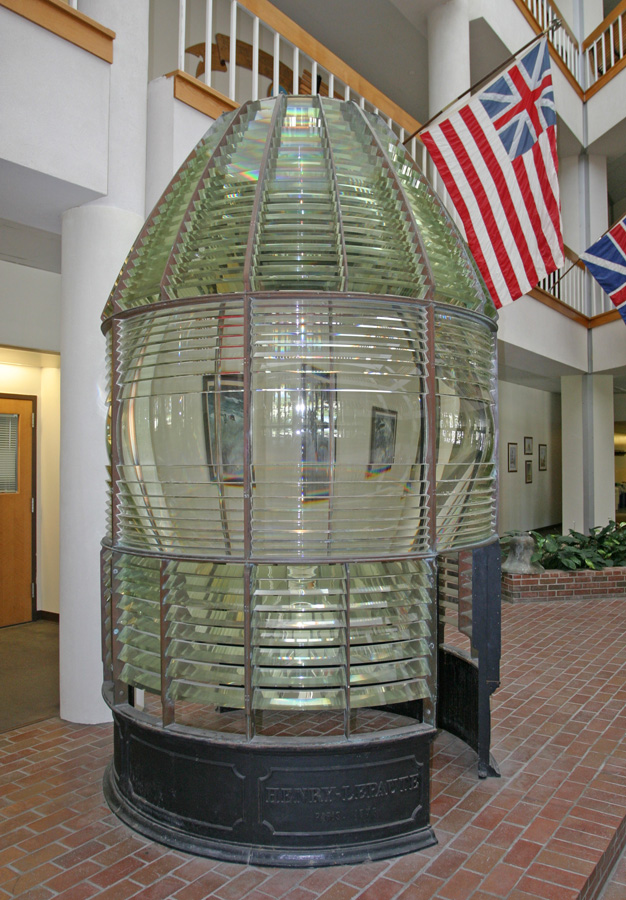
The two-story keeper’s dwelling, built inside the tower’s octagonal exoskeleton, was completed on April 30, 1878. The upper story had a Mansard roof, matching the pitch of the supporting piles. Inside the dwelling’s iron shell, wooden walls divided the space into eight commodious rooms. From the dwelling, a spiral staircase, wrapped in an iron skin, snaked upwards to the service room. Additional stairs led from the service room to the watch room, and finally up to the lantern room where the first-order Fresnel lens, manufactured in Paris by the company of Henry-Lepaute in 1876, was installed on May 25, 1878.
When Fowey Rocks Lighthouse was finished, Cape Florida Lighthouse was discontinued and keepers John and Simeon Frow were transferred from Cape Florida to Fowey Rocks, where they lit the lamps for the first time on June 15, 1878. John served as the head keeper, and his father, Simeon, as first assistant. One of Simeon’s two daughters married Robert H. Thompson, who would serve as second assistant at Fowey Rocks during 1879 and 1880.
|
The hurricane inflicted moderate damage to the tower, but one can only wonder what effect spending three days imprisoned in a metal hut surrounded by howling wind and raging seas had on the keepers.
The third participant in this ordeal was second assistant keeper Jefferson Browne, who had just graduated from high school. Browne was overworked during the hurricane and subsequent cleanup and repair work, but later, he found ample time to study the law books he had brought along. After fifteen months of lighthouse service and personal law studies, Browne enrolled at the University of Iowa Law School. Two years later, he had completed his degree, passed the bar exams in both Iowa and Florida, and was elected attorney for Key West and Monroe County. Browne would eventually become the Chief Justice of the Florida Supreme Court, and can be seen swearing in Governor Sidney J. Catts in this video clip.
In April 1893, three red sectors were added to the light, which had previously been fixed white. The light had a focal plane of just over 110 feet above the surrounding water. An oil house was built on the platform beneath the dwelling in 1898 and then replaced in 1914 by steel tanks suspended in the framework of the tower. The characteristic of the light was changed to a group of two flashes every ten seconds around 1930, when a numerical system of flashing characteristics was introduced along the Florida reefs to help mariners easily distinguish the lights. Hillsboro Lighthouse, the first light encountered by mariners sailing from north to south, had a signature of one flash. Fowey Rocks showed two flashes, Carysfort Reef three, Alligator Reef four, and Sombrero Key five. The sequence then started over with American Shoal showing one flash, Sand Key two, and Rebecca Shoal three. The pair of flashes at Fowey Rocks was created by metal screens revolving inside the fixed first-order lens.
Fowey Rocks Lighthouse was electrified in 1931, when a radiobeacon was added to the station. This change from incandescent oil vapor to electricity increased the intensity of the light from 22,000 to 83,000 candlepower. The radiobeacon at Fowey Rocks together with one at Dry Tortugas would help mariners pinpoint their location along the long sweeping turn that ran for over 200 miles between these two stations.
The keepers at Fowey Rocks Lighthouse played a critical role in assisting boaters in the area. On December 28, 1919, Keeper Henry P. Weatherford and his two assistants rescued two ladies and three gentlemen from the sinking yacht Inwood, which had struck an old wreck near the station. The keepers towed the yacht to the station and helped repair it and also took the ladies to Miami in the station motorboat. Five years earlier, Keeper Weatherford and an assistant rescued five passengers from the yacht May Belle, just before it sank.
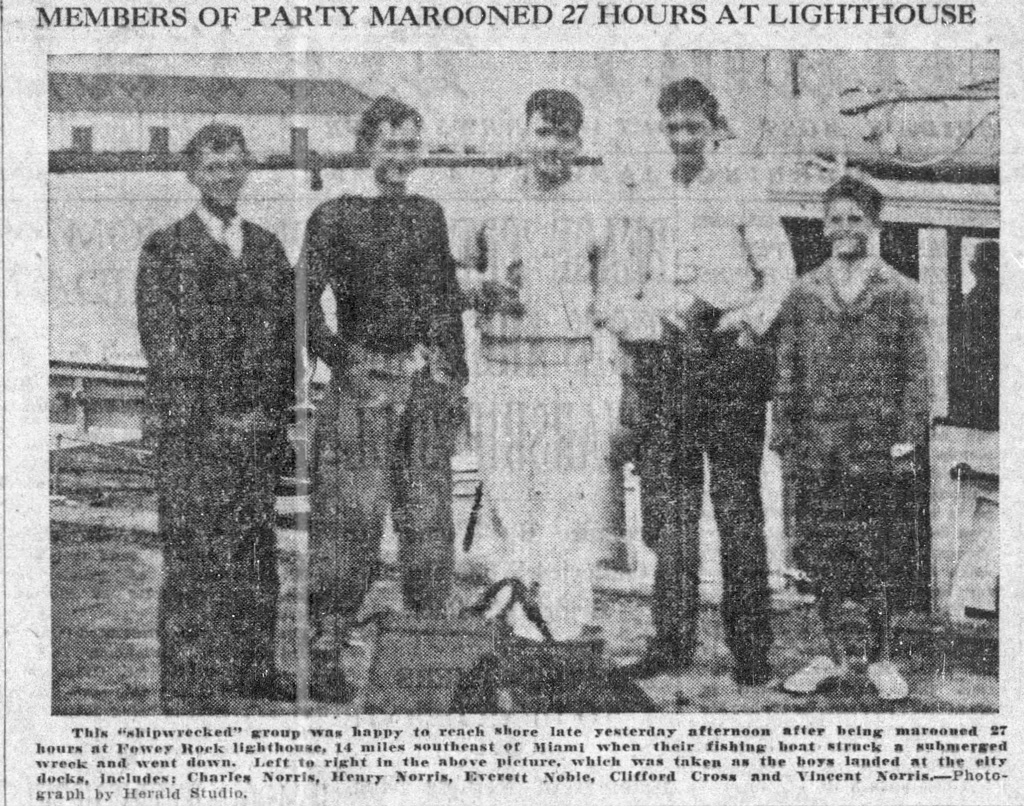
On January 2, 1929, the yacht Linda Lou struck a submerged wreck near the lighthouse, knocking a hole in its bottom. The vessel called at Fowey Rocks Lighthouse for assistance, but due to heavy seas no repairs could be made. Keeper Richard Palmer and Perry Hamilton, his assistant, welcomed the captain and his five passengers to the lighthouse and removed as much equipment as possible from the sinking yacht. A Coast Guard vessel rushed to the lighthouse to help, but was unable to take aboard any passengers due to the conditions. The keepers were told to cut the yacht loose so the patrol boat could pick it up in deep water and tow it to Cape Florida. The unexpected visitors were provided food and dry clothing, and they remained at the lighthouse until the following day, when conditions improved and a Coast Guard vessel was able to pick them up. Someone captured a picture of the marooned party just after they reached shore.
While trying to deliver gasoline and oil to the lighthouse in December 1933, the small oil tanker R. Ogario was driven into a piling about 100 feet north of the tower by a strong incoming tide. The piling punched a hole in the tanker, and the vessel started taking on water. An assistant keeper quickly went alongside the tanker in the station’s boat and was able to remove the captain, his wife, and two crewmembers before the tanker went under.
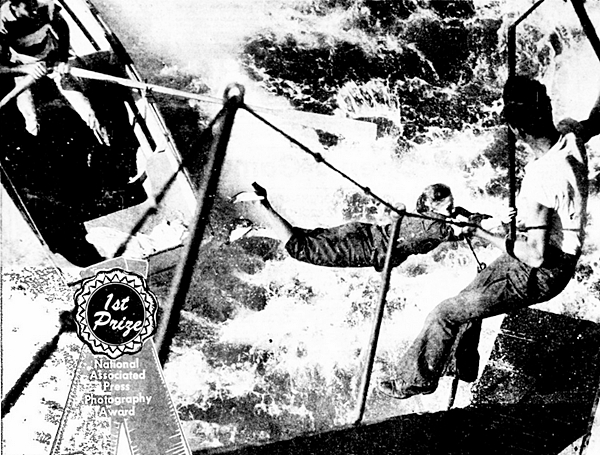
In 1950, Rose Mallory, a Miami Daily News reporter, accompanied a census taker to Fowey Rocks Lighthouse to count the four coastguardsmen stationed there. Just as Rose was stepping onto the lighthouse ladder from a rowboat, a five-foot wave struck and the reporter plunged into the Atlantic. Walter Davis, a photographer for the paper, captured Rose in midair and won first prize in the annual Associated Press national contest for excellence in news photography. A severe loss of dignity was the only injury Rose sustained, but a coastguardsman named Riles, who served on the lighthouse during World War II, was not as fortunate. He fell into the water while trying to climb aboard the lighthouse on December 23, 1942 and was swept under the lighthouse and killed when his head struck a brace.
Ken Roper served as engineman and lightkeeper at Fowey Rocks from 1965 to 1967, during which time a fourteen-foot square dock was built adjacent to the tower. The coastguardsmen were forbidden to swim while on duty at the lighthouse. After seeing an eighteen-foot shark pass by the tower, Ken had to agree that this was a wise regulation. At this time, Fowey Rocks Lighthouse received its power via an electrical line that ran to the University of Miami’s Sea Lab on Biscayne Bay. In case power ever failed, it was Ken’s responsibility to keep the backup generators in readiness.
“I dreaded the evening and mornings when I had to climb the spiral stairs to the top of the light to turn on or turn off the light,” recalls Ken. “I think I remember there were 77 steps round and round to get up there. In those days I could run that in a minute or so flat. The reason the switch was up there was so it could be verified that the light was working.”
On Ken’s days off, a captain would come by and take him fishing for king mackerel and lobster. With a monthly salary of $107, a bedroom with an ocean view, and a steady supply of mackerel steaks and lobster, life on Fowey Rocks wasn’t too bad.
Fowey Rocks Lighthouse was manned by faithful keepers until the Coast Guard withdrew its personnel in 1974, following automation of the light. A decade later, the first-order Fresnel lens was removed and placed on display at the Coast Guard’s National Aids to Navigation School in Yorktown, Virginia. Fowey Rocks was the last lighthouse on the Florida reefs to be automated.
In 2011, Fowey Rocks Lighthouse was made available for transfer under the National Historic Lighthouse Preservation Act. The Florida Keys Reef Lights Foundation announced its intention to apply for ownership, but the lighthoues was removed from the transfer process and directly tansferred from the Coast Guard to Biscayne National Park on October 2, 2012. Due to the location of the lighthouse within the park, the National Park Service exercised its option under the NHLPA to request a direct transfer.
In 2015, the Florida Trust for Historic Preservation listed Fowey Rocks Lighthouse as one of the eleven most endangered sites in the state.
Although Fowey Rocks Lighthouse must occasionally endure the buffeting of a hurricane, and, sadly, the attacks of vandals, with the tower now standing in the protected waters of Biscayne National Park, its future should be secure.
Keepers:
References