Carysfort Reef, FL 


Select a photograph to view a photo gallery
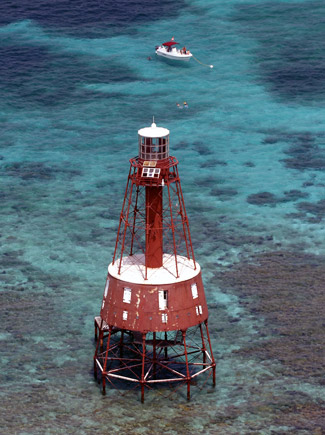
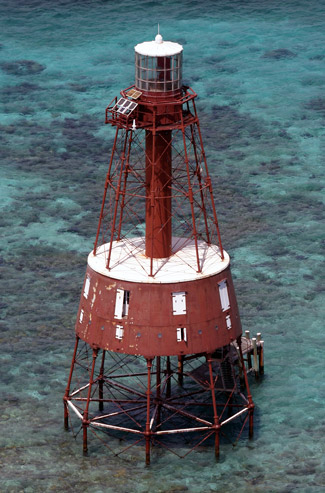
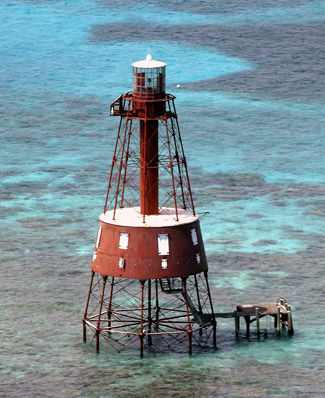
Photo Gallery
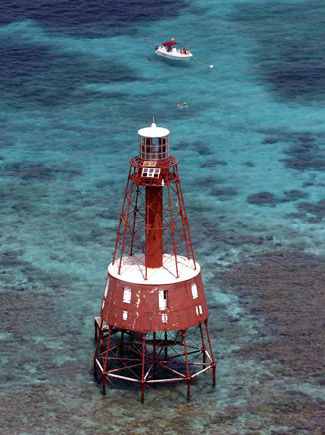
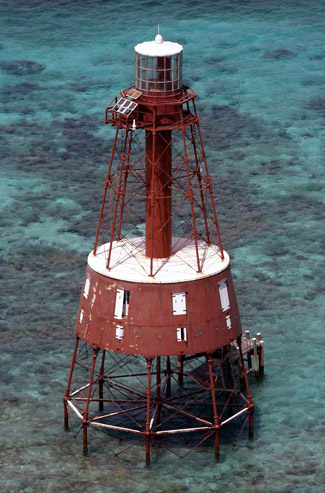
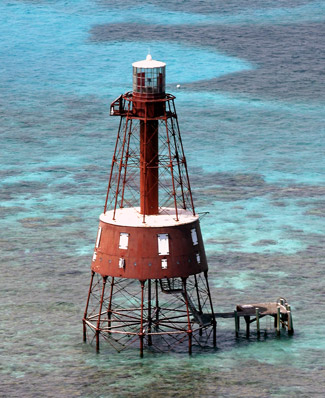
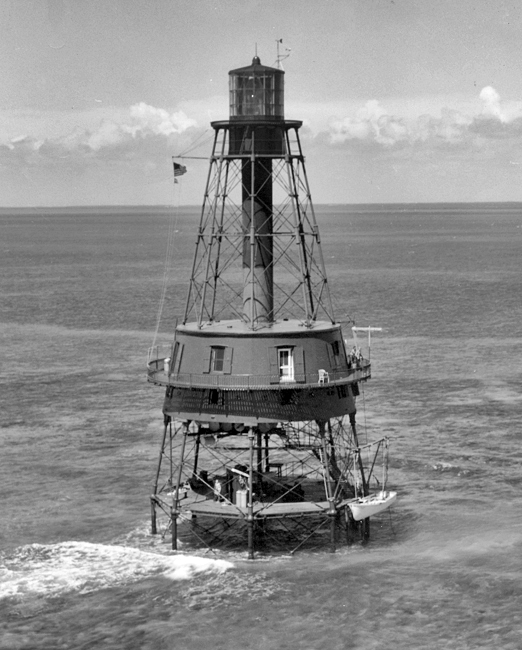
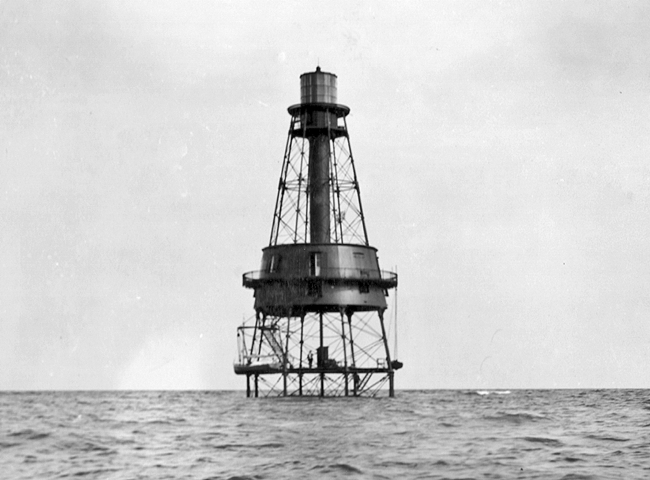
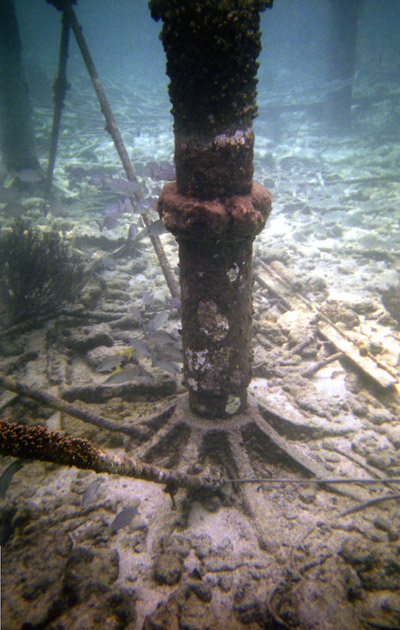
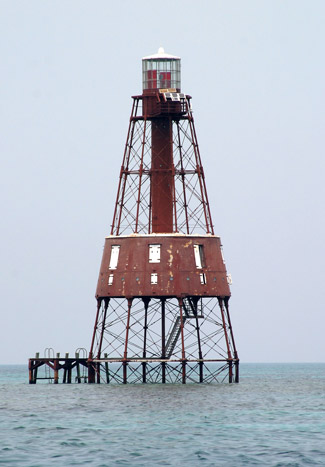
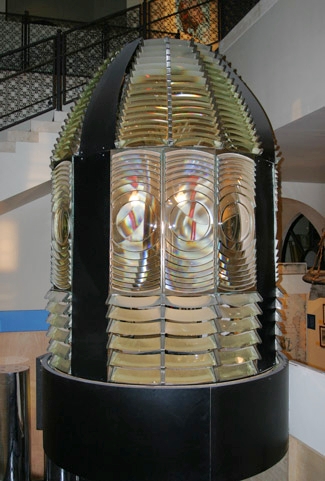
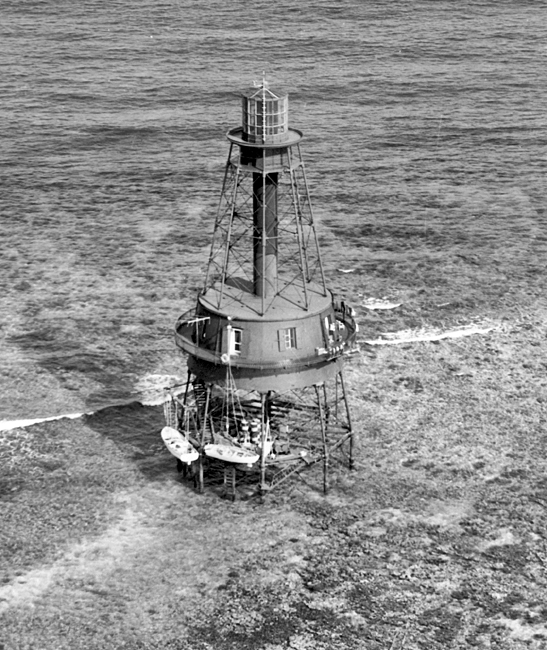
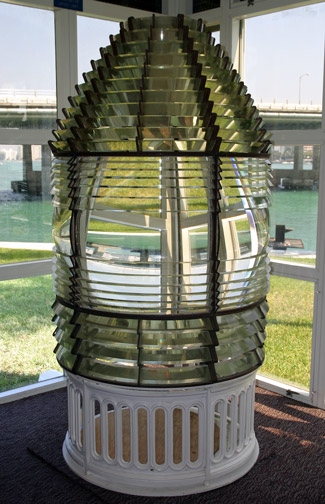
Photo Gallery
Photo Gallery
|
Carysfort Reef Lighthouse, however, was not the first navigational aid to mark the reef. That honor would fall to a lightship, for which Congress provided $20,000 in 1824. A year later, the vessel, christened Caesar, set sail from New York for the Keys. Off Key Biscayne, a fierce storm blew the ship onto the reefs. Wreckers came to the rescue, freed the ship, and towed it to Key West, where a handsome salvage award had to be paid to regain possession of the lightship. After just five years of service on the reef, Caesar was found to have so much dry-rot in her timbers that Congress was forced to cough up another $20,000 in 1830 for a replacement vessel. Caesar thus became the shortest-lived lightship in Lighthouse Service history. Given the vessel’s name, perhaps it was not too surprising that its life came to a premature end.
The second lightship for Carysfort Reef, the Florida, fared much better than its predecessor, but the same cannot be said of its crew. John Whalton had served as keeper of the lightship Caesar and continued in that capacity aboard the Florida. Whalton’s family was visiting aboard the lightship when, on June 26, 1837, Whalton and four crewmen rowed ashore to Key Largo, where the crew maintained a garden to supplement their rations. The following report, given by a member of the crew, details the results of a surprise encounter with Seminole Indians that happened shortly after landing:
Capt. Whalton and one of his men were shot dead – the other three made their escape, two of which were wounded, one on the left side, the other in the arm. The Indians, after taking scalps, stripping the bodies entirely naked and stabbing them in several places, even cutting off Capt. Whalton’s finger to get his ring, retreated to the bush. The wreckers, or several of them, deserve much credit. In the afternoon of the same day they resolved to go on shore at the risk of their own lives to get the bodies, and Capt. Cold of the Schooner Pee Dee, Capt. English onboard the sloop Brilliant with their crews, ventured and got the remains.Interestingly, the Schooner Pee Dee had also provided assistance after Seminole Indians attacked Cape Florida Lighthouse the previous summer.
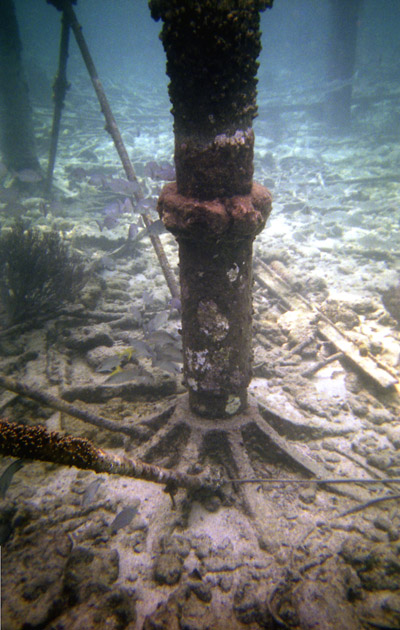
Congress provided $20,000 in 1837 and another $40,000 the following year for a lighthouse to replace the lightship on Carysfort Reef. I.W.P. Lewis was dispatched to determine the feasibility of erecting a permanent lighthouse on the reef and found three acceptable sites. For some reason, however, the funds for the project reverted to the treasury in 1840, and Congress didn't make the first in a series of appropriations for a lighthouse to replace the Lightship Florida until 1847. Winslow Lewis proposed a masonry tower, but a screwpile design submitted by his nephew I.W.P. Lewis was selected instead. The wrought-iron parts for the tower were forged in Philadelphia, and then shipped to the Keys. Captain Howard Stansbury of the U.S. Army Corps of Topographical Engineers was responsible for erecting the tower. Stansbury expected the coral reef to be solid, but test borings revealed that underneath a solid crust was a softer mass of sand. Fearing that the soft sand would not support the weight of the tower, Stansbury passed each foundation pile through the center of a large cast-iron disk. The piles were then sunk into the sand until collars, attached to the upper portion of the piles, rested on the disks atop the coral. In this manner, the weight of the tower was transferred over a large area of the coral. Before Stansbury could finish the tower above his innovative foundation, construction funds were depleted.
|
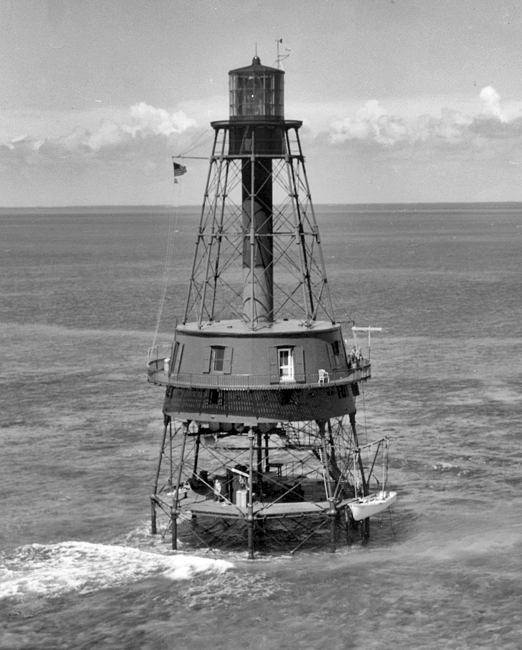
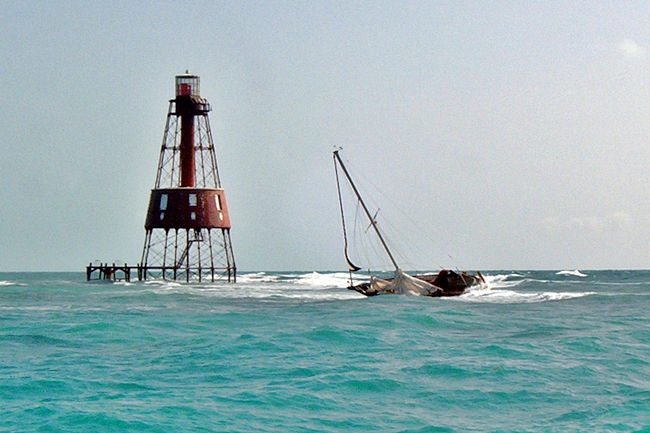
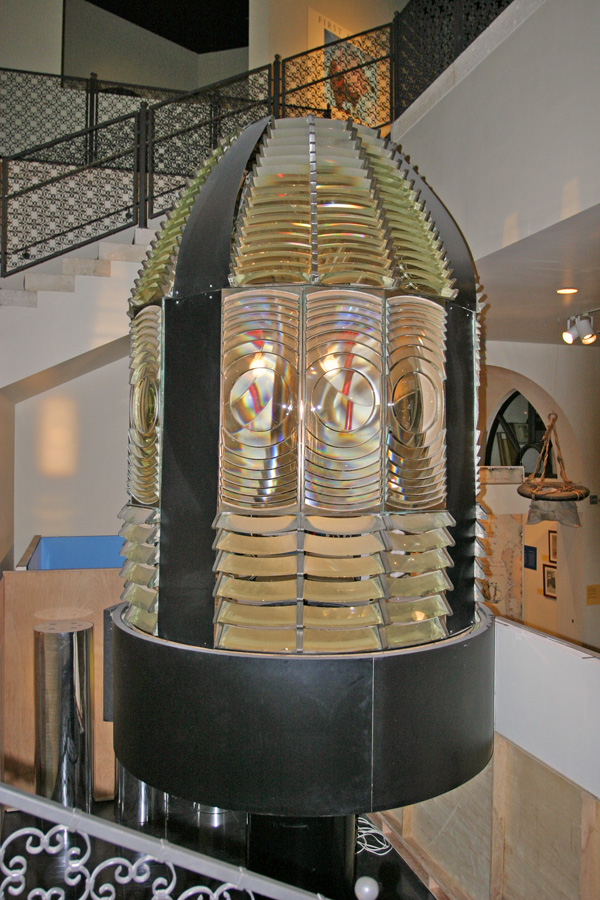
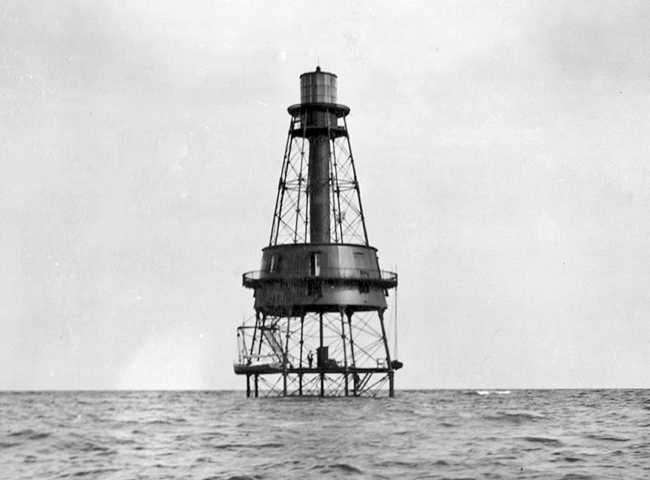
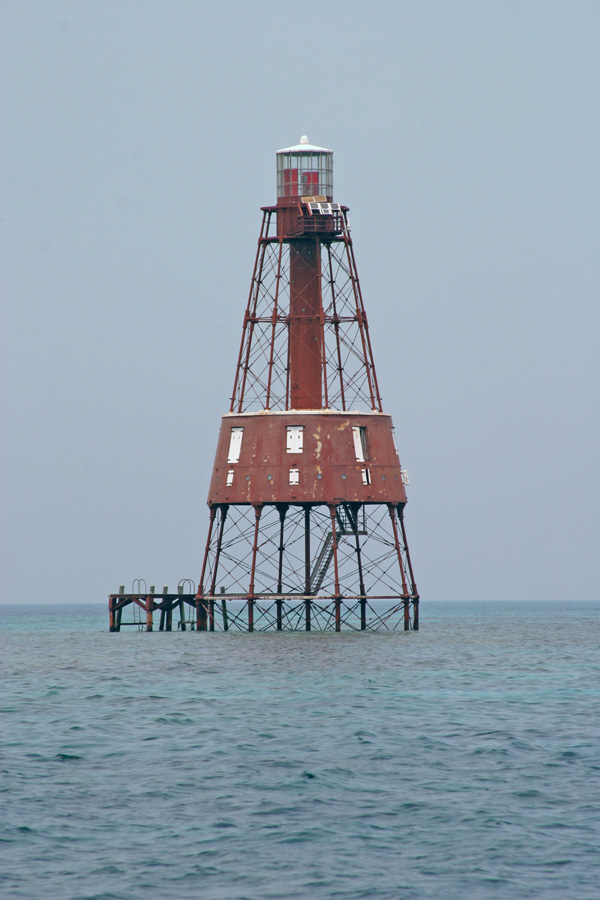
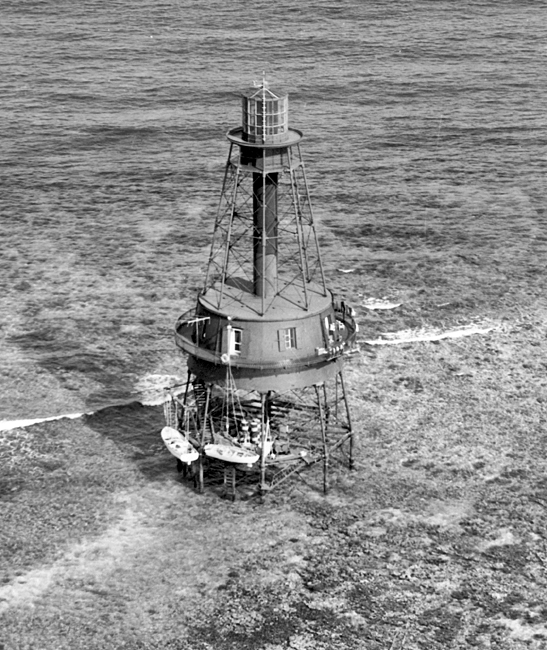
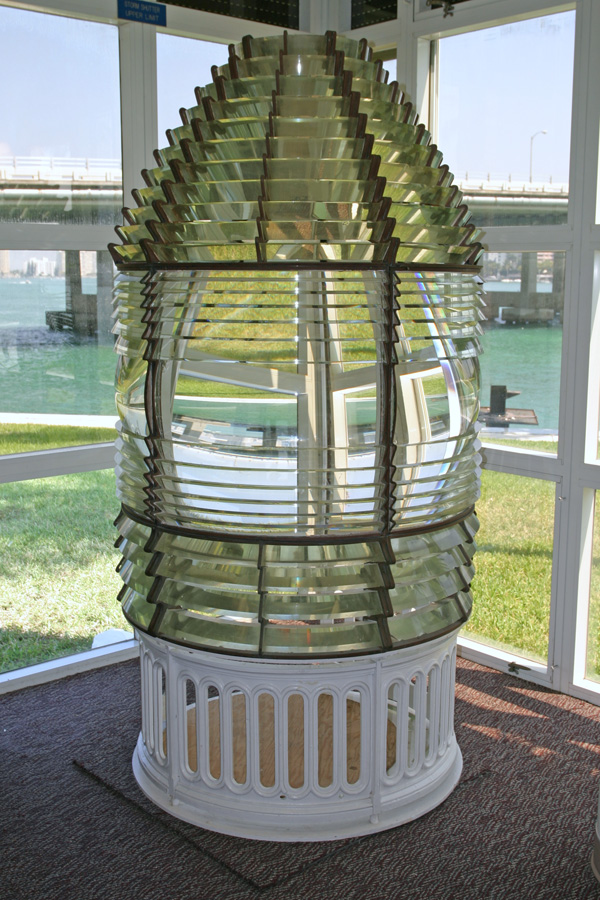
… composed of a framework of 9 iron piles, occupying the center and angular point of an octagon of 50 feet diameter and taper from 50 feet at the base to 19 feet at the top. The dwelling house is the frustum of a cone, the sides having the same inclination as the Piles. The floor is 33 feet above the low water, and the house of two stories is 20 feet high. From the top of the house to the Lantern is a Cylindrical Tower for a stairway 38 feet high. The whole structure is painted Red – except the Piles which are Black – and the doors and windows of the dwelling and roof of the Lantern which are white.The lighthouse was originally outfitted with eighteen lamps set in twenty-one-inch reflectors, but in 1855, just three years later, a first-order Fresnel lens manufactured by Henry-Lepaute and purchased for $22,000 replaced the array of lamps. A revolving first-order Fresnel lens was activated in the lantern room on March 17, 1858, when the new lighthouse on Sombrero Key was established, and the characteristic of Carysfort Reef changed from a fixed white light to a bright flash every thirty seconds. On April 30, 1893, three red sectors were added to the light to indicate hazardous areas.
On the morning of September 6, 1919, Keeper William H. Curry departed Key West for the 110-mile return voyage back to Carysfort Reef, after having picked up supplies and official mail. On the night of September 8, Curry anchored in Boot Key Harbor, five miles north of Sombrero Key Lighthouse, as a hurricane was passing through the area. No further sign of the keeper was seen until his capsized craft, with its mast broken off, was located several days later about twenty-five miles north of where he had anchored. It is presumed that during the night of September 8, the keeper’s boat was driven into an arch in the Florida East Coast Bridge and overturned, leading to the drowning of the keeper.
On January 4, 1922, First Assistant Charles F. Fine and Second Assistant Eley J. Whidden sighted the motor yacht Napinee of Jacksonville in distress about three miles from the lighthouse. The keepers lowered the station’s powerboat, and Whidden set off for the yacht, which ran onto rocks before he was able to get a towline fastened to it. Before any damage was done to the vessel, Whidden managed to pull it off the rocks. Once safely back at the lighthouse, the four occupants of the Napinee related that they had experienced engine trouble and had been adrift for two days. The keepers provided dry clothing and food for their famished guests.
|
As counting more than five flashes could be difficult during storms, the number was reset at American Shoal. American Shoal Lighthouse thus produced a white flash every five seconds, while Sand Key, the next light along the reefs, produced a group of two flashes every ten seconds. An acetylene gas triple flasher was installed in Rebecca Shoal Lighthouse to change its characteristic to three white flashes every fifteen seconds. Authorities planned on changing the light at Dry Tortugas to show four flashes, but decided instead that it would retain its characteristic of a white flash every twenty seconds since its illuminating apparatus “had proven so satisfactory.”
A local man by the name of Charles Brookfield often fished near Carysfort Reef Lighthouse. On one excursion to the reef, he took along some newspapers, magazines, and fresh meat and vegetables for the keepers. In return, he was invited to spend the night at the lighthouse. Brookfield recalled that he was just starting to dose off when a loud groan shook the room he was sleeping in and startled him awake. “I sat up thinking it may have been a dream,” he said. “Then another groan came and I knew it was real.” Brookfield grabbed a flashlight and climbed up to the lantern room to question the keeper about the strange noises. Keeper Jenks replied, “That’s old Captain Johnson. You know, he died aboard this light, and he still comes around at night and groans.” After giving it some serious thought, Brookfield came up with his own theory for the groans. He deduced that during hot days the metal tower expanded, and then as it contracted during the cooler nights, it would produce the human-like groans.
The Keys typically don’t experience that wide of a temperature swing, so perhaps the tower really is haunted. Regardless, the last living occupants of the tower left in 1962, when the Coast Guard automated the light. At that time, a fixed third-order lens replaced the revolving first-order lens in the lantern room. The third-order lens was removed in 1982, when a modern beacon was placed in the tower.
There was a plan to convert the lighthouse into a marine research center in the 1990s, but this dream was never realized. In 2014, the Coast Guard deactivated Carysfort Reef Lighthouse after determining that the structure was “unstable and considered unsafe.” While the historic lighthouse remains standing, Carysfort Reef’s defining characteristic of three flashes each minute is now displayed from a nearby structure at a height of just forty feet.
On February 1, 2019, Carysfort Reef Lighthouse was declared excess to the needs of the United States Coast Guard and made available to eligible organizations under the provisions of the National Historic Lighthouse Preservation Act of 2000. Qualified entities were given sixty days to submit a letter of interest. After no organization was selected to assume responsibility for Carysfort Reef Lighthouse, the General Services Administration initiated an online auction for the structure in February 2022. The bidding started at $15,000, and bidders were required to supply a $5,000 deposit. Six bidders participated in the auction, which ended on May 16, 2022 with a high bid of $415,000.
Keepers:
References