Alligator Reef, FL 
Select a photograph to view a photo gallery
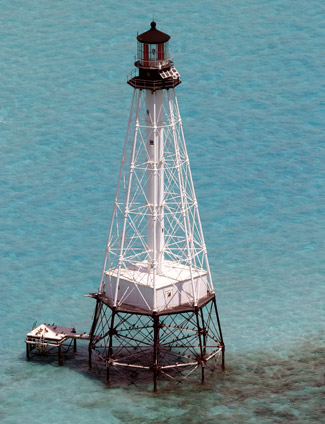
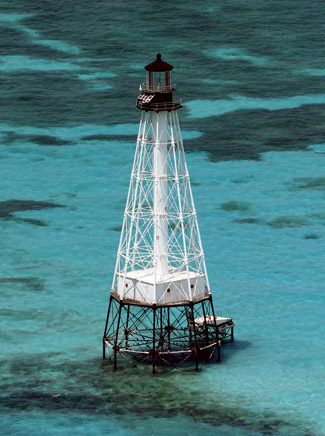
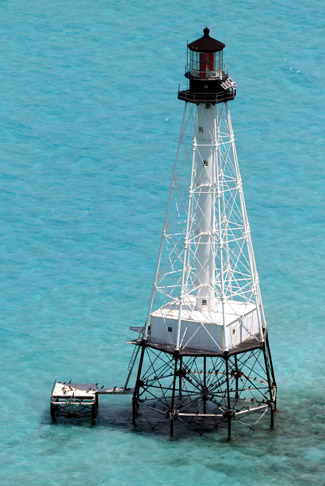
Photo Gallery
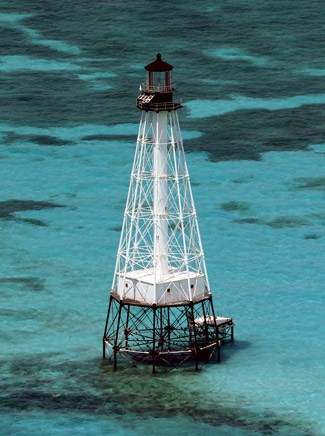
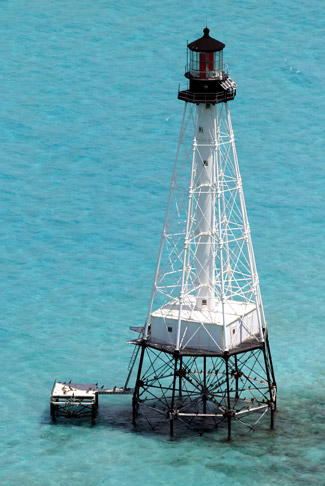
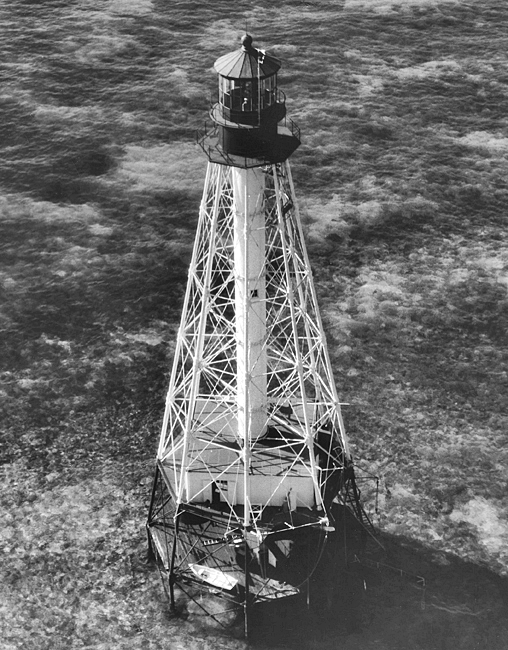

Photo Gallery
Photo Gallery
While at anchor in the harbor at Matanzas on Cuba’s northeast coast, Lieutenant Allen was informed that pirates were holding several ships for ransom in a nearby bay. The following morning, the Alligator surprised the pirates and dispatched its launches to confront them. In the ensuing battle, Lieutenant Allen took two musket balls but led his comrades to a rout of the pirates before succumbing to his wounds. Now under the command of Lieutenant John M. Dale, the Alligator escorted the small flotilla of liberated vessels north to the states.
|
The first effort to mark the dangerous reef was made in 1852 by Lieutenant James Totten of the U.S. Army Coast Survey. Under his direction, one of fifteen iron shaft daymarkers being placed along the reefs was erected on a screwpile foundation at Alligator Reef and topped by a black barrel. Five years later, the barrel was replaced by a white, hoop-iron cylinder and a red vane displaying the letter "C" to uniquely identify the reef.
After providing a written response to thirteen questions posed by the Lighthouse Board, M. Carrington Watkins, inspector for the seventh district, offered the following recommendation in 1855:
I cannot press upon the board with too much zeal the necessity of a light-house on Alligator reef; four vessels have been wrecked there, and in the neighborhood, in the last four months; when, if there had been a light, the vessels could have rounded the point of reef and come to in a good roadstead, in from six to three fathoms.
Two years later, the Lighthouse Board petitioned Congress for an iron skeletal lighthouse for Alligator Reef, writing “The only additional aid to navigation required in this district, and the only first class light-house which it is believed is required on any party of the coast of the United States, is one on or near Alligator reef.” Congress failed to make the necessary appropriations that year, and its attentions were soon turned elsewhere as the nation spent the next decade planning for, fighting in, and recovering from the Civil War.
The Lighthouse Board resurrected its request for Alligator Reef Lighthouse in 1867. The petition was repeated the next two years, and the following need for the lighthouse was provided in 1869.
Alligator Reef forms a kind of elbow or turning point for vessels passing either way through the Florida Pass. It is about midway between Carysfort Reef and Dry Bank [Sombrero Key] light-houses, sixty-one nautical miles distant the one from the other, leaving between them an unlighted space of upwards of thirty miles for the navigator to grope his way through, and having to contend against strong and irregular currents, which are greatly influenced by the prevailing winds, by the tides, and by the general character and state of the weather. With the establishment of this light on the border of the reefs, navigation around Cape Florida from the Gulf of Mexico will, with the other aids to navigation, be made comparatively easy and safe, with ordinary attention and care.On July 15, 1870 Congress finally responded with $100,000 to start construction. Indian Key, situated four miles from the reef, was selected as the staging area for the construction effort and was equipped with a wharf, storage facilities, and lodging and a cistern for the laborers.
The iron pile lighthouse was forged by Paulding Kemble of Cold Spring, New York, and then transported to Indian Key. The lighthouse would be situated near the northeast end of the reef, thirty yards from daymarker “C,” and about two hundred yards from the deep Gulf Stream waters.
To receive the lighthouse, the reef was leveled and nine heavy cast-iron disks were arranged on the coral, eight at the corners of an octagon having a diameter of fifty feet and one at its center. The foundation piles that would pass through the disks were twenty-six feet in length and twelve inches in diameter. A steam-powered pile driver raised a two-thousand-pound “hammer” eighteen feet in the air before gravity brought it crashing down on the pile. Each blow would drive the pile about an inch further in its ten-foot descent into the coral.
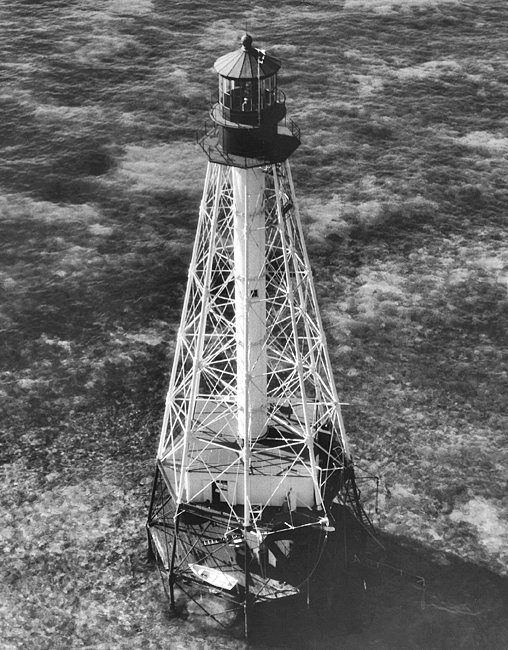
Atop the vertical foundation piles, six lengths of piles sloped upwards to the lantern and watch rooms. Running horizontally and diagonally between the piles, a network of braces held the structures together like the filaments in a spider’s web. A one-story square dwelling was built on a platform high above the water to keep it safe from even mountainous seas. A spiral staircase sheathed with iron served as the tower’s spine, providing structural support and linking the dwelling to the lantern room, over 130 feet above the water.
After $185,000 had been expended in its construction, the lighthouse was placed into service on November 25, 1873. A revolving first-order Fresnel lens filled the lantern room and produced a scintillating series of flashes separated by five seconds and with every sixth flash red. In July 1880, additional ruby panels were installed on the lens to change its characteristic so every third flash was red. New mineral-oil lamps were supplied to the station in 1884 to take the place of the lard-oil lamps, and an oil room, large enough to hold a year’s supply (about 2,206 gallons), was built and hung beneath the dwelling. Red sectors were added to the lantern room in September 1891 to mark nearby reefs.
Alligator Reef Lighthouse was staffed with a head keeper and two assistants. On August 1, 1918, First Assistant Keeper Richard C. Roberts raced to the assistance of a seaplane, which had fallen into the water about ten miles from the lighthouse. Braving shark-infested waters, Roberts dove into the sea and rescued two men trapped in the plane. After Roberts had towed the plane for four miles using the station launch, a naval boat took over.
In 1926, Secretary of Commerce Hebert Hoover, on learning that many remote lighthouses had no radio, made an appeal through the press, saying, “I don’t know of any of other class of shut-ins who are more entitled to such aid. The Government does not pay them any too well, and the instruments which they can hardly afford are in many cases their only means of keeping in touch with the world.” When the keeper at Alligator Reef Lighthouse received his radio, he expressed the joy it brought to him: “I just think it is grand to enjoy church sermons and all the good lectures and grand music in the lone hours of the night.”
Alligator Reef Lighthouse warned ships of the invisible danger posed by the submerged reef, but early on there was little to no warning of another danger that threatened ship traffic and even the crew on the lighthouse – hurricanes. The most devastating storm to strike Alligator Reef Lighthouse spoiled the Labor Day festivities of 1935. Keeper Jones A. Pervis left a detailed account of the event.
September 1st Quiet dutyA temporary lantern was delivered to the station on September 5, and by that night, the light was back in service.
2 Securing against tropical hurricanes. On the afternoon of the second day the Barometer began falling. Normal rating 29.98 fell as low as 27.35 by 9:30 P.M. Same day 10 P.M. the barometer began to rise and on the third day of this month at one o’clock P.M. the barometer reading was 29.38 with very bad rainy weather. Strong wind from the south the second day. The wind was from the north east blowing a fresh breeze and increased to gale force by 4 P.M. 6 P.M. was a regular hurricane. 6:30 P.M. while lighting the lamp for the night, the lantern glass began to break, red sectors began to break, flying glass was danger to life. I left the watch room and hurried to living quarters, the doors began to break in, the keeper, and second assistant room, was badly damaged to doors and water soaked beds and clothing. I managed to save doors in first assistant room, and the kitchen, the lens was completely wrecked, and other damage done by wind and water to the watch room, and property there in. The row boat washed away about 8 P.M. The launch no. 34 was in fair condition at 9:30 P.M. This was the last time we were able to be out side until the next day. The platform landing was completely wrecked and launch no. 34 gone. This is the worst hurricane I have experienced during the eleven years of service. The light will be out of commission until temporarily repaired.
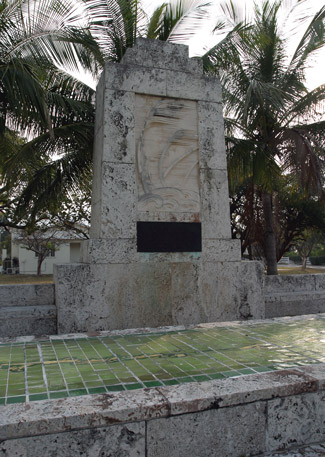
Accompanied with winds in excess of 200 mph, the hurricane devastated the nearby keys. 423 people lost their lives in the storm – 163 civilians and 259 World War I veterans who were employed in the area building a bridge to replace the ferry boats. As the Upper Keys were not densely populated in 1935, the death toll represented nearly 25% of the population. The hurricane produced the lowest barometric reading ever recorded in the U.S.: 26.35.
When a hurricane wasn’t threatening the tower, the life of a keeper could be relaxing. Dick Gooravin served on the reef in the 1950s, after it came under the control of the Coast Guard in 1939, and described a more idyllic and likely more typical time at the lighthouse: “The water around the lighthouse on most days was calm and gin clear. You could see the formation of the reefs perfectly, the sand spots in between, and the deep waters of the Gulf Stream just a few hundred yards away. When you looked down you would see all kinds of fish. There were always lots of barracudas cruising lazily around the lighthouse.” A few hours before dinner, a keeper, equipped with a spear, simply had to step of his back porch to procure his choice of a main course: lobster, snapper, or yellow-tail.
In 1963, the lighthouse was automated. The coastguardsmen must have been a bit disappointed to leave their home with an elevated 360° ocean view, but at least no one would have to endure another hurricane trapped on the lighthouse.
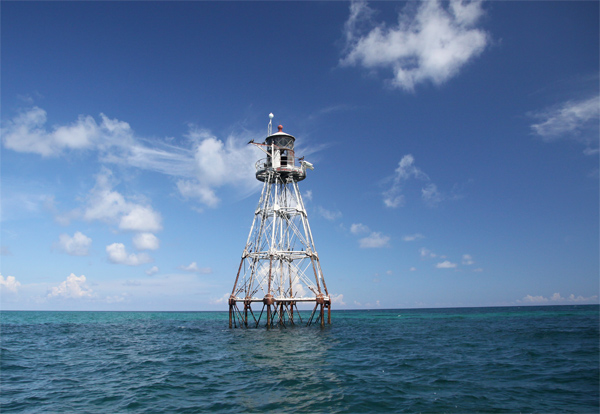
The central portion of Alligator Reef Lighthouse is kept a bright white, a striking contrast to the black lantern, black foundation piles, and the surrounding aquamarine waters, which still provide plenty of interest for fishermen, snorkelers, and divers. If you don’t make an excursion out to the lighthouse, keep an eye out for it when you are near Islamorada as the lighthouse is the most readily visible of Florida’s reef lights from the overseas highway.
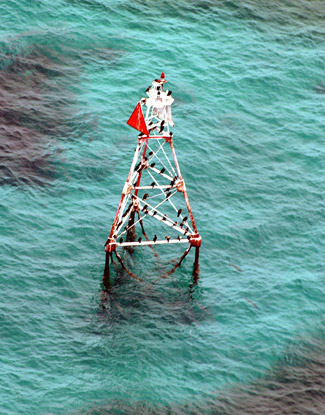
In 2015, Alligator Reef Lighthouse was deactivated, and a thirty-foot-tall tower, erected nearby and topped by an automated light, took over the function of warning mariners of the reef.
On February 1, 2019, Alligator Reef Lighthouse was declared excess to the needs of the United States Coast Guard and made available to eligible organizations under the provisions of the National Historic Lighthouse Preservation Act of 2000. Qualified entities were given sixty days to submit a letter of interest. In 2021, Secretary of the Interior Deb Haaland announced that the National Park Service had awarded Alligator Reef Lighthouse to Friends of the Pool, Inc., a nonprofit organization that has held an annual eight-mile roundtrip swimming race to the offshore tower. The first step planned by the organization is to have a detailed engineer study done to determine the needed steps to stabilize the lighthouse. After that, the keeper’s quarters will be refurbished and the structure painted. Larry Herlth, an Islamorada metal artisan who has created detailed replicas of Alligator Reef Lighthouse, started the annual “Swim for Alligator Lighthouse” and championed the effort to save the lighthouse. “Growing up here, enjoying the sights, the water all my life, I can’t imagine Islamorada without it and a lot of locals feel the same way,” Herlth Said. “It’s definitely an emotional piece of our history.”
In 2023, Friends of the Pool installed a solar-powered light in the lantern room of Alligator Reef Lighthouse and activated the lighthouse, after it had been dark since 2015. An engineering study commissioned by Friends of the Pool determined that five to six million dollars will be needed to restore the lighthouse. Rob Dixon, executive director of Friends of the Pool, noted in 2023 that $500,000 had been raised toward the project. Though there is a lot of money to be raised and a lot of work to be done, Dixon was optimisitic about the project, saying “We’ve got a great community behind us; we’ve got a lot of support — there’s nobody in this community that doesn’t want to help our project.”
Keepers:
References