Sand Key, FL 
Select a photograph to view a photo gallery
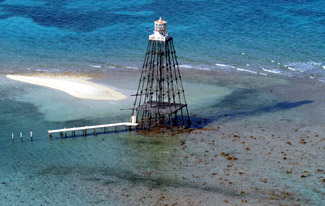
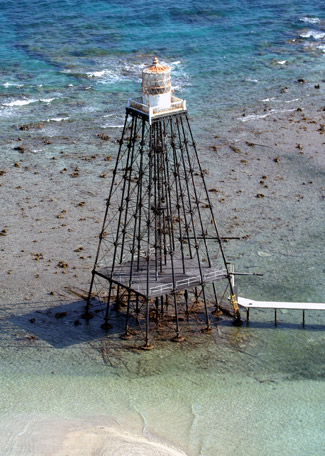
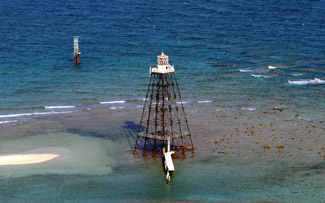
Photo Gallery
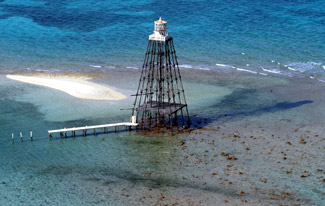
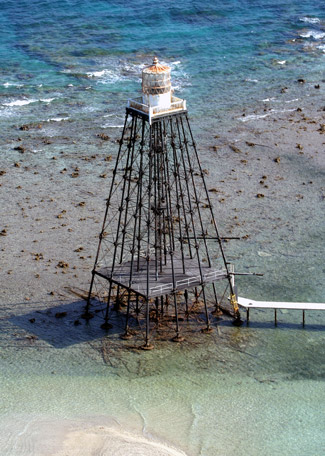
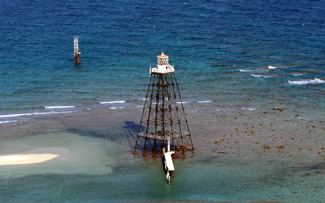
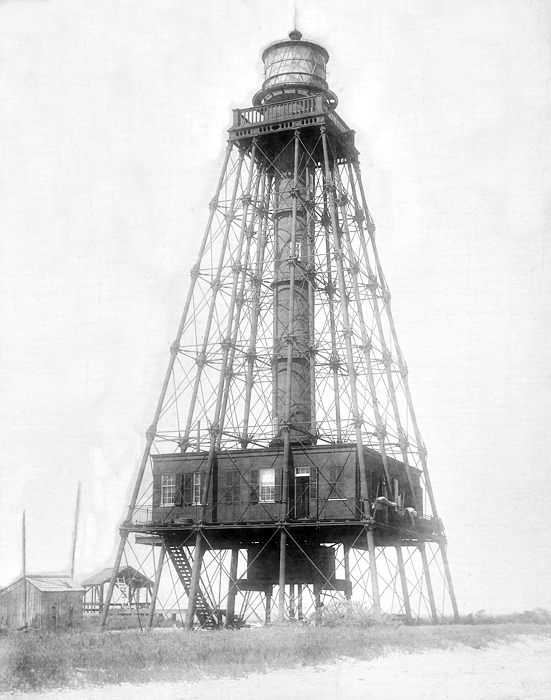

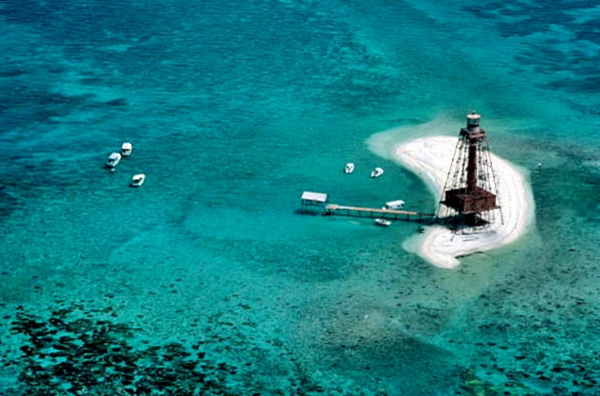
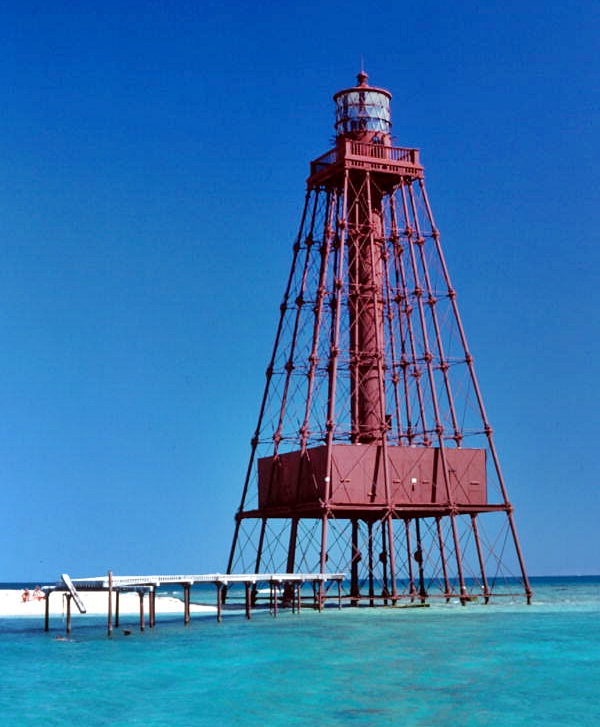
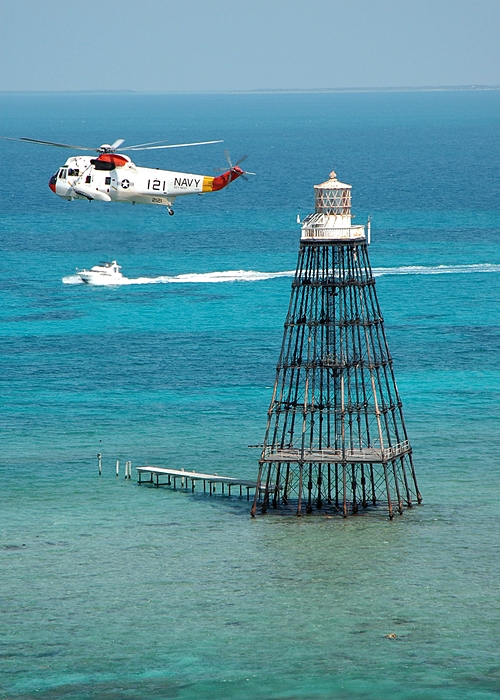
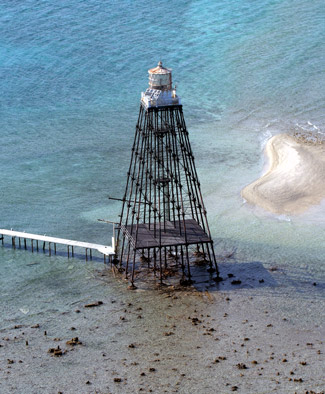
Photo Gallery
Photo Gallery
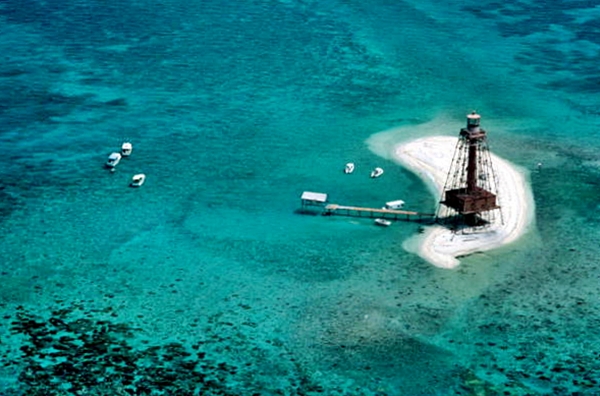
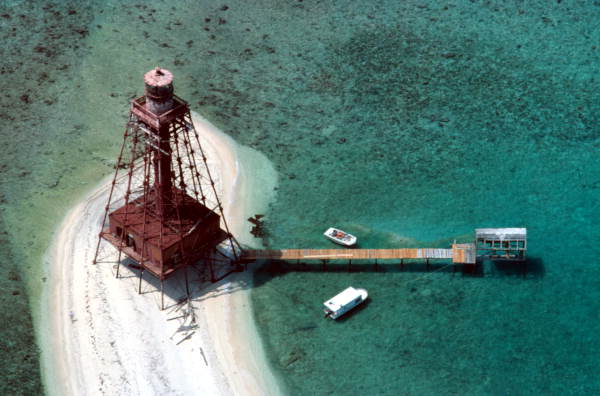
Sand Key is situated next to a channel that leads to Key West, located roughly eight miles to the northwest. In normal conditions, a significant amount of sand accumulates on the submerged reefs at Sand Key, creating a small island. Soon after the United States took possession of Florida in 1821, a wooden daymark was placed on the island to warn mariners of this nearly hidden threat to navigation.
|
The first keeper of Sand Key Lighthouse was slated to be Joseph Ximenez. However, Keeper John Flaherty and his wife Rebecca were having a terrible time adjusting to their isolated life in the Dry Tortugas, so the collector of customs at Key West, William Pinkney, arranged for the two keepers to trade assignments. Shortly after the Flahertys arrived on the island, Sand Key Light was exhibited for the first time on April 15, 1827. With fishermen, wreckers, and picnickers from Key West frequenting the island, the Flahertys thoroughly enjoyed their new social life. Their joy, however, was short-lived as John fell ill in May 1828 and passed away in 1830. Rebecca remained on the island and was appointed keeper after her husband’s death.
In June 1831, William Randolph Hackley, an attorney in Key West, recorded the following account of a visit he made to Sand Key Lighthouse: “The wind was so light that we did not get to the key until 12…I went up to the lighthouse. The light is revolving and is one of the best in the United States. It is kept by Mrs. Flaherty…She, with her sister and a hired man, are the only inhabitants of the key and sometimes there are none but the two females…The length of the key is from 150 to 200 yards and the average breadth 50 … [We] remained till evening and, having spent a pleasant day, returned to town at 8:00 P.M.”
The November 22, 1834 edition of The Florida Herald reported on a wedding at Sand Key Lighthouse; Rebecca Flaherty had married Captain Fredrick Neill. The newlyweds took a lengthy trip the next year to visit family, while a temporary keeper watched the light. Upon their return, Captain Neill was appointed keeper and served in this role until his resignation on February 10, 1836.
Captain Francis Waltington was the next keeper, maintaining the light until July 27, 1837, when the colorful Captain Joshua Appleby succeeded him. Born in Rhode Island in 1773, Appleby became a widower at a young age, when his first wife, Sarah Viall, died at twenty-three, leaving him alone to care for their year-old daughter, Eliza. In 1820, Appleby sailed for the Florida Keys, where he co-founded a settlement on Vaca Key and made a living from the sea through fishing, turtling, and salvaging shipwrecks. Appleby’s salvaging practices were soon called into question as he was accused of conspiring with privateer Charles Hopner to intentionally run aground vessels captured by Hopner so the cargo could be salvaged and sold. Commander David Porter, head of the naval squadron at Key West responsible for eradicating piracy, had Appleby arrested in 1823 and taken in irons to Charleston, South Carolina. Appleby must have been innocent or had friends in high places as he was released after Smith Thompson, Secretary of the Navy, and President James Monroe reviewed his case.
Upon securing his freedom, Appleby returned to Rhode Island for a time, and then relocated to Key West by 1830. The government granted Appleby a license as a wrecker, a trade that he practiced for several years. Then, on July 27, 1837 he accepted an appointment as head keeper of Sand Key Lighthouse. While Appleby’s livelihood had previously depended on ships misfortunes, it was now his duty to help keep ships safely away from the reefs.
During Appleby’s tenure at the lighthouse, hurricanes struck Sand Key in 1841 and 1842, with the latter destroying the keeper’s dwelling and seriously damaging the lantern. In 1843, a seawall was built around the lighthouse property to provide protection from the storm surge that accompanied the hurricanes. The following year, the wall was put to the test, and it failed. The new keeper’s dwelling was swept away along with a good portion of the island.
|
Still, the reef posed a threat to vessels, and the Honey, a 140-ton ship, was soon purchased in New York, recommissioned as a lightship, and sent to Florida to mark Sand Key. Congress acted quickly as well, allocating $20,000 on March 3, 1847 for a new Sand Key Lighthouse and then adding an additional sum of $39,970.74 to the project in 1848. Before the new lighthouse was completed, at least eight vessels had run aground on the reef, resulting in a loss of over $425,000. Although lighthouses were expensive to construct, the reduction in lost cargo easily offset the investment.
Around 1850, control of U.S. lighthouses was passing from the Fifth Auditor of the Treasury, Stephen Pleasonton, to a Lighthouse Board. This change in leadership most likely delayed work on the new lighthouse. As one of their first acts, the newly formed board chose a screw-pile design by Isaiah W.P. Lewis for Sand Key. John F. Riley Ironworks in Charleston fabricated the body of the tower, while J.V. Merrick and Son made the lantern room. Lewis sailed to the Keys with the material and work crew, and then oversaw the placement of the seventeen foundation pilings. The piles were arranged in a 4x4 grid around a central pile, and each of them was bored into the coral seabed to a depth of ten feet. At this point, construction stopped due to a lack of funds.
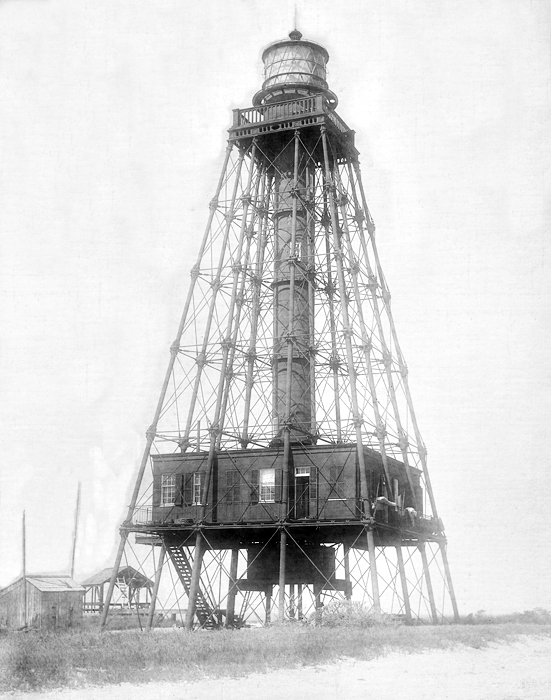
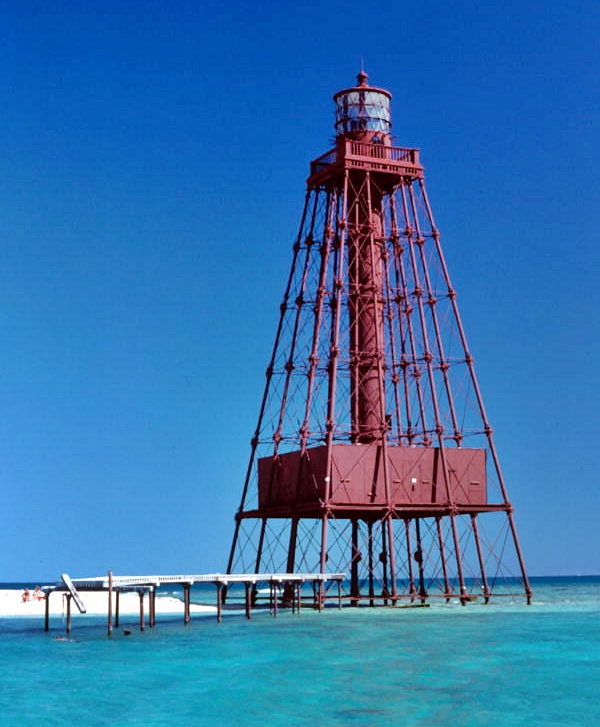
An additional $44,127.81 was finally approved on August 31, 1852, and George Meade, who had completed Carysfort Reef Lighthouse in March of that year, was transferred to Sand Key to assemble the lighthouse. Work began anew on January 22, 1853. Meade described the lighthouse as a “pyramidal framework … divided into six [horizontal] sections, the piles at both ends fitting into cast-iron sockets at the juncture of each section, and being united together by a uniform system of horizontal tension and diagonal braces. The dimensions of the piles, sockets, and braces of each section diminish proportionately to its elevation.”
Within the second horizontal section above the water, a thirty-eight-foot-square dwelling, consisting of nine, twelve-foot-square rooms, was constructed. One of the rooms held a five-thousand-gallon tank for holding rainwater collected from the roof and a thousand-gallon tank for oil. From the dwelling’s central room, a spiral staircase with 112 steps led up a cylindrical tube to the lantern room. Over 450 tons of iron were used in constructing the lighthouse, which stood 132-feet tall.
A first-order Fresnel lens, Florida’s first, was placed in the lantern room and lit for the first time on July 20, 1853. Manufactured in Paris by Henry-Lepaute, the lens produced a unique characteristic consisting of the repeated cycle of a fixed white light for one minute, a partial eclipse of twenty-five seconds, a white flash of ten seconds, and finally another partial eclipse of twenty-five seconds.
|
The new lighthouse hadn’t been standing long when it too was exposed to the full force of a hurricane. Hurricanes struck the tower in 1856 and 1865, followed by the “Twin Hurricanes” of 1870, and another one in 1875. Each hurricane swept away most of the island, and the station’s wharf, boathouse, privy, and oil house were destroyed multiple times. By 1875, the dwelling perched in the tower had suffered so much abuse at the hands of the hurricanes that it too had to be replaced using a $20,000 appropriation made by Congress in 1874. As the bolts used to hold the dwelling together were thoroughly rusted, much cutting was required to remove the old structure before it could be replaced with a new, heavier one.
During the periods between hurricanes, when sand built back up around the lighthouse, thousands of terns congregated on Sand Key to nest. Tern eggs were found to be quite tasty, and the lighthouse keepers would collect them by the basketful to deliver to their friends on Key West. Keeper Charles G. Johnson, stationed at the lighthouse in 1902, reported to William Dutcher, chairman of the American Ornithological Unit, that “nine to twelve thousand birds used to nest on Sand Key, but so many eggs were taken only two to three hundred young ones hatched.” On neighboring islands, birds were being killed by plume hunters seeking fancy feathers to adorn ladies hats. Alarmed by the decimation of the bird population, Dutcher formed a Bird Protection Committee, and hired bird wardens to patrol the islands. Keeper Johnson signed up as a warden, and made Sand Key a safe haven for the terns by running off anyone attempting to disturb the nests.
Red sectors were added to Sand Key Light on September 30, 1891 to mark dangerous water near the lighthouse. The signature of the light was changed to a group of two flashes every ten second around 1930, when a system of numerical flashing characteristics was introduced to the reef lights. This change was brought about through the use of a fixed lens and an acetylene gas double flasher.
In 1941, not long after the lighthouse came under the control of the Coast Guard, the light was automated and the dwelling vacated. The first-order Fresnel lens remained in the tower until 1967, when it was replaced by a fourth-order Fresnel lens. In 1975, Bruce M. Williams was part of a three-man team that disassembled the fourth-order lens, removed it from the lantern room, reassembled it on the balcony, and then lowered it by rope down to their Coast Guard vessel. A 300mm beacon was installed in its place. According to Williams, the removed lens was stolen from their locked offices just a few days later, and it was later discovered that a Chief Warrant Officer had converted it into a base for a glass-topped table.
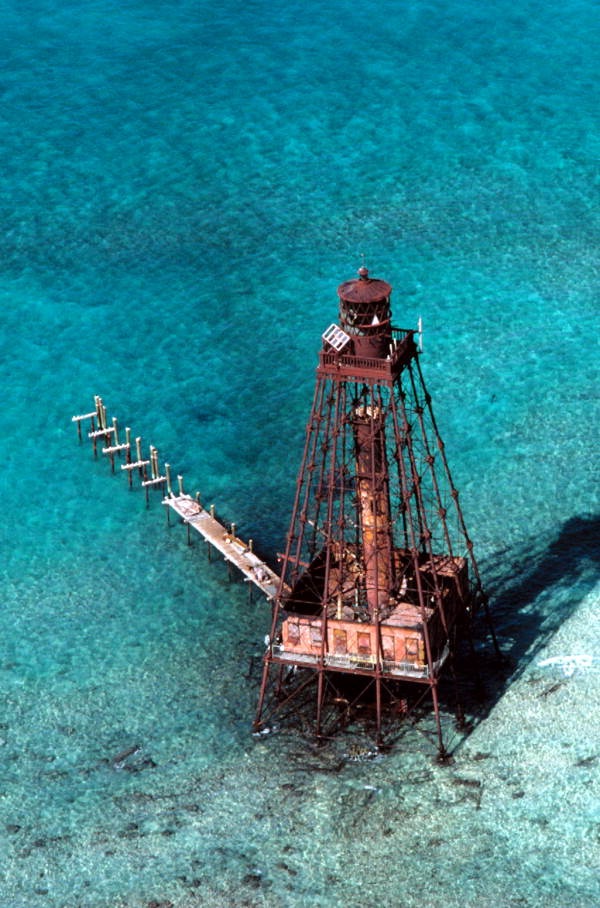
Major renovation of Sand Key Lighthouse was undertaken in 1989. Workmen were in the process of replacing corroded parts, and sandblasting and painting the structure, when during the evening of Sunday, November 12, Coast Guard Key West received a report that the historic lighthouse was ablaze. One would think that the iron structure would be immune to fire, but the contractor’s flammable paints and the dwelling’s wooden furnishings provided ample fuel for a fire. Much of the damage was limited to the core of the lighthouse, where the intense heat caused the spiral staircase and its cylindrical covering to collapse.
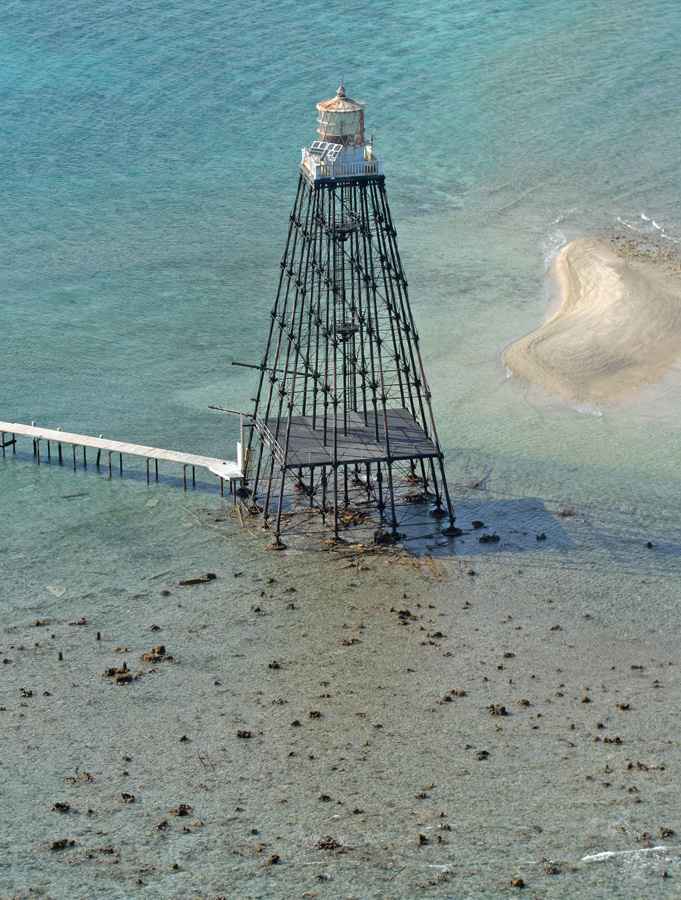
A study, complete with computer modeling, was funded to determine if the damaged structure could be saved. Based on the results, the Coast Guard decided to spare the lighthouse, and a $500,000 restoration project started in 1994. Even though the lighthouse was on the National Register of Historic Places, the decision was made to remove the damaged dwelling and central column, as restoring the lighthouse to its former state proved too costly. A light was absent from the tower from 1989 to 1998, when a solar-powered VRB-25 aerobeacon was placed atop the lighthouse.
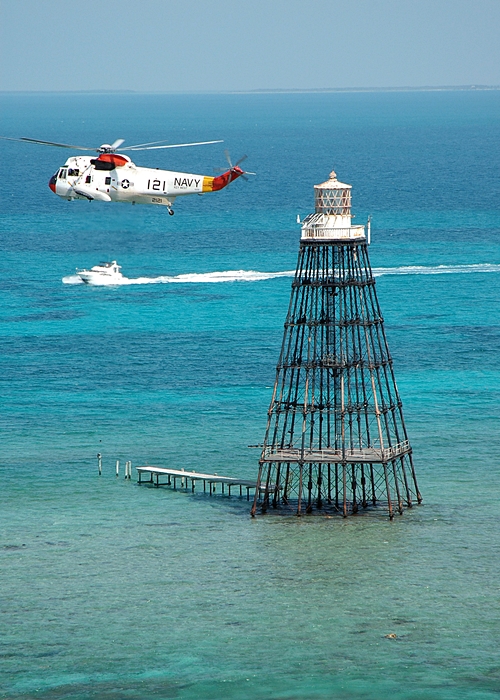
Today, the iron structure still stands sentinel over the dangerous reef, but no evidence of human habitation remains on the island. The nearby waters are often dotted with snorkeling tourists from Key West, who are likely oblivious that on this tiny, transient patch of ground keepers lived for over a hundred years, giving their time and even their lives to provide safe passage through these dangerous waters. In 2014, the Coast Guard deactivated Sand Key Lighthouse after determining that the structure was “unstable and considered unsafe.” While the historic lighthouse remains standing, Sand Key’s defining characteristic of two flashes every fifteen seconds is now displayed from a nearby structure at a height of just forty feet.
On June 1, 2017, Sand Key Lighthouse, deemed excess by the Coast Guard, was made available under the guidelines of the National Historic Lighthouse Preservation Act “to eligible entities defined as Federal Agencies, state and local agencies, non-profit corporations, educational agencies, or community development organizations, for education, park, recreation, cultural, or historic preservation purposes.” Interested parties were given sixty days to submit a letter of interest.
After no organization was selected to assume responsibility for Sand Key Lighthouse, the General Services Administration initiated an online auction for the structure on March 29, 2019. The bidding started at $15,000, and bidders were required to supply a $5,000 deposit. The close of the auction was delayed due to an issue with the state of Florida pertaining to the submerged land at the lighthouse. After this was resolved, an initial closing date was finally set for November 17, 2020, and the auction closed on November 27, 2020 with a high bid of $83,000. Nine bidders participated in the auction.
Keepers:
References