Mobile Bay (Middle Bay), AL 
Select a photograph to view a photo gallery
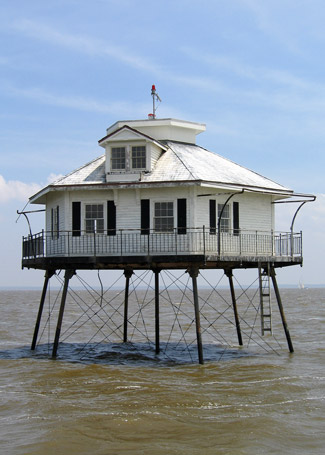
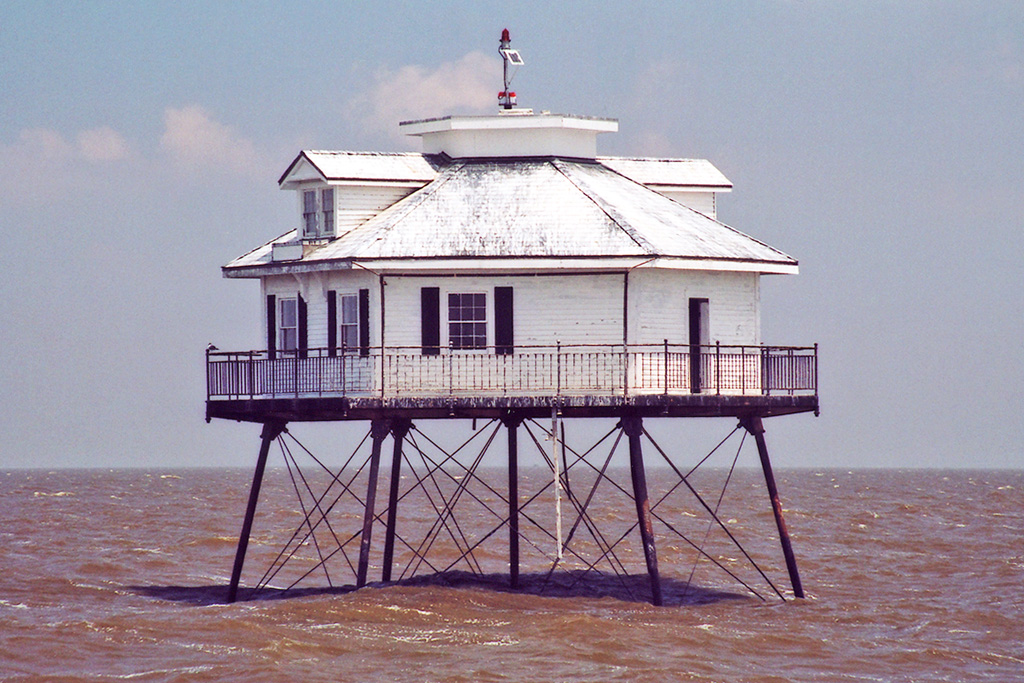
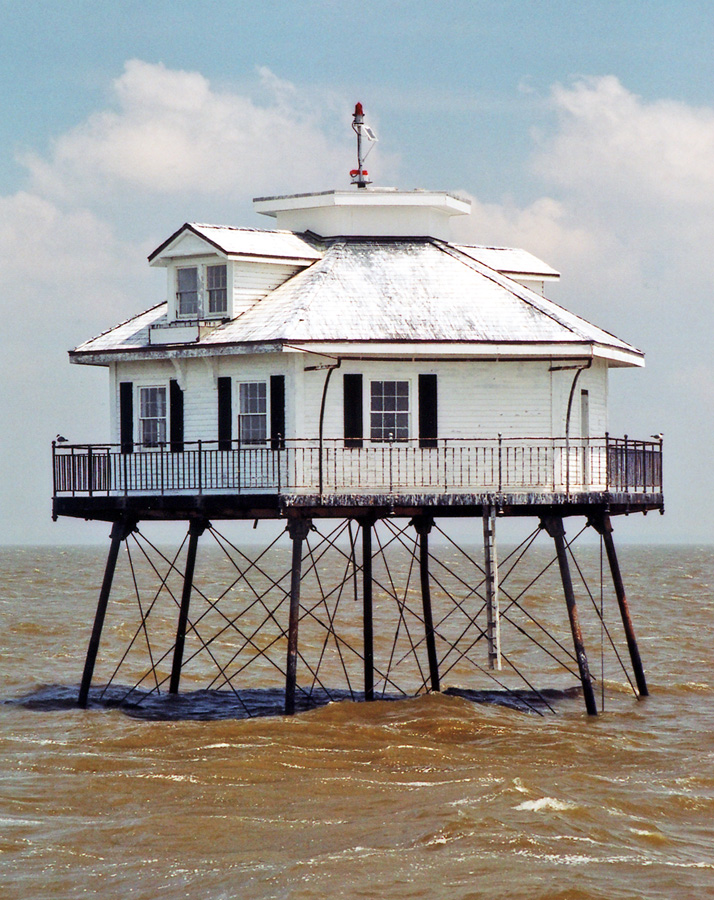
Photo Gallery
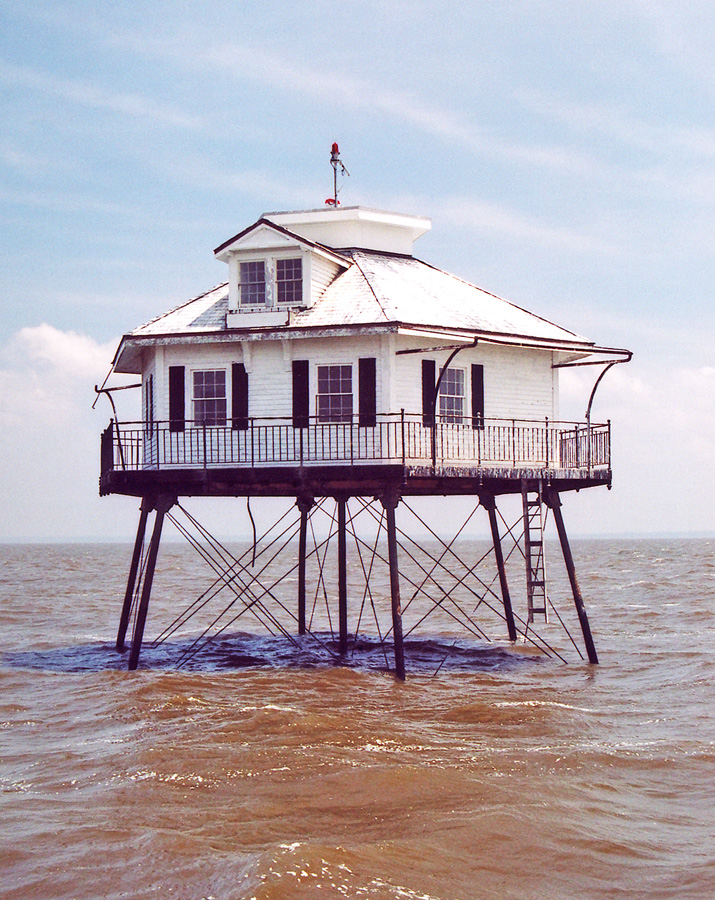
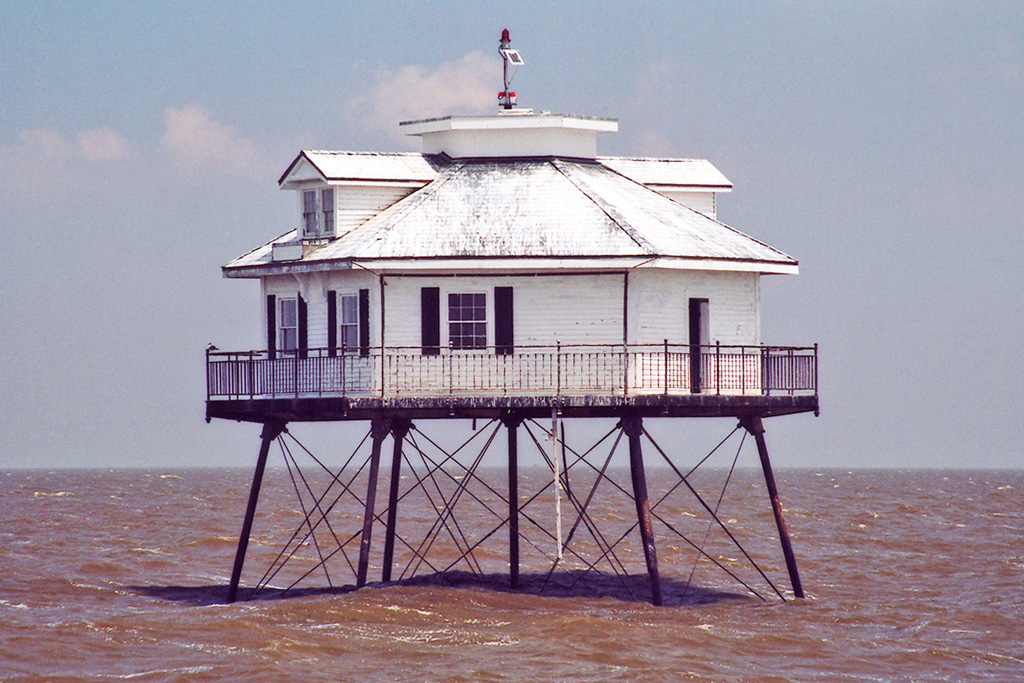
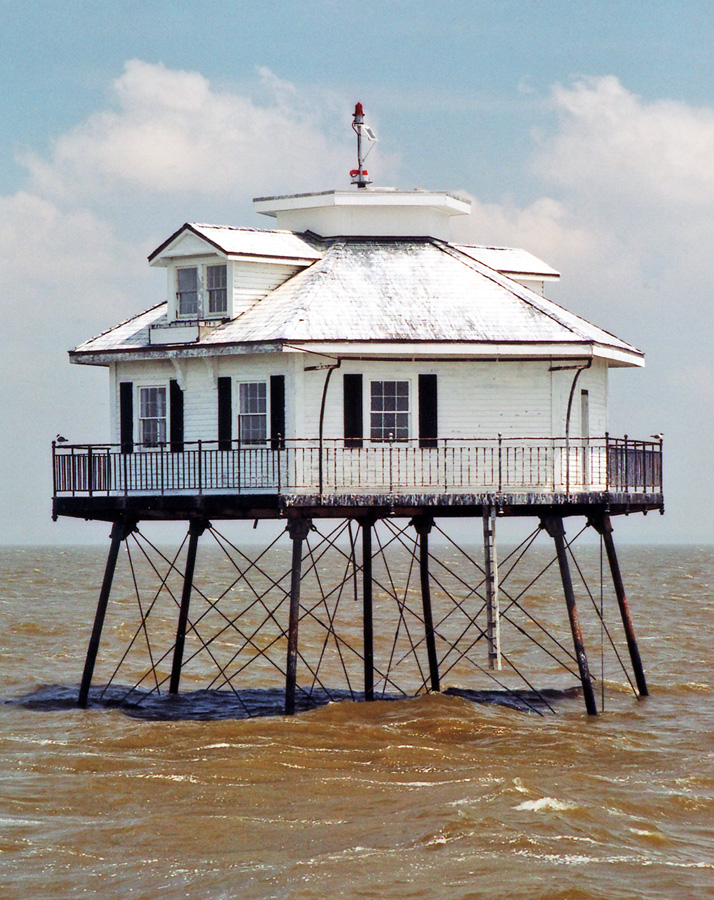
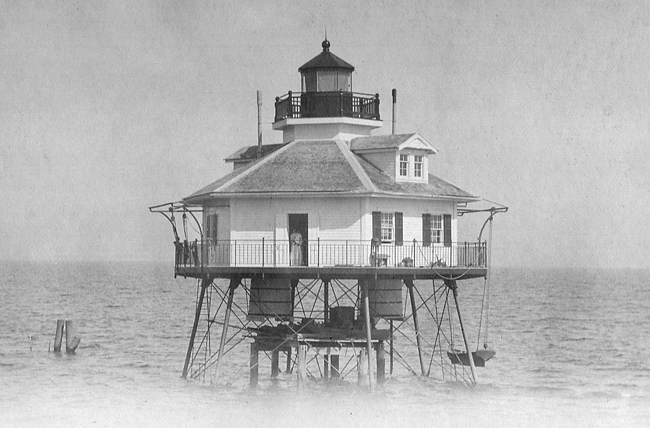
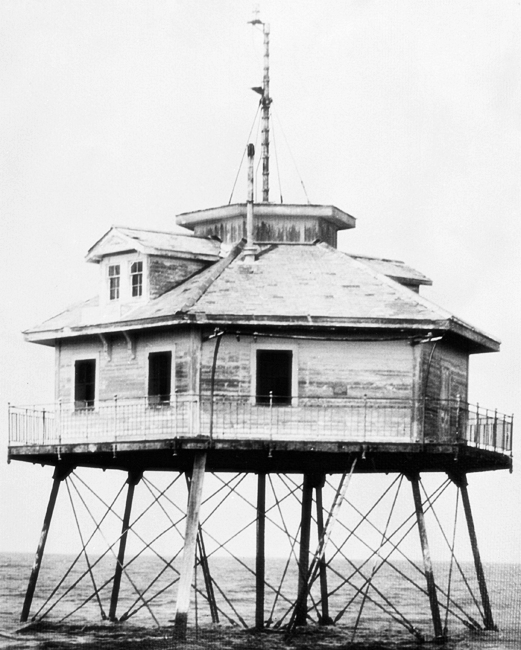
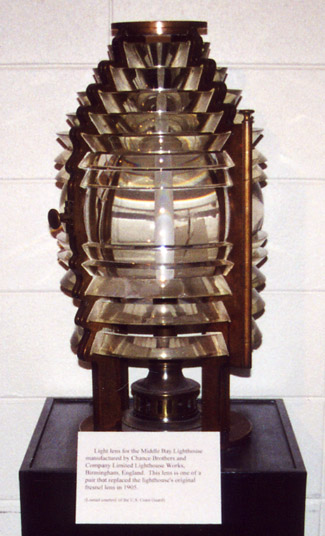


Photo Gallery
Photo Gallery
|
Due to high labor costs in the post-Civil-War South, the lighthouse was prefabricated in the North and then shipped to Mobile Point, where it arrived in 1885. A temporary working platform, which measured sixty feet square and was supported by forty-eight fifty-foot piles, was established at the site to support the workers tasked with erecting the lighthouse.
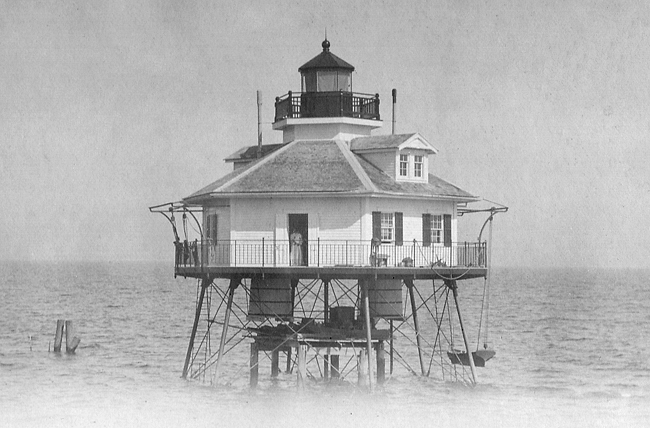
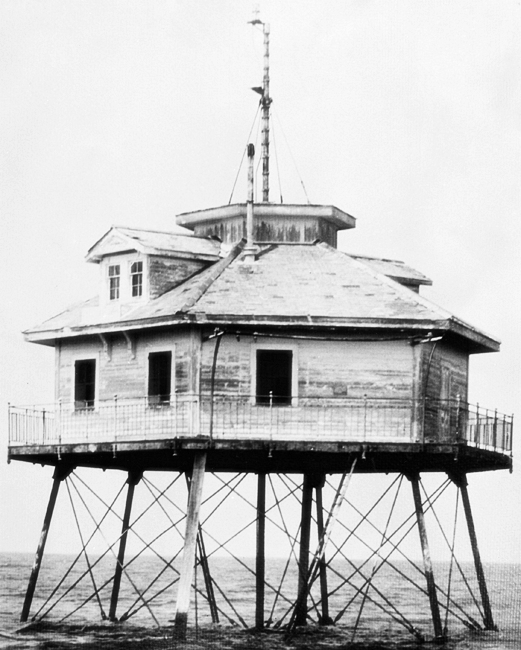
The screwpile lighthouse consisted of a wooden hexagonal dwelling with a pyramidal roof that slopped upwards to the centrally located lantern room. The lighthouse was supported by seven legs – one in the middle, and a single leg extending from each corner of the superstructure. After the piles had been screwed into the bottom of the bay, the structure suddenly settled seven-and-a-half feet on September 12, 1885. Wooden piles were hurriedly driven around the screwpiles and succeeded in stabilizing the lighthouse. The settling was so even on each screwpile, that the lighthouse was only three or four inches from being perfectly level.
On December 1, 1885, the light from a fourth-order Fresnel lens first cast its beams from atop the lighthouse at a focal plane of forty-one feet. The light’s characteristic was fixed white varied ever thirty seconds by a red flash. The station also had a fog bell that was struck a blow every five seconds when conditions merited it. The foundation piles were painted red, the dwelling white with green blinds, and the lantern room black.
After serving for just twenty years, the lens and lantern room were removed from the lighthouse in 1905, and two acetylene lights were mounted on a pole protruding from the roof. During World War I, the keeper responsible for the lights and his wife had a baby at the lighthouse. When the mother was unable to nurse the infant, the couple’s creativity was put to the test. Rather than send the mother and child ashore, a small corral was created on the lighthouse’s gallery, and a milk cow was transported to the station.
|
In 1967, the Coast Guard received permission from the General Services Administration to demolish the dilapidated lighthouse. Fortunately, several parties protested the decision. The Mobile Bar Pilots Association argued that the lighthouse still served a vital navigational role, as it was more readily picked up on ships’ radars than the small, modern buoys. The pleas were convincing, and the lighthouse was spared.
Mobile Bay Lighthouse was placed on the National Register of Historic Places in 1975, helping to ensure its continued preservation. The Alabama Historical Commission assumed responsibility for the lighthouse, and as its 100th anniversary approached, the Middle Bay Light Centennial Commission was established to restore the lighthouse for a celebration. Decking was replaced, along with doors and windows, and the lighthouse received a fresh coat of paint. On December 1, 1985, ships of all sizes converged on the lighthouse to participate in the anniversary celebration.
Like any exposed structure, the lighthouse is in need of periodic maintenance and refurbishing. By 2002, the lighthouse had deteriorated quite badly, and a major restoration effort was initiated by Thompson Engineering under a $349,400 contract from the Alabama Historical Commission. As part of this project, the lighthouse received a new slate roof, and damaged wood and corroded tie rods were replaced. The roughly fifteen-foot-tall pyramidal structure that displayed a red flashing light atop the lighthouse was replaced by a six-foot pole supporting a solar-powered red light.
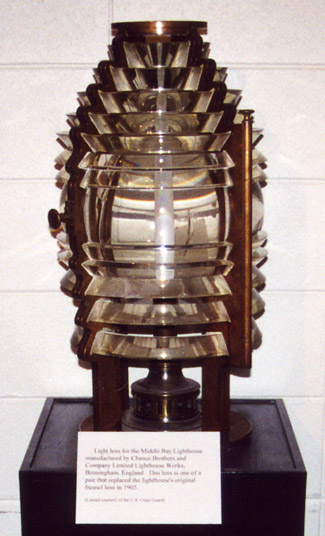
A Fresnel lens thought to be from Mobile Bay Lighthouse was on loan to the Fort Morgan Museum, where it was on display along with the lens from Sand Island Lighthouse, but that lens is now with the Coast Guard in Mobile. A note below the lens stated that it was one of a pair of lenses that replaced the original fourth-order lens used in the lighthouse. Other sources claim the lens that was in the museum is the original lens. A lantern room similar to the one used on Mobile Bay Lighthouse was obtained from a collector in California and restored by the Alabama Lighthouse Association. The lantern room along with a Fresnel lens on loan from the Coast Guard were displayed for some time at the Mobile Regional Airport. This lantern room and Fresnel lens can now be seen at the National Maritime Museum of the Gulf of Mexico.
The Alabama Lighthouse Association had new exterior doors installed at the lighthouse around 2005 and is working to raise funds for new handrails so public access can be allowed.
In June 2008, the Alabama Lighthouse Association published a “strong proposal” to move Mobile Bay Lighthouse ashore, where it would be more accessible to the public and easier to maintain. The proposed site for the lighthouse was Battleship Park, which receives 300,000 visitors each year. The Mobile Bar Pilots Association strongly opposed moving the lighthouse. On December 2, 2009, the Alabama Historical Commission voted against the proposed move and instead unanimously agreed to spend $30,000 a year on maintenance and restoration of the structure in its present location.
A $270,000 restoration of the lighthouse was undertaken in 2010 and included structural repairs, above-water stainless steel tie-rods, ten new windows and a complete exterior painting. In 2013, a shrimp boat ran into the lighthouse, bending a metal support piling and breaking some stainless-steel tie-rods. The damage was not reported until about a month later when Dauphin Island Sea Lab personnel visited the lighthouse to work on its water monitoring equipment. The damage was estimated to be between $50,000 and $75,000.
Keepers:
References