Sankaty Head, MA 


Select a photograph to view a photo gallery


Photo Gallery


Photo Gallery
Photo Gallery
|
The Shoals of Nantucket are known and dreaded by every navigator on the Atlantic seaboard, and among the great number of missing vessels recorded at the insurance offices there are doubtless many that have been swallowed up in these treacherous quicksands. …An accurate and detailed, hydrographical survey of all these shoals, as also of numerous others lying north of the same island, is of vital importance. …A more important measure, however, is the erection of a first class light-house upon the highlands near Siasconsett, and it is really very remarkable that this most striking omission in the lighting of our sea coast has not before been observed.On the eastern side of Nantucket island there is a deep safe channel inside of all the shoals and rips. The erection of a light on the high land near Siasconsett would not only render this valuable channel available to all classes of shipping, but would be, if sufficiently elevated, a safe mark, in clear weather, to clear the South shoal, twelve miles distant, and all the rips to the eastward.
Lewis’ recommendations were heeded but not in his prescribed order. Lieutenant Charles Davis conducted sounding operations off Nantucket in 1847 and discovered some heretofore unknown but very dangerous shoals, which were soon named Davis South Shoals in his honor, but money for a lighthouse at Sankaty Head near Siasconsett was not appropriated until August 14, 1848.
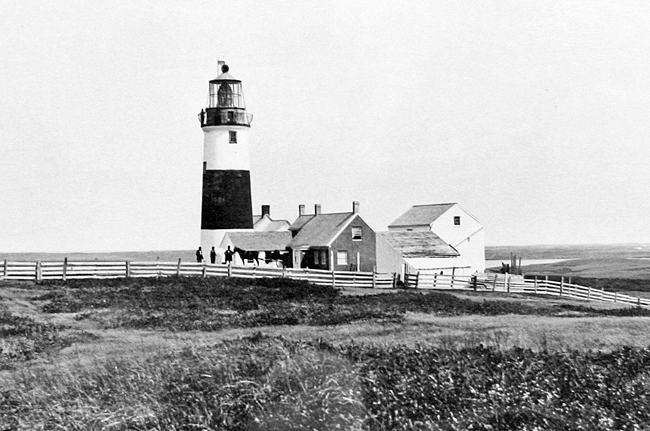
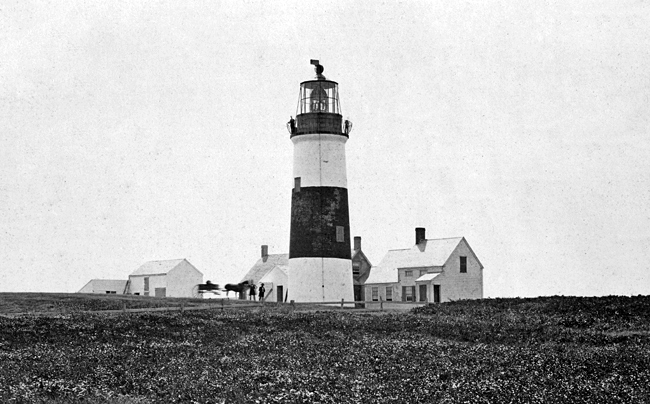
Ten acres on Sankaty Head, the most southeastern headland in New England, were purchased from George Myrick in May 1849 for $250, and Cabet King was contracted to build the brick tower. Supplies for the project were landed at Nantucket Harbor and transported across the island to the construction site. The tower’s foundation was set five feet below the surface of the ground, and the brick portion of the tower rose to a height of fifty-three feet. Atop this was a granite section, six feet in height, and finally the lantern, with a height of nine feet. The tower featured a cast-iron spiral staircase and floors, and a dwelling was built nearby for the head keeper.
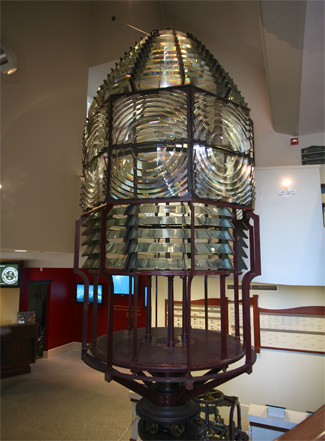
Sankaty Head Lighthouse was the first in the United States to be equipped with a Fresnel lens as original equipment. This second-order lens, supplied by Henry-Lepaute of Paris, was lit for the first time on February 1, 1850. Benjamin F. Isherwood, a talented engineer with the Navy Department, supervised the construction of the tower and the installation of the lens and had a plan for “discriminating one light from another, and of determining the distance of a vessel from a light.” It is not clear exactly what this plan was, but it likely involved the use of red glass panels on the lower portion of the lens, which would produce distinctive flashes and would also be visible at a lesser distance than a white flash. Isherwood went on to become the Engineer-in-Chief of the U.S. Navy in 1861, and was known as the “father of the modern steam navy.”
The Lighthouse Board was formed by Congress in 1852 and issued a report that year highly praising the Fresnel lens at Sankaty Head Lighthouse and its first keeper, Alexander D. Bunker.
This lens is acknowledged universally, so far as could be ascertained, to be, if not the best light in point of brilliancy and power, greatly superior to all others (except, perhaps, those on the Highlands of Navesink, New Jersey,) on the entire coast of the United States.The present principal light-keeper in charge of this establishment is a most respectable and intelligent retired sea captain, who commanded a merchant ship for twenty-five years, and who knows the importance of his trust, and evinces a most praiseworthy interest in the performance of all his duties.
He is assisted by two persons, who, for want of quarters at the light-house, are compelled to reside at some distance from it, to the detriment of the service.
The present keeper took charge of the light on the night it was first lighted without previous knowledge or instruction as to its management, but encountered no other difficulty in managing the mechanical or carcel lamp than that arising from the use of bad oil, which he has frequently had….
The keeper to this light is a man of far greater intelligence than the light-keepers generally in this and other countries, but the successful manner in which he has managed it, without previous instruction, goes far to prove the necessity for employing just such persons in all of our seacoast lights.
|
The brilliant flashes of the Fresnel lens at Sankaty Head attracted the attention of not only mariners offshore but of nearby residents and visitors to the island who often took a day-long trek from Nantucket out to the lighthouse and back. In October 25, 1856, The Nantucket Mirror noted: “The narrow aperture on the platform under the lantern at Sankaty lighthouse has been widened to allow ladies with hoop skirts to pass through to see the reflectors.”
Samuel Adams Drake visited Sankaty Head Lighthouse in 1875 and commented:
…when built, this light was unsurpassed in brilliancy by any on the coast, and was considered equal to the magnificent beacon of the Morro. Fishermen call it the blazing star. Its flashes are very full, vivid, and striking, and its position is one of great importance, as warning the mariners to steer wide of the great Southern Shoal. Seven miles at sea the white flash takes a reddish hue.
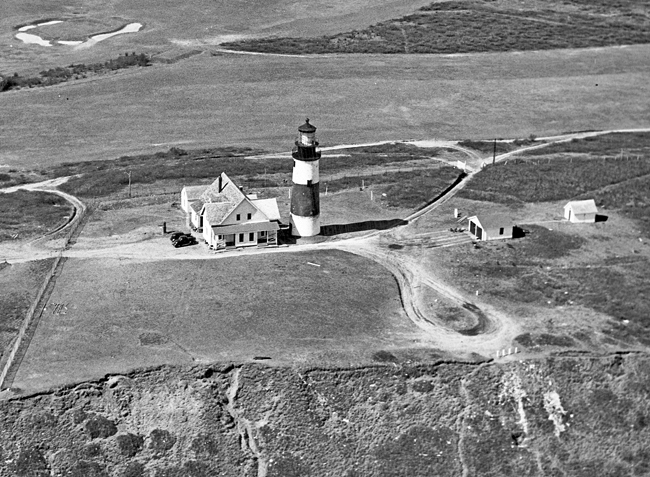
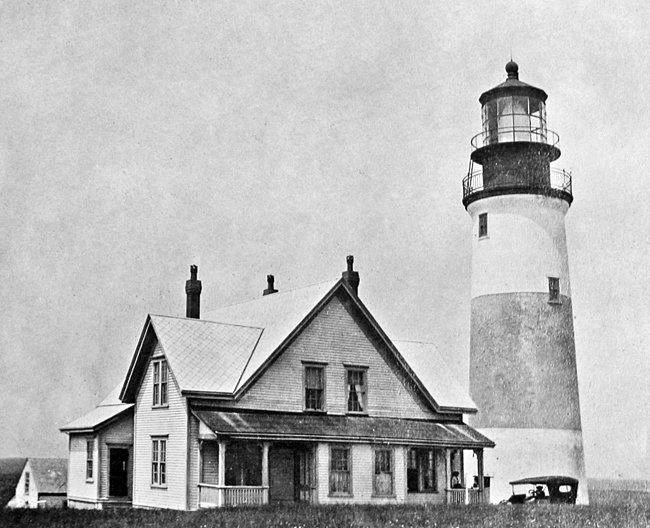
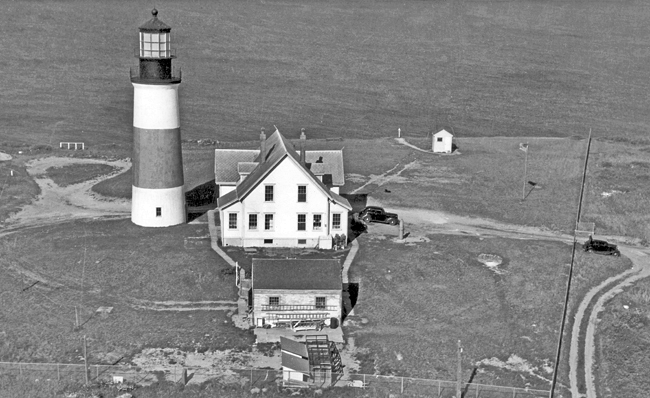
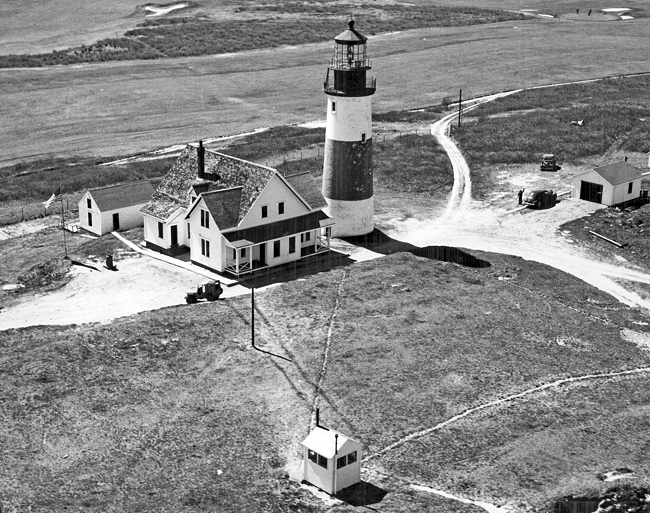
Numerous improvements were made to the station over time. Telegraph and telephone lines were installed in 1886, and a fifty-foot flagpole was erected on the bluff for displaying weather signals. The following year, the station’s two keeper’s dwellings were replaced with a large wooden duplex with room for both the keeper and assistant. In 1888, two machinists and four laborers from Boston installed a new iron watchroom and lantern room that raised the focal plane of the light by ten feet. During this work, a temporary light from a fourth-order Fresnel lens was exhibited from a nearby wooden tower. For the convenience of the keepers, a speaking tube linked the new watchroom with both sets of living quarters. A brick oil house, for storing the kerosene that replaced lard oil as the illuminant in 1883, was erected in 1892.
Joseph G. Remsen was the longest-serving head keeper at Sankaty Head, having spent over twenty-five years at the station while working with seven different assistants. Remsen started his lightkeeping career at Brant Point Lighthouse in 1887, and then served as captain of South Shoals Lightship for two years before arriving at Sankaty Head.
On the morning of January 20, 1892, Keeper Remsen telephoned Walter N. Chase, keeper of Coskata Life-saving Station, to let him know that during the previous night, rockets had appeared in the sky off the coast and that the masts of a schooner stranded on Bass Rips could now be seen. The life-saving crew promptly launched their lifeboat that frosty morning and rowed nearly fifteen miles out into the churning Atlantic to find seven half-dead men clinging to the rigging of the schooner. After a line was secured to the schooner, a life car was used to bring the sailors aboard the lifeboat. With the wind blowing offshore, the life-saving crew could make little headway on their return trip to Nantucket, and had to take turns catching a few minutes of sleep as day turned to night and Sankaty Head Lighthouse began sending out its beams of light. Worried wives had given up hope of seeing their husbands again when the crew finally landed on the beach twenty-six hours after setting off to make the rescue.
Up until 1898, access to the station was via a rough road crossing private property. The owner of that land gave notice that he would withhold access unless the road was greatly improved, so that year an appropriation of $300 was approved to build a new road between the lighthouse and the nearest public road.
Eugene N. Larsen arrived with his family at Sankaty Head Lighthouse in 1914, after he had served at Minot’s Ledge, Cape Ann, and The Graves. Larsen remained an assistant keeper until 1920, when he was promoted to principal keeper to replace Charles Vanderhoop, who was transferred to Gay Head. During the Larsens’ time at Sankaty Head, five daughters were added to their family, joining a daughter, born on Thacher Island, and a son born in Norway, before the family immigrated to the United States. In 1939, Keeper Larsen received the Commissioner’s Pennant, the highest honor a light station could receive, and he retained that pennant until his retirement in December 1943, after twenty-nine years at Sankaty Head.
|
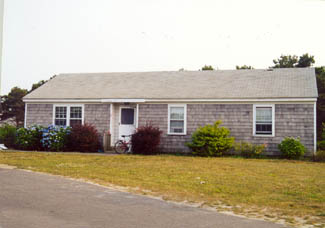
After the retirement of Keeper Larsen, Archford Haskins served as the station’s final civilian keeper until 1947, when Coast Guard crews took over responsibility for Sankaty Head Lighthouse. The Fresnel lens was removed in 1950 and replaced by rotating aerobeacons, while the 1887 keeper’s duplex was torn down in 1953 and replaced with two one-story, ranch-style houses. The lighthouse was automated in 1965, although personnel continued to live at the station until 1992. In 1969, the Coast Guard removed the lantern room from around the aerobeacons, but residents complained loudly about the disfigured lighthouse until a new aluminum lantern room was placed atop the tower.
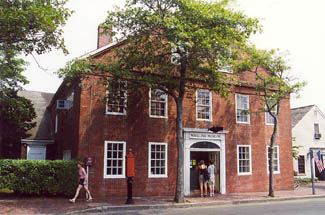
Over the years, erosion slowly ate away at the bluff in front of the lighthouse, and by the early 1990s all buildings on the grounds were removed except for the tower itself. One of the houses was moved to Miacomet Village to be used as low-income housing; the rest of the buildings were destroyed. After the Perfect Storm in 1991 tore away huge chunks of the bluff near the lighthouse, six ‘Sconseters formed Save Our Sankaty to rescue the endangered tower. When both the Nantucket Lifesaving Museum and Nantucket Historical Association decided they couldn’t take on the project, ‘Sconset Trust finally acquired the lighthouse, raised the necessary $4 million, and contracted the relocation of the tower with International Chimney of Buffalo, New York, who with their moving subcontractor, Expert House Movers of Virginia Beach, Virginia, had relocated several other lighthouses including Southeast Lighthouse on Block Island, Rhode Island, Cape Hatteras Lighthouse in North Carolina, and Massachusetts’ Highland Lighthouse and Nauset Lighthouse.
In September 2007, the movers used chainsaws with diamond-studded teeth to carve holes in the foundation of the lighthouse so that a matrix of steel beams could be used to jack up the lighthouse and facilitate its relocation. Using a system of roll beams and hydraulic jacks, the tower was relocated 390 feet to the northwest and 250 feet from the bluff’s edge to a new home on a parcel of land donated by Sankaty Head Golf Club.
On October 11 and 12, 2008, one year after the successful relocation of the tower, an open house was held at Sankaty Head Lighthouse to welcome the public to the restored tower in its newly landscaped surroundings. The interior of the lighthouse will only be open on special occasions, but the grounds will be open to the public daily.
In December 2023, the Coast Guard installed a rotating LED beacon in the lantern room atop Sankaty Head Lighthouse.
The lighthouse remains an active aid to navigation, showing a white flash every seven-and-a-half seconds. Standing 166 feet above the sea, Sankaty Head Lighthouse is a highly visible landmark from both land and sea, with its white tower and distinctive wide red band.
Keepers:
References