Isle au Haut, ME 



Select a photograph to view a photo gallery
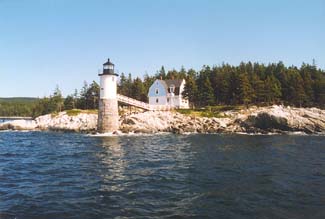
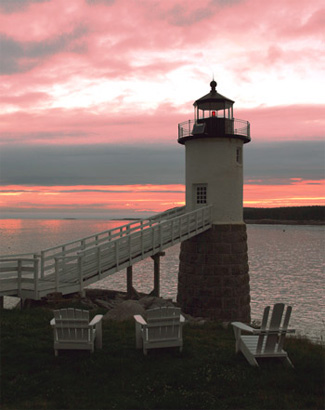
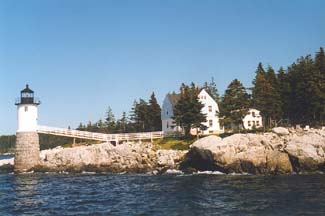
Photo Gallery
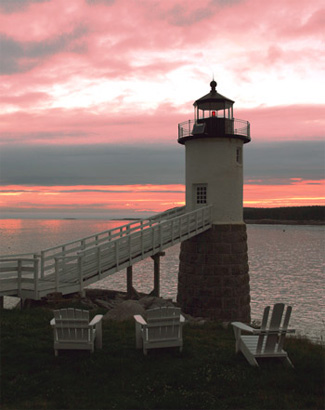
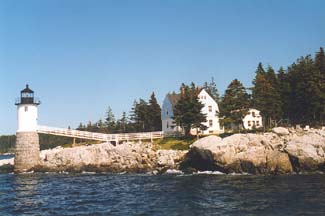
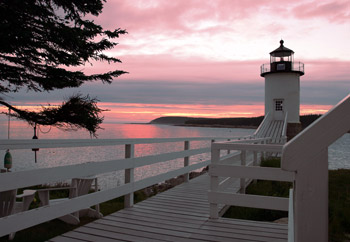
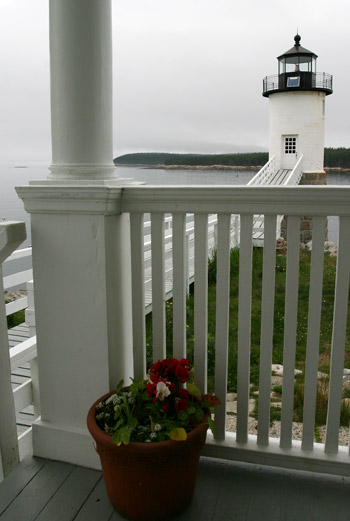
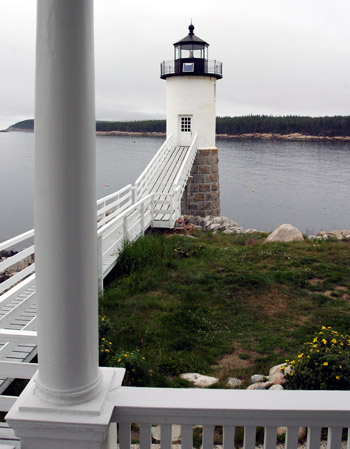
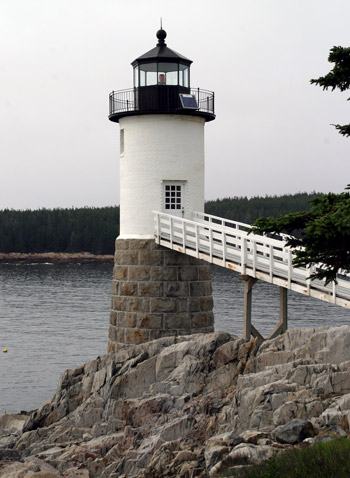
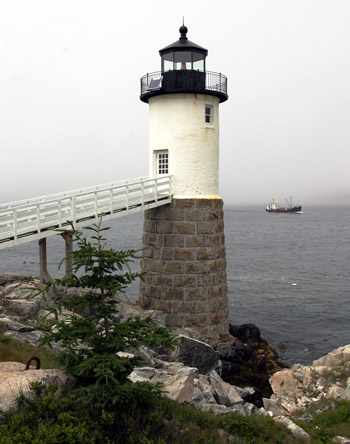
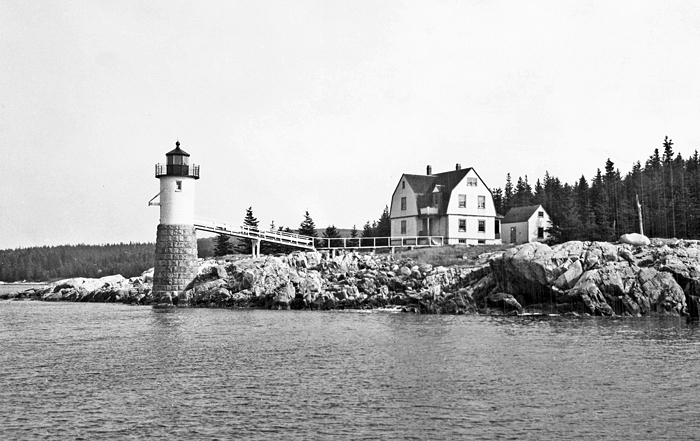
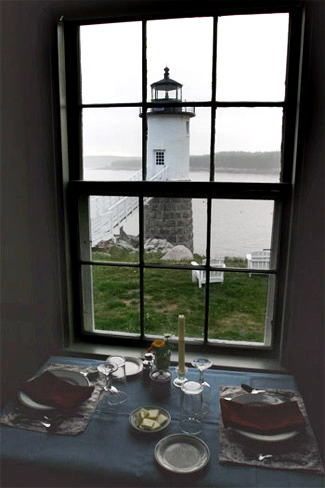
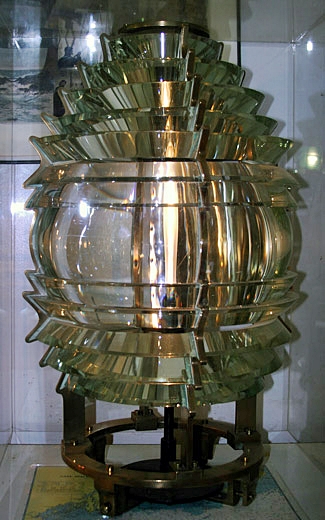
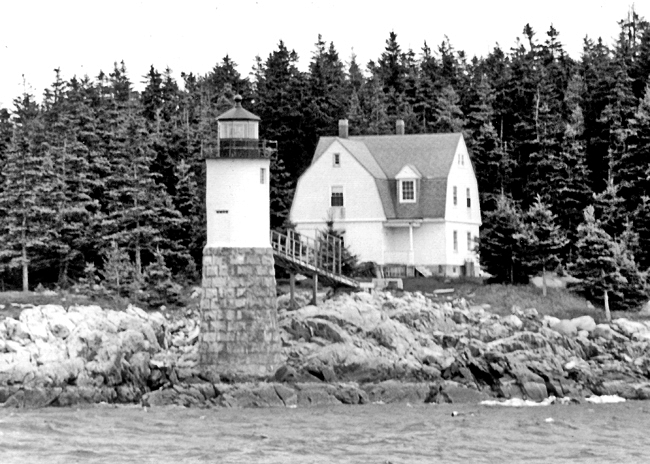
Photo Gallery
Photo Gallery
The majority of permanent residents on Isle au Haut turned out in 1997 for a referendum on whether to pursue ownership of Point Robinson Lighthouse. Despite the financial burden of maintaining a light tower, locals voted 27 to 11 in support of owning the light. Soon, the community was hard at work raising money to restore their beloved tower. They managed to gather $62,000 for replacing the tower railing, windows, and doors with replicas of the originals. The restoration, new paint, and structural work were completed by June 1999.
Isle au Haut is one of the few places where the pace of life remains somewhat close to that experienced by lighthouse keepers. And most residents prefer it that way. There is a sense of community, with bake-offs, and strong school support – despite the fact that students number in the single digits. The number of visitors to the island is limited by how many the mail boat can carry. There are no ferries that transport cars to Isle au Haut, but bicycles can be rented on the island. Many houses are without electricity, and Isle au Haut was the last U.S. community to give up crank telephones. No hotels or tourist facilities are planned. One of the few places to stay has been The Keeper’s House, comprised of the old keeper’s dwelling and outbuildings, which were purchased by Jeff and Judi Burke in 1986 and renovated into a popular inn for tourists. In May 2012, the two-acre property was for sale with an asking price of $1.9 million, including the “seven room main house with four bedrooms and two baths, a four room house with one bedroom and one bath, two small heated cabins, two storage buildings, a large boathouse, pier, ramp, floating dock, boat mooring and 700 feet of deep water frontage on Isle Au Haut Bay.” The station was powered by a generator, solar panels, and a windmill; and water was drawn from the sea and desalinized.Half of Isle au Haut lies within Acadia National Park. Visitors can see porpoises, seals, deer, eagles, mink, and osprey as they hike, and it was the bounty of nature that generated the need for a lighthouse. The area was considered to be “exceedingly good fishing grounds,” rich in haddock, cod and hake. From 1902 – 1905, the Lighthouse Board repeatedly recommended the building of a lighthouse on the island:
Lower East Penobscot Bay and the water seaward for a distance of about 10 miles outside of Saddleback Ledge Light-house are claimed by fishermen to be exceedingly good fishing grounds, and are frequented by fishing vessels ranging in size from 10 to 100 tons burden. Haddock are caught here from March till May, haddock, cod, and hake from May till October, and cod from October till January. The most profitable fishing is during November and December, when northeast snowstorms are apt to prevail, and are often of great severity. The trawls set by fishermen, which often contain several thousand hooks, can not be suddenly left without material loss or disadvantage, and when storms or night approach the vessels often need to remain on the grounds till the last moment, when it is of the utmost importance that they be able, quickly and with certainty and safety, to make a secure harbor.Isle au Haut Harbor is the best harbor convenient to these fishing grounds, and is so convenient in distance and has such good holding ground and is so well sheltered, especially from all the worst winds, northeasterly and easterly, from which shelter is most needed, it is highly valued and much frequented by fishermen. A light-station with a fog bell, struck by machinery, would guide fishermen into this harbor when they could not find it without such aid. It is estimated that these could be established here for $14,400, and the Board recommends that an appropriation of this amount be made therefor.
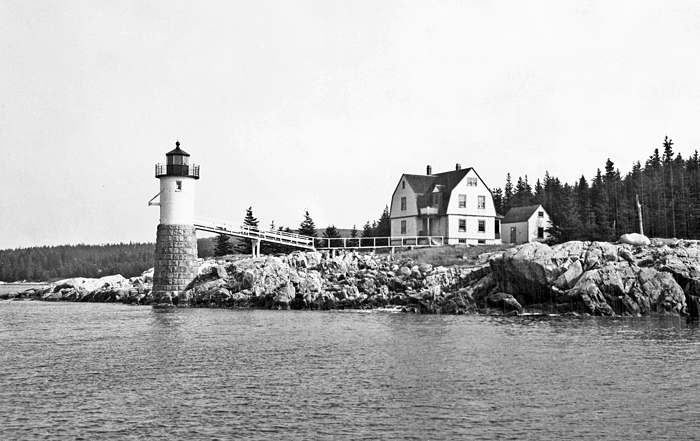
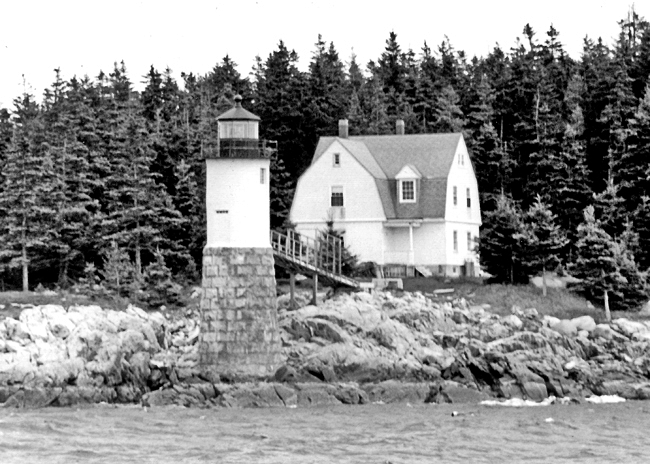
Land for the station on Robinson Point was purchased from Charles E. Robinson and work moved ahead on Robinson Point Lighthouse, as Isle au Haut Lighthouse is also known. The Board insisted that the light station could not be built for the $14,000 appropriated on June 23, 1906, and asked that another $400 be passed, which did not come to be. Records for 1907 show that: “The station consists of a [40-foot] granite and brick tower, dwelling, oil-house, fuel house, and boathouse. The entire amount of the appropriation was exhausted in the construction of the station,” which was completed on December 30, 1907. Perhaps the shortage in funds was circumvented, because the following year, a “Bell struck by machinery [was] established.” The bell was mounted on the seaward side of the tower and was alternately struck a single and a double blow, at intervals of thirty seconds.
|
Locals say that eight-year-old Esther Holbrook, daughter of Francis Elmer Holbrook, the first keeper, was given the honor of first lighting the tower’s fifth-order Fresnel lens. This supposedly occurred on Christmas Eve 1907, but construction wasn’t completed until December 30, and another source says the light was first lit on New Year’s Day 1908. The tower was built a bit offshore and reached via a wooden walkway.
Holbrook began his light-keeping career on remote Matinicus Rock as a third assistant keeper in 1898, and over the next decade worked his way up to first assistant keeper, before being transferred to Isle au Haut in 1907. In June 1922, Keeper Holbrook took a one-year leave of absence and then resigned a year later.
Harry Smith, the next and final keeper, stayed until Isle au Haut Lighthouse was automated on June 29, 1933, and then spent the rest of his career at Two Bush Island Lighthouse. Keeper Smith served as an assistant keeper at Rockland Breakwater, Egg Rock, and Petit Manan before becoming a head keeper at Boon Island in 1916. After four years on Boon Island, Smith was in charge of Petit Manan Lighthouse before being transferred to Isle au Haut in 1922.
When Isle au Haut Lighthouse was automated, its characteristic was changed to flashing red and its fog bell was discontinued. In August 1934, articles in various newspapers announced that nine Maine lighthouses, abandoned during the national economy program, were being sold by the U.S. Lighthouse Service. These lighthouses included those at Pumpkin Island, Hendricks Head, Winter Harbor, Grindle Point, Indian Island, Tenants Harbor, Narraguagus, Isle au Haut, and Doubling Point. Charles E. Robinson, who had originally sold the land for the light, was able, with the assistance of Maine’s Senator Margaret Chase Smith, to buy back the keeper’s house and land – excluding the tower, which remained federal government property.
For the next three generations, over fifty years, the keeper’s house welcomed members of the Robinson family. Linda Greenlaw, a great-granddaughter of Charles Robinson, wrote about her summers there in her book, The Lobster Chronicles:
The keeper’s house became my family’s summer home. It’s where we went when we weren’t in school, and where we longed to be when we were. Not many people can say they lived in a lighthouse. The times we spent in the house, my siblings all agree, were magical. We slept at night in rooms whose walls were massaged every four seconds by the soft, red wink of the tower. The house seemed to have a life of its own, protecting us and the memory of those who had lived there before. I’ve never felt so at home in any other dwelling, and perhaps never will. There are those who believe the Keeper’s House is haunted. I think spirited is more accurate.
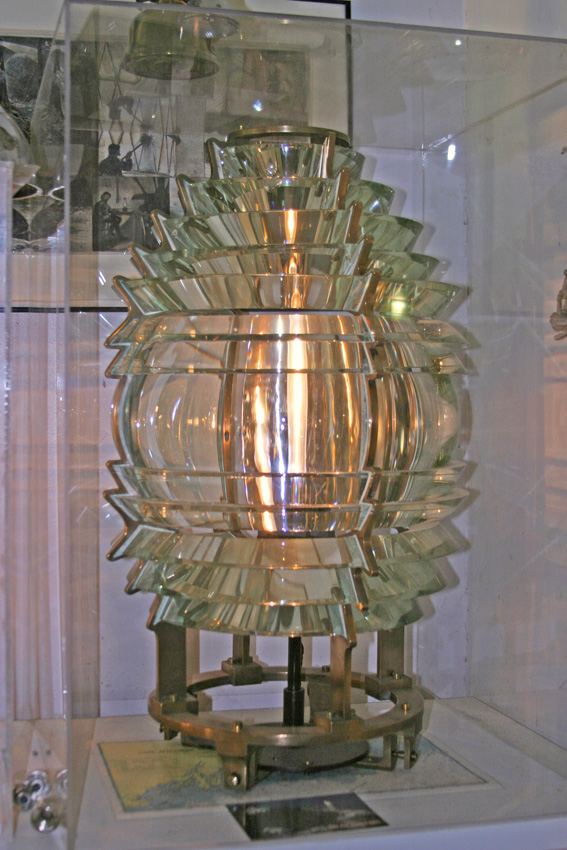
A fourth-order order Henry-Lepaute Fresnel lens was originally used in the lantern room, but at some point after automation a fifth-order Fresnel lens was installed in the tower, and it is this lens that is on display at the Maine Lighthouse Museum in Rockland.
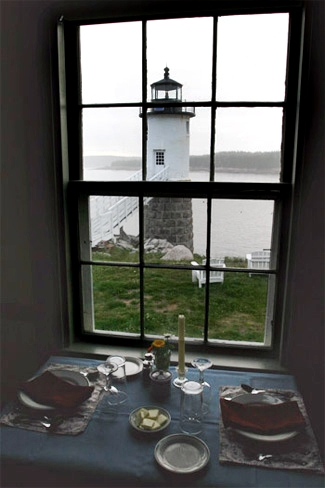
Judi Burke, daughter of a former Coast Guard keeper at Highland Lighthouse, Massachusetts, and her husband Jeff purchased the home in 1986 for $190,000 and quickly spent another $100,000 turning the dwelling into the Keeper’s House Inn. “The type of experience that people have here usually takes them by surprise,” said Jeff. “Strange things happen to people while they’re here. …They make career altering decisions, they propose to their sweethearts, they decide they’re going to leave the city, or they’re going to embark on some new adventure that they never thought they would do.” In his book, Lighthouse Inn: A Chronicle, Jeff Burke describes the pleasures and challenges of running the inn, of which there were plenty. After roughly twenty years of hosting guests, the couple retired from inn-keeping in 2007. While the inn was on the market, Jeff focused on his portrait painting, offering Portraits at the Lighthouse, where for $3,600 a person could spend the night at the lighthouse and have a portrait painted.
On December 31, 2012, Marshall Chapman, an associate professor of geology at Morehead State University and longtime island summer resident, purchased the property. Chapman re-opened the popular inn in June 2013, with the Burkes serving as consultants. While studying at the University of Massachusetts, Chapman did his field work on the geology of Isle au Haut and fell in love with the island. Chapman closed the inn after the 2018 season and placed it on the market for $1.975 million. The inn was available for summer rentals in 2019, but was closed during the pandemic, and finally sold in 2023 for $1.3 million.
Ownership of the lighthouse tower was transferred to the Town of Isle au Haut in 1998 under the Maine Lights program, and the following year Campbell Construction Company restored the tower for the Isle Au Haut Lighthouse Committee.
Friends of Isle au Haut Lighthouse was formed in 2016 to support further restoration of the lighthouse. During the summer of 2021, Knowles Industrial Services of Gorham restored Isle au Haut Lighthouse. Scaffolding was placed around the lighthouse so that spalled bricks could be replaced, mortar in the granite base could be renewed, and the tower could be painted. New structural steel girders were installed to support the interior floors. Friends of Isle au Haut Lighthouse raised the funds for the work with money coming from Belvedere Historic Preservation Fund of the Maine Community Foundation, the Fisher Foundation, the Maine State Historic Preservation Commission, U.S. Lighthouse Society, Friends of Acadia, and Camden National Bank.
Head Keepers: Elmer F. Holbrook (1907 – 1922), Harry Smith (1922 – 1933).
References