Marshall Point, ME 



Select a photograph to view a photo gallery
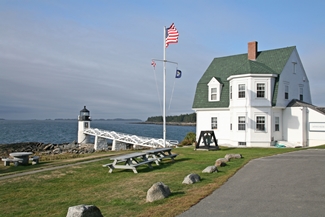
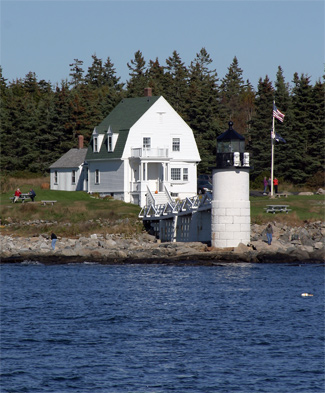
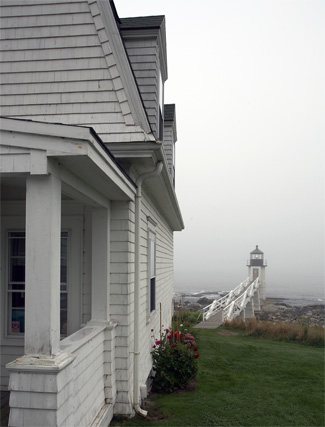
Photo Gallery
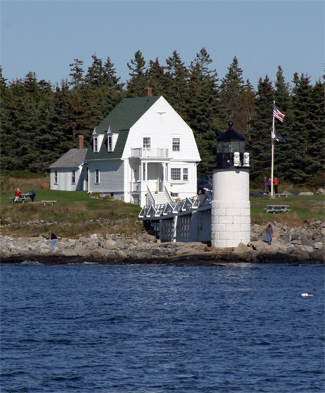
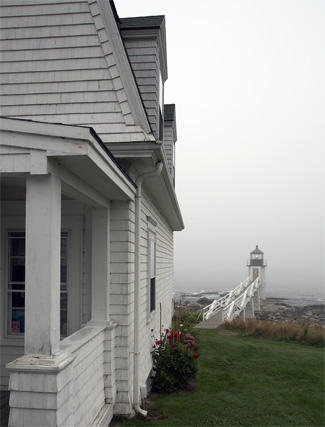

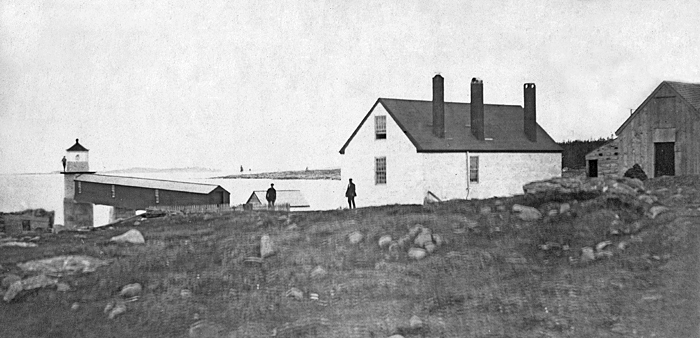
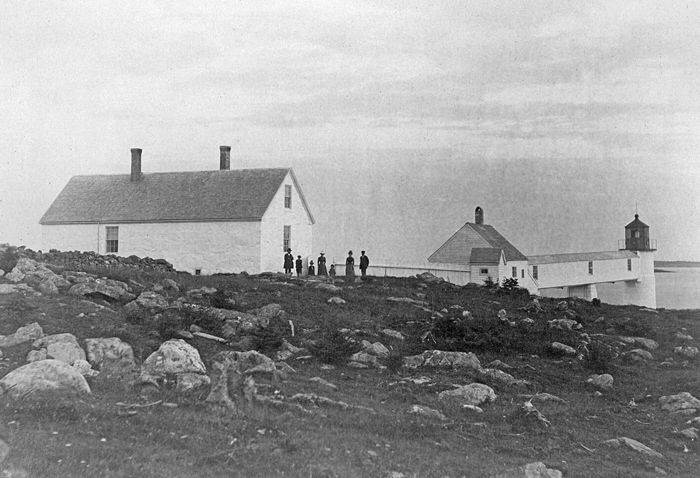
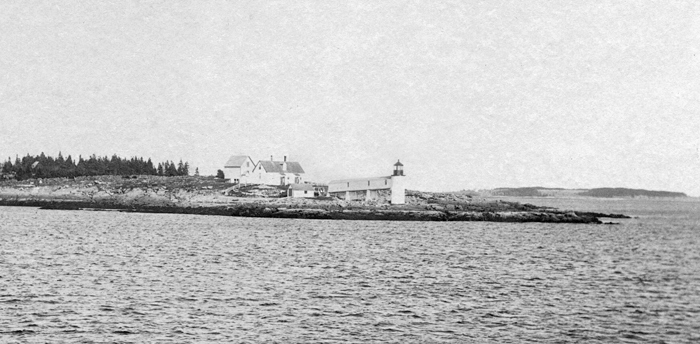
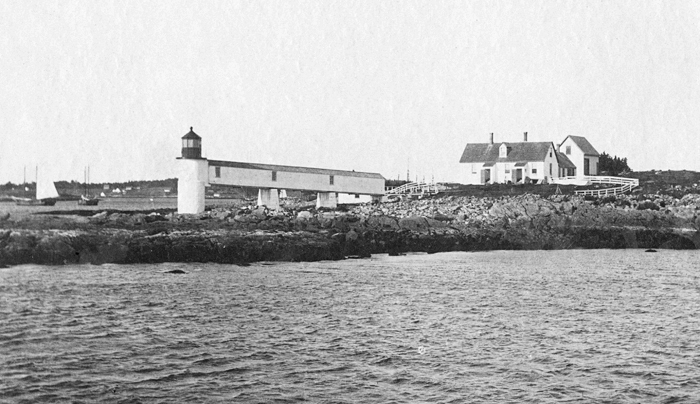
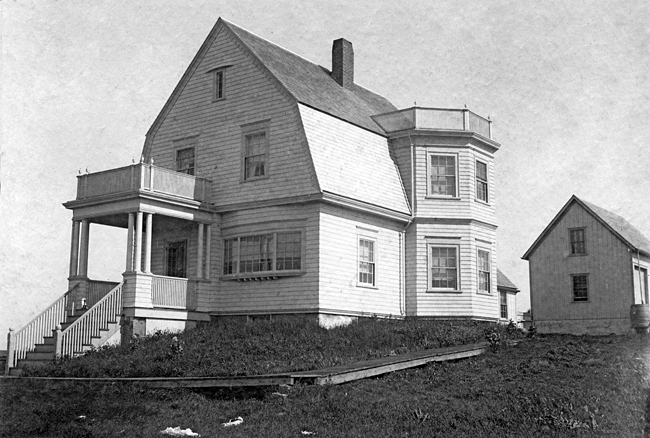
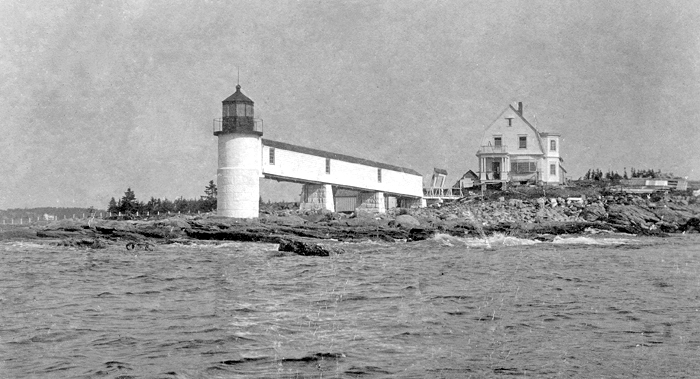
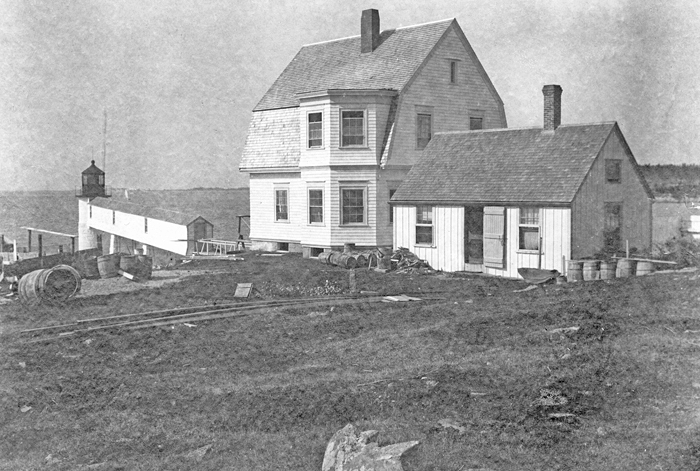
Photo Gallery
Photo Gallery
|
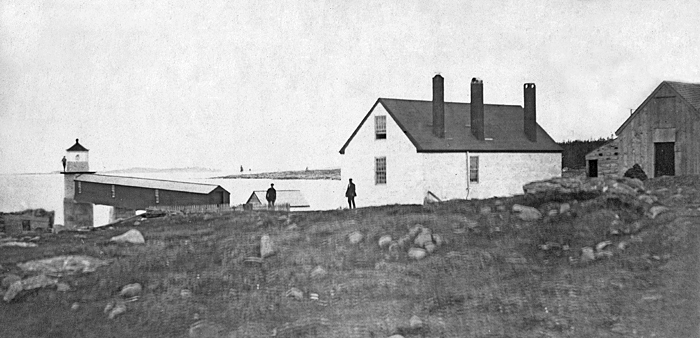
I was appointed keeper of this light in July, 1841, upon a salary of $350. My dwelling-house leaks at the east end so badly that we dip up pails full of water, and barrels of water run into the cellar. The windows and eaves of the house also leak. The chimneys smoke badly. The masonry of the walls required new pointing. We have no rain-water cistern, and the well is dry during midsummer. I then bring all my water from the distance of half a mile.The tower of the light-house is in a bad state, and was defectively built at first. All the joints of the masonry are open to the weather, from having been built with wet sand instead of cement, or even common lime mortar. The tower leaks so in winter that its interior is coated with ice in large flakes, and I frequently have found great difficulty in getting the door of the tower open, owing to the ice which had accumulated inside during the night. I consider the tower to be in a dangerous state, and, if not well repaired, liable to be destroyed by storms during the ensuing winter.
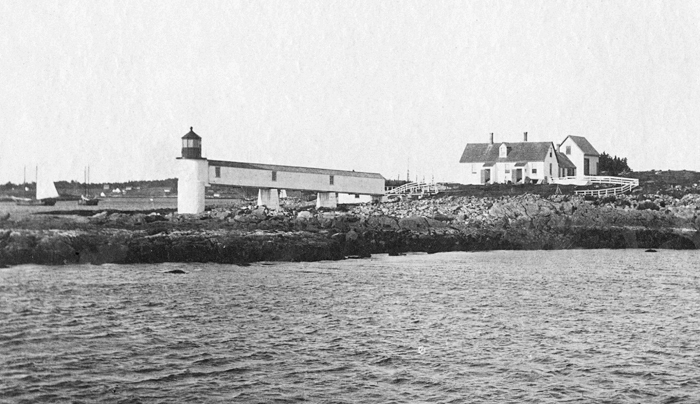
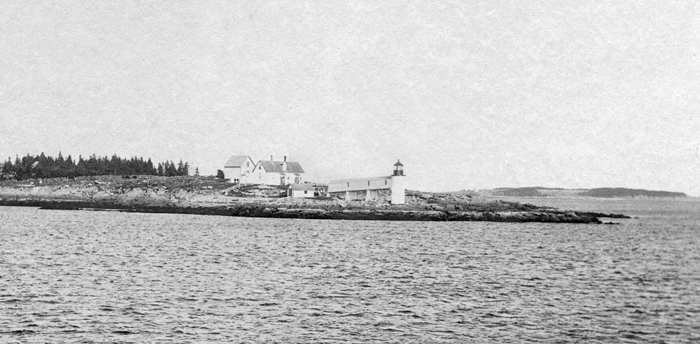
In 1857, work began on the present tower, situated near the tide line. The lower half of the twenty-four-foot-tall, cylindrical tower was built of granite, and the upper half of brick. The lantern was made of cast iron and housed a fifth-order Fresnel lens showing a fixed white light. The cost for the new lighthouse and its modern illuminating apparatus was $5,000.
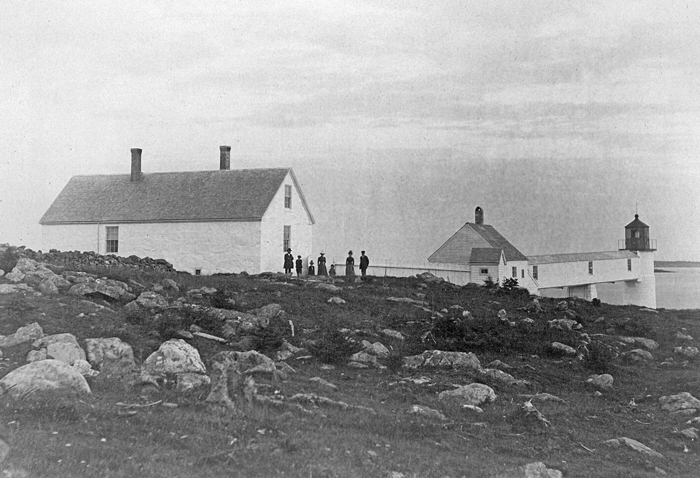
Charles Clement Skinner became keeper of Marshall Point Lighthouse in 1874 and remained at the station for forty-five years, the longest period of service for a keeper at the same lighthouse in the history of the U.S. Lighthouse Service. After being wounded in the Civil War, Charles returned to Maine and married Amanda Colby. The couple had two daughters, the second of which died in infancy and was soon followed in death by her mother. Charles then married Amanda’s younger sister Arvilla and shortly thereafter accepted the position at Marshall Point. Charles had five more children while serving at the lighthouse.
|
Keeper Skinner made the following journal entry in June 1895: “Heavy thunder showers passed over here at 1 o’clock this morning. The dwelling house at this station was struck by lightning and one chimney, the roof, one window, and three rooms badly shattered, lightning entered from rooms besides the cellar, no one seriously injured.”
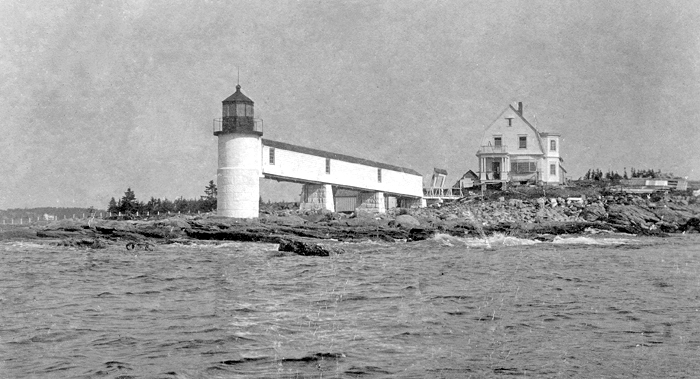
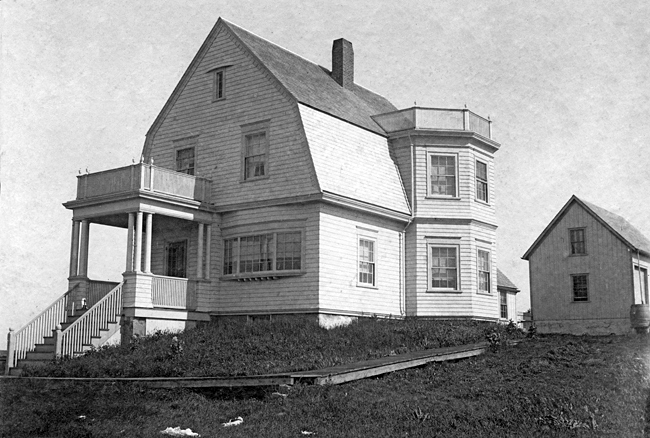
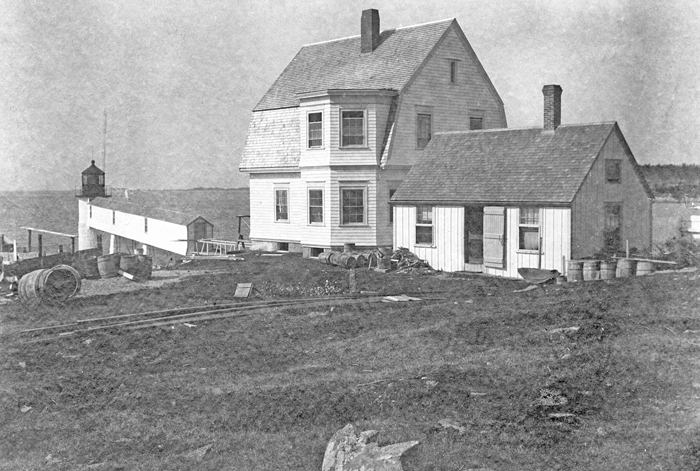
Repairs were quickly made to the residence, but on July 19 it was vacated so the present dwelling could be built. The displaced Skinner family moved into a workshop, while, over the next five months, their new home was constructed of wood in a Colonial Revival style. A 1,500-gallon, brick cistern was built in the dwelling’s cellar to hold rainwater captured from the large gambrel roof. This served as the station’s water source until a well was later dug in the woods behind the dwelling.
A bell tower, equipped with a 1,018-pound brass bell, was added to the station in 1898. In times of fog, the keeper had to wind up the weight-driven striking mechanism every four hours so it could toll the bell every twenty seconds. A telephone line was extended to the station in 1898 to relay weather warnings for display on a signal tower that was installed on the point that year by the Weather Bureau. On February 18, 1902, Keeper Skinner recorded, “Hurricane signal ordered up last night, but lines were down and did not get message until today.”
In his logs, Skinner noted many strandings of both man and beast in the area of the station. On October 28, 1884, he wrote: “A fin-back whale stranded on Mosquito Point last night. Sixty-seven feet in length.” And on February 10, 1886: “Steamer Cambridge was wrecked on Old Man Ledge at 4:45 AM. Passengers and crew all saved & landed on Allen Island where they were taken off by Steamer Dallas this forenoon and taken to Rockland. The Cambridge is a total loss, is fast breaking up.”
|
A replica of the station’s summer kitchen was rebuilt adjacent to the dwelling in 1995 to commemorate the hundredth anniversary of the dwelling and to provide additional floor space for museum exhibits. Ownership of the lighthouse, dwelling, and grounds was officially given to the Town of St. George in 1998 as part of the Maine Lights Program, spearheaded by the Island Institute.
Millions of Americans have seen Marshall Point Lighthouse, even though they might not know it. The lighthouse’s wooden walkway served as the terminating point in Forrest Gump’s cross-country run… “Run, Forrest, Run.”
In March 2017, the Coast Guard replaced the beacon that had been inside the lantern room since 1971 with a modern LED light. The beacon removed from the tower is now on display in the museum. The walkway linking the tower to shore and the exterior of the tower were restored in the fall of 2017.
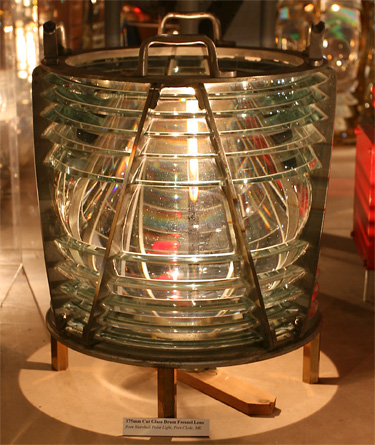
In September 2018, ground was broken for a replica of the barn/workshop, a building that was demolished in 1971. The fifth-order, drum-style Fresnel lens removed from the lighthouse in 1971 was displayed for years at the Maine Lighthouse Museum in Rockport before being returned for display at the museum in 2020.
A lightning strike in July 2023 destroyed the LED beacon used in the lighthouse. All associated electrical equipment and the beacon had to be replaced. A winter storm in January 2024 damaged the walkway linking the light tower to shore.
Eula Skinner Kelly passed away in 1993 at a summer cottage near the lighthouse at the age of 101. Her sister, Marion, had preceded her in death the previous year. The two, both widows, had spent the last decades of their lives living together in Warren, not too far from the lighthouse. In videotape recordings made by the sisters before their passing, Marion told of trips to school in Tenants Harbor by herself when she would have to hold on to the horse’s reins for dear life when the animal got frisky. Eula recounted a story of getting a stomachache while berry picking near the lighthouse. The ache turned out not to be from too many berries but from a ruptured appendix, that was removed by a doctor while Eula lay on a table in the upstairs of the dwelling. The sisters found numerous fond memories at Marshall Point, and the place is still providing the same service today for thousands of visitors who each year come to experience this remarkable setting.
Head Keepers: John Watts (1832 – 1835), Joshua Watts (1835 – 1839), William Perry, Jr. (1839 – 1840), Job Rockliff (1840 – 1841), Daniel Bartlett (1841 – 1843), William Battles (1843 – 1845), John Alexander (1845 – 1849), Samuel Hart (1849 – 1853), Oren Prescott (1853 – 1857), Ruggles S. Torrey (1857 – 1861), Oren Prescott (1861 – 1868), Seth B. Prescott (1868 – 1874), Charles C. Skinner (1874 – 1919), Joseph M. Gray (1919 – 1921), Edward H. Pierce (1921 – 1933), Charles W. Allen (1933 – 1946), Wilson Carter (1946 – 1952), Ralph Banks (1952 – 1962), Ronald H. Brown (1962), Richard A. DeMayo (1962 – 1966), Rodney G. Drown (1966 – 1968), Lewis T. Carmichael, Jr. (1968 – 1979), William J. Boddy (1969 – 1971).
References