Nobska Point, MA 


Select a photograph to view a photo gallery
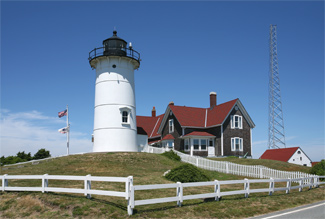
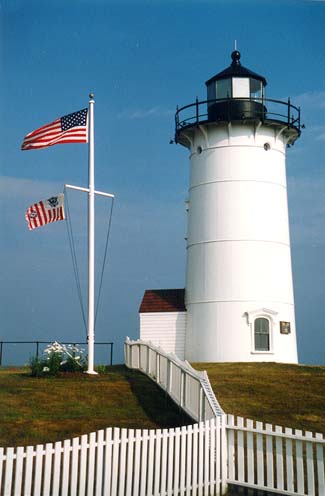
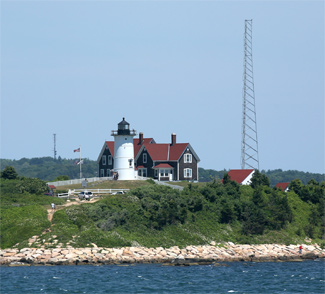
Photo Gallery
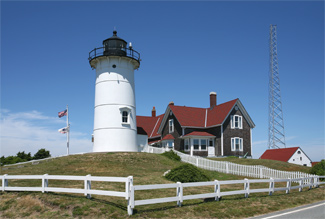
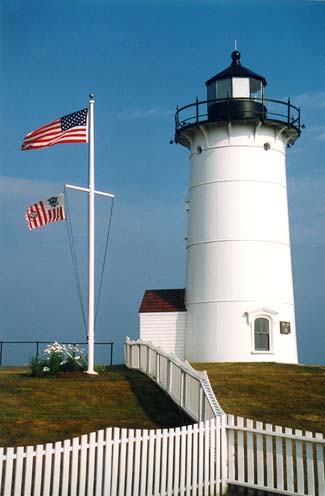
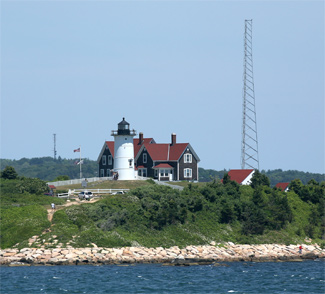
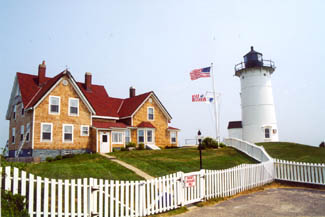
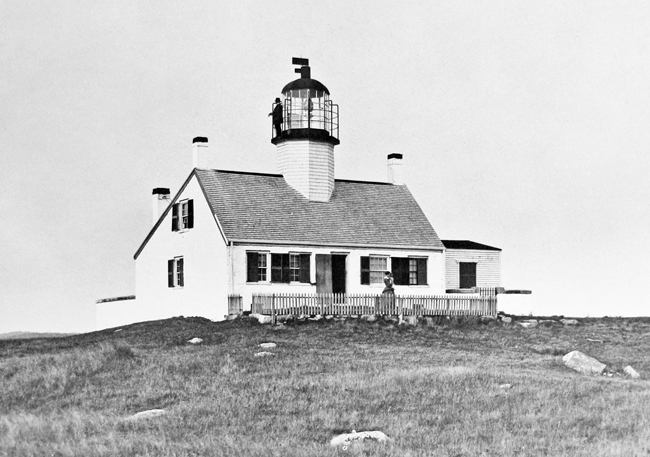
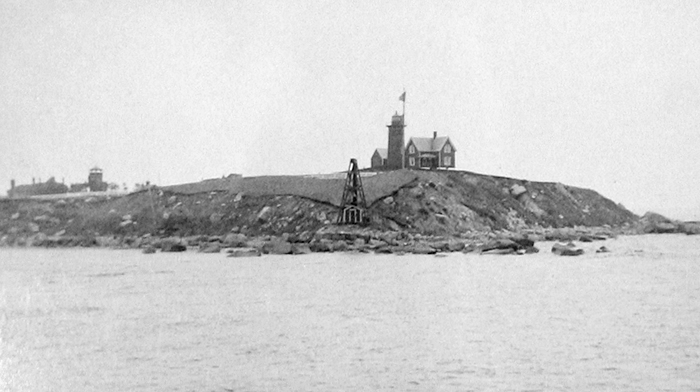
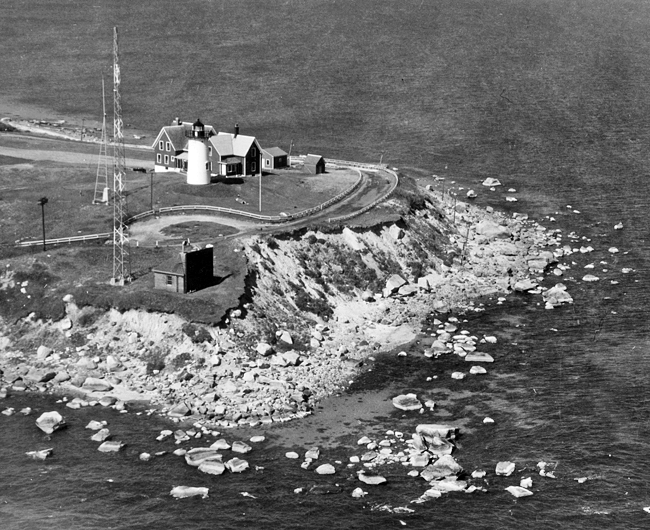
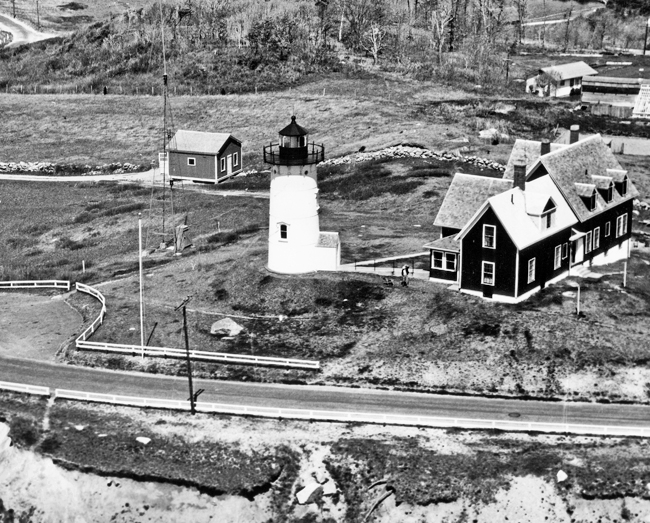
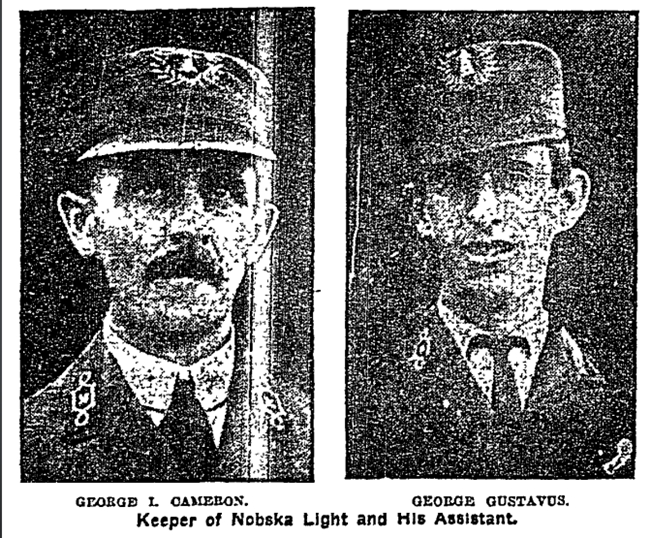
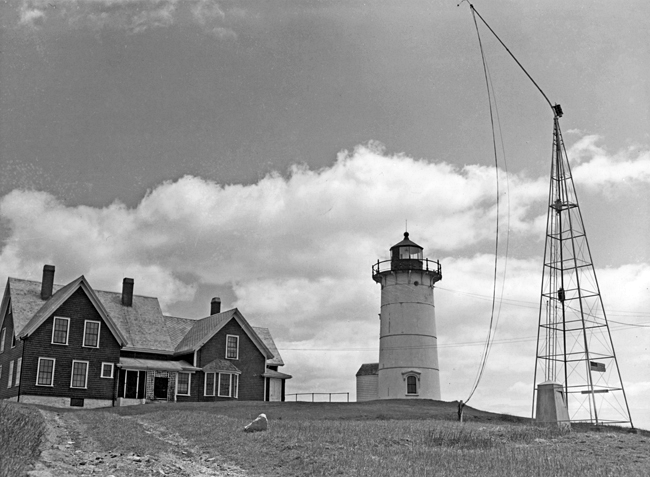
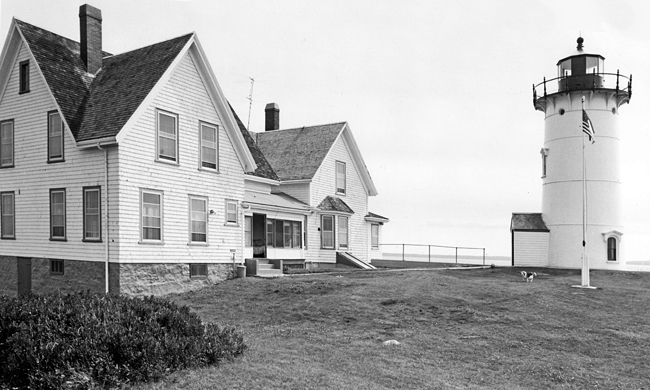
Photo Gallery
Photo Gallery
|
Mrs. Webster related to The Boston Globe that it was not uncommon for people to approach them in their home, even late in the evening, stating that as the lighthouse was federal property, it was their right as a taxpayer to enter.
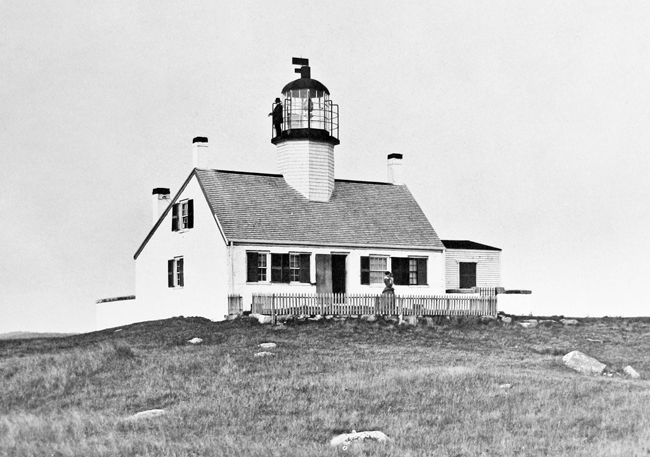
Nobska Point Light (or Nobsque Point Light, as it was known in its early days) was built in 1828 for $2949.30. The original lighthouse was in the typical Cape Cod-style with an octagonal tower atop a stone keeper’s house, which had three rooms on the first floor and two small ones upstairs. The lantern room held ten lamps with fourteen-inch reflectors, producing a fixed white light, seventy-eight feet above the sea.
The plans for the station laid out in detail the house, tower, and outbuildings, even down to the outhouse—five feet by four, shingled and painted. While a common lighthouse design, unfortunately, it was a poor one. The weight of the eight-foot in diameter tower topped by an octagonal iron lantern put severe stress on the dwelling’s roof, and ultimately on the keepers and their families. Several tenants complained that when it rained the entire family was forced to maneuver their beds to avoid the leaks.
Throughout much of the nineteenth century, keepers were required to track maritime traffic in a Journal of Vessels and submit it monthly—e.g., in 1829, 10,000 vessels were recorded passing Nobska Point. In the month of November 1864, there were 833: Ships—1; Barks—8; Brigs—69; Schooners—652; Sloops—82; Steamers—21. During a single day in 1864, Nobska Point Keeper Frederick Ray counted 188 vessels, including 175 schooners.
For several years during the tenure of Oliver A. Nickerson (from 1874 to 1911—the longest of any keeper at Nobska), his daughter, Florence, was the designated “observer” tasked with tracking ships that passed during the day. A 1908 article described her as “shrewd and kindly, one of those Yankee girls who fear nothing and take life cheerfully.” Besides her lookout duties, she also tended the chickens and kept house.
The state of each lighthouse and the quality of the keeper’s work was evaluated for the Lighthouse Service on a regular basis. In a November 1, 1838 report, Lieutenant Edward W. Carpender, U.S. Navy, praised Peter Daggett, the light’s first keeper, for his “neatness and reputation” but pointed out that the lantern room’s ten lights, six in a lower series and four in the upper, could be reduced to only the lower lights, as the upper ones were “entirely superfluous.”
Carpender asked that an exception be made to the Lighthouse Service’s rule refusing the issuance of boats to keepers on the mainland. “Should the regulation be waived in the favor of any one, I hope it will be extended to this individual, who once had it in his power, with the Government boat, no longer serviceable, to rescue some persons from drowning.”
Peter Daggett, a veteran of the War of 1812, served as keeper at Nobska Point from 1828 to 1849 and some of his papers are in the hands of the Falmouth Historical Society. Although a poor speller, there is evidence he took pride in his work. Several times he complained to his supervisor about the poor quality oil he received for the light. One December report states:This Month Nothing to remark onely have a Great Deal truble to Mak the Oil burn. Everything in Good Order But the Ventilators that wase Put up on the Chimnyes Is bloon of in the hard Gales It will Lum Smith to alter them a Little in the Spring so Thay will Not blow of.In 1845, Daggett used 209 gallons of summer oil and 130 gallons of winter oil (the winter oil was much lighter than the summer, so that it would stay liquid in the unheated lighthouse).
A newspaper article praised Daggett’s service: “No light in the world was better kept. Honesty, fidelity and capacity in the keeper were evident to all.”, but then noted that during the summer of 1849, Daggett was removed, “for no other reason than because he is a democrat.” Lighthouse keeping posts were political appointments at the time and subject to the whims of elected officials.
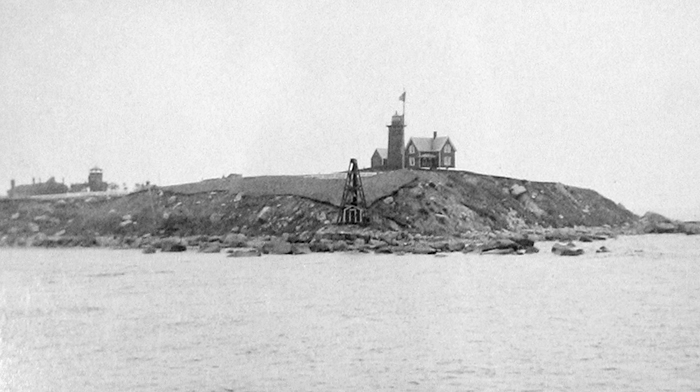
A fog bell sounded by machinery was established at Nobska Point in 1875, and that year the Lighthouse Board noted that although “repairs of a temporary nature” had been made, the station was in a dilapidated condition and needed to be rebuilt.
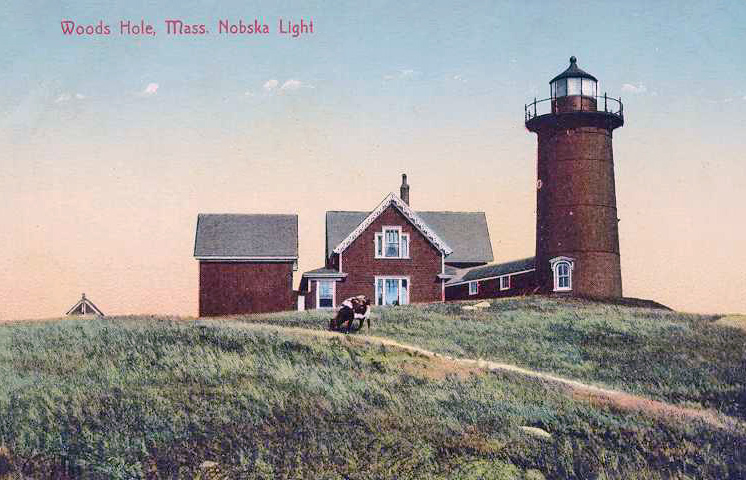
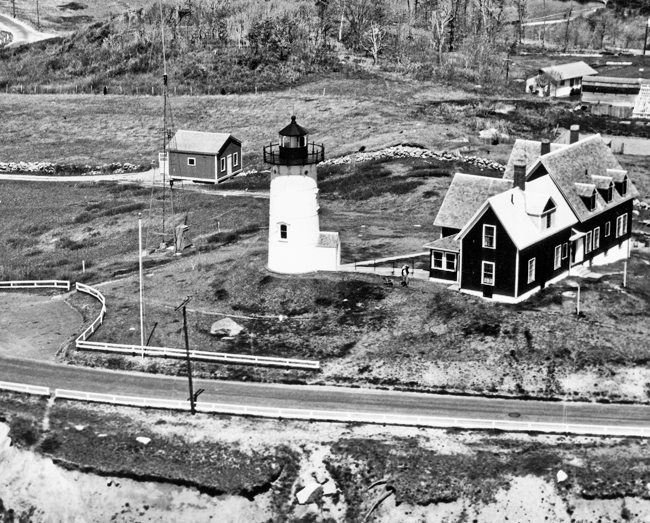
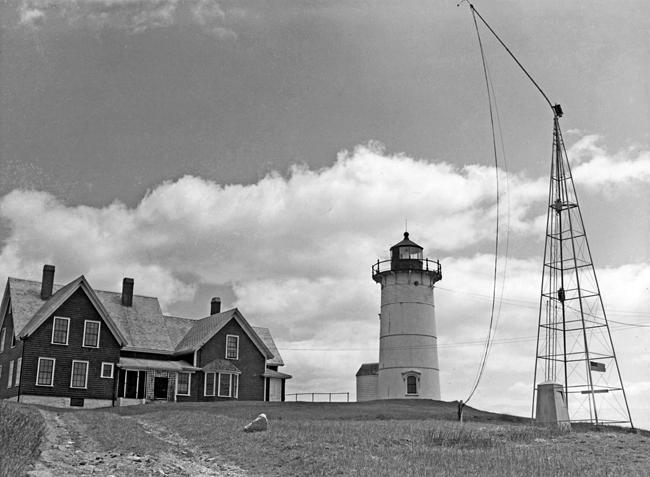
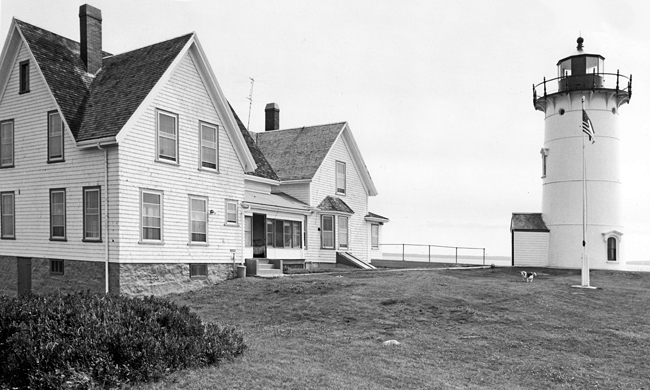
The present Nobska Point Lighthouse, a forty-foot-tall, cast-iron tower lined with brick, was erected in 1876 along with a one-and-a-half-story, wood-frame dwelling. The pieces for the tower were cast in Chelsea, Massachusetts, and transported in four sections. The tower was painted a dark reddish brown and had a rare adornment in the form of miniature lighthouses on top of each baluster that encircled the lantern room.
A fifth-order lens, which had been installed in the original lighthouse in 1856, was transferred to the new tower and served there until December 1887, when a larger fourth-order lens was placed in the lantern room and fitted with a red sector to mark dangerous shoals in the area. A covered walkway connecting the tower to the keeper’s house was added in 1899.
A battle broke out in 1910 over the Lighthouse Board’s plan to install a steam fog whistle at Nobska Point. Summer residents objected to the plan on grounds that it was unnecessary and would reduce the value of their property, and shipping interests countered, writing: “No local interests, however influential, should be permitted to deter your honorable Board from giving the fullest possible protection to the great amount of traffic that daily uses this highway of commerce.”
Adolph Marix, the chairman of the Board, made trips to Nobska Point in February and March of 1910 to investigate the effects the fog signal would have on the locality, and after months of delay, a first-class Daboll trumpet went into operation on the point later that year. The press noted the frustration felt by the parties involved in the dispute over the fact that the Lighthouse Board met just once a month, thus lengthening the time to reach a decision. With 2,753 employees, the Lighthouse Service was the largest division of the Department of Commerce and Labor at the time, and though it operated efficiently some felt a change in the way it was governed was needed. In June 1910, Congress reorganized the Lighthouse Service by creating the Bureau of Lighthouses, which was governed by just one commissioner instead of a board. George Putnam, the first commissioner, served for twenty-five years.
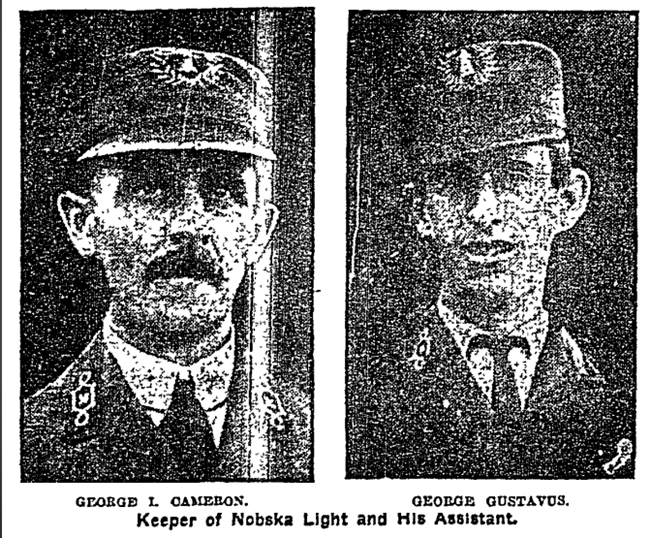
A brick fog signal building was built on the point to house the fog signal equipment that was sounded when visibility dropped below five miles. George Cameron was appointed the station’s first assistant keeper to help with the extra workload, and a second dwelling was added to the station for his use.Even with the light and fog signal, the area still proved hazardous. Cameron, who had been promoted to head keeper after the death of Keeper Oliver Nickerson , was on duty in August 1911, when the Boston-bound steamer Bunker Hill, carrying over 300 passengers, ran aground on a clear, calm night. “If the pilot or captain, whoever was in charge of the steamer, was trying to hit Nobska Lighthouse,” wrote a passenger, “he was a very poor shot, as he didn’t come within 100 feet of it, and if he was trying to avoid hitting it he was equally a poor shot, as he had plenty of water in the broad Vineyard sound to escape striking the beacon, the rays of which must have blinded him as he was running his vessel toward it.” Help was summoned by the keeper and all passengers were safely unloaded.
While George Cameron was head keeper, Herman, the son of Oliver Nickerson, the former head keeper, was allowed to remain at the light as a boarder—a decision that was to have repercussions. A newspaper in October 1911 noted that Cameron’s wife took their six children, ranging in age from twelve to just six months, and ran off to parts unknown with Herman.
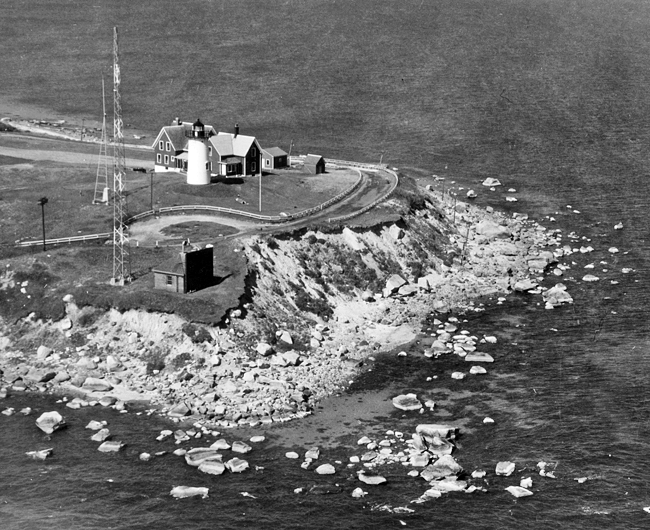
In 1937, a 125-foot steel radiobeacon tower was erected at the station, and during the next decade the fog signal was changed from a reed horn to a diaphragm. The fog signal could be heard for five miles and was activated by a sensor that measured the moisture content of the air.
Joseph Hindley took over as head keeper of Nobska Point Lighthouse in 1968, and when he retired on November 3, 1972, after forty-four years of service, he was believed to be the last civilian lighthouse keeper in New England. His wife, Charlotte, described their years at lighthouses as “very uneventful,” even though she was fully aware that people always try to romanticize the keeper’s life. She feared that after so many years of having to talk between foghorn blasts, it would be hard to sleep without the noise.
Following its 1985 automation, the station became home to the commander of the U.S. Coast Guard Group Woods Hole and was “adopted” by members of the Coast Guard Auxiliary Flotilla 11-01. One volunteer was Payson A. Jones of North Falmouth, an Auxiliary veteran with over forty years experience, who loved to greet visitors in his old-fashioned keeper’s uniform during open house days. He would tell children, “We don’t do two things at Nobska. We don’t go out on the catwalk at the top of the light, and we don’t touch the 100-year-old Fresnel lens that’s valued at $250,000.”
In March 2016, the selectmen of the Town of Falmouth voted unanimously to approve a license with the Coast Guard that made the town the stewards of Nobska Point Lighthouse, and a formal transfer was held at the base of the lighthouse on April 25, 2016. The town is now responsible for maintaining the four-acre lighthouse site and its historic keeper’s dwelling and lighthouse, but this work will be handled by Friends of Nobska Light, which was incorporated in 2015 to raise funds for the property.
At the annual town meeting in April 2017, voters approved allocating $264,000 toward restoration of the lighthouse. EnviroVantage, of Epping, New Hampshire, was hired to perform the first phase of restoration, which included stripping off layers of paint from the tower, fixing corrosion issues, replacing broken glass, and giving the tower a new coat of paint. A ceremony to celebrate the start of phase one was held on September 15, 2017, and planning for phase 2 of the restoration, which will see the keeper’s dwelling become a maritime museum, was already underway at that time.
In May 2023, the General Services Administration offered Nobska Lighthouse at no cost to eligible entities defined as federal agencies, state and local agencies, non-profit corporations, educational agencies or community development organizations for educational, park, recreational, cultural or historic preservation purposes. Qualified entities were given sixty days to submit a letter of interest.
In June 2024, Friends of Nobska Light opened the restored tower and keeper’s dewlling to the public. Friends of Nobska Light received the deed to the lighthouse property from the federal government on July 21, 2025, and a private transfer ceremony was held on September 15 of that year with federal, state, and local officials attending.
Keepers:
References