Bakers Island, MA 

Select a photograph to view a photo gallery


Photo Gallery


Photo Gallery
Photo Gallery
|
According to Bentley’s diary: “the intended Beacon was raised by a large and Jovial party.” While Bentley considered the interior badly vented and the foundation stones to be “very miserably laid,” the red, conical beacon, which was fifty-seven feet high and topped by a black, two-foot diameter ball, nonetheless served as a daytime guide for the next several years.
The Salem Mariners Society also established some buoys in the waters near Bakers Island, but as shipwrecks continued at an alarming rate, the society petitioned local lighthouse superintendent General Benjamin Lincoln and the U.S. Congress in 1791 for a proper lighthouse on the island.
While waiting for Congress, activity in Salem did not cease. On Aug. 6, 1793, Bentley recorded a discussion about what color of tower would provide the greatest visibility:
White, being the absence of colour, & so a contrast to all other colours has been generally approved. But it is supposed that an illuminated horizon will not transmit it defined so well with white, as the darker colours. The presumption that white is not so well defined upon a Sky Horizon has induced the persons who have erected the late Beacon to chuse a deep red colour. The question which colour will be of most use through the changes of the sky, seems not attended to. The argument from a bright horizon is more attended to than an approach in the night or the land horizon, in which white is supposed to have an advantage.
On April 8, 1796, President Washington approved $6,000 for a set of twin lights for Bakers Island, in spite of General Lincoln’s fear that mariners would mistake the lights for the twin lights on Thatcher Island to the north and Plymouth to the south. Lincoln had proposed a two-story building with three lights spread along a 50-foot span of its roof, but his plan was rejected.
|
The first keeper, Capt. George Chapman of the Salem Mariners Society, served until he turned seventy-five in 1815. When Chapman later went blind, his condition was blamed on the brightness of the lights he tended on Bakers Island. Joseph Perkins was selected as keeper upon Chapman’s retirement. While serving on Bakers Island as a harbor pilot during the War of 1812, Perkins spied the USS Constitution being pursued by two British ships, the Tenedos and Endymion. Perkins immediately leapt into his dory, rowed out to the Constitution, and, with his intimate knowledge of the local waters, piloted her to safety in Marblehead Harbor.
A severe storm in August 1815 ended up drastically altering the appearance of the station. “Nearly every square of glass on the Western side of the Light house, and in the Lanterns” was smashed, according to a local newspaper report. The damage forced the station to close for a few months and cost $4,000 in repairs. When the station resumed operation, a single, freestanding octagonal stone tower, had taken the place of the twin lights.
Not too long after the new tower was erected, a pre-dawn snowstorm in February 1817 caused the Union, loaded with $80,000 worth of pepper and tin from India, to slam into the island’s rocky shoreline. This wreck and the increased incidence of other accidents lent credence to complaints that the light was too low (the new tower had a focal plane lower than that of its predecessors) and too dim (partially a result of heavy condensation on the lantern glass).
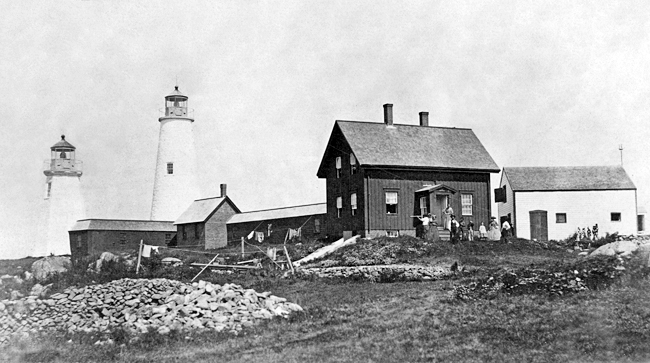
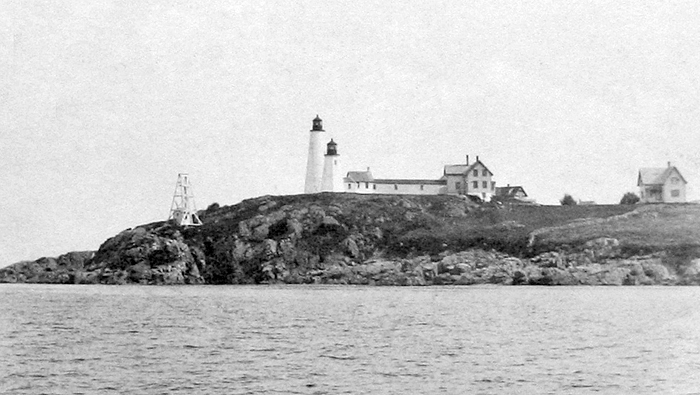
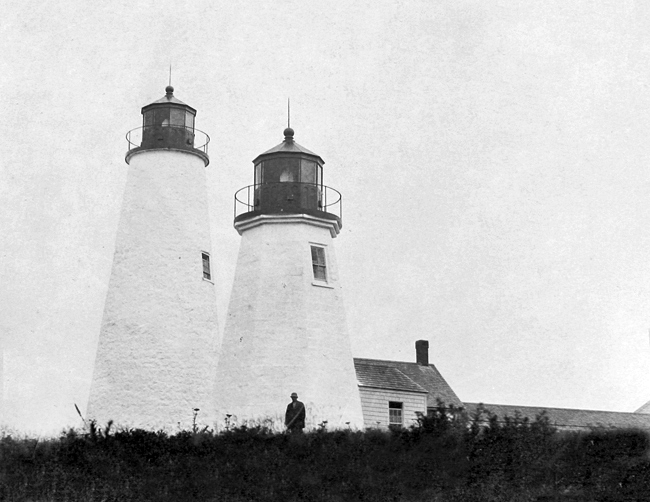
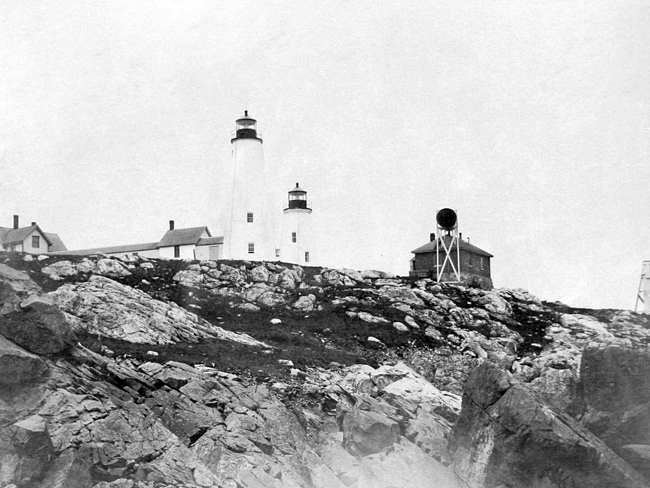
Following the appeals of the Salem Marine Society and the citizens of Salem, Marblehead, and Beverly to restore a second light, on May 15, 1820, funds were appropriated to build a new forty-seven-foot, conical granite tower to join the existing twenty-six-foot tower. The two towers, first lit together in October 1820, would become affectionately known as “Mr. and Mrs.” or “Ma and Pa.”
Despite their best efforts and precautions, keepers often led a life fraught with danger and discomfort. In late October 1825, a squall claimed the lives of both Keeper Nathaniel Ward and his assistant Mr. Marshall. The pair set off from the mainland with a load of supplies, but heavy seas prevented them from reaching the island. Ward’s body washed up near the light, and Marshall’s was found in the station’s small, flat-bottom boat. The 49-year-old Ward was reported to have a large family left destitute by his drowning.
|
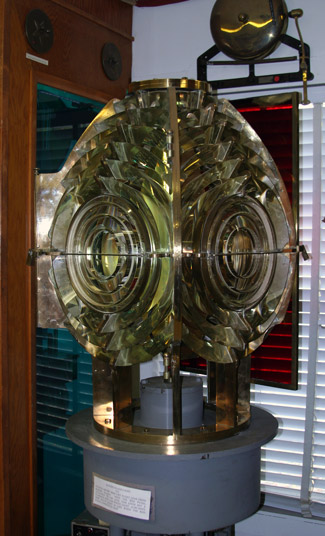
No light-house of its class in Massachusetts is so poorly provided for in respect to the quality of its apparatus, which was old when introduced here, and now completely worn out. The keeper is deserving of the greatest praise for the extreme neatness of the whole establishment, which is second to none in this particular. A good apparatus, therefore, in such hands, would be well cared for, and is absolutely required in so important a locality; and seventeen years residence in a house little better than a barn entitles a faithful public servant to a comfortable dwelling in his old age.Keeper Martin never received the dwelling he so merited, as it took another fifteen years before the station received a new keeper’s house, lantern rooms, and Fresnel lenses. Fourth-order Fresnel lenses and a single lamp were placed in each tower in 1857 in place of the array of fifteen lamps and reflectors used in the taller tower and the eleven lamps and reflectors used in the shorter tower.
Not only did the two fixed lights at different heights tell mariners they were off Bakers Island, but the lights could also be aligned to help mariners avoid the outlying rocks and reefs at the entrance to the harbor. In 1869, the Lighthouse Board called for the lights on Bakers Island to be moved farther apart to better indicate the proper approach to the harbor, but the owner of the adjacent plot refused to sell the necessary land. In 1871, $5,000 was approved to rebuild the front light on a proper site, but the plan was never carried out.
According to a 1901 report from the Collector of the Port of Salem, 667 vessels entered the port that year with cargoes amounting to 656,039 tons, and in coal alone, 417, 924 tons, valued at $1,670,000. Vessels were often forced to enter Salem Harbor due to the “capricious” New England weather where blinding fog and thick snowstorms arose with little notice. To better serve these vessels during thick weather, the Lighthouse Board requested $10,000 for a steam fog signal to replace the fog bell that had been established on the island in 1877 but had a very limited range.
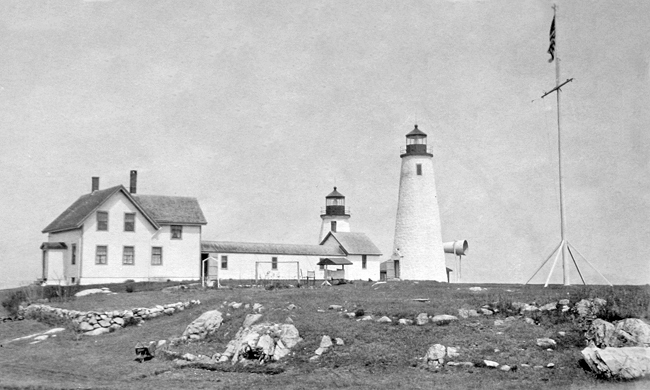
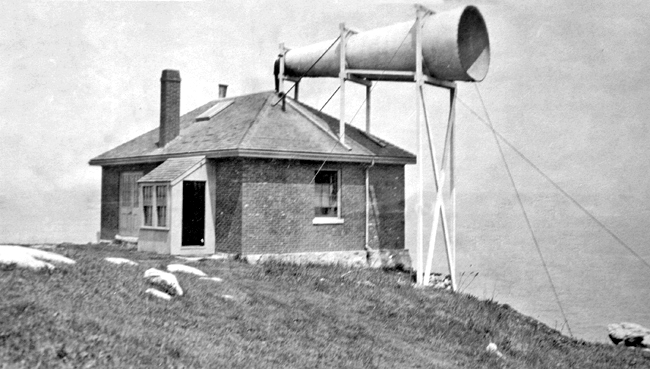
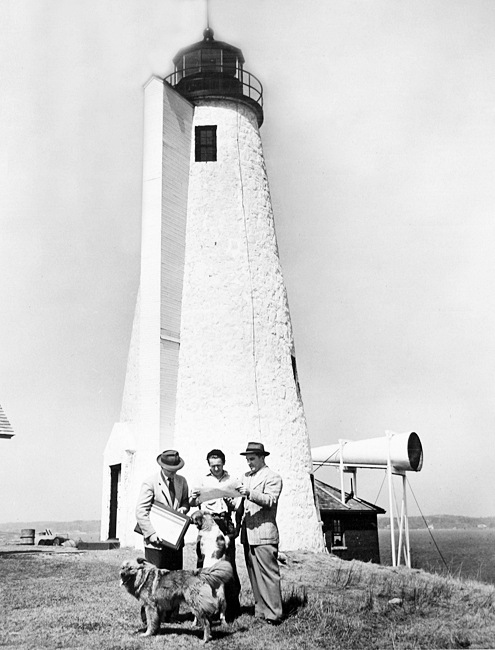
An act appropriating funds for an improved fog signal on Bakers Island was passed in June 1906, and work soon began on a brick fog signal house to shelter two, twenty-horsepower oil engines that powered a compressed-air siren. The signal was placed in operation on July 8, 1907 and featured a very large trumpet for projecting the sound seaward.
|
Rescues by Keeper Payne were quite common. During the twenty-five years he was in charge of the light, he went to the assistance of at least ten vessels near Bakers Island which were either broken down or whose occupants needed help. His lifesaving efforts weren’t limited to the sea, as in 1931 he put out a grass fire which had gotten out of control at a cottage near the lighthouse.
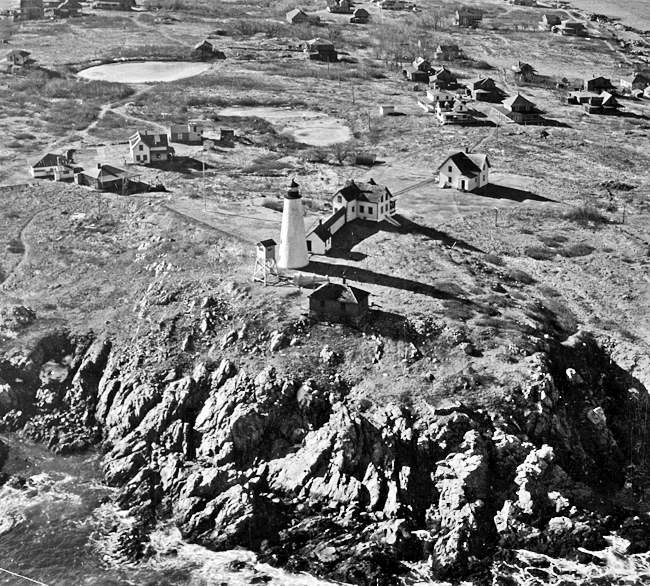
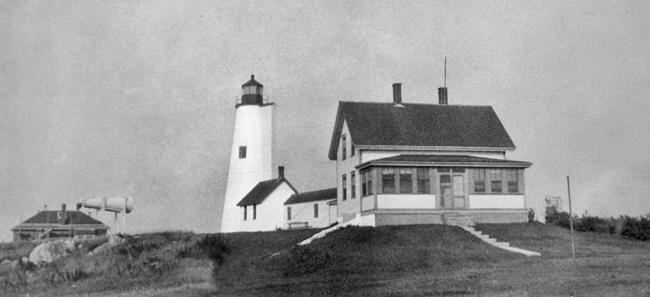
The smaller tower on Bakers Island was deactivated and dismantled in 1926, and at that time an addition was made to the taller tower to serve as a drop tube for the weights that revolved the lighthouse’s new lens.
Bakers Island Light was automated in 1972 and converted to solar power in 2000. When the U.S. Coast Guard attempted to remove the tower’s fourth-order Fresnel lens, which floated on a bed of mercury, the crew was overcome by fumes and had to be rushed by helicopter to a hospital. That lens is now on display at the Maine Lighthouse Museum in Rockland, Maine.
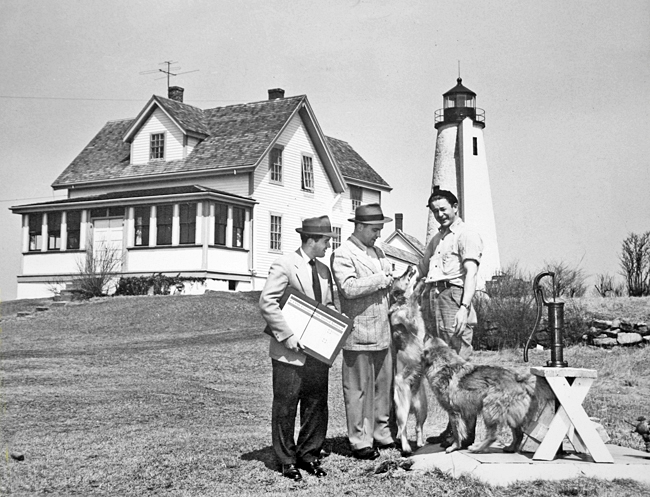
The Bakers Island Association (founded in 1914) manages the island and only permits the islanders and their guests to land there. In 1988, the association was granted a thirty-year lease for the keeper’s dwellings, which are inhabited by island residents during the summer season.
Ownership of the lighthouse was offered to qualified nonprofits and governmental organizations in 2002 under the National Historic Lighthouse Preservation Act. The Island Association applied for the lighthouse, but after the submitted applications were reviewed, the lighthouse property was awarded in April 2005 to the Essex National Heritage Commission, a nonprofit organization that spotlights the historical, cultural, and natural resources of Essex County.
The Island Association appealed the decision claiming that the government was biased in awarding the lighthouse to the Essex Commission, which receives a portion of its funding from the National Park Service. The original decision was subsequently upheld, leaving many island landowners concerned about the safety of their property if the lighthouse were opened to the public as required under the transfer. The Essex Commission’s initial plans for the property included offering ranger-escorted tours to groups of up to forty people and allowing marine studies students from Gordon College to live in the keepers’ houses for six weeks during the summer. A ceremony marking the transfer of the lighthouse was held on the island on August 27, 2014, but the islanders’ battle to protect their privacy was not over as they controlled the island’s only dock.
On July 1, 2015, the Essex Commission began offering boat tours to Bakers Island Lighthouse using the Naumkeag, a landing craft with a bow that drops down so that passengers can offload directly on the beach instead of at the private landing dock. Overnight stays at the lighthouse were initiated the following year.
Keepers:
References