Cape Ann (Thacher Island), MA 

Select a photograph to view a photo gallery
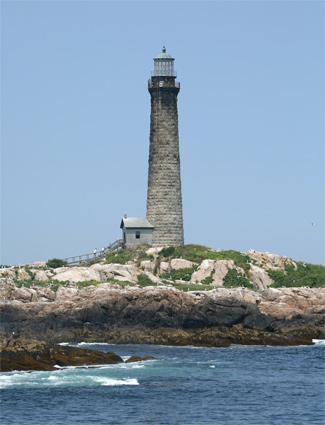
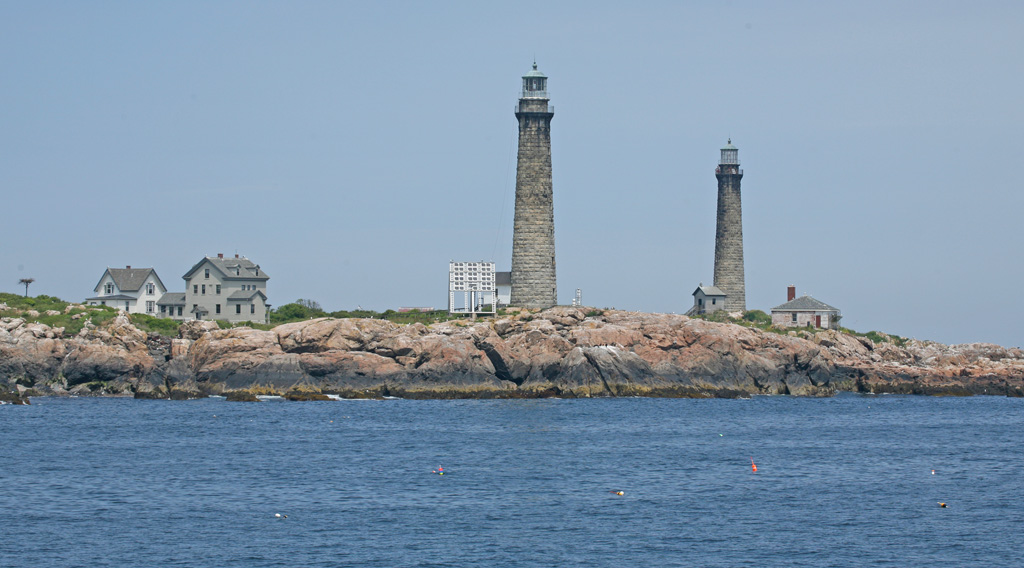
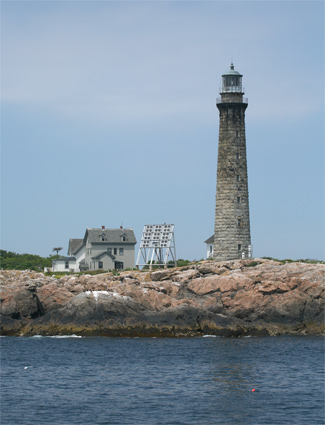
Photo Gallery
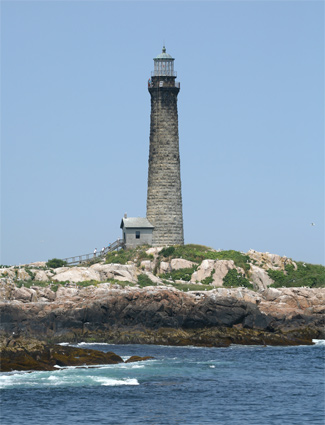
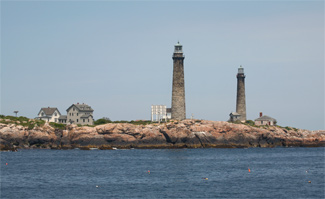
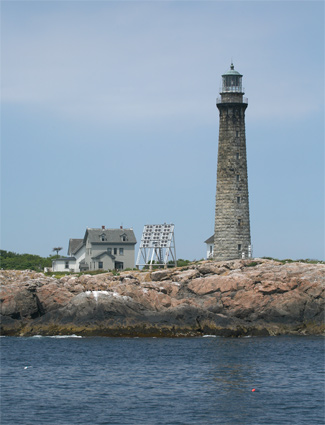
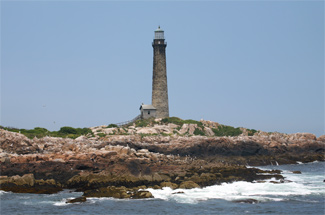
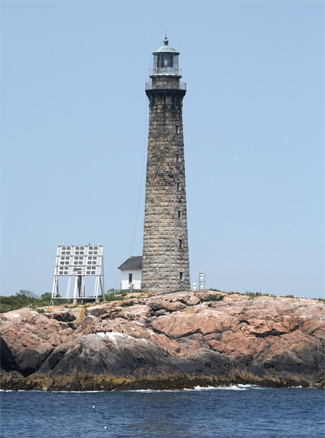
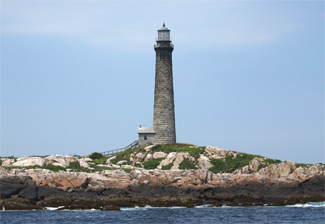
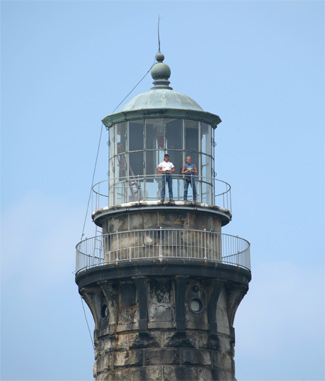
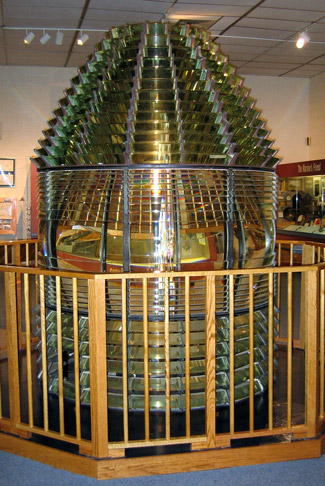
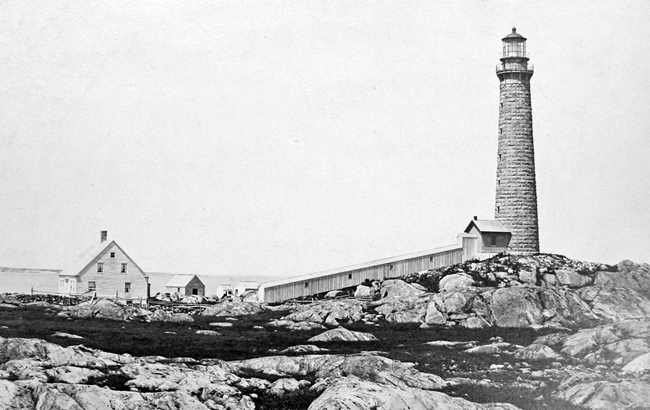
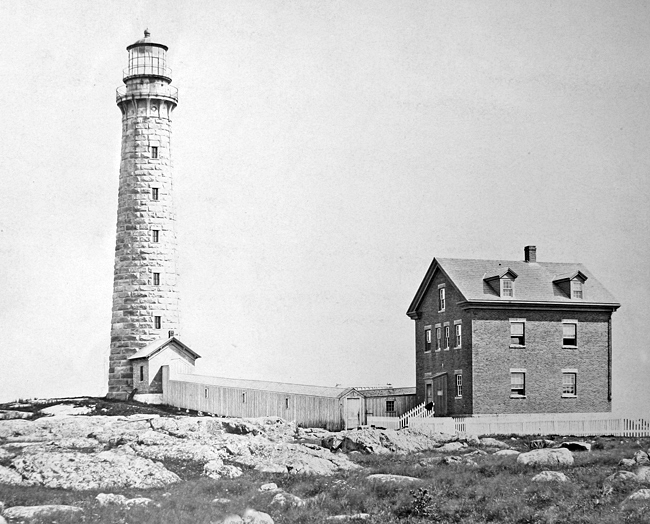
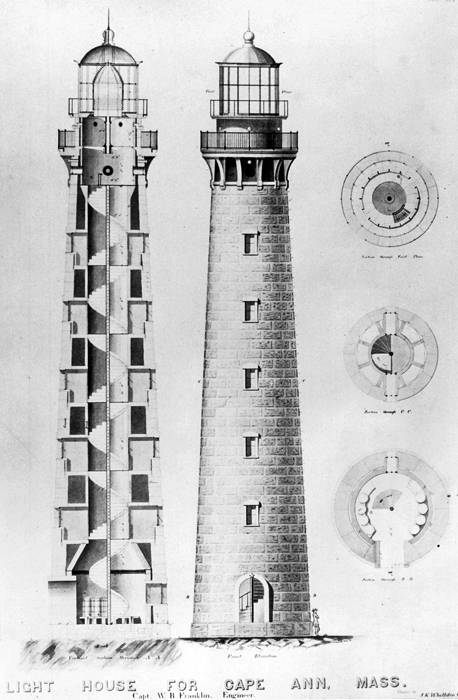
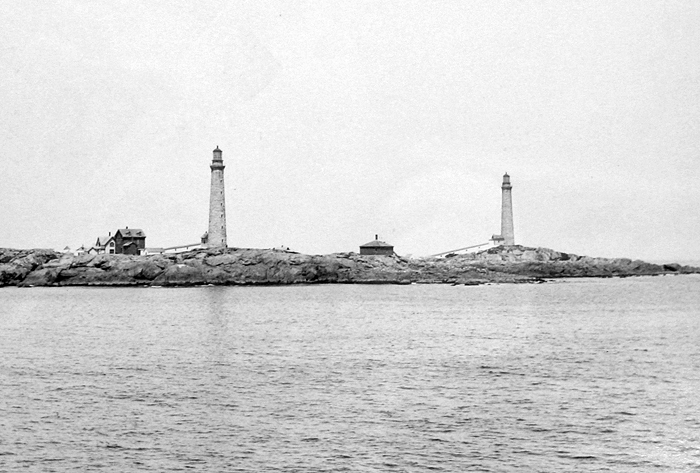
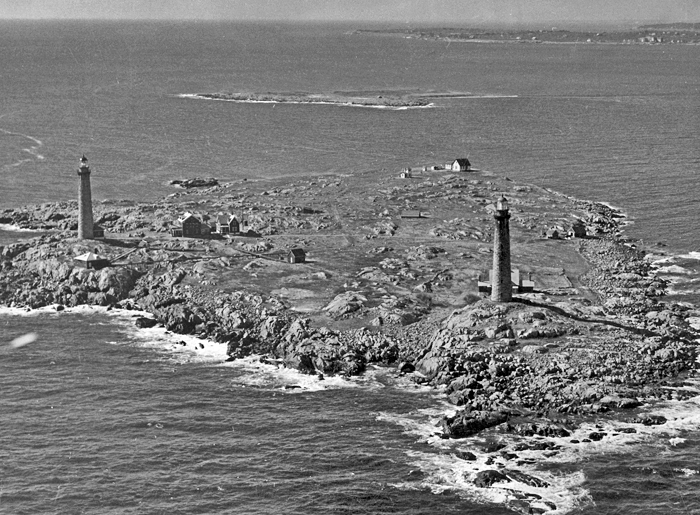
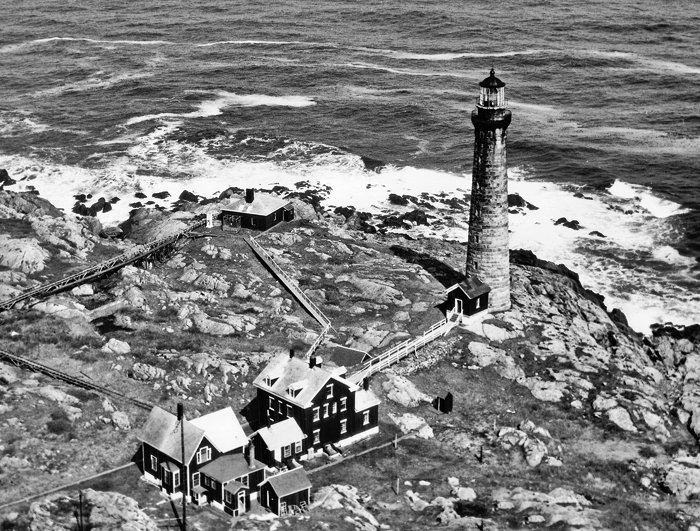
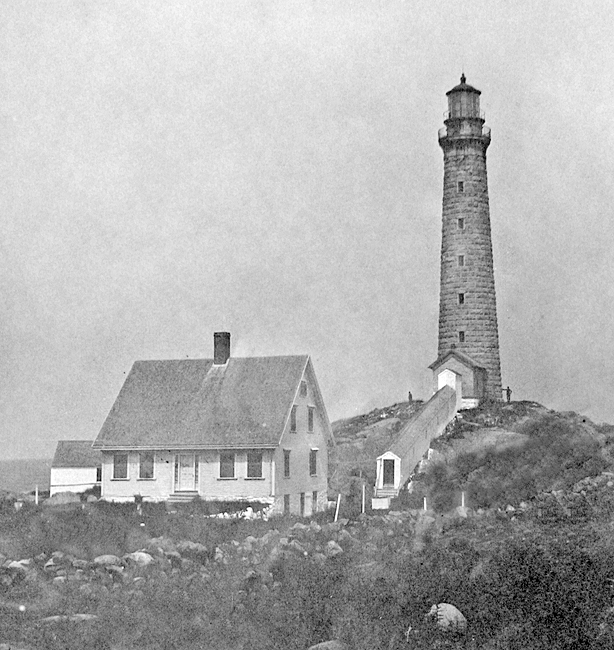
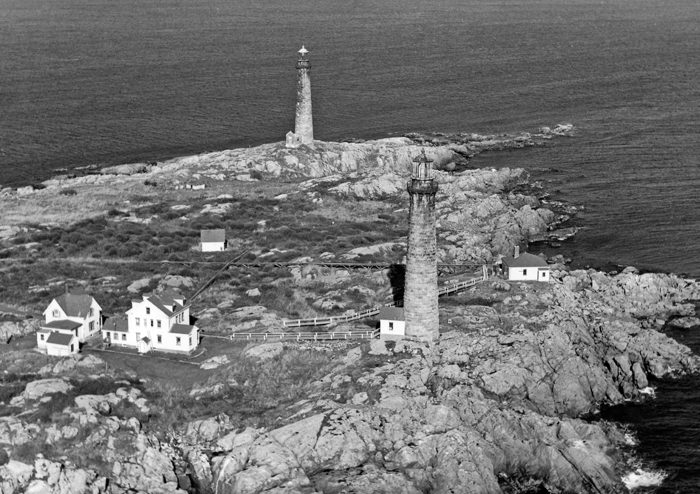
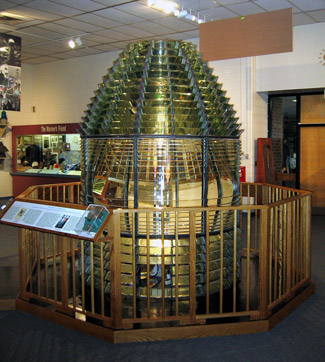
Photo Gallery
Photo Gallery
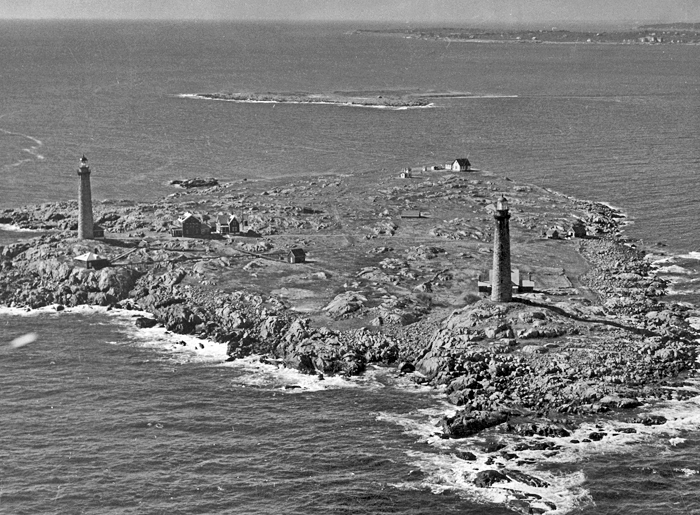
Thacher Island, located one mile east of Cape Ann, near Rockport and Gloucester, consists of about fifty acres of exposed rock, covered in places by a small amount of soil. From early Colonial times, much of the surrounding area’s history and economy were tied to the sea. Over 500 shipwrecks are said to lie beneath the waters off Cape Ann, and it was one of these that lead to the naming of the island.
|
In 1771, a six-man committee was authorized by the Massachusetts Bay Colony to buy Thacher Island for 500 pounds and to “erect a lighthouse or houses, and a convenient house for the keeper.” All previous lighthouses in the colonies had served to mark the entrances to ports, but the two towers on Thacher Island were the first to mark a “dangerous spot” on the coast — the Londoner, a partly submerged reef one-half mile from the island.
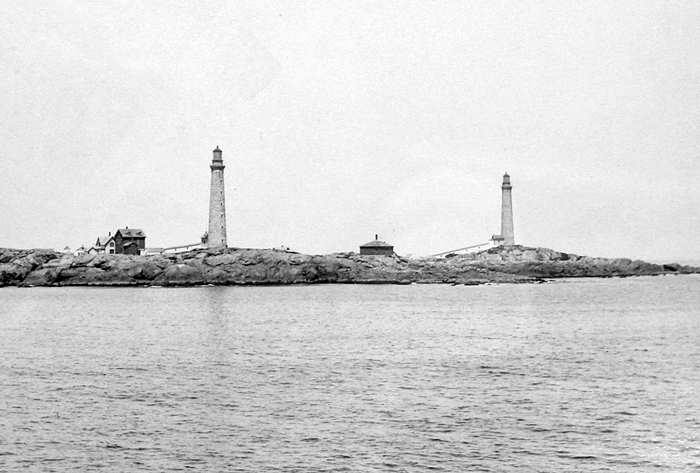
The original twin wood and stone towers were likely octagonal in shape, and stood forty-five feet tall and about 300 yards apart. The lights were positioned on a north/south axis enabling seafarers to line up the lights one behind the other to locate due north and were the eleventh and last light station in America built under the British. Cape Anners, mainly seafarers, looked on from the mainland as the towers were lit on Forefathers’ Day (a holiday honoring the Pilgrims), December 21, 1771, and promptly dubbed the twin lights “Ann’s Eyes.”
Captain Richard Derby of Salem and Captain Nathaniel Allen of Gloucester (Allen supervised the lights’ construction) selected Captain Kirkwood as the first keeper. Kirkwood—a Tory—held his post until July 6, 1775, when militiamen forcibly removed him. A report to British headquarters stated: “This day two or three companies went from Cape Ann to Thacher’s Island, broke the lighthouse glasses and lamps all to pieces, brought away the oyl [sic] together with Captain Kirkwood’s family and all he had on the island and put them on the main to shift for themselves.”
The lights remained dark during the revolution and were not fully repaired until 1784, when the General Court appointed Peter Coffin and Samuel Whittemore to make the Cape Ann lighthouses operational again.
The thirteen colonies had been responsible for their own navigational aids, but Congress, realizing the importance of lighthouses, voted on August 7, 1789 to place them all under Federal responsibility. Officers of the Revenue Cutter Service—a precursor of the modern Coast Guard—inspected the lighthouses and delivered supplies to them.
From 1792 to 1814, Captain Joseph Sayward served as keeper on Thacher Island. In 1814, James Sayward was offered the “old and feeble” Joseph’s position, but as the pay was only $250 per year, he refused. Aaron Wheeler, however, accepted the assignment, and he was given the additional task of clearing 300 yards of large boulders and surfacing smaller ones to create a path between the towers, for which he was paid a $100 bonus. Aaron Wheeler was followed by Austin Wheeler (1934 – 1836) and then Charles Wheeler (1836 – 1849), who ended up earning $450 annually for caring for the twenty-two lamps in the two towers.
|
Keeper Charles Wheeler provided the following report on the station in 1842:
I was appointed keeper of these lights in November, 1836, upon a salary of $450 per annum. I have, during the whole term of my service, employed an assistant keeper, paying him from $100 to $150 per year for his services. The two towers here stand eight hundred and sixty feet apart, and the path, from one to the other, through the rocks, is about one-thousand two hundred feet. The towers are built of rubble stone, resting upon the solid ledge, and are fitted with wooden stairs, window casings, and sashes, all of which are more or less rotten, particularly the inside lintels. There are very bad leaks in the towers, about the decks; the water runs through inside coasting the inside walls and stairs with ice from top to bottom. A year ago both towers were refitted with new lanterns and lamps. The lanterns are glazed with plate glass, except on the side where the door is, and there are no lamps on that side. In a gale which occurred last October, both lanterns were severely racked, and the northern one was thrown out of plumb one and a half inches, and a pane of glass was cracked in the southern lantern by its motion. During the gale, all the glass worked loosed, and I only saved the lanterns from destruction by wedging up the plates with slips of lead. …A year, last October, a new frame dwelling-house was erected here, five rooms on a floor, with five chambers. This house was built after a plan which I furnished to the collector at Boston. It is a good and comfortable building. The old house is of stone, and I use it for a school room, storehouse, &c….My family consists of ten persons. I hire a teacher for my children.
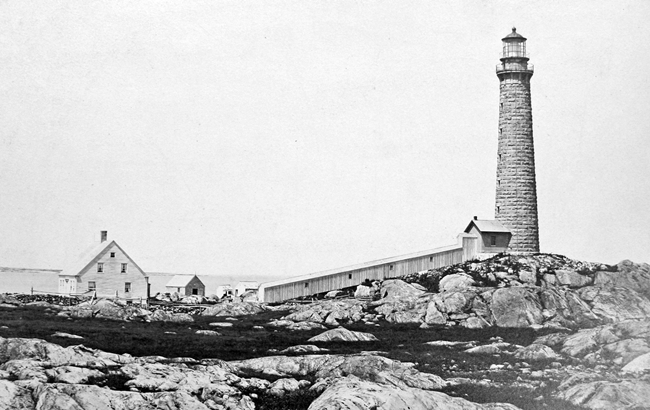
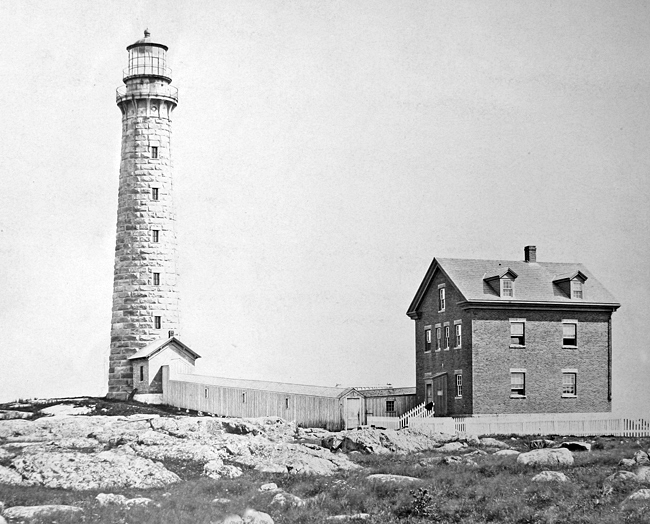
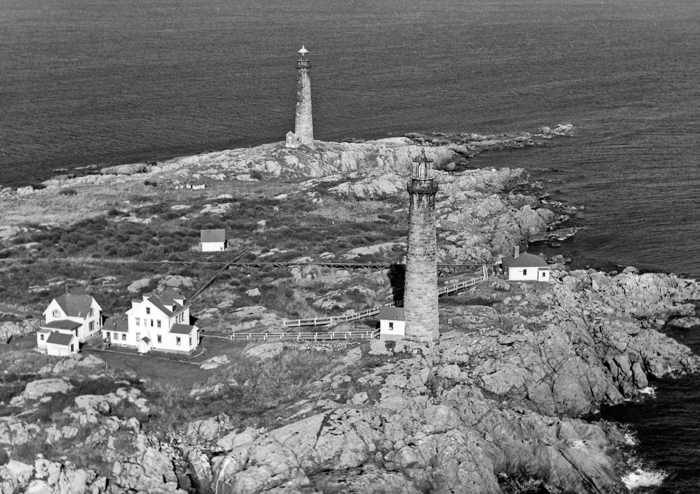
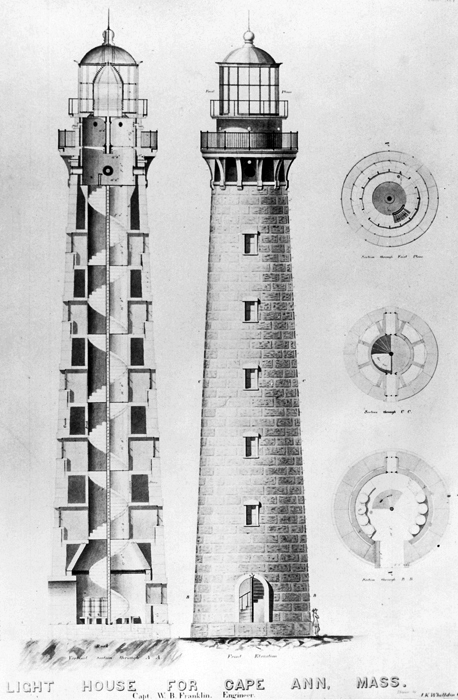
In 1857, Congress appropriated $81,417.60 for two new towers equipped with first-order illuminating apparatuses, and in August 1860, the original towers were removed and temporary lights installed in preparation for the construction work. The New Hampshire granite blocks used in the towers were cut, fitted, and numbered on the mainland before being transported to the island. Local Rockport granite was considered too soft and iron-rich, although it would later be used to build other lighthouses including Graves Light in Boston Harbor. Situated 900 feet apart, Cape Ann’s current twin towers are 124-feet-tall and were lighted for the first time on October 1, 1861, roughly seven months after President Abraham Lincoln took office.
The diameter of the lighthouses is thirty feet at the base and tapers to eighteen feet where the ten-foot-tall lanterns are seated. Cast-iron spiral staircases lead to the watch room and lantern room, each of which open to a balcony that encircles the tower. A ventilating ball with a lightning rod tops the sixteen-sided iron and bronze lantern.
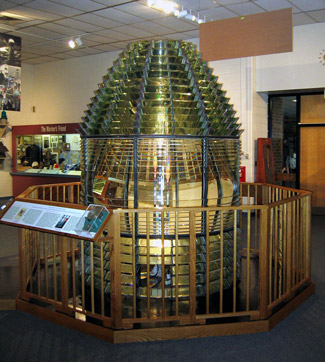
First-order Fresnel lenses from France were used in the towers, a vast improvement over Lewis’ Argand lamps and reflectors. Each lens stood twelve feet tall, was six feet in diameter, weighed over three tons, and employed thousands of pieces of glass to focus the light of whale oil lamps into beams that could be seen twenty-two miles at sea. The new towers began to be called “The Twin Towers of Thacher Island,” but have always officially been named the Cape Ann Lights. In 1859, there remained only two major lighthouses in the United States that had not been equipped with a Fresnel lens: Cape Ann and Cape Canaveral.
|
Maria was a multifaceted woman who wrote and edited stories and articles, participated in the anti-slavery and temperance movements, and studied sea mosses and algae. She also learned to perform her husband’s lighthouse duties, which proved quite fortunate.
After Keeper Bray, a Civil War veteran, was promoted from assistant to principal keeper with an annual salary of $1,000, one of his assistants required transport to the mainland for emergency medical care on December 21, 1864. Keeper Bray and another assistant who accompanied him planned just a brief stay on the mainland, but a fearsome blizzard prevented their return to the island. For two long nights, Maria was forced to repeatedly brave the blinding storm, climb 148 steps to the top of the nearest tower with fuel in tow, trim the wicks and clean the lantern panes, and then make her way through the howling wind and snow to the other tower, 900 feet away, where she performed the same tasks. Although the storm raged on, Alexander eventually decided to attempt the crossing and managed to return home guided by Cape Ann’s Eyes in time for Christmas. Some sources say Maria’s young nephew, Sidney Haskell, helped operate the fog signal and lights during those two nights, but her obituary credits the wives of the two assistants.
Do not believe Maria’s actions were without peril, or that she could have sat idly by waiting for her husband’s return without repercussions. Keeper John Farley died in 1891 when he was washed off the island by an “ugly wave” while performing his duties, and to let the lights go out could have been disastrous, for even with Cape Ann lit, in 1898, the great Portland gale claimed the steamer Portland with all 176 souls aboard, along with 150 more ships in a mere day and a half.
The 1875 Annual Report of the Light-House Board records that illumination experiments were conducted at the station with one of the light towers being supplied with lard oil and the other with sperm whale oil. A photometrical trial showed that lard oil, which was less expensive, produce a brighter light.
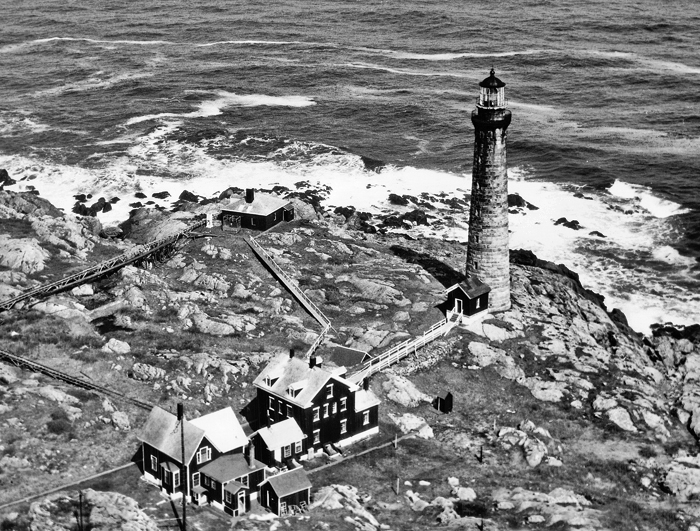
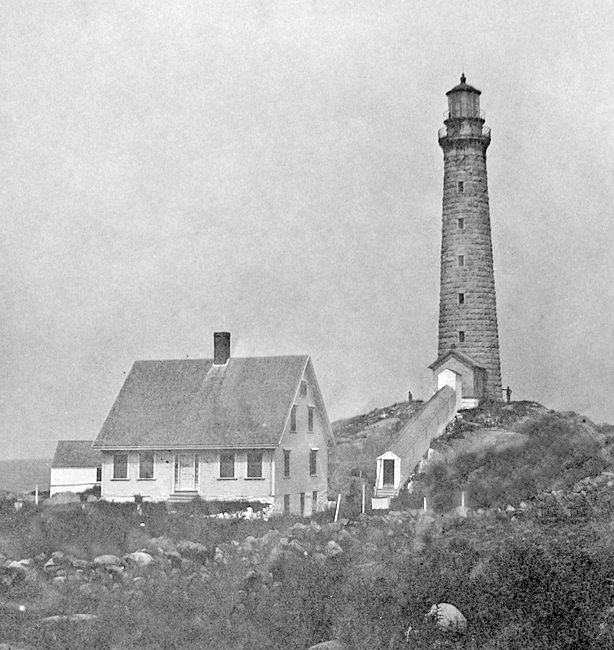
The station’s five keepers, each of whom had a family, were living in just two dwellings in 1875, when the attic of the head keeper’s residence was finished to provide four additional bedrooms. A one-and-a-half-story, wood-frame dwelling was constructed for the head keeper near the south tower in 1876, leaving the four assistants to share the other two dwellings. The head keeper’s house sits on a granite foundation and has a kitchen, living room, and bedroom on the first floor, and two bedrooms and a bathroom on the second floor. Nearby, the 1816 brick dwelling built by Winslow Lewis remains standing though it was greatly enlarged over the years to accommodate two assistants and at one point even a schoolroom. A keeper’s dwelling was built near the north tower in 1861 and later expanded into a duplex, but this structure was destroyed by fire in the 1950s. Its foundation is still visible on the island.
A fog signal was established on Thacher Island in 1861, the same year the current granite towers went into service. The original fog signal was a whistle sounded by a caloric engine, and in 1869 a new structure was built to house an Ericsson engine for sounding a fifteen-foot trumpet. A steam fog whistle was added to the station in 1871 for redundancy. The present, thirty-two-foot-square fog signal house was finished in 1887. A compressed-air diaphone replaced the station’s steam whistle in 1916.
At 9 p.m. on December 31, 1920, a large flock of geese struck the north tower, killing five of them. Three penetrated the lantern room, breaking two window panes and badly chipping prisms on the northeast side of the lens.
|
The Fresnel lens was removed from the south tower in 1975 and was on display at the U.S. Coast Guard Academy Museum in Connecticut until 2011. Vandals destroyed the Fresnel lens in the north tower, but pieces of it can be seen at the Sandy Bay Historical Society and on the island. Following the automation of the south light and fog whistle in 1979, the Town of Rockport leased the island from the U.S. Coast Guard, which removed its last four-man crew in 1980. In late 2012, the Cape Ann Museum announced it had been offered the lens and was raising funds for its restoration and exhibition. The lens arrived at the museum in May 2013 and was soon placed on display.
The Thacher Island Association was founded in 1983 to support and encourage historic preservation and restoration of the structures on the Island. The north tower was extensively renovated beginning in 1986, after which it was relit as a private navigational aid. A fifteen-watt fluorescent lamp replicates the amber glow of the original lamp and is visible for about eight miles. A flashing red beacon in the South Tower continues to be operated by the Coast Guard as an official aid to navigation making Cape Ann Light Station the only twin light in official operation in the United States.
The Thacher Island Association restored the brick assistant keepers duplex in 2002, providing facilities for resident keepers as well as an apartment that at one time could be rented by the public. From 2003 to 2007, the principal keeper’s dwelling was restored, and it now serves as a visitor center. Under the care of the association, Cape Anne’s Eyes seem certain to keep watch over the surrounding waters for the foreseeable future.
After a 400-pound granite block from the gallery deck of the north tower fell to the ground in 2016, International Chimney Corporation was hired to repair and reinforce the tops of the twin towers. Workers hoisted the stone back to the top of the north tower in 2018 and pinned and epoxyed it into place. Stainless steel bands were then placed immediately below the gallery and lantern room decks to prevent other stones from falling to the ground.
Keepers:
References