Harbor of Refuge, DE 



Select a photograph to view a photo gallery
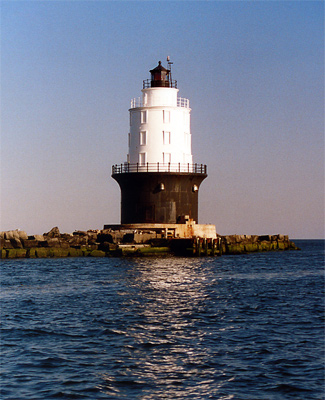
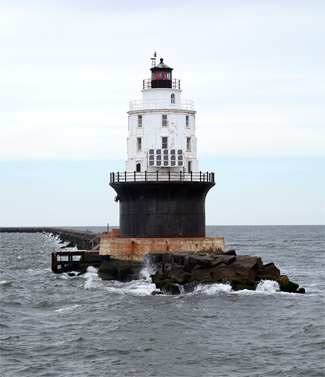
Photo Gallery
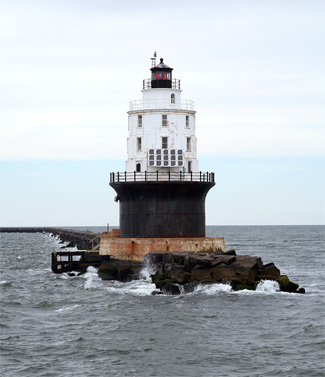
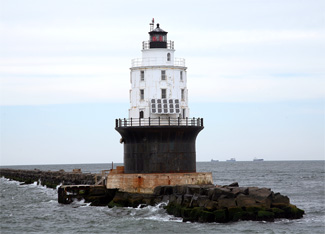
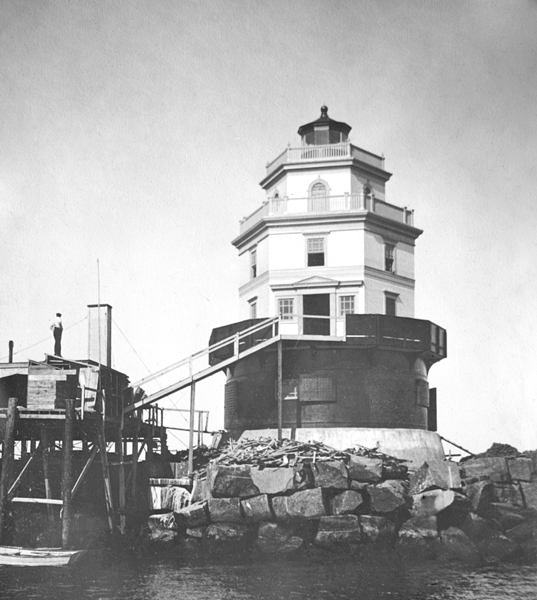
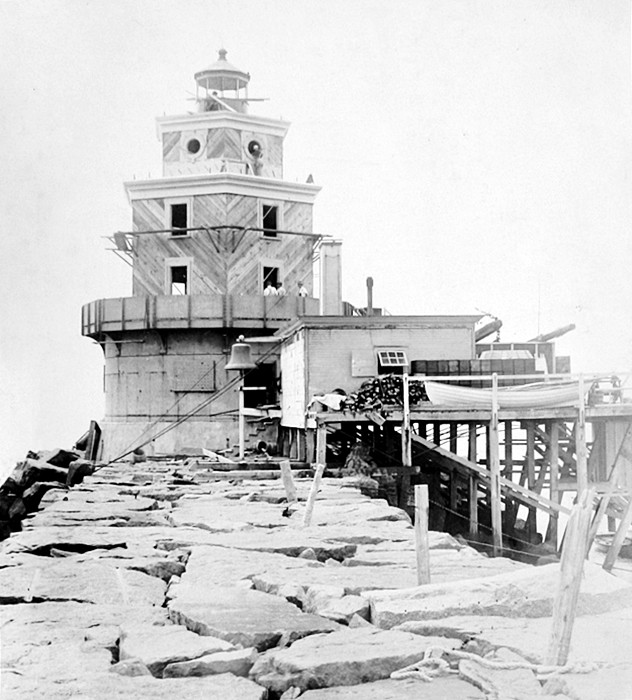
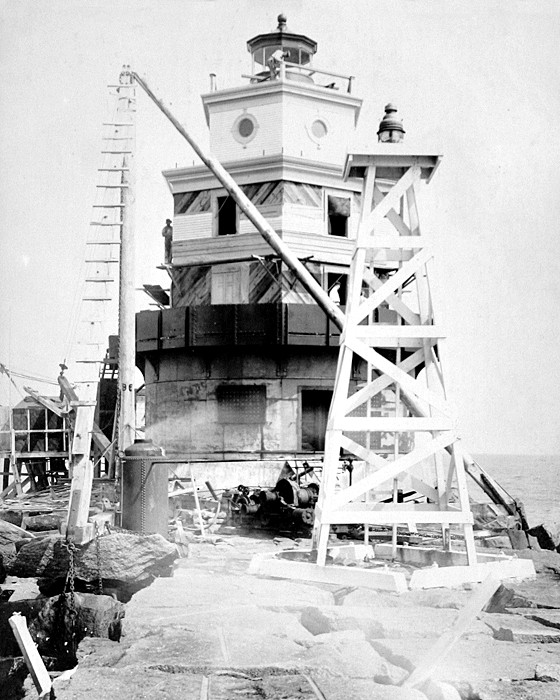
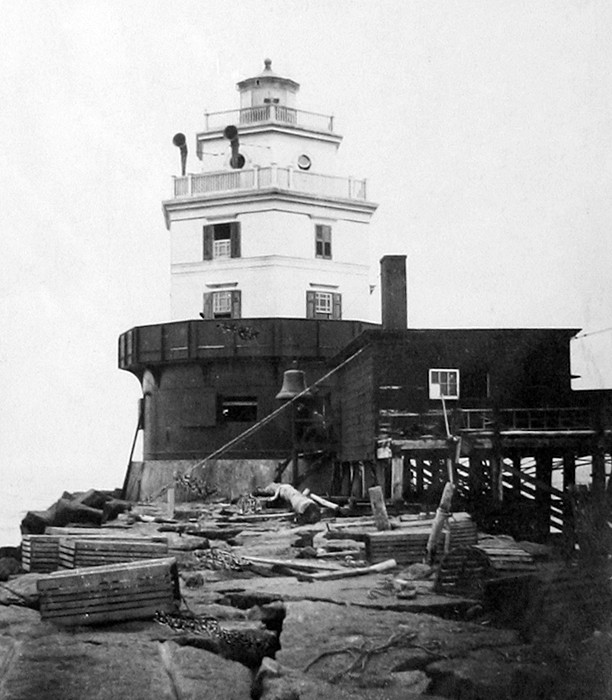
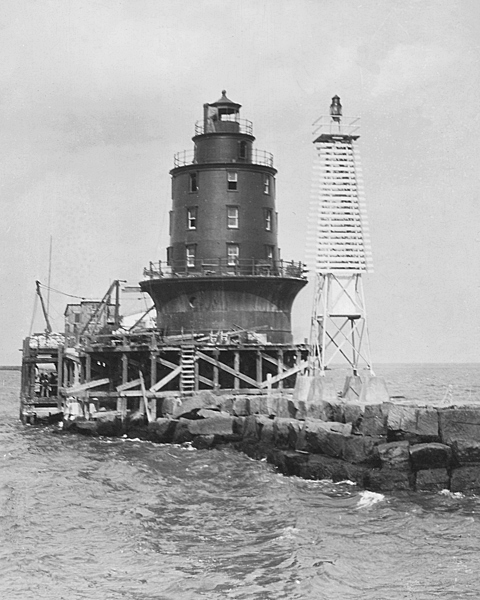
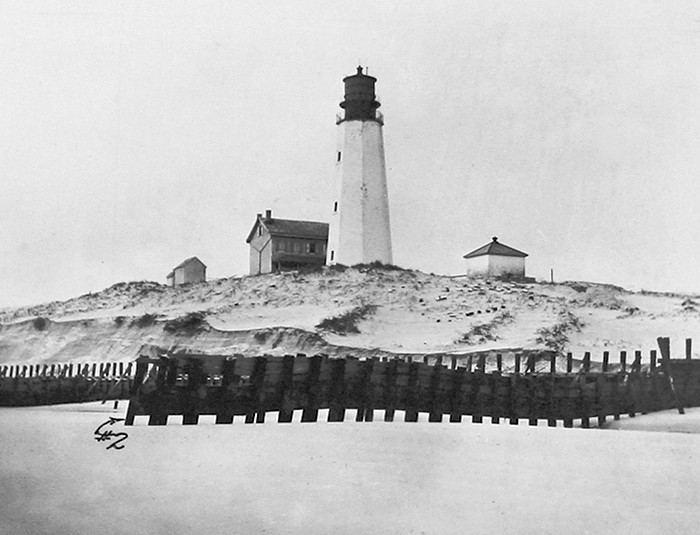
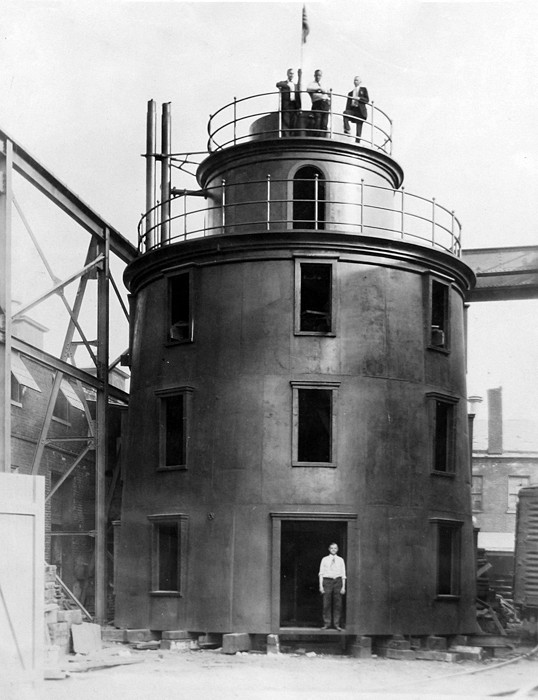
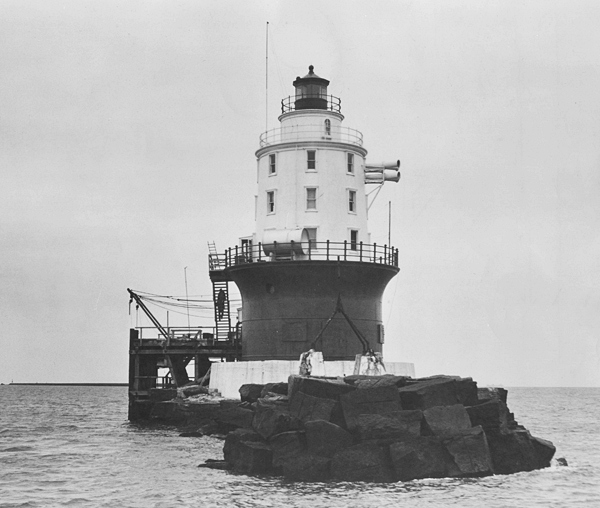
Photo Gallery
Photo Gallery
|
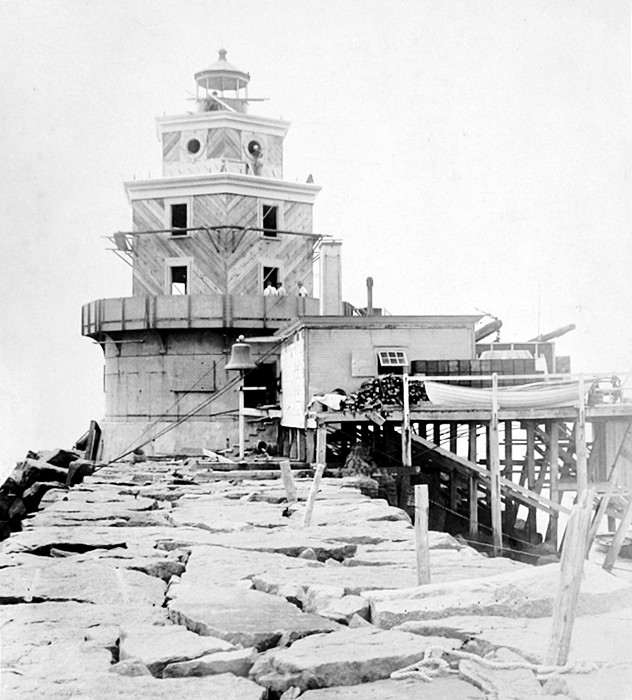
Left unmarked, the breakwater would present a danger to navigation, so temporary lights were placed on each end of the structure. A thirty-foot frame tower topped by a lens lantern showing a fixed red light was positioned on the southeast end of the breakwater, while at the opposite end a beacon with the same characteristic was mounted atop a post. Both lights were exhibited for the first time on January 1, 1902. In May 1903, a 700-pound fog bell, sounded by a striking machine, was added to the southern end of the breakwater along with a temporary dwelling.
While preparations were being made for a permanent lighthouse, a powerful storm packing wind gusts of eighty-five miles per hour struck the breakwater in September 1903 and swept away the fog bell, striking machine, and frame tower. Keeper Charles Marshall, who was in charge of the temporary lights, came ashore after the storm and reported that the windows in his dwelling on the breakwater were smashed and the entire house flooded. The wooden schooner Hattie A. Marsh was riding out the storm in the harbor of refuge when it slipped its anchors and was dashed against the stone breakwater. Another vessel quickly came to the rescue and saved two of the crew, but the captain, Joseph Mehaffey, and four sailors were lost. This incident should have been sufficient evidence that a stout and durable lighthouse was required at this exposed location, 1.25 miles north of Delaware Breakwater.
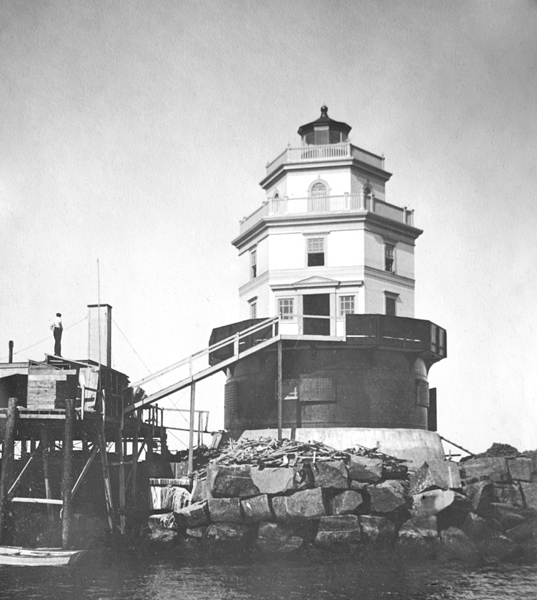
A new fog bell and a steel tower were placed on the breakwater the following spring to replace those swept away by the storm. Congress had provided $30,000 for a lighthouse on Harbor of Refuge Breakwater in June 1900, but by the time work was ready to begin, the cost of labor and material had increased sharply, and another $20,000 had to be allocated in 1906. To save money, the brick superstructure first proposed for the lighthouse was replaced by a wooden structure, even though the Lighthouse Board was fully aware that the exposed site was “an extremely dangerous one and subject to attacks of most violent seas.”
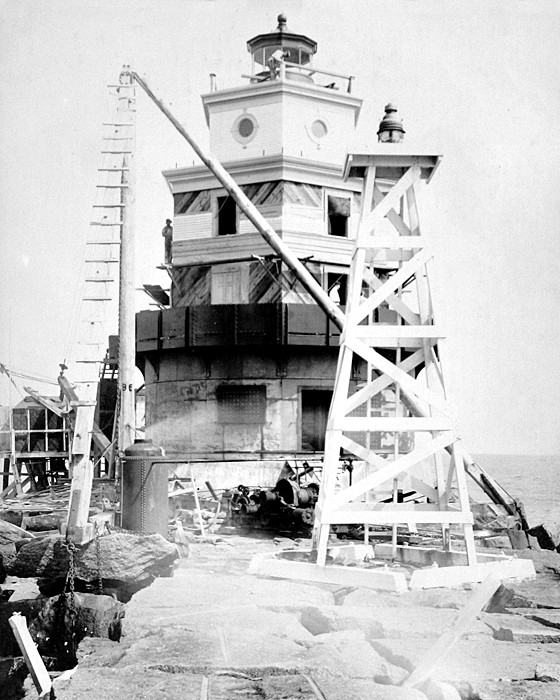
In June 1907, the metalwork for the lighthouse’s concrete foundation was delivered at Lewes and excavation work began on the breakwater to provide a pit for the foundation. Seventeen months later, the lighthouse was completed at a cost of $49,941, and the subsequent Annual Report of the Lighthouse Board contained the following detailed description of the station.
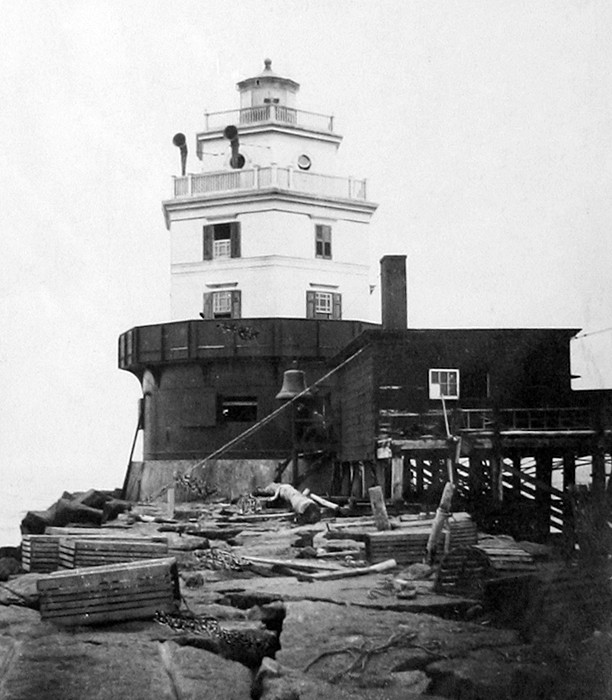
On November 20, 1908, a fourth-order, incandescent oil-vapor light, illuminating the entire horizon, and flashing white every 12 seconds, was established in the white, hexagonal, three-story frame structure, with lead-colored trimmings, resting on a brown cylindrical iron foundation, located on the southerly end of the Harbor of Refuge Breakwater, southwesterly side of the entrance to Delaware Bay. The foundation of this lighthouse, completed in 1907, consists of a concrete block 40 feet in diameter and 15 feet 6 inches high, resting upon the enrockment of the breakwater. The superstructure consists of a center column of iron, a basement 32 feet in diameter of two courses of iron plates, and a hexagonal frame superstructure from the basement to the lantern. The fog-signal is a first class siren operated by compressed air.
|
April 10 & 11, 1918: “We had a storm wind, N.E. gale did considerable damage to this station’s storehouse roof. Broken lighthouse foundation shifted the big light about 2 inches on the foundation.”Keeper Taylor and George C. Hickman, his assistant, were commended for the “exceptional service and devotion to duty in maintaining the light and fog signal” during the February 1920 storm, which ripped up about forty feet of the gallery decking and swept away all the outbuildings on the platform at the rear of the tower.February 3 –5, 1920: “We had a N.E. storm and gale did some damage here. The old house, the bell and the davit and the rowboat, water tanks, and in fact, all that was in the house, washed overboard with the house. One barrel of oil, lots of tools, also fog signal gears. It washed everything off the dock. The wind and high sea … also moved the big lighthouse about 2 inches on its foundation.”
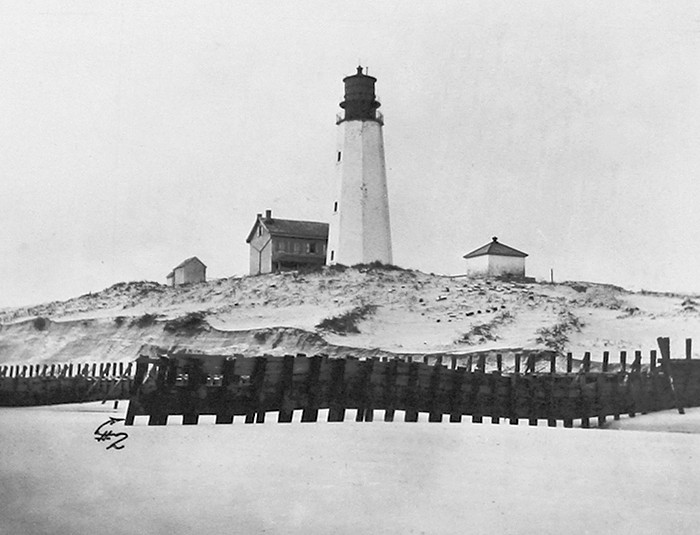
The Lighthouse Service realized as early as 1915 that erosion would eventually claim Cape Henlopen Lighthouse and began requesting funds to rebuild Harbor of Refuge Lighthouse so it could also fulfill the role of the endangered lighthouse on the nearby cape. “Every purpose now served by Cape Henlopen Light,” the service wrote, “would be better served by the rebuilding of Harbor of Refuge Light to a height of about 140 feet.” After years of requests, Congress finally allocated money for the project in 1922.
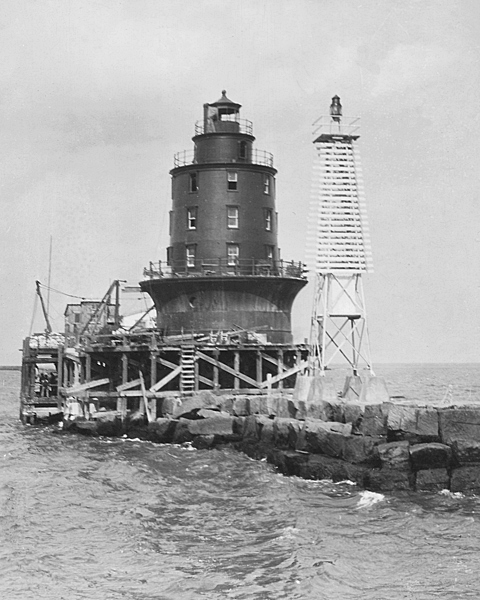
Nearly undermined by the sea, Cape Henlopen Lighthouse was discontinued on October 1, 1924 and replaced by a temporary steel light tower erected nearby. (Cape Henlopen Lighthouse finally collapsed in April 1926). After a temporary tower and light had been established on the Harbor of Refuge Breakwater, Keeper Taylor extinguished the wooden lighthouse’s light for the final time on April 12, 1926, as a work crew arrived to dismantle the structure.
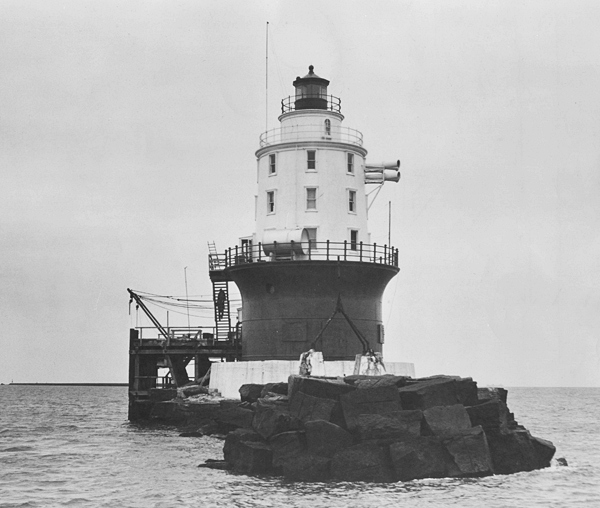
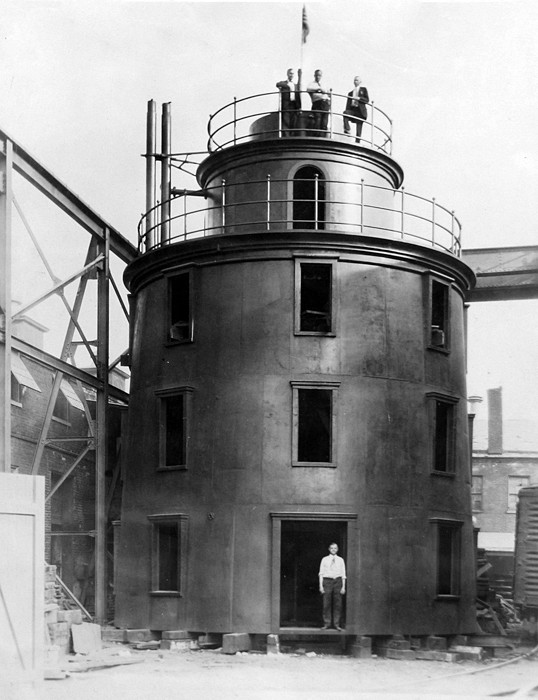
Years of abuse had taken their toll on Harbor of Refuge Lighthouse. In its place, three-story cast-iron tower, fabricated by the Smyser-Royer Company, was erected in time for its light to first be exhibited on November 15, 1926. The following description of the new lighthouse was given by the Lighthouse Service:
The structure as remodeled consists of a conical tower supporting a watch room and lantern and supported by a cylindrical pier with a flaring upper course of plates to run the sea during rough weather. The tower shell of the pier and tower is made of cast-iron plates, the pier lined inside with reinforced concrete, and the tower proper with brick. The interior of the pier houses the fog signal, machinery, and air tanks. The tower proper, in three stories, contains the keepers’ quarters, and the fog signal apparatus is located on the third floor. The whole structure is supported upon a heavy block of concrete lying within the breakwater.The illuminating apparatus consists of a four-panel fourth-order lens with type-A incandescent oil-vapor lamp, giving a single flash of 22,0000 candlepower every 10 seconds. The lens revolves on ball bearings and is driven by clockwork actuated by weights within the hollow central iron column of the structure.
The fog signal consists of a compressed-air siren, with two-way horns, projecting from the third floor on the channel side of the tower. The characteristic is a group of 3 blasts, each 2 seconds, every 45 seconds. The entire fog-signal installation, from engines to horns, is in duplicate.
|
A DCB-36 aerobeacon replaced the Fresnel lens in the lantern room in 1947, and in 1996, a Vega VRB-25 replaced the aerobeacon.
Harbor of Refuge Lighthouse was automated in December 1973, when its final crew of coastguardsmen, including Angelo Rigazio, who joined the Coast Guard in 1970 after he was drafted to serve in Vietnam, left the station. When asked why he had joined the Coast Guard, Rigazio replied “because I can swim better than I can duck bullets.” Rigazio doesn’t regret his time at Harbor of Refuge, though he thought he had made some superior mad to be stuck out at the isolated station. Winters were bad, but summers, with sunsets, fishing, and visitors, were enjoyable.
Fishermen would sometimes ask if they could fish off the breakwater, and the crew didn’t have any problem with that, especially when a six-pack of beer, which was banned at the lighthouse, was left behind. Rigazio would remove one can to make it a five-pack, and lower it into the lighthouse’s 4,000-gallon fresh-water tank. “We’d have a hook,” Rigazio explained. “We’d open the lid up, fish around with the hook and pull up a five-pack. And that’s how we kept our beer cold. And out of sight out of mind.” Angelo Rigazio later served as president of The Delaware Bay Lighthouse Keepers and Friends Association and provided commentary on lighthouse boat tours offered by the organization.
In the years after automation, Harbor of Refuge Lighthouse received only periodic maintenance, and then only the most essential repairs were made. The lighthouse did receive a major overhaul in 1998-1999, when the station’s exterior metalwork and concrete foundation were rehabilitated at a cost of roughly a quarter million dollars.
On April 1, 2002, the non-profit Delaware River and Bay Lighthouse Foundation (DRBLHF) signed a twenty-year lease on Harbor of Refuge Lighthouse with the Coast Guard. Just over a year later, on June 21, 2003, the lighthouse received its first tour group, whose members were allowed a rare glimpse into an offshore lighthouse. The ambitious foundation became the official owners of the lighthouse in 2004, when the tower was transferred to DBRLHF under the guidelines of the National Historic Lighthouse Preservation Act of 2000. Seasonal tours of the lighthouse are offered by DBRLHF each year as conditions permit. Ambitous volunteers have restored the DCB-36 formerly used in the lighthouse and placed it on exhibit in the tower.
Harbor of Refuge Lighthouse may be endangered due to the poor condition of the breakwater on which it rests. In 2007, Congress appropriated $340,000 so the Army Corps of Engineers could conduct a detailed study of the damage and recommend how to stabilize and repair the breakwater. Through the efforts of DBRLHF, the U.S. Army Corps of Engineers awarded a contract for nearly $3 million in repairs to the 110-year old Harbor of Refuge Breakwater wall under and near the lighthouse. This work was carried out in 2011.
Winter storms in 2010 damaged the station’s docks, which made it impossible to offer tours of the lighthouse. Thanks to a $1 million grant, a custom dock, designed to withstand harsh conditions, was installed at the breakwater in 2016. The exterior of the lighthouse was painted and the interior restored in 2017, and the tower was opened again to tours in 2018.
Keepers:
References