Newport News Middle Ground, VA 

Select a photograph to view a photo gallery
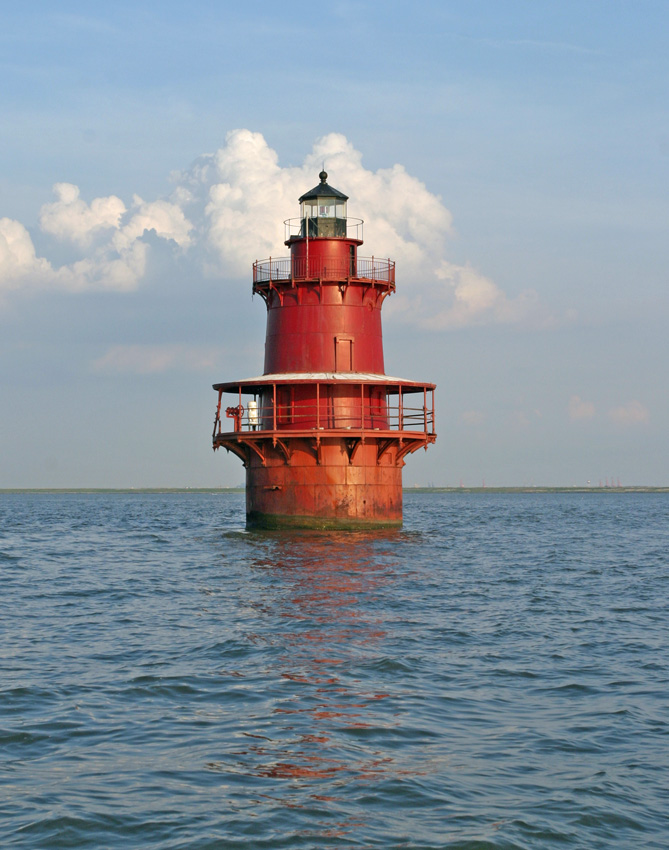
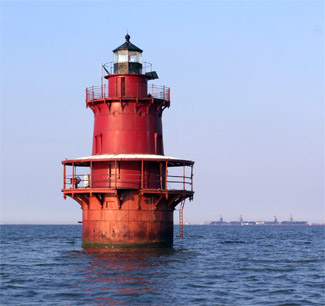
Photo Gallery
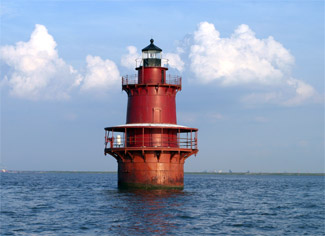
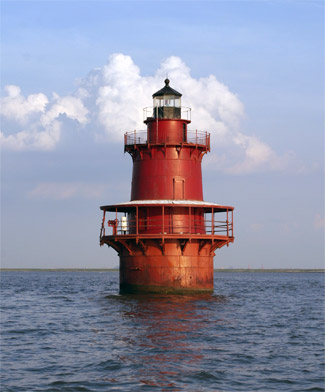
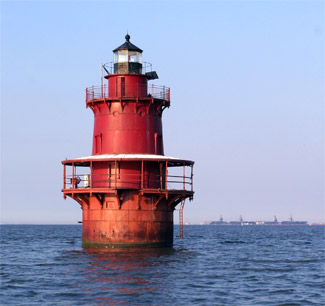
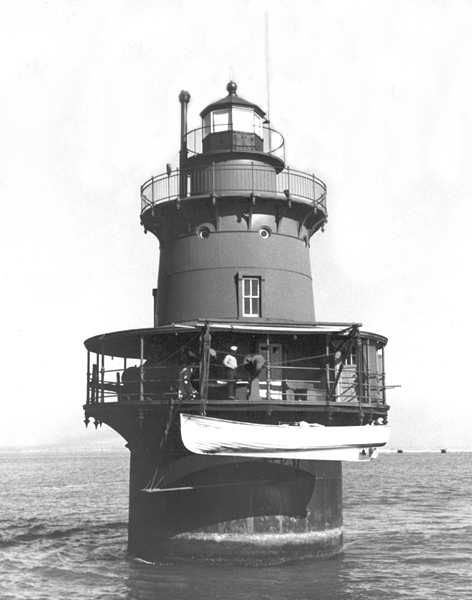
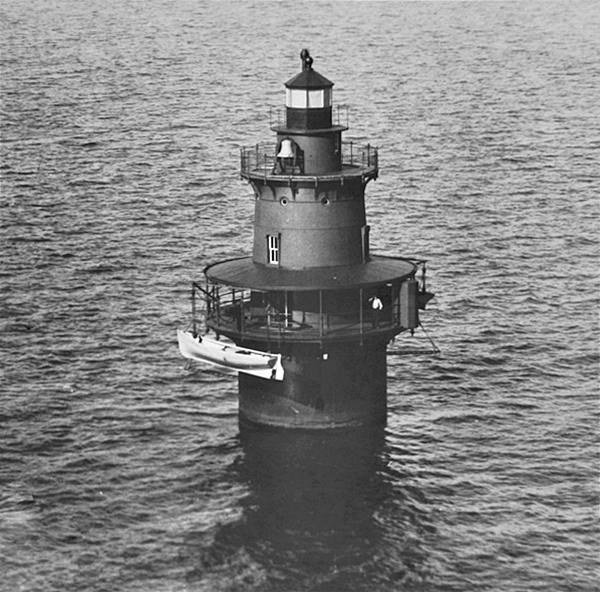
Photo Gallery
Photo Gallery
Vessels leaving the docks at Newport News drawing 24 feet of water invariably pass to the southward of the Middle Ground, and because of the several changes of course masters now hesitate to leave their berths for sea on very dark or foggy nights. To obviate the necessity for thus losing much valuable time a light-house and fog-signal should be established on the Middle Ground, near Newport News, or in the vicinity of Newport News at such a point as may be selected by the Board.An examination of the shoal in question, with reference to a foundation for a light-house, shows that it is composed of sand and clay until at 32 feet in depth below the surface of the bottom perfectly clean white sand is reached. There is, therefore, no doubt about the suitability of the foundation.
The light-house, however, will have to stand in about 17 feet of water at low tide or about 21 feet at high tide. It will be exposed to shocks from fields of running ice, and being in comparatively deep water will also be exposed to the danger of being run into by both steam and sailing vessels. Under the circumstances no structure less suitable than an iron caisson should be built. To build and equip an iron structure 35 feet in diameter, concrete-filled, surmounted by an iron light-house, will cost about $50,000, and the Board recommends that this amount be appropriated for the purpose.
|
The framing of the crib commenced in May at Newport News, and in July, “the wooden caisson with four sections of the dredging shaft and two courses of the foundation cylinder was towed to the site and sunk.” By the end of October, the caisson had reached its prescribed depth — the layer of clean, white sand thirty-four feet beneath the top of the shoal. After the caisson had been filled to the proper height with concrete, the work of erecting the superstructure began in December and was completed in January. The interior of the tower and the remaining finish work was wrapped up on March 6, when the lighthouse was formally accepted, and on “April 15, 1891, the light was first exhibited from the lens for the benefit of mariners.” The tower’s fourth-order Fresnel lens displayed a fixed white light punctuated by a white flash every twenty seconds.
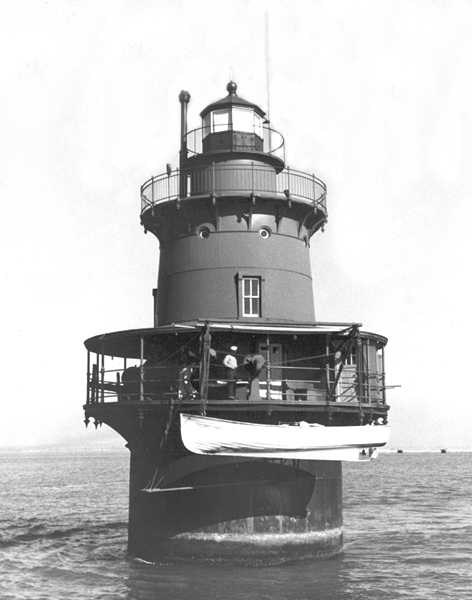
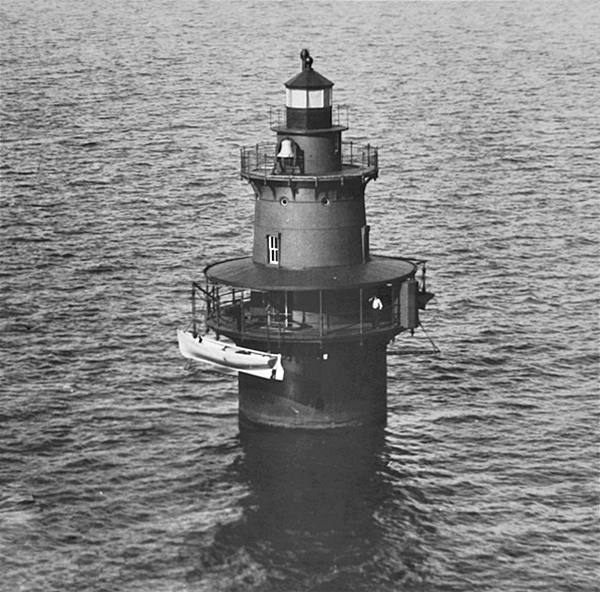
The lighthouse’s caisson foundation is fifty-six feet tall, has a diameter of twenty-five feet, and extends fifteen feet above water level. The lighthouse superstructure stands twenty-nine feet high, and its base, which is encircled by a covered gallery, has a diameter of twenty-one feet. Atop the tower, the octagonal lantern room housed an iron pedestal that supported the lens at a focal plane of fifty-four feet. Newport News Middle Ground Lighthouse was originally endowed with a fog bell, which was struck a double blow every fifteen seconds when necessary. The caisson was initially painted black and the tower brown, but today the entire lighthouse is red.
The lighthouse has five levels, beginning with a basement in the top of the caisson, where cisterns stored the rainwater collected by gutters running along the first-level gallery roof. The main level, which contained most of the living space, has a tongue-and-groove floor and brick-lined walls. The next level up housed equipment, and above this is the watchroom, featuring an iron floor and tongue-and-groove walls. An iron ladder ascends through the ceiling of the watchroom, leading to the octagonal lantern room.
James B. Hurst was appointed the first head keeper of Newport News Lighthouse, but he was transferred just a couple months later and replaced by Daniel J. Clayton, his assistant, who remained in charge of the lighthouse for just over three years before resigning in 1894. Head Keeper Malachi D. Swain and Assistant Keeper Martin B. Tolson were recognized in 1920 for rendering assistance to a motorboat lost in fog. During a storm the following year, a motorboat became uncontrollable and ran into the station’s ladder. Homer T. Austin was head keeper at this time, and he provided assistance to the occupants of the vessel.
James B. Cox was transferred to Newport News Middle Ground Lighthouse in 1931 when the position of first assistant was eliminated at Currituck Beach Lighthouse. Assistant Keeper Cox was in charge of the lighthouse on December 19, 1937 with Wash Brown also on station as a temporary substitute keeper. After having breakfast that morning, Cox told Brown he had indigestion and took a dose of soda. After Cox took another dose of soda and said he felt better, Brown went ashore to mail some letters about noon. Brown returned to the station at 2:15, and Cox met him at the davits and passed the falls down. After hooking onto the falls, Brown looked up to give Cox the signal to hoist him up but the keeper was gone. Brown assumed Cox had gone inside to get his gloves. After waiting ten minutes, Brown hollered for Cox and then pulled the boat over to the steps and went up on deck and found Cox laying on the deck unconscious. Keeper Cox gasped one last time and was gone. Brown hailed the Chesapeake Ferry and sent word to the buoy yard that Cox was dead. The lighthouse tender Linden took a coroner out to the lighthouse and retrieved the body. The coroner concluded that the cause of death was an acute coronary occlusion.
When the lighthouse was automated in 1954, the characteristic of the light was changed to a white flash every six seconds and the fog bell was subsequently tolled just once every fifteen seconds, instead of twice. The Coast Guard terminated the lighthouse’s direction calibration service at this time and removed unnecessary equipment, including the station’s boats. The batteries that powered the automated light had to be changed every nine days, a task that proved difficult as the iron ladder descending from the first level deck ‘reverts’ itself, forcing maintenance crews embarking from their boats to swing around to the opposite side of the ladder after climbing up the first ten feet.
|
Some immediate repairs were made, and in 1987 solar power was installed at the station. Two twelve-volt batteries were placed on the floor of the lantern room, and the light was removed outside to a pole above the gallery. In 1988, the Coast Guard spent $14,400 on a long list of improvements, including sandblasting and painting, replacing railings, and installing a new and safer access ladder, but a 1992 inspection found that iron plates of the tower were rusting away and water was still leaking into the caisson. These observations were confirmed in 1994, when inspectors noted pitting rust all around the waterline of the foundation, and “considerable rust” up and down the seams of the tower’s plates. Corrosion had also attacked the new access ladder and the underside of the first level deck. Additional pieces of the structure were found to have fallen off, including a support for the main deck along with one third of the main deck balustrade. Also, the interior masonry of the basement and caisson was cracked. The state of disrepair even extended to the very maintenance logs themselves, which were missing.
The inspector’s report made some practical suggestions to immediately improve Newport News, like moving the light from its exterior pole back inside to the lantern pedestal, where it would be easier to service, replacing the age-yellowed lantern panes, and changing out the steel plates over the tower’s windows with vented acrylic glazing to improve air flow. The inspectors also recommended that qualified sub-contractors be hired to address the structural instability in the main deck and foundation.
In 2005, Newport News Middle Ground Lighthouse was auctioned off on an online site for the disposal of government property after no eligible government agencies or non-profit groups were judged qualified to assume stewardship of the property when it was offered under the National Historic Lighthouse Preservation Act in 2002. The auction website described the lighthouse as “56 feet tall with catwalk and roofed canopy” and warned that prospective buyers would likely need to obtain an occupancy license from the State of Virginia. Lighthouse auctions are a method of last resort for defraying the expense of maintaining these unmanned structures, as both the Coast Guard and many historical preservation groups have found them too costly for their limited budgets.
Though sold at auction, Newport News Middle Ground Lighthouse remains an active aid to navigation, and its new owner is required to provide safe access to the Coast Guard to service the beacon. Given its structural deficiencies and poor condition, the lighthouse only fetched $31,000, far below the normal market value for a sturdy offshore lighthouse, but then the station is the oldest caisson lighthouse in Virginia.
Robert Gonsoulin of Williamsburg, Virginia is the proud owner of Newport News Middle Ground Lighthouse, and he and his extended family have poured hundreds of hours of labor and over $30,000 into turning the lighthouse into an offbeat vacation home. After the lighthouse had been rigged with an electrical system, Coast Guard-approved toilets, and heavy-duty storm windows, the family officially opened their new residence on July 4, 2006. According to the family, the panoramic views the lighthouse offers of one of the country’s busiest harbors simply can’t be beat.
Keepers:
References