New Point Comfort, VA 
Select a photograph to view a photo gallery

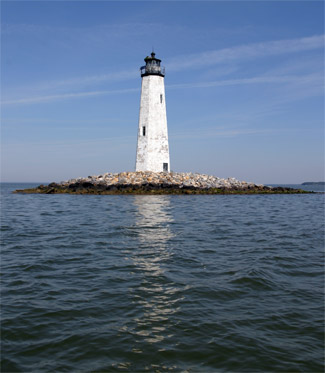
Photo Gallery
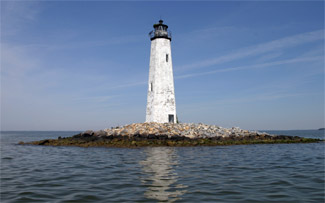
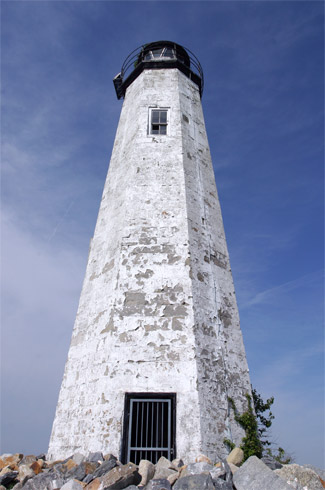
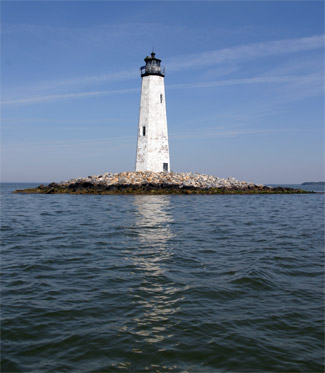
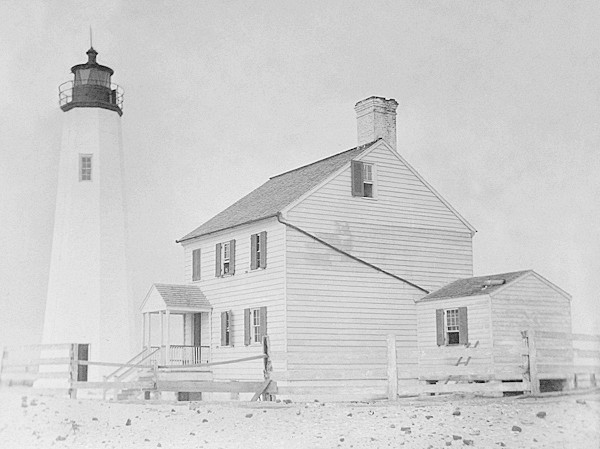
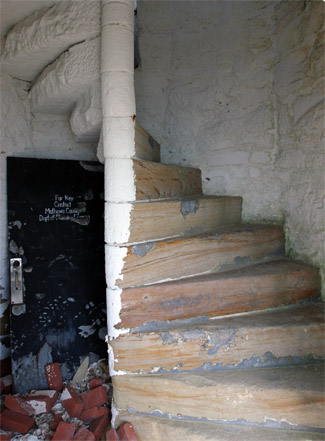
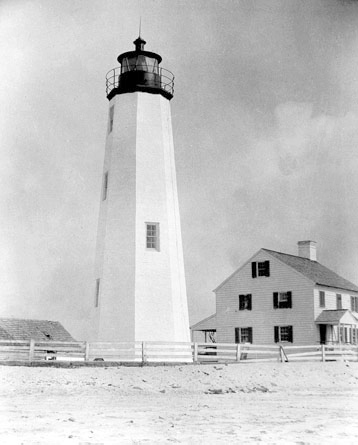
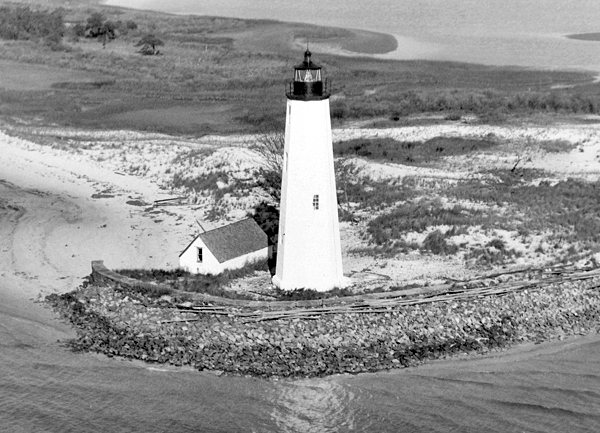
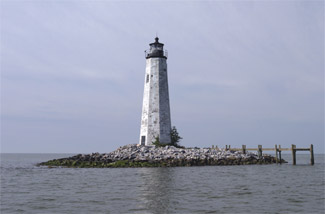
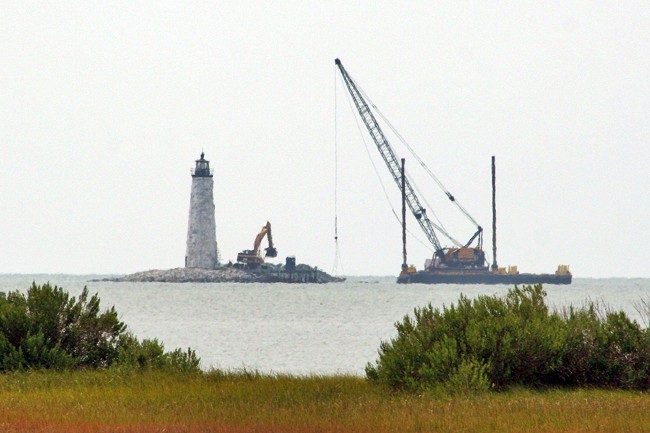
Photo Gallery
Photo Gallery
Funds for New Point Comfort Lighthouse were first appropriated in an 1801 Congressional act that also commissioned a lighthouse at Smith Point, approximately thirty miles to the north. Five thousand dollars were earmarked for the project, and the Treasury Department’s Commissioner of Revenue William Miller (who was responsible for the nation’s lighthouses at that time) ordered a preliminary survey of the area. John Patterson completed this work and noted some of the features of the land:
New Point Comfort is an Island separated from the main land by a creek of three and a half to four feet water at high tide, with Mobjack upon the west side and the Chesapeake on the east. The Island is about 3/4 of a mile in length...the width of the land varies from 350 to 500 yards, and contains about 100 acres...It lies generally low and much broken, and covered over with drifted sand hills. About the centre of the Island lies the most elevated firm spot to be found, of about 2 to 3 acres running quite across the point, commanding a good front upon each side...the foundation is good and appears entirely secure against the drifting of the sand...In this last observation “appears” is the operative word, as Patterson’s choice of location would subject the lighthouse to repeated measures to save it from tumbling into the sea.
|
At this point Elzy Burroughs, who erected the towers at Smith Point and Old Point Comfort, enters the picture. Based on input from Burroughs, Commissioner Miller negotiated an additional $3,500 for the project. Burroughs also solved the land dispute at New Point Comfort by simply purchasing the entire island from Phillip Tabb and selling the government the necessary two acres. With the land roadblock removed, Burroughs was rewarded the lighthouse contract, which called for an octagonal, hewn-stone tower with “six strong cedar cisterns with covers...a two-story brick dwelling house and a brick kitchen...with a covered way between.”
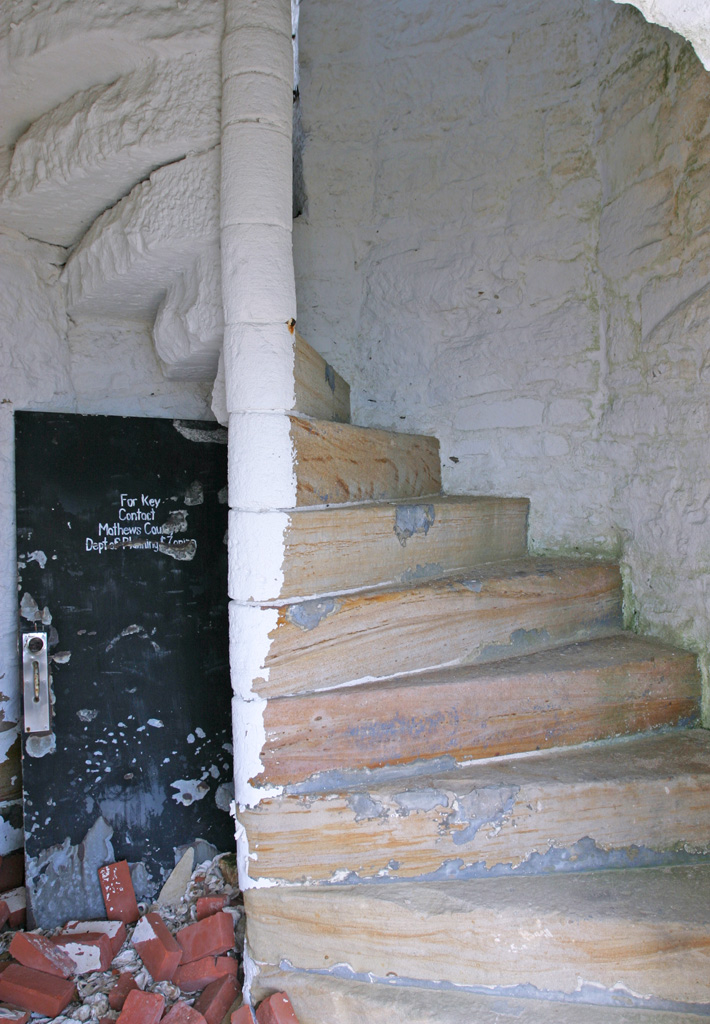
Burroughs relocated his family to the point, and between March and November of 1804 he completed the lighthouse tower with its spiraling stone steps. The lantern and cisterns were subcontracted to Samuel Wheeler of Philadelphia, which proved to be a wise decision, but subcontracting the dwelling and kitchen to Samuel Stubbs proved unwise. While Stubbs was ill for six weeks, his workers ruined the bricks in attempting to fire them, thus delaying the completion of the project. To appease the government overseer, Burroughs volunteered to keep the light himself until the dwelling was finished.
Furnished with oil and wicks, Elzy Burroughs lit New Point Comfort Lighthouse for the first time on January 17, 1805. The tower’s lantern had arrived from Philadelphia in December, along with an iron floor that “prevented every kind of danger of communicating fire from the lamps.”
The overseer pleaded with Burroughs to finish the keeper’s dwelling, but he had no means to do so. “His circumstances,” wrote the overseer, “are now so limited (having latterly been compelled to take the benefit of the Act of Insolvency) that it is now entirely out of his power to procure either materials or laborers...” In short, Burroughs was bankrupt. Mr. Stubbs had been almost fully compensated by Burroughs for the still unfinished dwelling, and under the threat of legal action, Burroughs himself was forced to complete the dwelling.
The fifty-eight-foot, sandstone lighthouse is similar in design to its sister tower at Old Point Comfort and other period sandstone structures constructed at Cape Henry and Montauk Point. The original light was a fixed signal generated by nine lamps and cast out to sea by nine-inch reflectors. Winslow Lewis revamped the lantern and added fourteen-inch reflectors in 1841, while a Fresnel lens replaced the entire lighting apparatus in 1855.
|
After the war, Elzy Burroughs was replaced by Robert Lithburn as keeper of the lighthouse, and Burroughs’ skills as a builder were once again called upon, this time to repair damaged lighthouses on Chesapeake Bay. Burroughs was given a second chance to build the New Point Comfort keeper’s dwelling and was also consulted about the erosion problem at the lighthouse, as “the water every full tide (was) entirely reaching it.” Burroughs recommended digging a ditch in front of the lighthouse, driving piles into the ditch and filling it with treetops, brush and rubble. The cost for the erosion control was estimated at $900; a bargain considering the alternative was moving the lighthouse. According to Burroughs, relocating the lighthouse would have run $6,000, and he should have known since his lighthouse at Smith Point had to be moved.
Like many lighthouses during the Civil War, New Point Comfort was extinguished by Confederate soldiers in 1861 to hinder the Union’s superior naval forces. A post-war inspection showed the lighthouse grounds neglected and somewhat damaged, but the Confederates had shown far more restraint than the Brits. After a general overhaul, which included the installation of a new lens, the station was up and running in September 1865 without too much trouble.
The second keeper appointed following the Civil War was J. McHenry Farley, one of the few known African Americans to receive an official appointment as keeper, though William Davis, a former slave, was serving at the same time just thirteen miles away at Old Point Comfort Lighthouse. Keeper Farley petitioned the Lighthouse Board for an assistant or rations to help him get by just a little easier:
Dear sirs this is an isolated island, and only about 3 or 4 months in the year, is there any one on the island at all, while the fishery is being carried on, after which during the remainder part of the year; this is a lonely and dreary place. [During the past winter,] the constant & watchful care both night & day to keep a brilliant light as the law requires… was almost too much for one keeper. Many nights had I to remain in the lantern tower for hours to keep the frost from the glass. Therefore gentlemen would it be too much for me as Keeper of this station to ask the favor of your body to grant to this place an assistant keeper… if I cannot succeed in getting an assistant keeper—would it be too much to ask to have this station placed for the coming year in the list of stations for ration, as everything is so high & hard to be gotten on this island.The local lighthouse inspector described Farley as “a colored minister of the gospel,” who deeply felt “the privation of church priviledges,” but who was also “proud of his position as Light Keeper [and] faithful in the performance of this duty & careful to do nothing that will involve neglect of his light…”
|
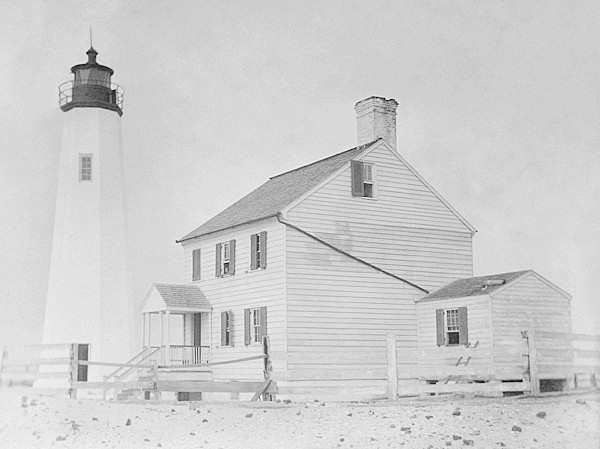
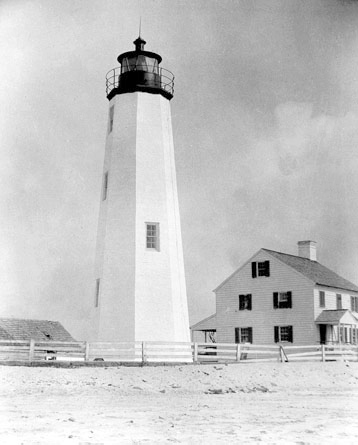
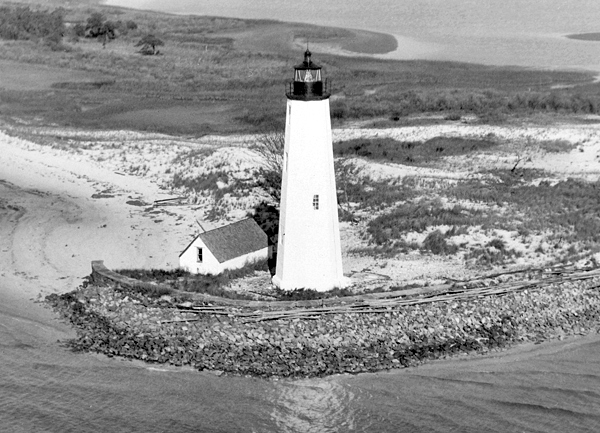
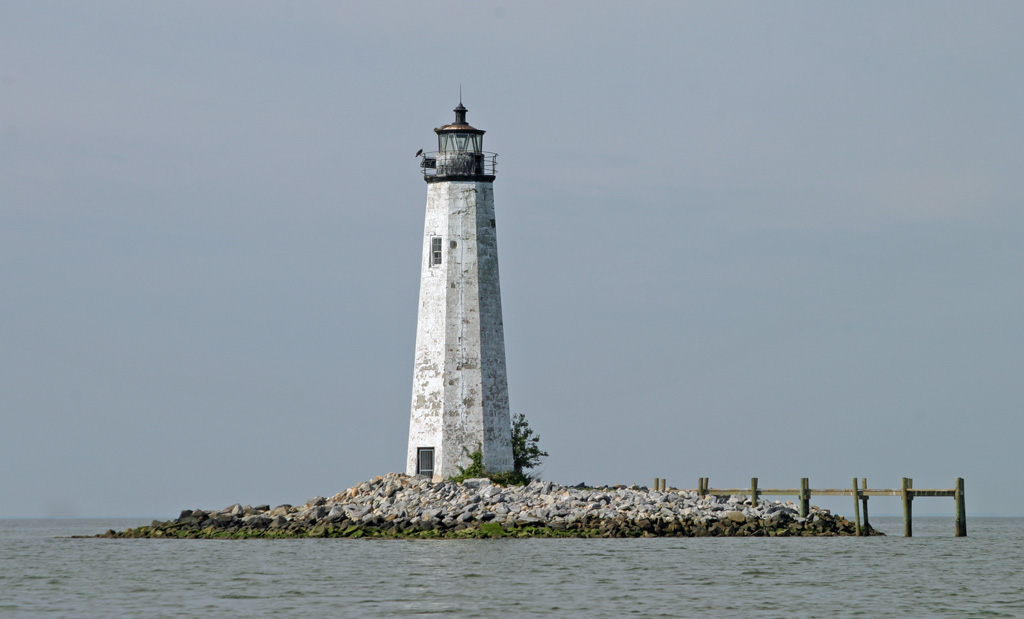
A series of photographs of the lighthouse taken over time illustrates the dramatic change to the island. The black and white photographs above taken in 1858 show the lighthouse standing on firm ground with its attendant dwelling, kitchen, and oil vault, while the one taken in 1928 shows that by this time the keeper’s house was gone, and the water appears much closer. A recent snapshot reveals the lighthouse perched in solitude on a mere hundred yards of rocky rubble surrounded by water.
When the light source was converted to acetylene gas in 1919, the keeper position was replaced with a mere occasional lamplighter. In 1950, New Point Comfort Lighthouse was converted to electricity, and in 1963 it was decommissioned, replaced by a lighted buoy.
The lighthouse was deeded to Mathews County in 1976, and since then restoration efforts have focused primarily on stabilizing the structure. The lighthouse was rededicated in August 1981, following an $80,000 restoration effort that saw the tower cleaned and painted, windows and the entry door replaced, a new dock built, and 600 tons of riprap placed around the structure. The Mathews County Historical Society is involved with long term preservation plans, and in 2001 the New Point Comfort Lighthouse Preservation Task Force was established “to develop a plan to preserve the…lighthouse as a permanent historic sentinel representing American navigation, transportation, commerce, craftsmanship, engineering, and American’s perseverance through peace and war.”
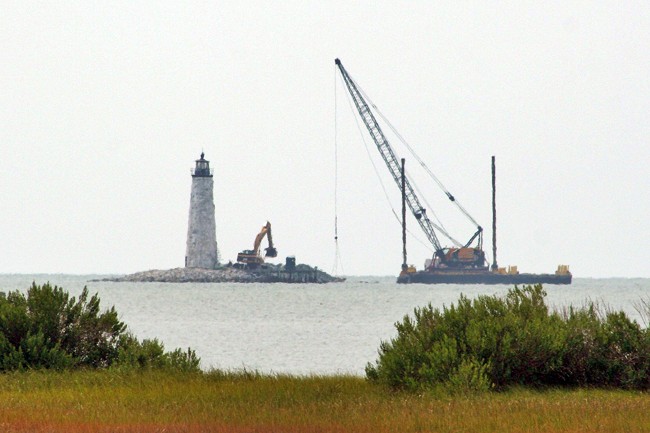
In 2010, Mathews County received a $424,000 Virginia Department of Transportation Enhancement Grant that was used to build a large rock wall to protect the exposed lighthouse. The wall was designed to have a length of 300 feet, a width of forty six feet, and a height of twelve feet above the mean low water mark. This photograph shows the protective rockwork being put in place in 2012.
The New Point Comfort Lighthouse Preservation Task Force created a fund to ensure the long-term upkeep of the lighthouse. Local residents Bill Burroughs and Wilbur Burroughs, descendants of Elzy Burroughs, donated $10,000 that will be administered through the Mathews Community Foundation. Waterfront Development Corporation installed a new pier at the lighthouse in 2016 that allowed contractors to access the site for restoring the stone tower.
Restoration of the tower started in 2020 and concluded on October 12, 2021, when a ceremony was held to relight the lighthouse. The project cost $1.8 million, with most of the money coming from a federal transporation grant.
Head Keepers: Elzy Burroughs (1804 – 1814), Robert Lithburn (1814 – 1815), James B.H. Johnson (1815 – 1819), William Johnson (1819 – 1830), William R. Brownley (1830 – 1846), Isaac Foster (1846 – 1854), James B. White (1854), Edward S. White (1854 – 1861), Joseph S. Allen (1865 – 1870), Sylvester H. Wolhiser (1870 – 1871), James McHenry Farley (1871 – 1873), John D. Hudgins (1873 – 1876), Leonard Smithers (1876 – 1879), Augustine F. Hudgins (1879 – 1881), Wesley F. Ripley (1881 – 1883), Charles W. Forrest (1883 – 1888), Oliver R. Hudgins (1888 – 1899), James B. Hurst (1899 – 1901), Richard W. Marchant (1901 – 1906), Riley S. Hudgins (1906), Wesley F. Ripley (1906 – 1916), Willie V. Gayle (1916), Christopher C. Butler (1916), Edward A. Sibley (1916 – 1919).
References