Turkey Point, MD 



Select a photograph to view a photo gallery
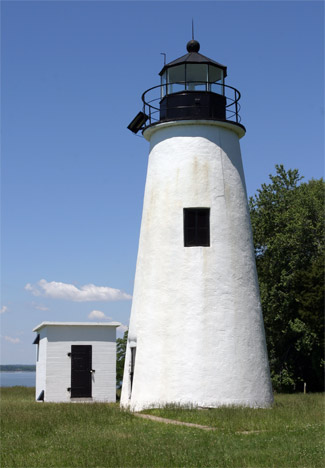
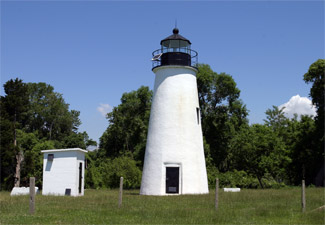
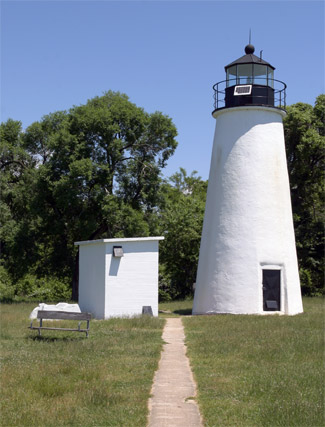
Photo Gallery
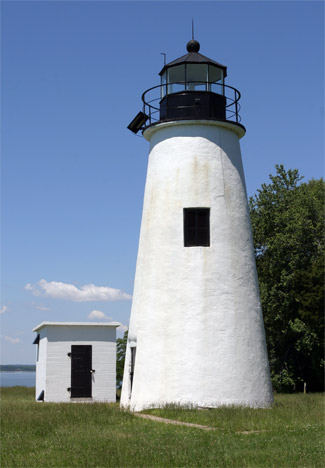
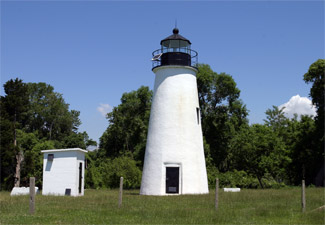
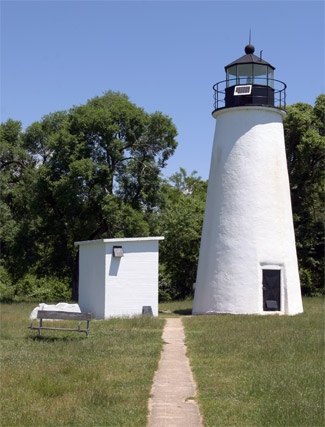
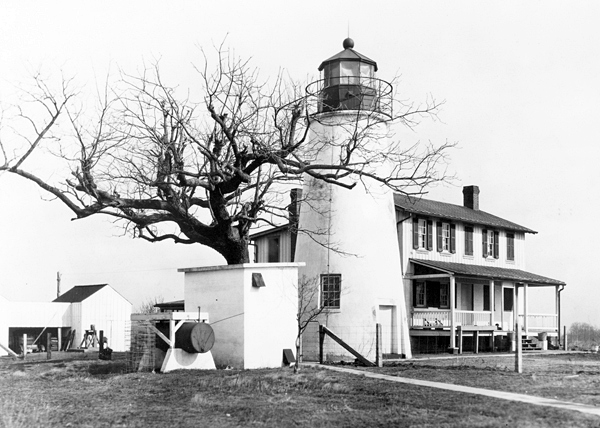
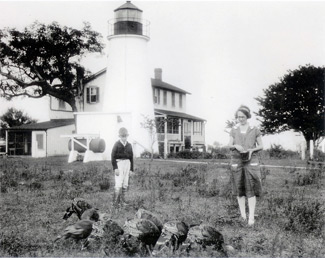
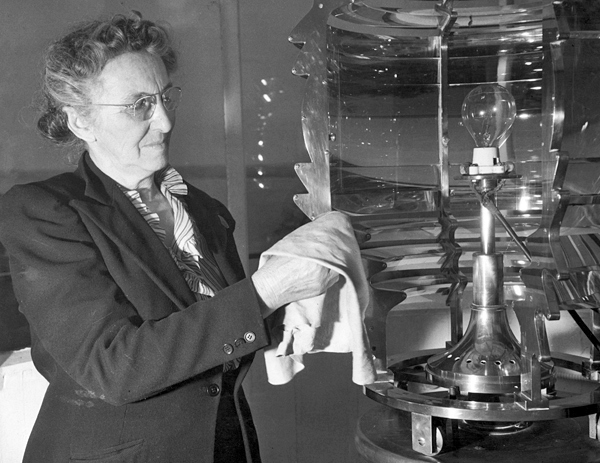
Photo Gallery
Photo Gallery
|
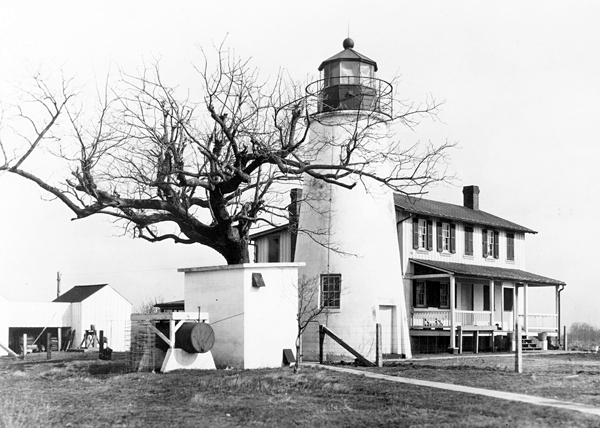
Turkey Point Lighthouse is very similar in design to other Donahoo towers and was built using the plans from Concord Point Lighthouse. The tower is sixteen feet in diameter at its base, with walls that taper from two-and-a-half feet to fourteen-and-a-half inches as they rise. The tower’s nine-sided lantern room is topped with a pyramidal iron roof and ventilator ball. While many sources have claimed that the lighthouse was built with cast-iron stairs, a 1930s photograph shows wooden stairs and the blueprints for the structure at the National Archive explicitly state “31 steps. Wood.”
The cast-iron lantern room is encircled by a gallery with three rows of railings supported by balusters. Originally painted red, the lantern’s color was changed to black in the late 1800s. James Geddes supplied the original eleven lamps, each backed by a fifteen-inch reflector, used in the lantern room to produce a fixed white light. In the1850s, the newly empowered Lighthouse Board set about to install Fresnel lenses in all U.S. lighthouses, and Turkey Point received a fourth-order lens in 1855. The fixed white light was changed to a flashing characteristic upon automation of the station in 1947.
The keeper’s house when first constructed was a one-and-a-half-story brick building, but in 1889 a full second story, built of whitewashed board and sporting gingerbread eaves, was added. The bottom story consisted of a central hall with a parlor to one side and a sitting room and fireplace to the other, while three bedrooms and a small storeroom were found upstairs. A kitchen was later added to the back of the dwelling.
In April 1888, the station received a fog signal, though the station’s elevated position caused some concern that the bell would not be heard by ships. For this reason, a thirty-foot-deep well was dug to house the weights of the winding mechanism, so the bell could be positioned as low to the ground as possible. The signal building itself was a one-story, eight-foot-square wooden structure that was built at the Lazaretto Depot and had at least one window.
|
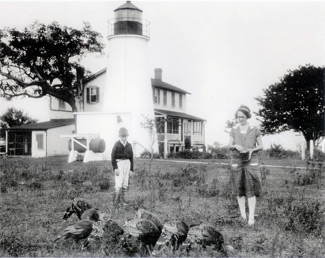
Other outbuildings on the property included a stable, woodshed, and smokehouse. These were rebuilt in 1895 and were located behind the keeper’s dwelling. The still-standing concrete oil house was erected in 1913, and a white wooden fence encircled the light station until about 1925. Photographs taken of the station in 1938 show that it had a garage, chicken and sheep houses, a water closet, and a concrete water cistern. A daunting 137 wooden steps led down the bluffs to the water, and next to the stairs, there was a chute with a windlass, which was used by the keeper to haul supplies delivered by the lighthouse tender up to the station.
Turkey Point Lighthouse has been distinguished by a number of long-tenured female keepers. In fact, women were responsible for the light for more years than men. The first female keeper was Elizabeth Lusby, who took over for her husband Robert upon his death in 1844 and served until 1862. Rebecca L. Crouch similarly replaced her deceased husband as keeper, and her term of service lasted from 1873 to 1895. Rebecca’s daughter, Georgiana S. Brumfield, moved to the station with her parents at the age of sixteen, and kept the light for twenty-four years after her mother’s passing, spending a total of fifty-four years at Turkey Point.
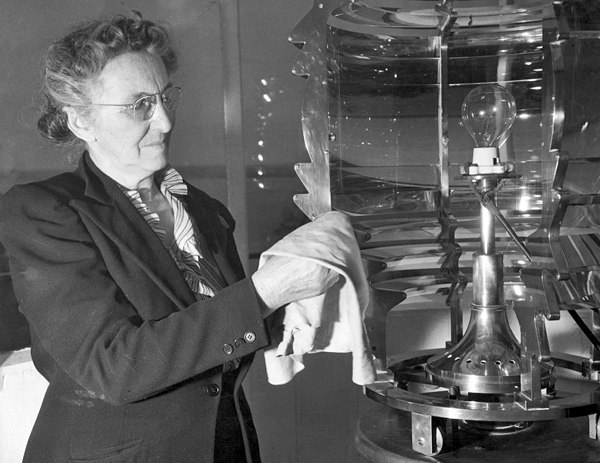
In the early twentieth century, the well-known Fannie May Salter was installed as keeper at the personal behest of President Calvin Coolidge. The service was not going to let her assume her husband’s position due to her relatively young age of forty-three, but she appealed to her senator, who took up the issue with the President. Clarence Salter, Fannie’s husband, was keeper of Turkey Point Lighthouse for just a couple of years when he passed away in February 1925 a few days after having been operated on for appendicitis.
Four times a night, Fannie Salter would haul a copper kettle filled with kerosene up the thirty-one stairs of the lighthouse and the iron ship’s ladder that led to the lantern. When combined with the labor of winding the heavy fog bell mechanism and transporting the stores from the water 137 steps below, one would think that the job took a physical toll. Salter, lauded at her retirement in 1947 as “the last of the lady lighthouse keepers,” had only this to say: “Oh, it was an easy-like chore, but my feet got tired, and climbing the tower has given me fallen arches.” Fannie Salter was once forced to manually sound the fog bell during a mechanical failure as a steamer was heading into the Elk River in foggy conditions. She rang the bell every fifteen seconds for nearly an hour until the steamer had safely passed from the river into the canal. During her absence from the dwelling while tolling the bell, she missed her son-in-law’s call announcing the birth of a granddaughter.
|
Following automation in 1947, the remote lighthouse was subject to vandalism. In one incident, the original wooden door to the tower was broken down and the valuable Fresnel lens was stolen. To protect the lighthouse, the rather extreme step of removing a large portion of the interior stairs had to be taken.
The keeper’s quarters, vandalized and neglected, were finally torn down by Maryland’s Parks Service in 1972. The lighthouse was decommissioned in April 2000 and subsequently leased to the non-profit Turkey Point Light Station (TPLS) Inc., which had been formed in 1995 to help care for the lighthouse. On November 30, 2002, people congregated at the lighthouse to see it reactivated as a private aid to navigation by TPLS, after electricity was extended to the lighthouse.
In 2004, the lighthouse was offered to non-profits and government agencies under the provisions of the National Historic Lighthouse Preservation Act, and two years later, the property was transferred to the State of Maryland, which then leased the lighthouse to TPLS.
TPLS has ambitious restoration plans for the station that include rebuilding the keeper’s dwelling. This is a painstaking process, as the Maryland Historic Trust must approve all changes, and will need significant funding. There has also been talk of restoring the lantern room’s red sector, which used to warn ships away from the shallow sandbars of the Susquehanna Flats.
Improvements made by TPLS include the construction of a new wooden staircase inside the lighthouse in 2007, and the erection of a flagpole in 2008. After receiving $100,000 from the state, TPLS broke ground for a replica fog bell tower. The tower was completed in 2023, and a fog bell that was cast in 1891 and had been used in a church in New jersey was mounted on the tower in June of that year. The bell will only be run on weekends at the opening and closing of Turkey Point Lighthouse.
Access to Turkey Point Lighthouse closed in March 2024 to permit work to being on a new trail and parking lot for the popular attraction. The project, which cost $3.8 million, increased the number of parking spots from 26 to 52 and included the construction of a new trail that provides easier access to the lighthouse. The work finished five months ahead of schedule, allowing the lighthouse to reopen to visitors in September 2024.
Head Keepers: Robert C. Lusby (1833 – 1841), John C. Waters (1841 – 1843), Robert C. Lusby (1843 – 1844), Elizabeth Lusby (1844 – 1862), Edward Cloman (1862 – 1865), John M. Crouch (1865 – 1873), Rebecca L. Crouch (1873 – 1895), Georgiana S. Brumfield (1895 – 1919), Cale B. Stowe (1919 – 1922), Clarence W. “Harry” Salter (1922 – 1925), Fannie M. Salter (1925 – 1947).
References