Montauk Point, NY 






Select a photograph to view a photo gallery
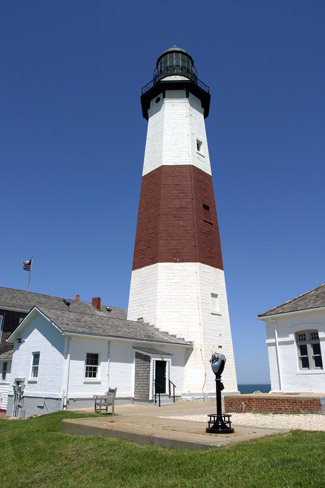
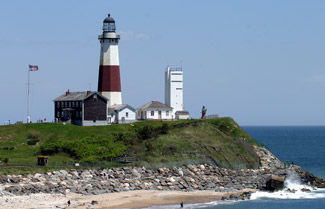
Photo Gallery
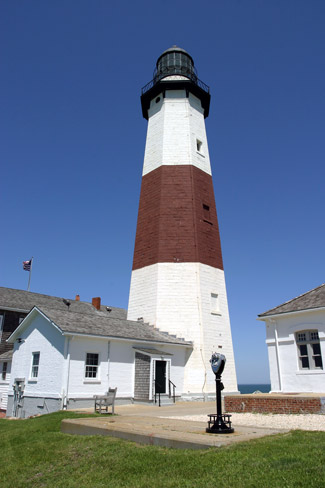
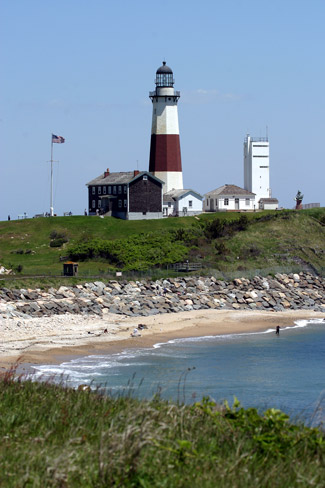
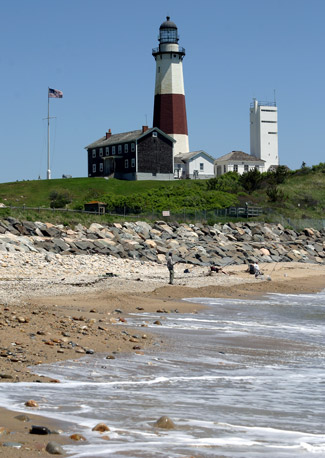
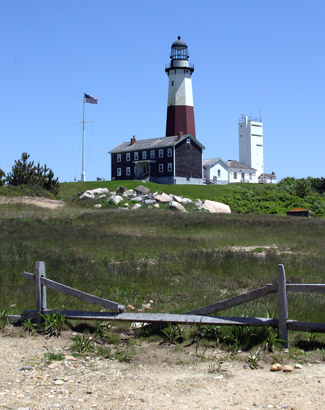
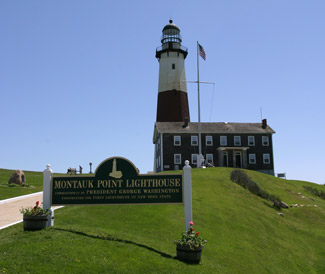
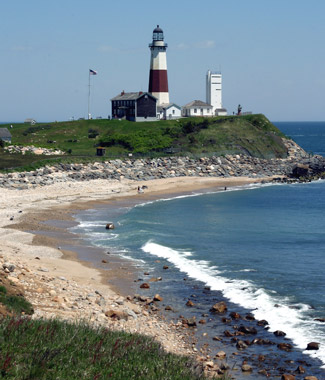
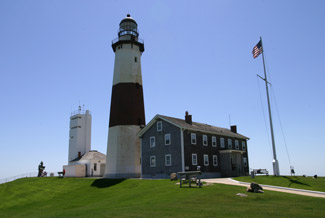
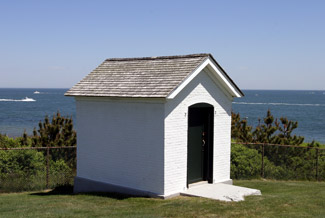
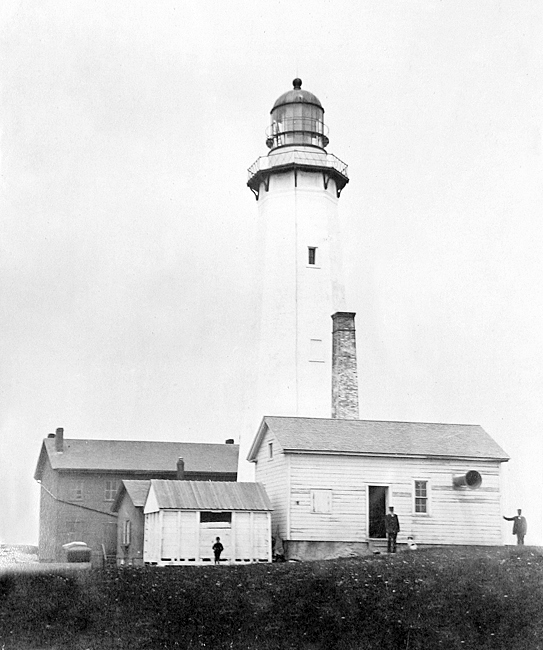
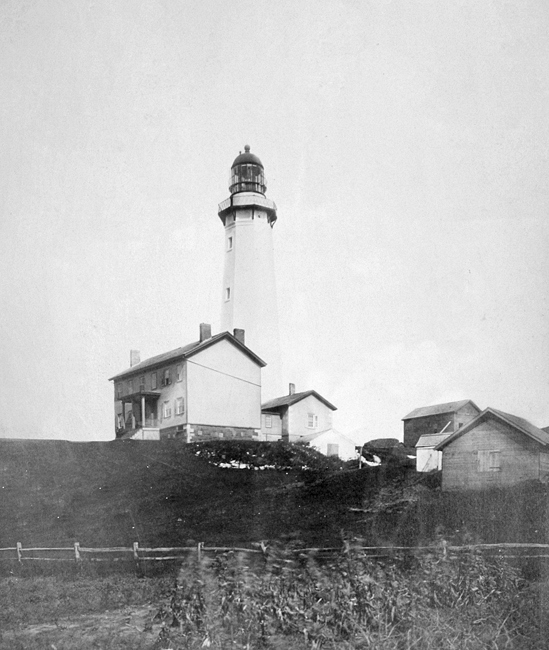
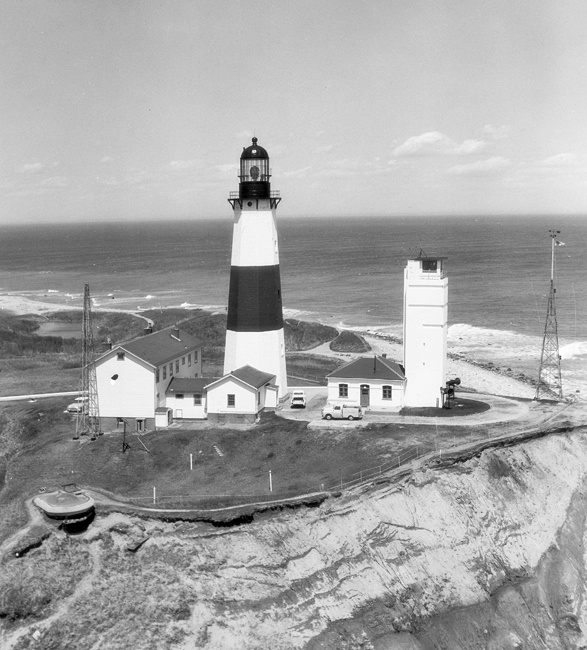
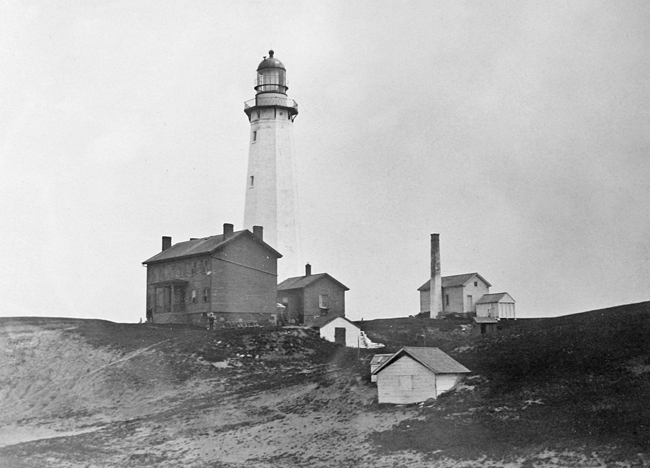
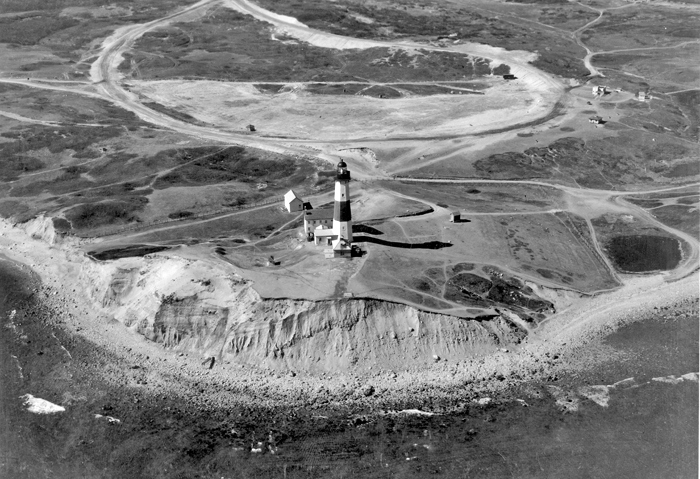
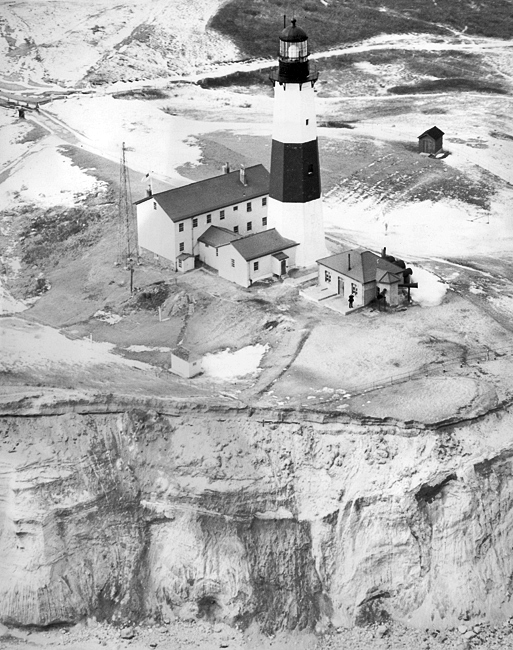
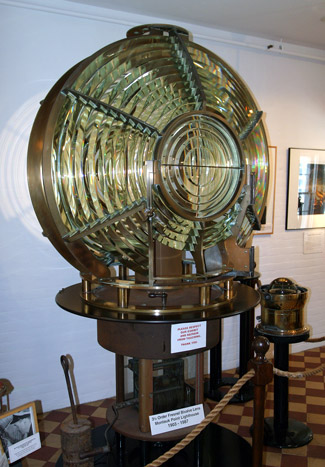
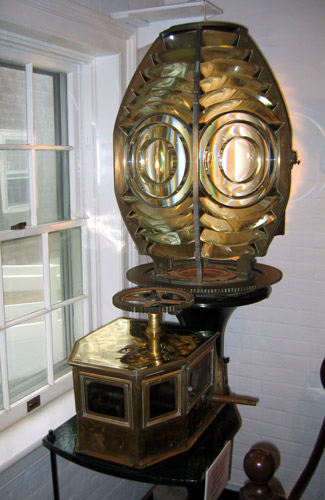
Photo Gallery
Photo Gallery
|
Montauk Point was considered such an important and dangerous piece of land that in 1792 President George Washington personally authorized construction of a lighthouse there. In building the lighthouse, the U.S. government was following a long line of tradition – according to legend, the Montauket tribe lit signal fires on the point to summon chiefs and warriors to council. During the Revolutionary War, the British kept large fires burning on the hill to act as a beacon for their warships lying off Montauk Point to blockade Long Island Sound.
A New York contractor named John McComb submitted the low bid of $22,300 for constructing Montauk Lighthouse, beating out Abisha Woodward, Nathaniel Richards, and Abraham Miller & Company. After assembling a fifty-man crew, consisting of masons, carpenters, blacksmiths, and bricklayers, McComb built Montauk Point Lighthouse like a fortress, with a foundation that went down thirteen feet and a base with walls seven feet thick. Construction started in early June 1796, and the tower and associated keeper’s dwelling were finished less than five months later. President Washington is often quoted as saying that this lighthouse would stand for 200 years, and it indeed still stands today after having endured more than two centuries of fierce Atlantic storms. McComb also built the old Cape Henry Lighthouse in Virginia in 1791, which also remains in place today, despite being unused for over a century.
For generations of immigrants, Montauk Point Lighthouse was their first sight of America, and it became as much a symbol of their new home as the Statue of Liberty (which also served as a lighthouse for a while).
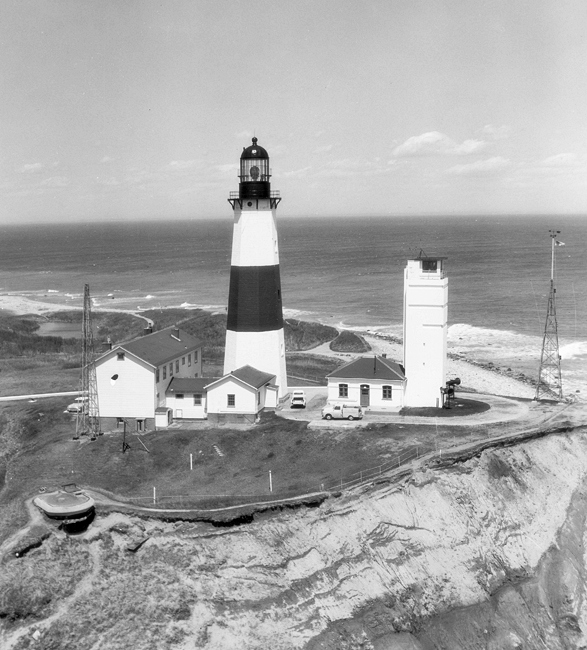
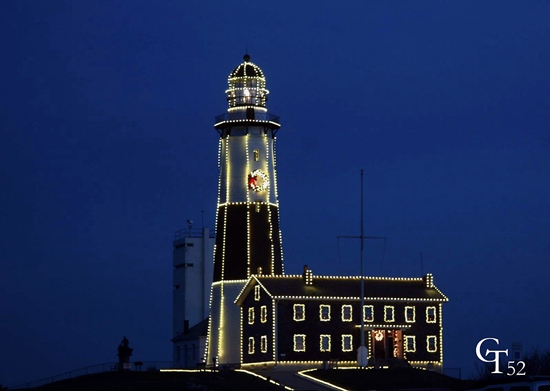
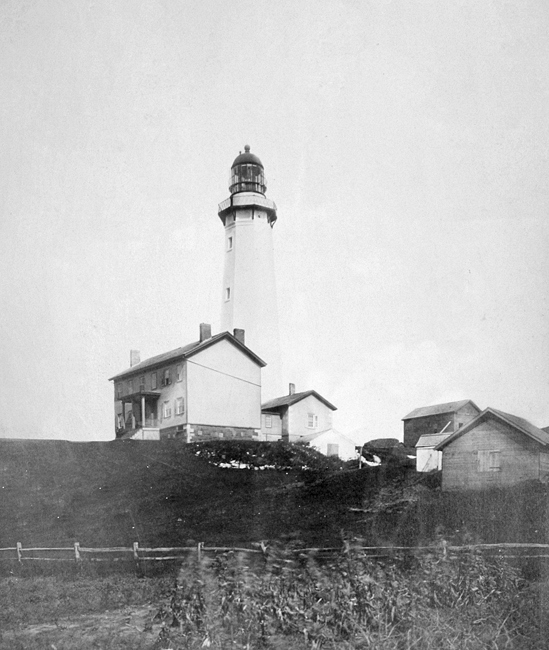
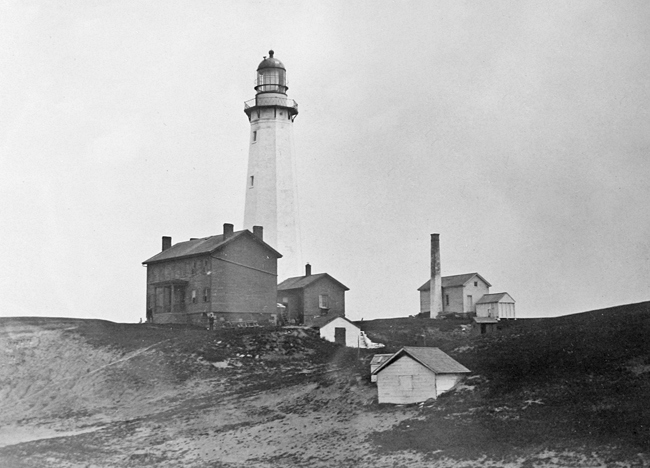
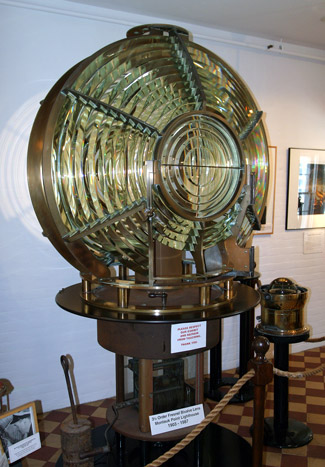
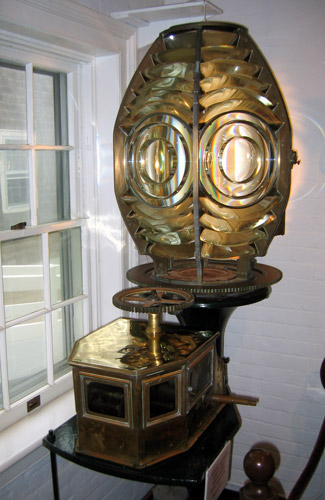
The octagonal, seventy-eight-foot tower was made with red Connecticut sandstone, brought to the site by ship. An iron lantern room was placed atop the tower and surmounted by a round copper ventilator, the opening of which was kept facing leeward by a weather vane. Various forms of illumination have been used in the tower, starting most likely with a spider lamp, followed by Argand lamps and reflectors, a first-order Fresnel lens, and a revolving third-and-a-half-order bivalve Fresnel lens that was placed in operation in the lantern room in 1903. The bivalve lens produced a white flash every fifteen seconds, while a fixed red range lens was added to warn mariners of Shagwong Reef. The familiar reddish-brown band that bisects the lighthouse was added in 1899. Before that time, the tower was painted all white.
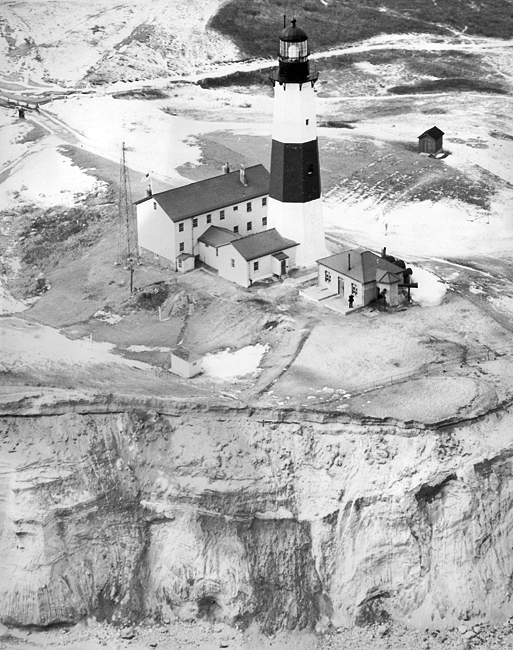
A new brick, six-room keeper’s dwelling was built at the point in 1837 and remains standing to this day, located at the bottom of the hill west of the tower. This residence joined a three-room frame dwelling and a four-room frame dwelling. In 1860, three years after the first-order Fresnel lens was installed, the tower was heightened fourteen feet to make it a proper first-class coastal beacon. At the same time, a new lantern room was put in place, and the wooden stairs in the tower were replaced with an iron staircase. The large, two-story keeper’s dwelling that stands just west of the lighthouse was also constructed as part of the renovations carried out in 1860.
|
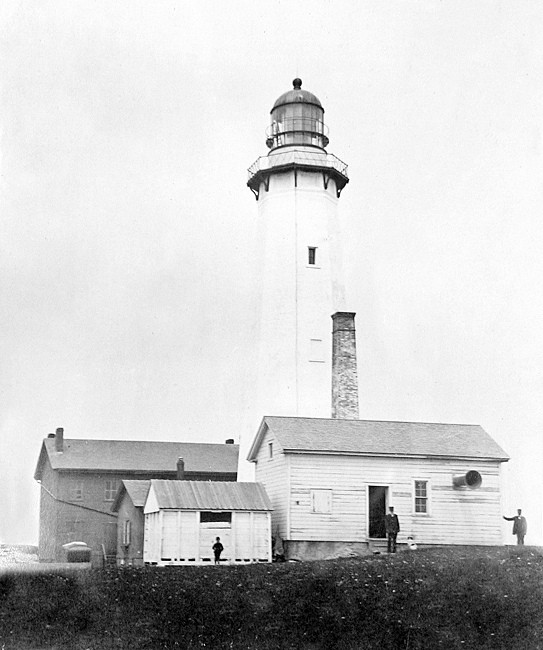
In 1871, the Lighthouse Board requested $8,000 to place a fog signal at Montauk Point, and on May 1, 1873, a Daboll trumpet, powered by two twenty-four inch Ericsson hot-air engines, was placed in operation. A steam engine had been considered for operating the fog signal, but lack of water at the point led to the hot-air engines being adopted. The fog signal consumed twenty-one pounds of coal per hour of operation, and could be in operation for up to 925 hours during the year. In 1898, a pair of ten-horsepower oil engines and two air compressors were placed in a new fog signal building erected at the point, and the old caloric engines were removed from the old fog signal house to provide quarters for a naval militia signal corps.
James G. Scott had the longest tenure of any head keeper at Montauk Lighthouse, serving from 1885, when he was transferred from Stratford Shoal Lighthouse, until his retirement in 1910 at the age of seventy. During Scott’s service, several ships foundered offshore, but none was as memorable as a schooner laden with cocoa beans whose cargo drifted ashore. The beans were consumed in various recipes, but the favorite soon became chocolate bread pudding, known locally as Montauk Pudding, which Keeper Scott continued to serve his guests long after the shipwreck. Another schooner, the Elsie Fay, went down off Long Island in 1890 with a load of coconuts, and the locals held a contest to come up with the best recipe featuring this now-plentiful ingredient. The winner was a four-layer coconut cake, which had grated coconut mixed into the batter and placed between the layers, and which was smothered in coconut icing. Keeper Scott’s daughter recalled, “We had cocoanuts in every style for about a year; and whenever you were invited out for a meal you knew you were more than likely to get cocoanut cake.”
In 1898, fourteen-year-old Walter Scott, the only son of Keeper Scott, drowned in Money Pond near the lighthouse. The boy and his friend were fishing aboard a rowboat, when it accidentally overturned and spilled the pair into the pond. Walter apparently became entangled in the boat’s ropes, and by the time the friend made it to shore and ran the quarter-mile to the lighthouse for help, Walter had perished.
Until the late 1920s, the last few miles of road leading to the lighthouse were narrow, unpaved, and sandy. Only the most adventurous of drivers tried to make it out to the lighthouse, and even they became trapped at times. The isolation of the station made it an attractive location for smugglers during Prohibition. In 1925, a father-and-son team named Miller, who maintained the lighthouse as head keeper and first assistant keeper, was suspected of collaborating with sea-borne bootleggers.
The Coast Guard had received a call about two ships that had run aground on a sandbar near the lighthouse, both of which were suspected of carrying illegal liquor. When the Coast Guard called and talked to the younger Miller, he replied that he had not seen the grounded ships, and that they must have gotten themselves off the beach. A Coast Guard inspector, however, soon found the two wrecked ships on the same beach, surrounded by empty liquor cases. When the Millers then neglected to return calls to the Coast Guard, suspicions were aroused. As there was not enough evidence to accuse them of any crimes, it was finally concluded that a heavy snowstorm on the day of the incident had prevented the Millers from seeing the ships.
|
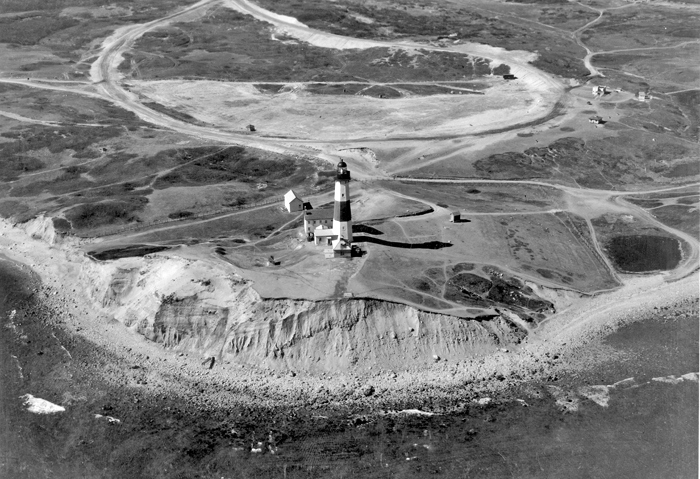
Reid had patented an innovative method for stopping erosion on hillsides, using trenches that were dug across the eroded face of a hill and then planted with tall grasses and reeds. The vegetation slowed runoff and further erosion, while at the same time holding moisture and giving other soil-grabbing grasses and plants a chance to grow. The Coast Guard pronounced Reid’s method a roaring success, and the lighthouse remains at its original site. A border of large stones has since been placed around the base of the point to lessen the impact of the pounding surf.
Montauk Point Lighthouse was automated in 1987, shortly after its bivalve Fresnel lens was replaced by a DCB-224 optic consisting of two revolving twenty-four-inch drums. The Montauk Historical Society signed a lease for the lighthouse on April 1, 1987, and opened it as a museum just over a month later on May 23. The oldest lighthouse in New York was fortunate to have virtually no gap between the removal of Coast Guard personnel and the takeover by the historical society.
In 1998 – 1999, International Chimney Corporation, which has restored and moved several lighthouses in the United States, carried out a three-phase restoration of Montauk Point Lighthouse at a cost of over $500,000. During the first phase, all of the metal decking atop the lighthouse was repaired. The exterior of the lighthouse was the focus of phase two, which saw several of the tower’s limestone blocks repaired and a lime-rich mortar used to repoint the tower. In phase three, workers repointed the interior of the tower, and repaired and restored the tower’s windows. Finally, the exterior of the tower was blasted with baking soda to remove paint and fungus, and the lighthouse then received two coats of Modac paint.
The lighthouse was added to the National Register of Historic Places in 1969 and declared a National Historic Landmark in 2012. On November 6, 2023, the bivalve Fresnel lens, removed in 1987, was activated atop Montauk Point Lighthouse. The return of the lens to the lantern room is a two-year pilot program initiated by the Coast Guard to assess Fresnel lens operation in an environmentally controlled lantern room. This program will help established action plans for the Fresnel lens that remain in operation.
Some lighthouse fans believe that if you can only visit one lighthouse in the U.S., this one would make a good choice. The view from atop Montauk Point Lighthouse is outstanding, and the old, two-story keeper’s dwelling is filled with an outstanding collection of various maritime and lighthouse objects, including several Fresnel lenses.
Keepers:
References