Cape May, NJ 




Select a photograph to view a photo gallery
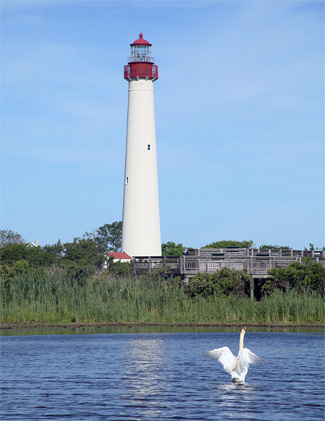
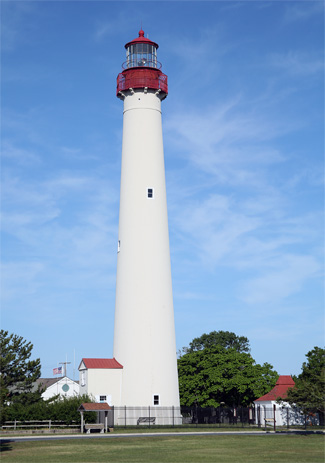
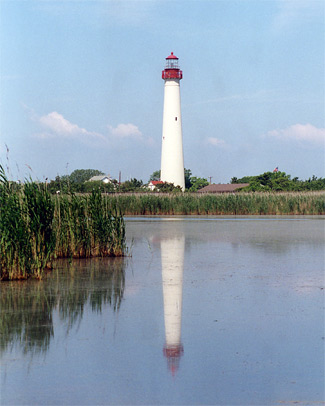
Photo Gallery
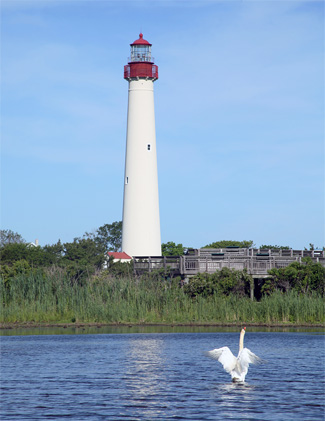
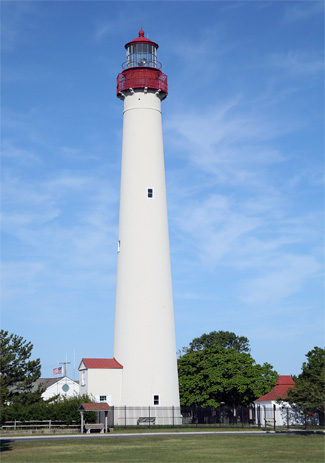
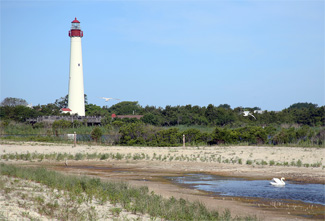
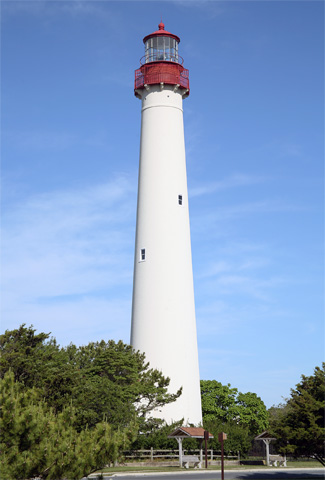
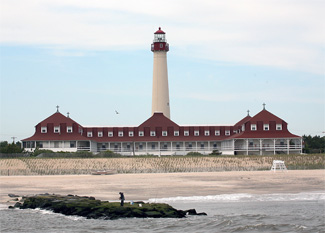
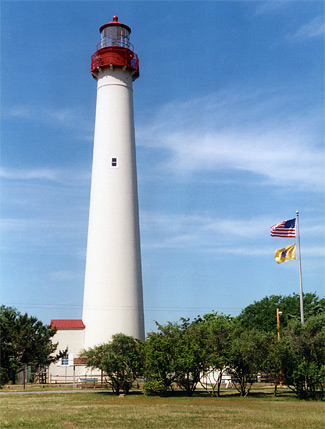
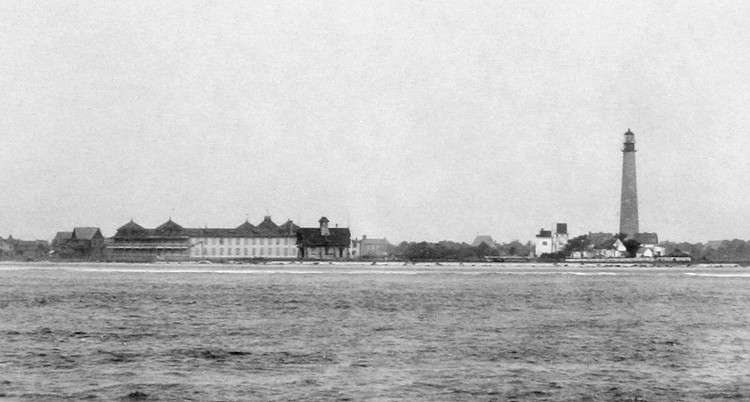
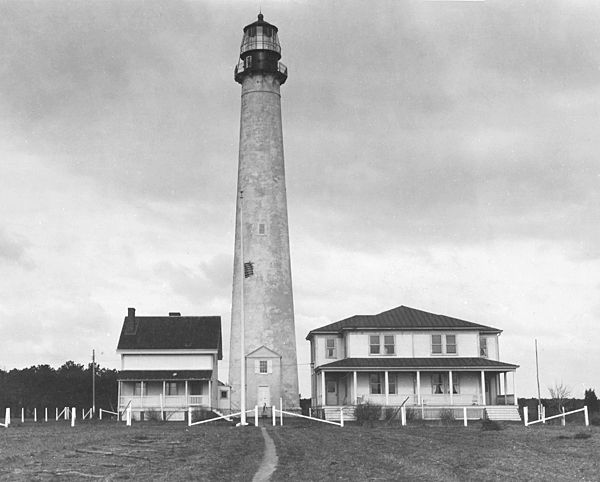
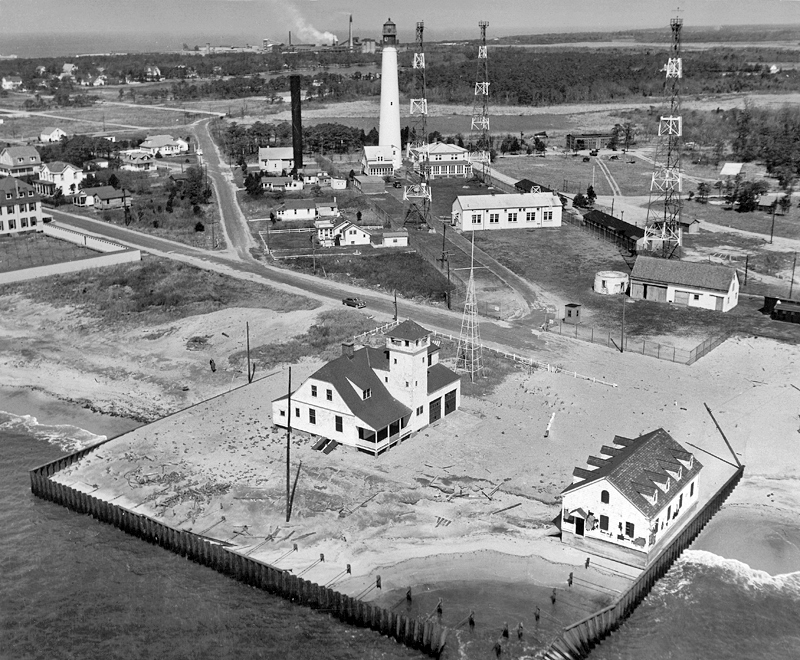
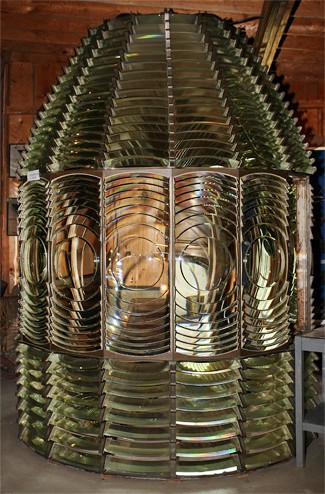
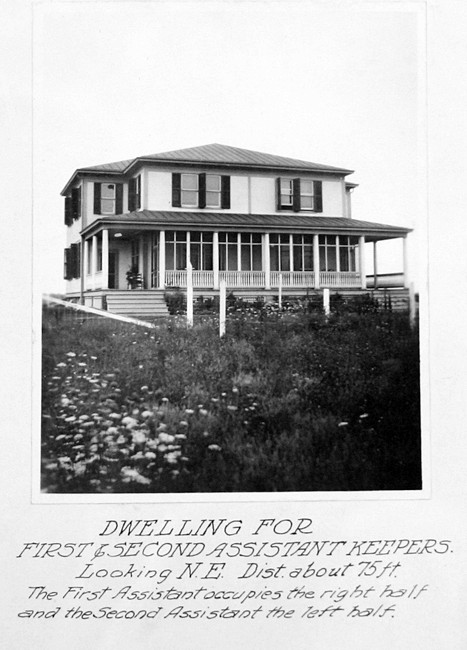
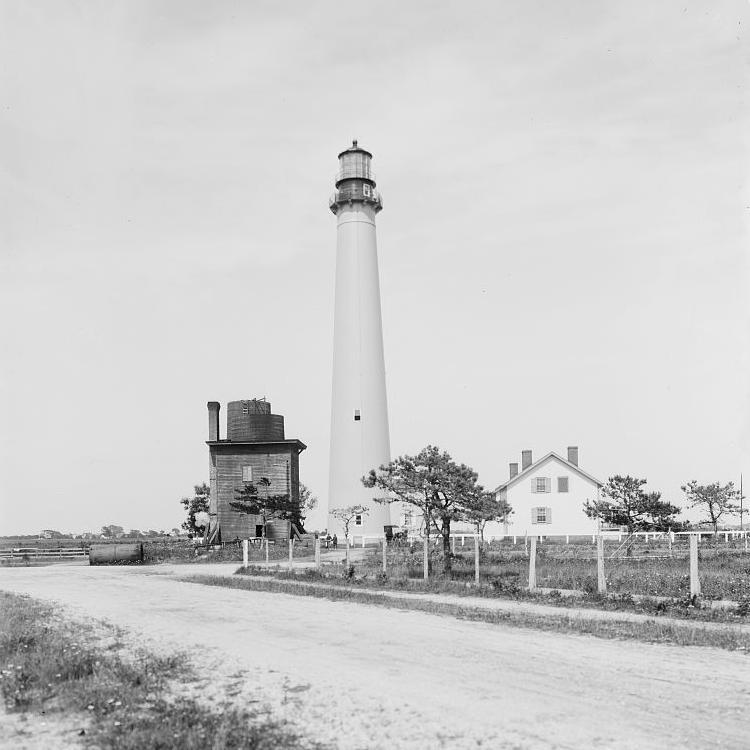
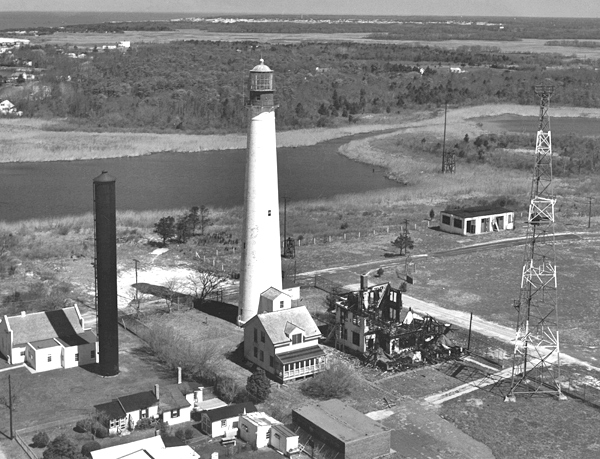
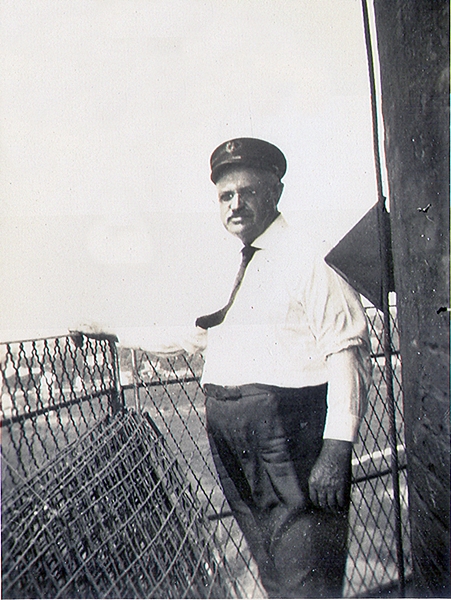
Photo Gallery
Photo Gallery
The second Cape May Lighthouse was built on a parcel of land that was sold to the government for $1,150 by Alexander Whilden on April 9, 1847. Built by Samuel and Nathan Middleton, the tower stood seventy-eight feet tall and was located six hundred feet south of the present Cape May Lighthouse and roughly 400 yards northeast of the original lighthouse. The sea did not lead to the immediate undoing of the second tower, though it would later have a part in that. Rather, it was the height of the tower and its poor construction that contributed to its short life.
An Inspection Report compiled at the station in 1851 noted the sorry condition of the four-year-old lighthouse.
Thin plate-glass 20x28 in the lantern; no paint in dome or frame of lantern – painted black originally; astragals and sashes rusty, and greatly in want of paint; iron conductor; rough square box for leading weight of clock-work movement down; wood-work rough beyond anything seen before; supports to stairway not planed; everything rough and unfinished; tower damp, from base to lantern; a rough hole through the arch of the lantern floor for leading weight to clock-work; the whole thing rude in the extreme;… tower wants whitewashing outside and in.The same report contained several unflattering phrases about the keeper’s dwelling as well: “leaks through the walls in a stream; rain drives in at the windows; plastering broken; …windows loose.”
|
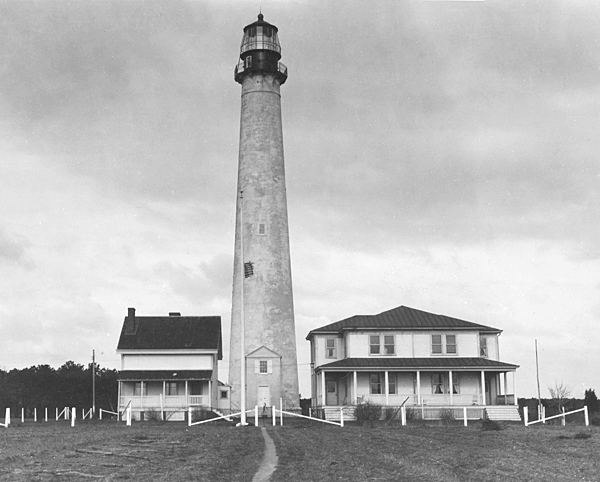
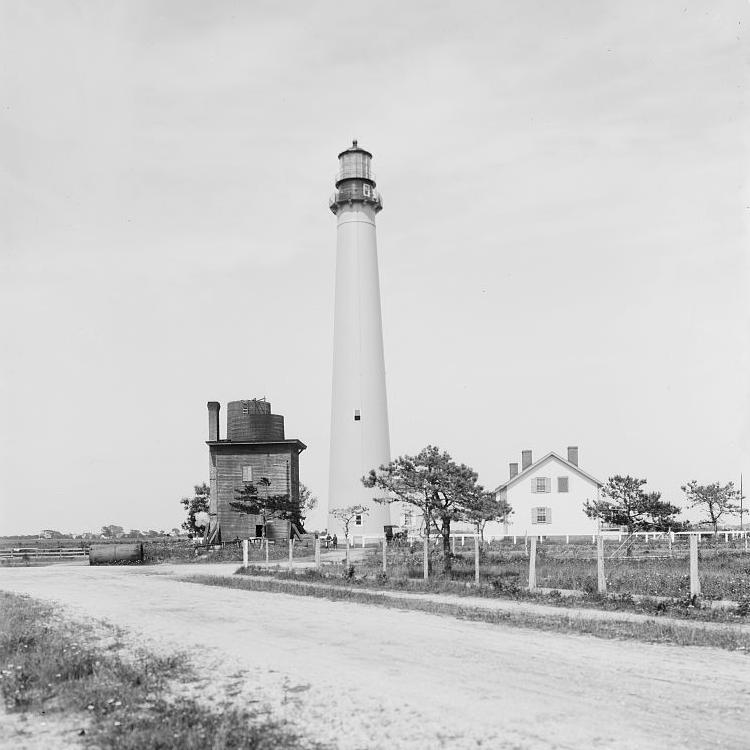
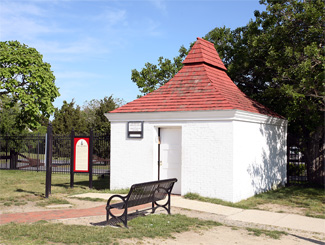
A deed dated April 8, 1858 records the sale of an additional two acres of land by Alexander Whilden to the government so a taller and proper tower could be constructed at Cape May to display a first-order light to mark the entrance to Delaware Bay. The third Cape May Lighthouse would be very similar to New Jersey’s other tall towers, Absecon and Barnegat Lighthouses, which were respectively activated on January 15, 1857 and January 1, 1859. George Meade had overseen work on the other two towers, but Cape May was constructed under the direction of Captain Willam F. Raynolds, followed by Captain W. B. Franklin and Major Hartman Bache. While the other two coastal towers stood over 170 feet tall, Cape May was several feet shorter, but still a respectable 157’ 6”. Access to the tower was through a two-story vestibule, which had an oil room on each side of the passageway on its first floor, and a storage room on its second floor.
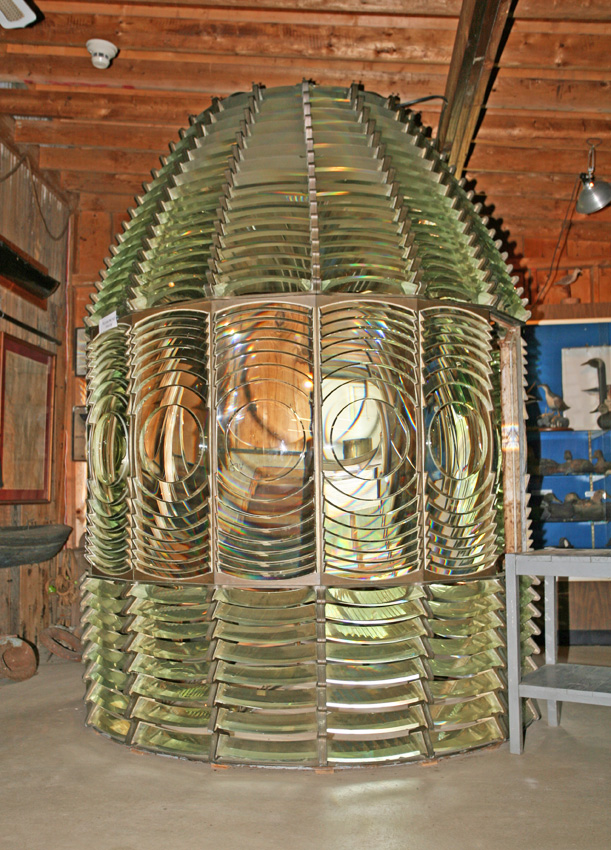
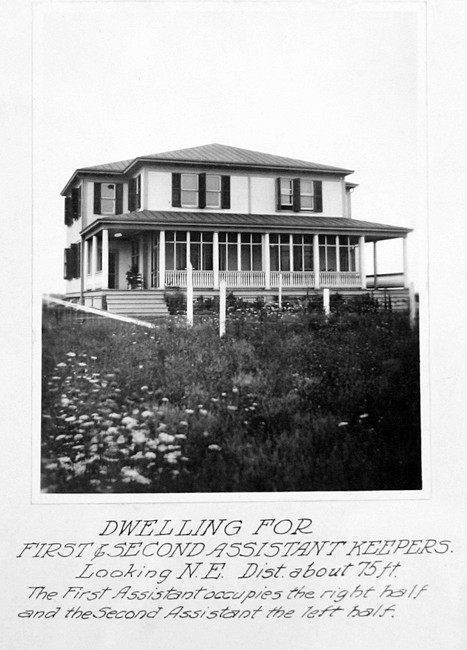
The illuminating apparatus for the third Cape May Lighthouse was a first-order, Henry-Lepaute Fresnel lens, which had sixteen flash panels and revolved to produce a white flash every thirty seconds. The lamp atop the lighthouse was lit for the first time on Halloween, 1859, and the following year, two keeper’s dwellings, positioned near the lighthouse, were completed. The one-and-a-half-story structures had three rooms and an entry in the first story, and four rooms upstairs. The 1847 lighthouse remained standing until 1862, when its top portion was dismantled and the remaining ten feet, or so, of the tower was capped and used for storage. The sea has since claimed the truncated tower.
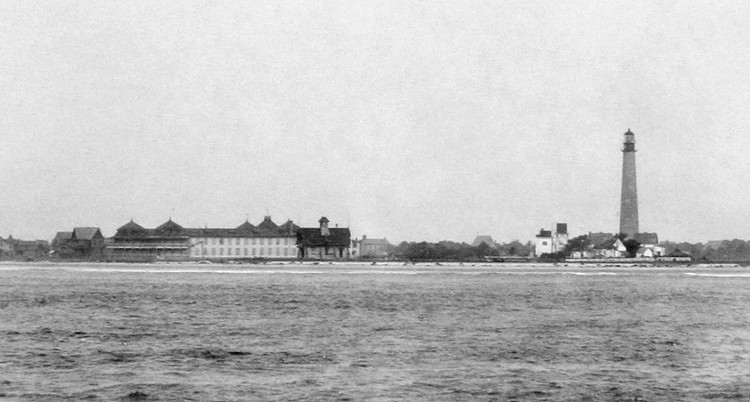
Besides the first two Cape May Lighthouses, the entire community of South Cape May fell victim to the encroaching waters of the Atlantic. A land developer named Theodore Reger purchased much of the shoreline between the lighthouse and the town of Cape May in 1882. Three years later, Reger had constructed a huge wooden and tin elephant, known as the Light of Asia to attract interest in his development at South Cape May. For a dime, tourists could enter the elephant through its hind legs, climb a spiral staircase to a hall in its belly, and then proceed up a second set of stairs to the howdah or viewing platform on the elephant’s back. Several cottages were built in South Cape May, but erosion has wiped away almost all signs of human (and elephant) habitation, and the area is now the Cape May Migratory Bird Refuge managed by the Nature Conservancy.
For many years, netting was hung outside the lantern room of Cape May Lighthouse. The lighthouse lies along one of the primary migratory paths for birds, and the nearby meadows serve as an important stopover for thousands of birds each fall. As noted in the following excerpt from Longfellow’s poem “The Lighthouse,” birds often fell victim to the blinding beacon exhibited by a lighthouse.The sea-bird wheeling around it, with the dinIn 1905, a reporter, while touring the tower at night with one of the keepers serving as his guide, heard a loud “thud” as the two stood talking in the lantern room. The keeper stepped out on the balcony and returned with a dead mud hen in his hand. Showing the specimen to the reporter, the keeper explained: “Sometimes we get five or six in a night. Often we find robins and ducks dead on the balcony.”
Of wings and winds and solitary cries,
Blinded and maddened by the light within,
Dashes himself against the glare, and dies.
Untrained Keeper Downes Foster of the second Cape May Lighthouse left after three years of service but then returned in 1861 to take charge of the third Cape May Lighthouse. In January 1876, Foster was reprimanded by the fourth district inspector “for giving away refuse oil and certain small quantities of alcohol,” but was saved from dismissal by his many years of faithful and honest service. The following year, a Commander Brigman visited the station and after finding conditions unsatisfactory concluded that the seventy-year-old Foster was “too old and feeble to do the work which seems to have been left almost entirely to the two Assistants, neither of whom is very competent.” Foster was replaced a few months later by Samuel Stilwell, who would serve as head keeper for twenty-six years before retiring in 1903 at the age of eighty.
The Annual Report of the Lighthouse Board for 1891 captured the following occurrence at Cape May:
This tower was struck by lightning on June 12, 1891. The lightning struck the ball on the dome of the tower, followed down the framework of the lantern, leaped from the pedestal of the lamp to the iron of the watchroom, passed around by the iron gallery to the lightning rod, and thence a part of the current was carried by the electric call bells into the keepers’ dwellings, causing much damage to the interior.The tower was struck again ten years later, and this time the daughter of one of the keepers was stunned and burned.
|
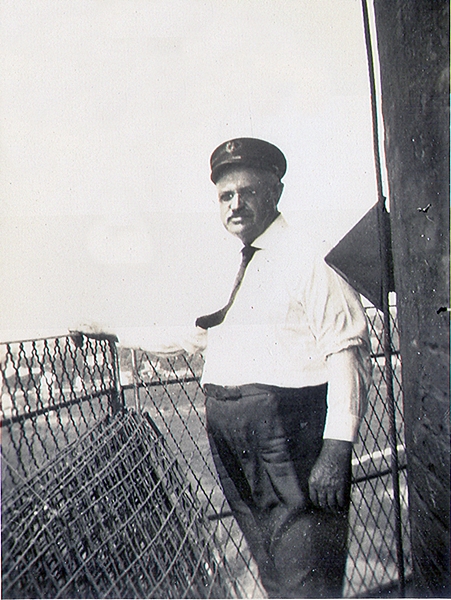
Not all keepers of Cape May Lighthouse were negligent in maintaining the station. In fact, Harry H. Palmer won the efficiency flag for having the model station in the Fourth Lighthouse District for at least four years in a row. In 1927, Supreintendent Benjamin B. Dorry noted that Palmer was being awarded the efficiency flag for that year and that he had earned the Superintendent’s Efficiency Star for eight consecutive years. In 1931, Keeper Palmer received first place from the Cape May County Chamber of Commerce for having the best-kept lawn and second place for combined lawn and garden. This showing was topped in 1933, when Palmer was awarded first prize and a blue ribbon for having the best-kept yard and garden. Keeper Palmer was known for his hydrangeas, and he took great pride in the pole beans, tomatoes, and corn produced by his half-acre garden.
After a fixed lens with an electrically flashed light source replaced the revolving first-order Fresnel lens with an incandescent oil vapor lamp, the position of second assistant was abolished in 1932. The Lighthouse Service then decided to automate Cape May in June 1933 and dispense with the remaining two keepers. Keeper Palmer, who had spent many years at the lighthouse, was allowed to retire with a pension. Rather than leave his familiar home, Palmer chose to remain at the station with his wife and two adult daughters and look after the property.
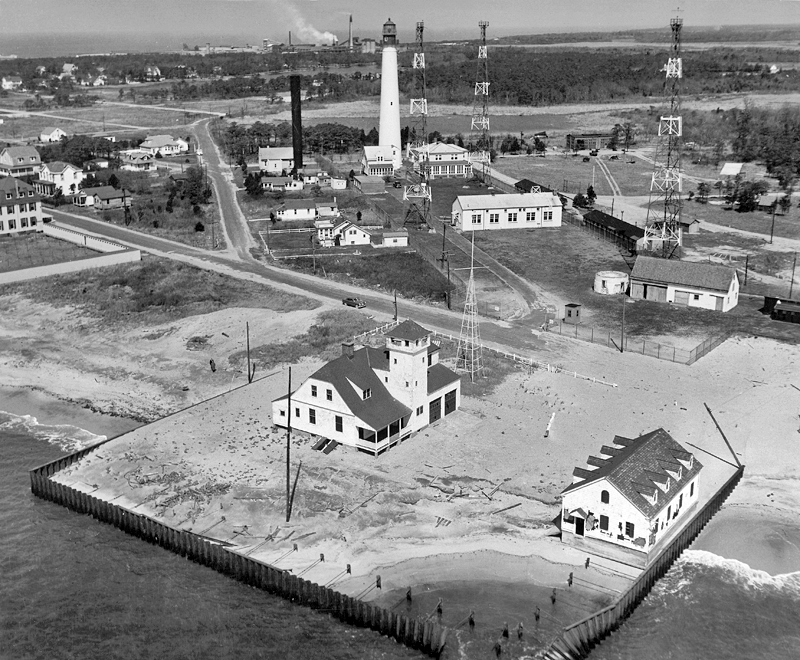
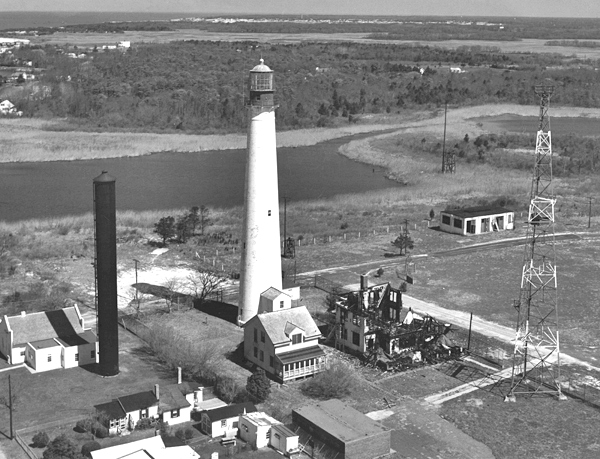
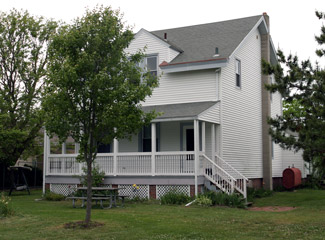
Cape May Light fell dark during the World War II years, and in 1946 the Fresnel lens was dismantled, removed from the tower, and loaned to the Cape May County Historical Museum, where it can be seen by the public. A rotating aerobeacon replaced the historic lens. In 1964, the lighthouse grounds were turned over to the State of New Jersey, which created Cape May Point State Park. One of the keeper’s dwellings, which had been converted into a duplex in 1903, burned in an arson’s fire in 1968, but the second dwelling stills stands and houses park personnel. The Coast Guard, not wanting to maintain the lighthouse, leased the tower to the state in 1986, and then transferred ownership of the station in 1992.
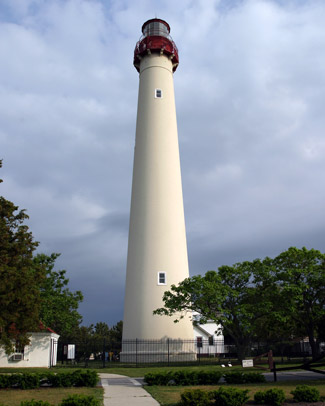
The lighthouse is leased to Mid-Atlantic Center for the Arts (MAC), which was successful in raising sufficient funds to restore the tower to a condition that it could be opened to the public in 1988. Over the years, MAC has raised more than $2 million towards preserving and maintaining the lighthouse. In 1994, the lighthouse, which had been painted white in the 1940s or 50s, was returned to its historic coloring of a light beige tower with a red lantern.
In 2002, the Coast Guard replaced the DCB-36 aerobeacon with a modern, solar-powered beacon. The lighthouse was repainted in 2017 thanks to federal and state grants and donor contributions.
Keepers:
References