Navesink, NJ 



Select a photograph to view a photo gallery
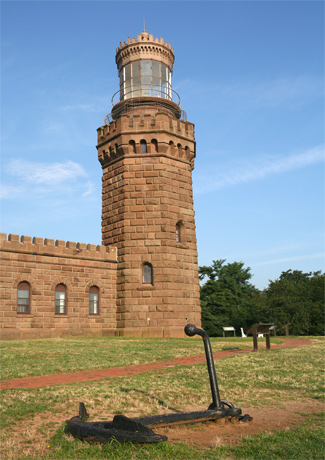
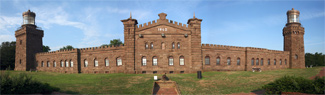
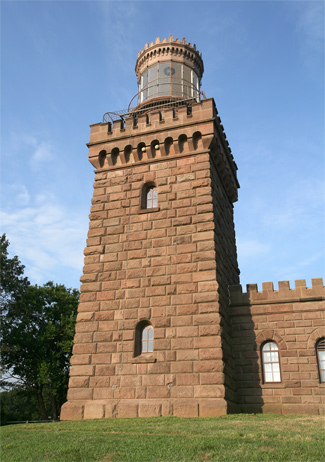
Photo Gallery
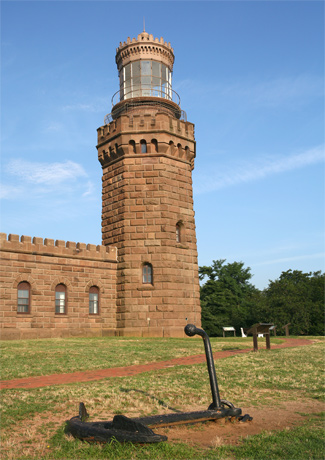
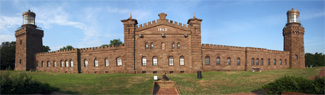
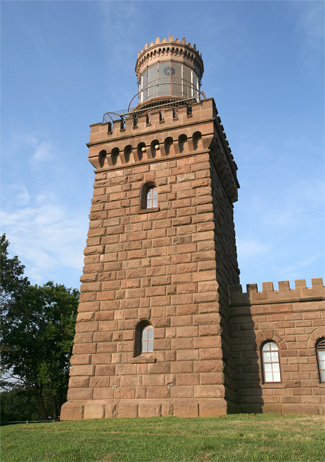
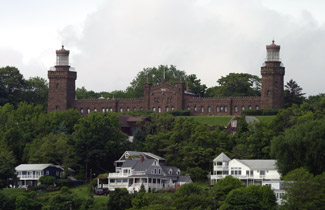
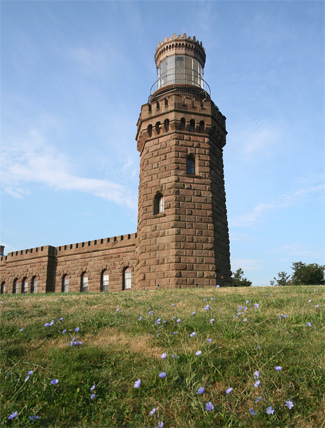
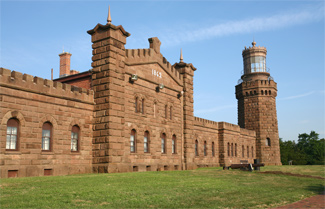
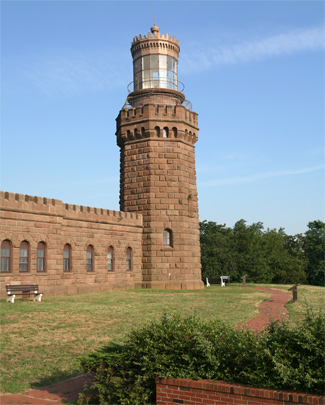
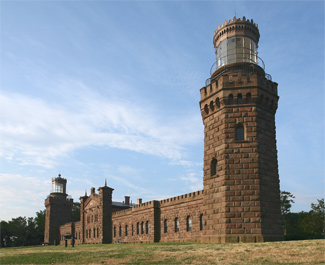
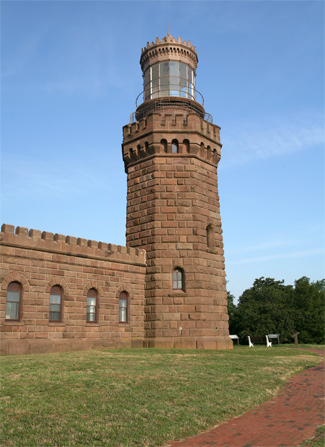
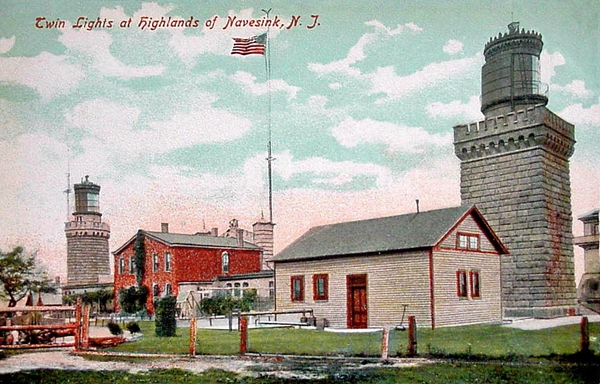
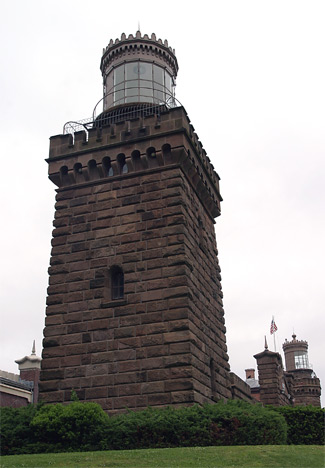
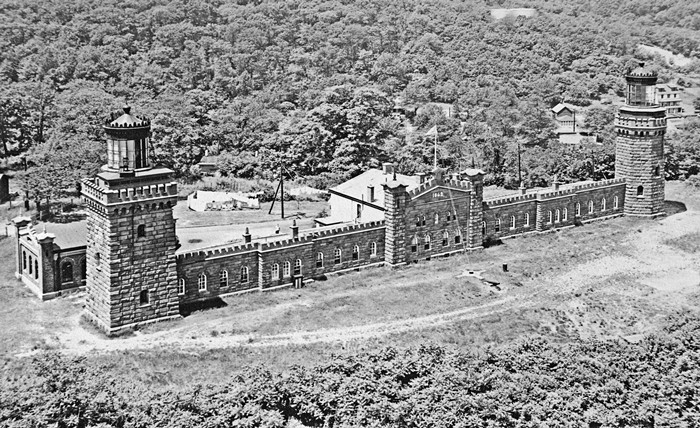
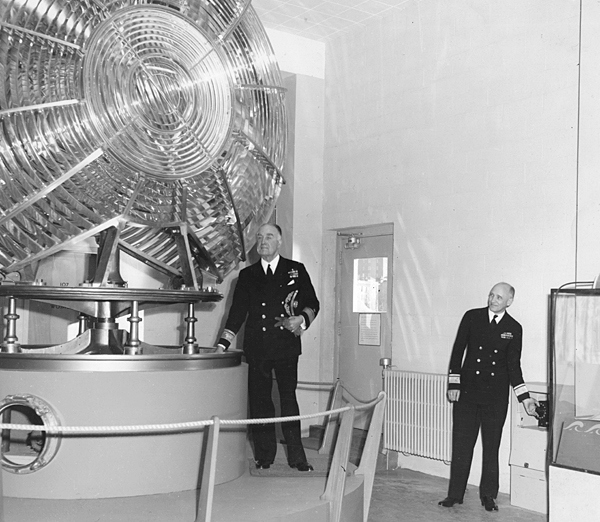
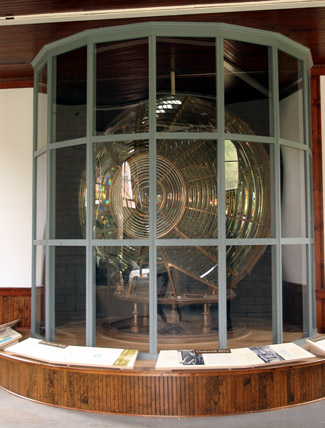
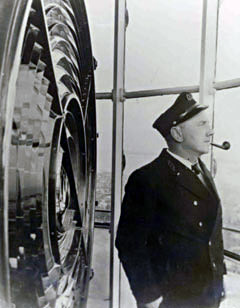
Photo Gallery
Photo Gallery
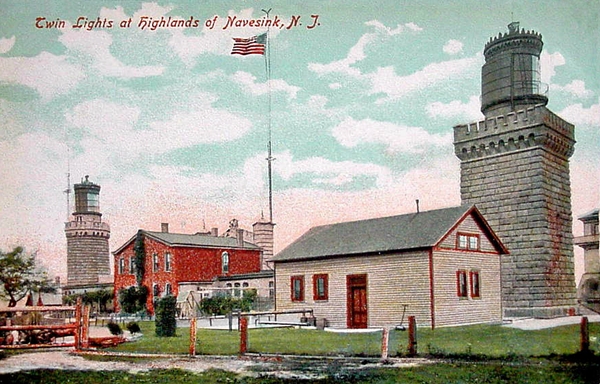
A lighthouse on Sandy Hook Lighthouse, just four miles north of the Highlands, was established in 1764 to mark the entrance to New York Harbor. While there are some clues that a lighthouse was established at Navesink around this same time, the evidence is inconclusive, and a pair of beacons built on the highlands in 1828 is considered the first Navesink Lighthouse. Congress appropriated funds for the lights on May 18, 1826, allowing 2 ¾ acres of land to be purchased from Nimrod Woodward for $600. Instead of a single tower, two octagonal ones, constructed of blue split stone and separated by 320 feet, were built on the summit. Charles Smith of Stonington, Connecticut erected the towers and a dwelling, located midway between them, for the cost of $8,440, while David Melville of Newport, Rhode Island supplied the necessary lamps and reflectors for $1,850. When Keeper Joseph Doty first lit the Twin Lights of Navesink, the north tower exhibited a fixed, white light and the south tower a flashing, white light. The twin lights were one of seven stations in the United States to feature two towers.
Commodore Matthew C. Perry was dispatched in 1838 to examine the state of lighthouses in England and France and to arrange for the shipment of two Fresnel lenses to the United States: a first-order, fixed lens, and a second-order, revolving lens. After the towers were raised nine feet and the installation of these two lenses was completed in 1841, Navesink became the first lighthouse in the United States to be equipped with a Fresnel lens. This would prove to be the first of many firsts for Navesink, which the Lighthouse Service would use as a testing ground for new technologies before deploying them throughout the country. The wide use of Fresnel lenses in the United States did not occur until the next decade, after the Lighthouse Board was made responsible for the country’s lights. The lenses first used at Navesink were manufactured by Henry Lepaute, and the fixed one was placed in the north tower, while the south tower received the revolving lens.
|
Upon a rough estimate of the cost of these two sets of lenticular apparatus, of the first and second order, and putting them up upon two light-houses already built, it appears to be between $23,000 and $24,000. The cost of these lenses, however, is nothing compared to the beauty and excellence of the light they afford. They appear to be the perfection of apparatus for light-house purposes, having in view only the superiority of the light, which is reported by the pilots to be seen in clear weather a distance of forty miles. It was my intention to have had the distance accurately ascertained by means of one of the revenue cutters, but I have not yet had an opportunity to do so. There are some drawbacks, however, in relation to their management, which would render them unfit for use in the United States upon a large scale, there being but one lamp which supplies all the light, with three or four concentric wicks, and this lamp, made upon the carcel principle, is very apt to get out of order, and the light become extinguished, if the keeper be not an intelligent mechanic, and capable at all times of making the necessary repairs.
The 1857 Annual Report of the Lighthouse Board contained the following: “The two light-house towers at Navesink, N. J., marking the approach to the bay of New York, are in a dilapidated condition, the consequence of original bad materials and workmanship, and it has been represented that there is apprehension that they are not capable of standing much longer the heavy winter storms of the coast. The position is one of great exposure, the lights of much importance, and it is believed it will not be safe to trust to the stability of the present towers much longer.”
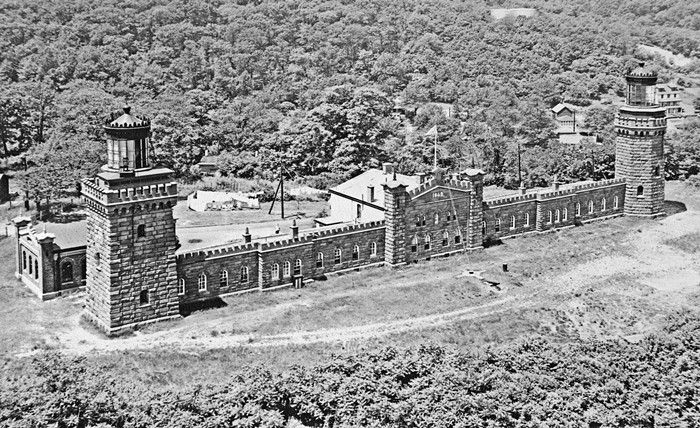
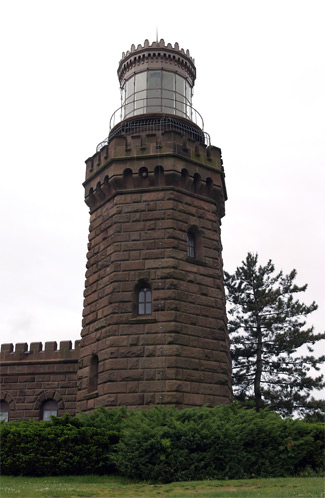
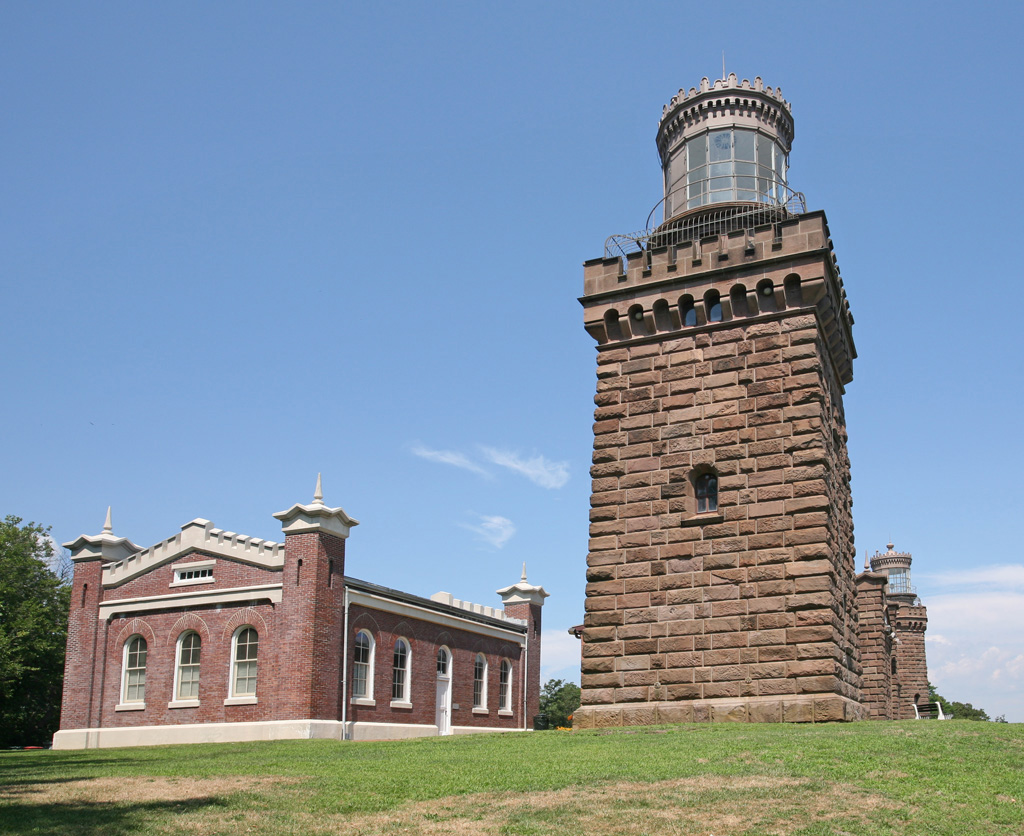
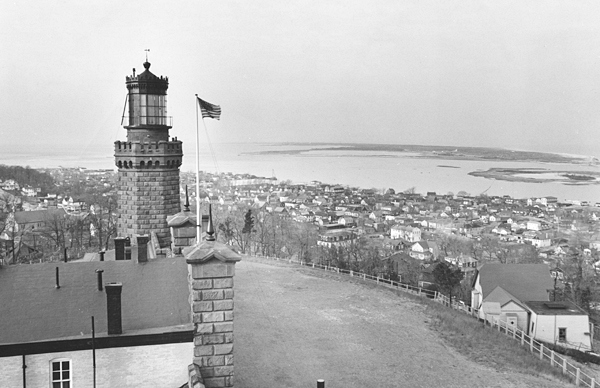
Congress appropriated $72,941 on June 20, 1860 for a new lighthouse at Navesink, and Joseph Lederle was selected as the architect. Lederle’s plans called for a castle-like structure, built of brownstone, with an octagonal tower on its north end and a square tower, 228 feet away, on the opposite end. A two-story residence for the principal keeper and his first assistant was centered between the two towers, while the living space for the second and third assistant keepers, along with workshops and oil rooms, were located in the wings that attached the towers to the two-story dwelling. Each tower was outfitted with a first-order Fresnel lens capable of producing 8,000 candlepower, making Navesink the most powerful lighthouse in the United States at the time.
|
In 1872, Keeper Taber Chadwick and his assistants were dismissed after complaints were made that the assistants neglected their duty and that one night they had abandoned the light. The light likely would have gone out had the neglect not been accidentally discovered.
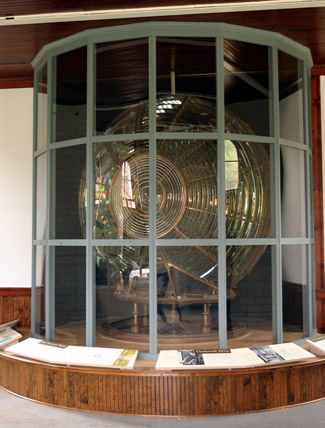
At the World’s Columbian Exposition, held in Chicago in 1893 to commemorate the 400th anniversary of Columbus’ landing in the new world, a giant bivalve lens was displayed by the French Lighthouse Board, along with other marvels and recent inventions from throughout the world. Rather than ship the lens back home after the exposition, the French convinced the U.S. Government to purchase the behemoth. Originally designated for Fire Island Lighthouse, the lens, crafted by Henry Lepaute, was eventually installed in the south tower at Navesink instead.
The seven-ton lens was designed to be used with an electric arc lamp, and as no electricity was available at Navesink, a temporary wooden building was built behind the south tower to house a generator. When activated on June 30, 1898, the lens and arc lamp produced a whopping 25,000,000 candlepower, making Navesink the first coastal light to use electricity and, once again, the most powerful beacon in the country. The revolving lens produced one flash every five seconds that could be seen from over twenty-two miles at sea, and the reflection of the light off clouds was reportedly seen at a distance of seventy-five miles.
Residents living near Navesink didn’t have the same admiration for the piercing beacon as the Lighthouse Service did. Neighbors complained that after the new light was installed, they could not sleep, their chickens wouldn’t lay eggs, and their cows refused to give milk. Three panels in the landward side of the south tower’s lantern room were soon darkened to placate the locals and pacify their animals. The powerful light affected the lives of the keepers as well, as they had to wear special goggles, similar to those worn by welders, when working near the light to protect their eyes.
|
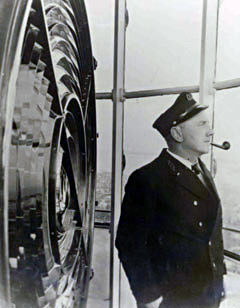
Robert A. Bishop, a former locomotive engineer on the New York, New Haven, and Hartford Railroad, was hired as head keeper when the new lens and electric light were installed as it took special skills to keep the generator running. While giving a tour of the lens in the south tower to a writer, Keeper Bishop stated, “Birds? Why, we brush them up in dustpans sometimes right here, where they fall stunned when they dash against the outer plate glass. The number varies with the season. For instance, migrating woodcock always fly at night, and we pick up dozens of them every morning at that time of year. The neighborhood cats know it, too. This is the greatest resort for the beasts in the vicinity. They have their banquets laid out on the grass there at the base of the tower.”
In 1917, the power generator was reaching the end of its life, and rather than pay for a replacement, the light was converted to incandescent oil vapor, reducing its output to 710,000 candlepower. After commercial electricity became available at the station in 1924, a cluster of three, 500-watt incandescent bulbs was used in the lens to bring the candlepower up to 9,000,000. The power of the light was reduced once again during World War II to comply with blackout regulations.
A couple of other firsts occurred not in the lantern room of Navesink Lighthouse but rather on the lawn outside the lighthouse. In 1899, Guglielmo Marconi erected the antenna mast of the first wireless telegraph in the United States for sending and receiving messages on a regular commercial basis. The telegraph was first used on September 30th of that year to receive reports from the steamship Ponce on the progress of the naval review saluting the victorious return of Commodore George Dewey from the Spanish-American War’s Battle of Manila Bay. The first experimental radiobeacon was established near the lighthouse in 1917, and just before World War II the first experiments in radar, called the “mystery ray” in local papers, were conducted in the shadow of the north tower. Ironically, these advances in technology pioneered at Navesink would lead to the eventual obsolescence of the nearby lighthouse.
|
Rockette was promoted to first assistant after seven years at Navesink and head keeper just three years after that. The Rockettes had one daughter, Ginny, before arriving at the station, and a second daughter, Elsie Jane, was born shortly after their arrival. Life changed a lot for the family during their stay at the station. In the early years, they used an outhouse, pumped their own water, and read by a kerosene lamp. Indoor plumbing, central heat, and electricity were all later added to the station, making their fortress-like home quite livable. When Elsie Jane married, her reception was held in the station’s generator building.
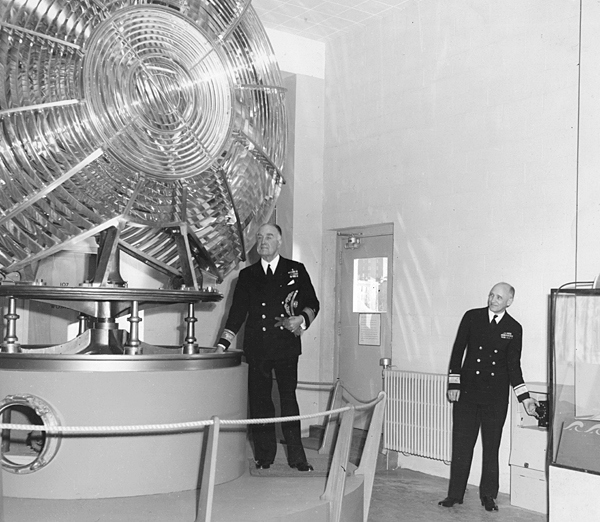
Navesink’s powerful light was active for just a few years following World War II before it was extinguished for good in 1949. A minor optic was installed outside the lantern room at that time. Rockette retired from his new employer, the Coast Guard, in 1951 but was permitted to stay in the lighthouse until it was closed for good the following year. The large lens was dismantled and shipped to the Boston Museum of Science, which placed it on exhibit.
The Borough of Highlands received ownership of the Twin Lights in 1954 after the property was declared surplus. Unable to maintain the lighthouse and grounds, the small community passed control of the site to the State of New Jersey in 1962. The State Park Service, Twin Lights Historical Society, and Rumson Garden Club managed to raise nearly one million dollars to fund the renovation of the lighthouse and establishment of a museum in several rooms near the north tower. Today, the thousands of visitors that come to see one of the country’s most unique lighthouses can climb the north tower, where a sixth-order Fresnel lens was in use until 2007, for a spectacular panoramic view of the area. The bivalve lens was purchased for $5,000 and returned to Navesink in 1979. This important piece of the station’s history is prominently displayed in the brick generator building, which at one time fed power to the impressive lens.
In 2002, a $460,000 project saw the restoration of the towers and the exterior of the building. Navesink Light Station was recognized as a National Historic Landmark in 2006. In 2015, the museum received a complete renovation, making it one of the best small museums in New Jersey.
Keepers:
References