Hillsboro Inlet, FL 


Select a photograph to view a photo gallery
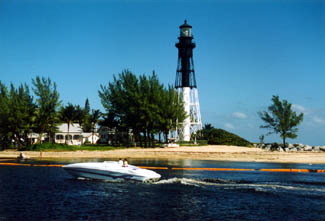
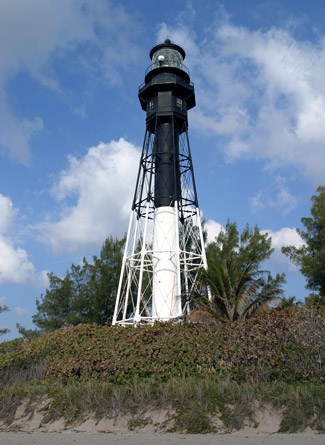
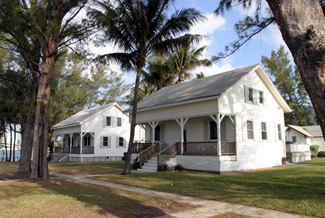
Photo Gallery
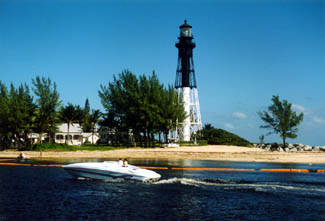
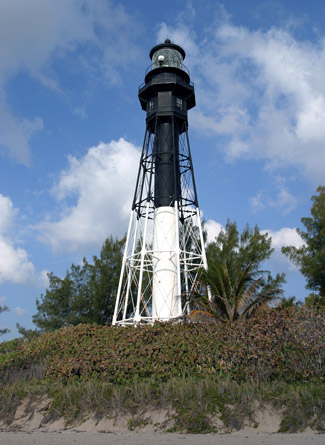
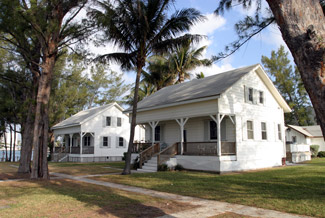
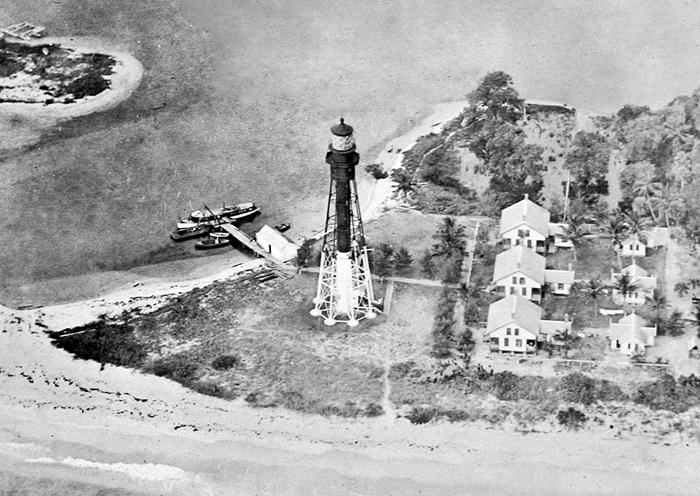
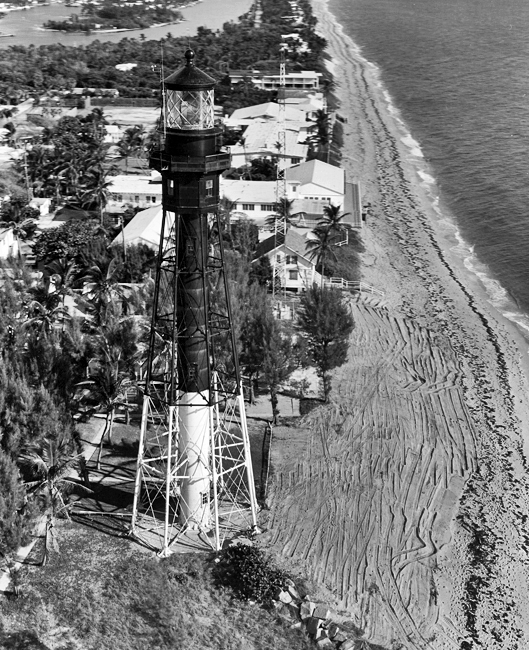
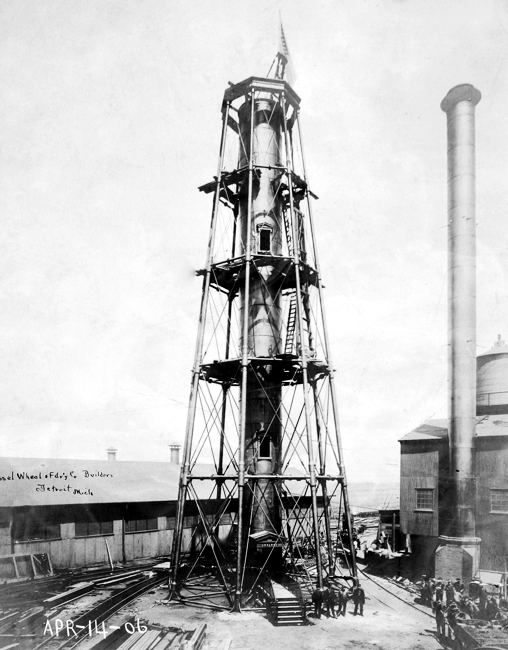
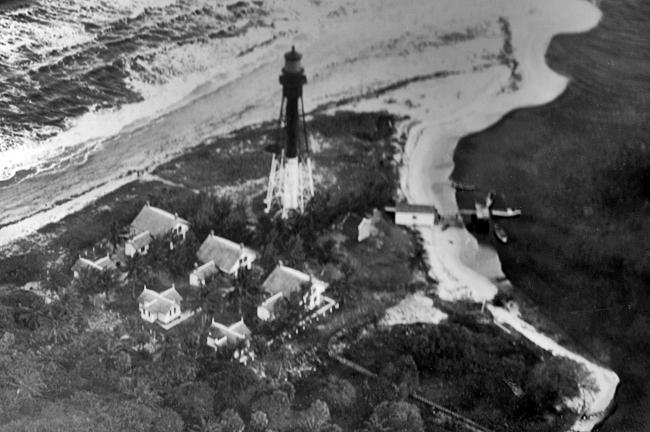
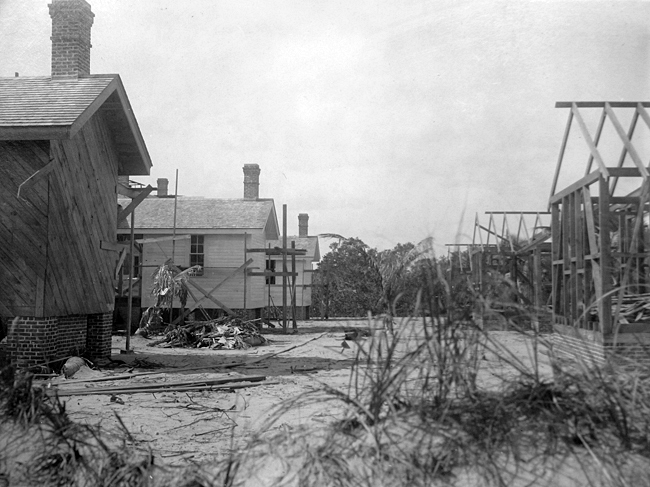
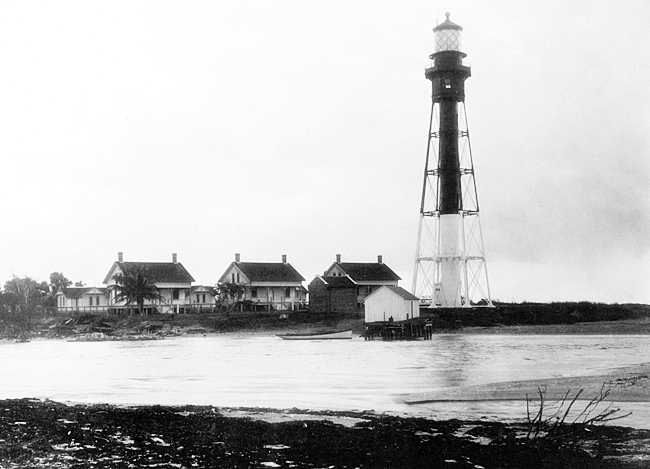
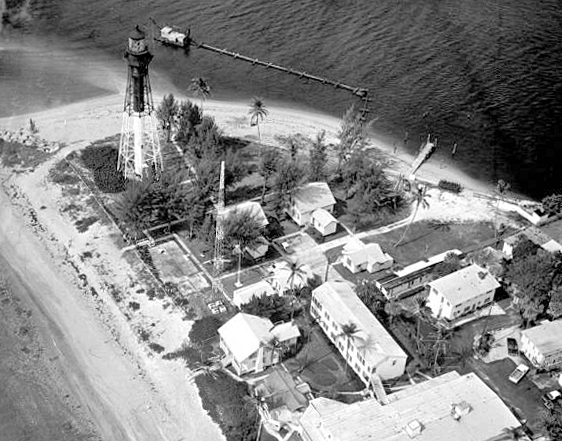
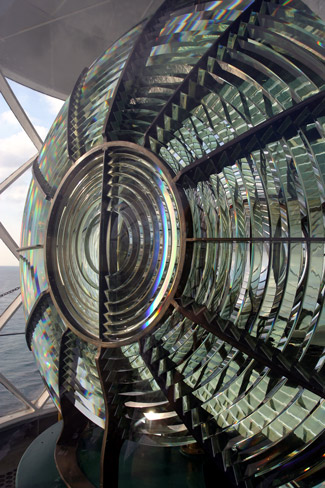
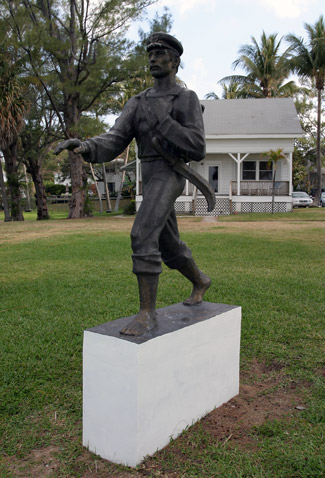
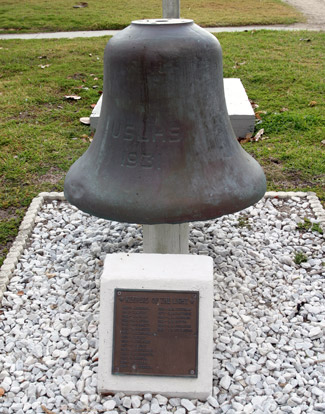
Photo Gallery
Photo Gallery
The establishment of a light at or near Hillsboro Point, Florida, would be of great assistance to all vessels navigating these waters. Steamers bound southward, after making Jupiter Inlet light, hug the reef very closely to avoid the current. The dangerous reef making out from Hillsboro Inlet compels them to give it a wide berth, and to go out into the Gulf Stream. Vessels coming across from the Bahama Banks would be able to verify their position if a light were placed here, a difficult matter in case they fail to make Jupiter Inlet. The establishment of this light would complete the system of lights on the Florida Reefs.Congress responded to the request for $90,000 for the lighthouse in a piecemeal manner, providing $45,000 in 1902, $25,000 in 1903, and $20,000 in 1905.
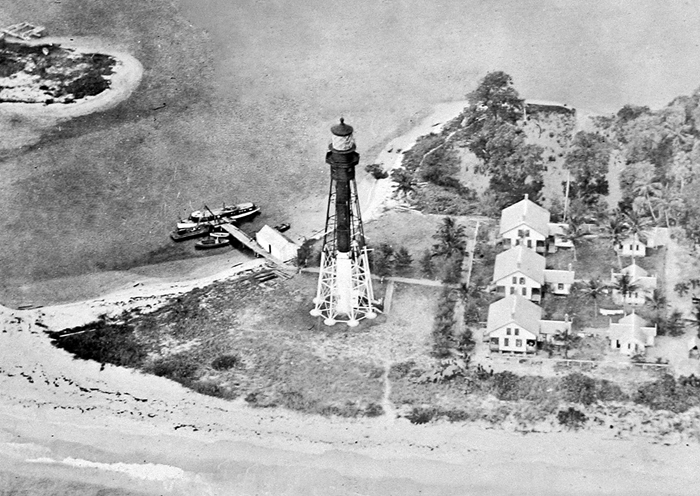
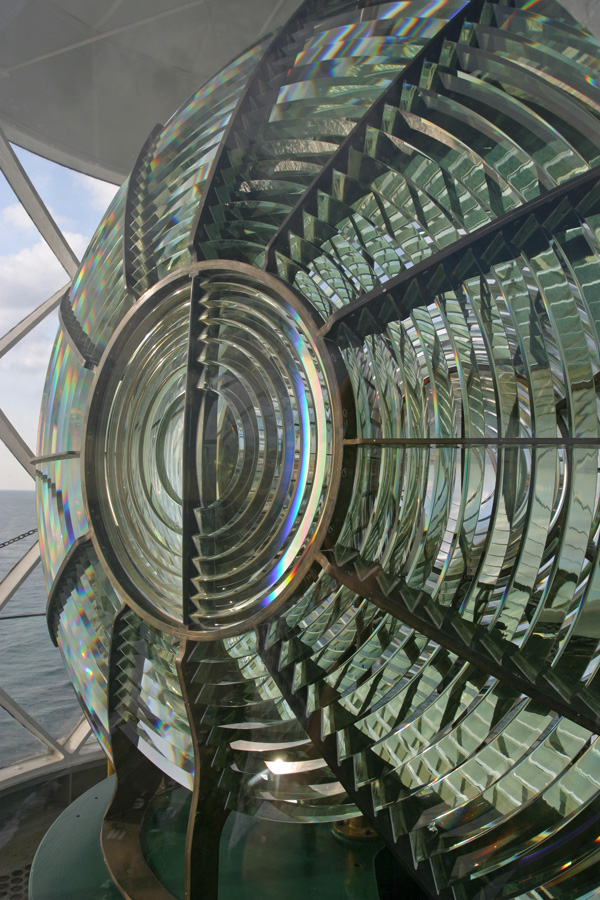
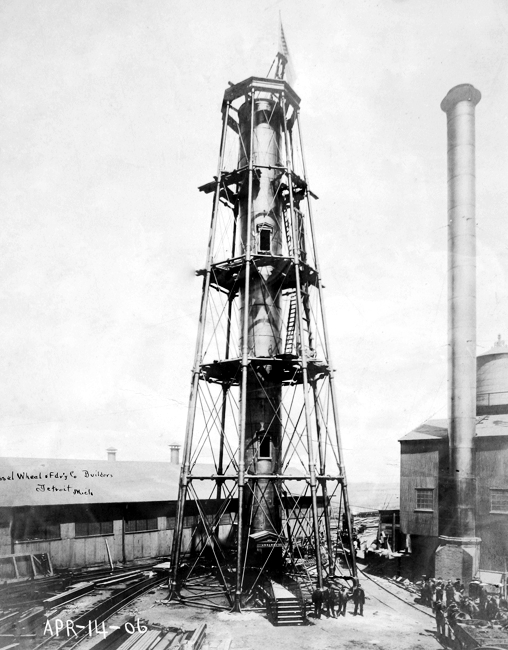
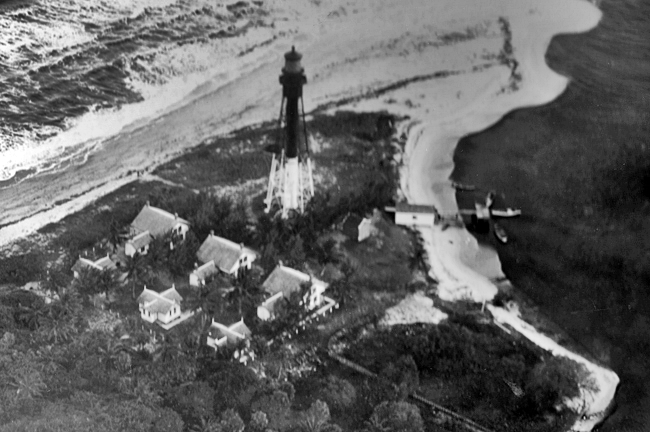
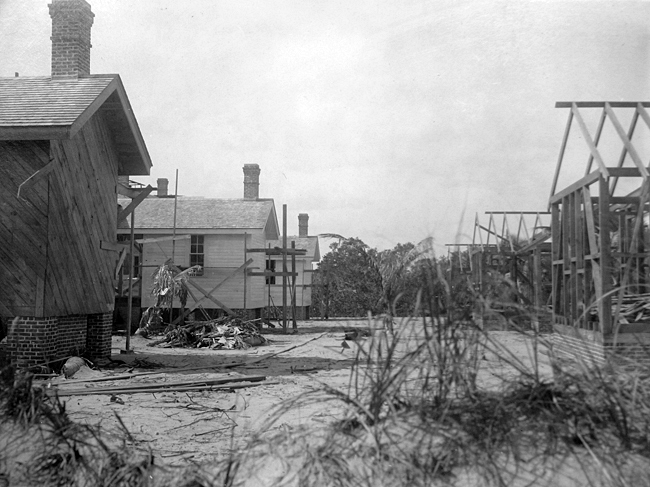
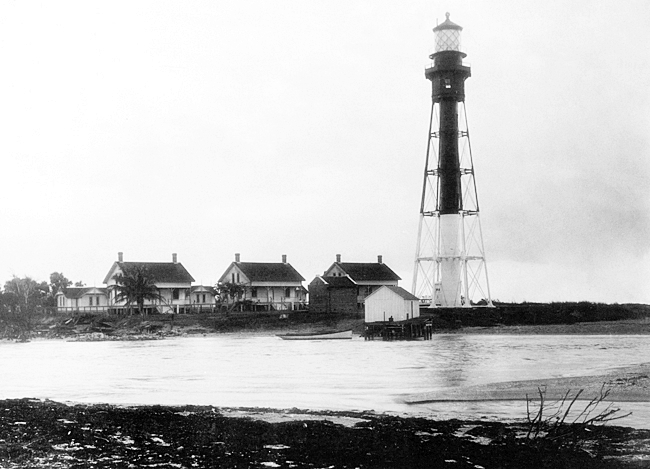
Test borings made on a site selected south of the inlet found the substrata to be unsuitable for the foundation of a lighthouse, so three acres of swampland north of the inlet were purchased in 1904. The contract for a 137-foot-tall octagonal skeletal tower was awarded to the Russell Wheel & Foundry Co. of Detroit, while Barbier, Benard & Turenne of Paris was paid $7,250 to provide a second-order bivalve Fresnel lens for the lighthouse. When completed, the tower embarked on a 4,000-mile nautical journey through two of the Great Lakes, down the Illinois and Mississippi Rivers, across the Gulf of Mexico, and up the Atlantic seaboard to its new home. J.H. Gardner Construction Co. of New Orleans was allotted $16,792 to clear the land, lay the foundation and assemble the tower, while G.W. Brown Construction of West Palm Beach was paid $21,500 to construct three keeper’s dwellings and other outbuildings.
With all of these projects completed, the keeper climbed the 175 steps to the top of the tower and lit the vaporized kerosene lamp inside the nine-foot-diameter Fresnel lens for the first time on March 7, 1907. To allow the lens to rotate, it floated on a pool of mercury contained in a cast-iron trough.
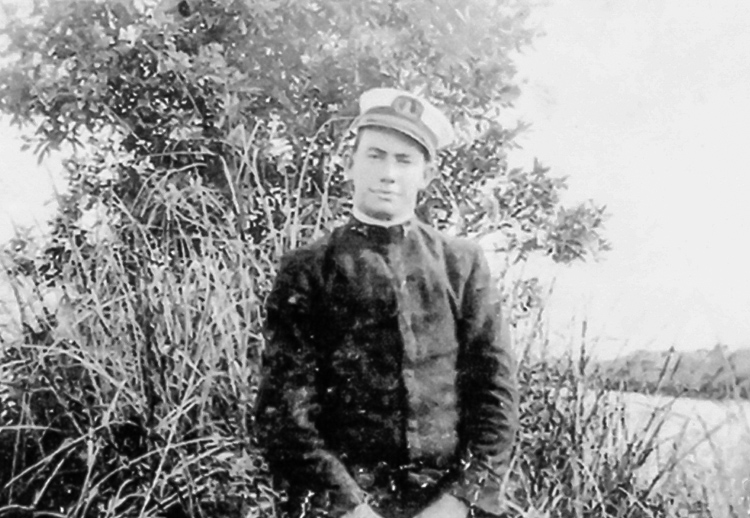
The first head keeper of Hillsboro Inlet Lighthouse was Alfred Alexander Berghell, who transferred to the station after service at four other Floridian lighthouses: Pensacola, Dry Tortugas, Rebecca Shoal, and American Shoal. Little is known of his experiences as a lighthouse keeper, but the story of his youth was quite eventful. Born to wealthy parents in Finland, Alfred early on developed a passion for the sea. When Russia’s boy prince, who later would become Czar Nicholas II, visited Finland with his family, Alfred was part of a rowing crew that provided recreational rides for the young prince. Alfred eventually enrolled in the Russian Naval Academy, located in Finland, and graduated as a captain at the age of nineteen.
Alfred’s life would forever change when, at his graduation ball, a Russian officer insulted the girl with whom Alfred was dancing. The two left the hall for a duel, during which Alfred pinned the officer and ripped the Russian insignia off his uniform. Fearing arrest and possible banishment to Siberia, Alfred’s uncle, a senator, arranged for a passport, and Alfred left his homeland before daybreak, never to return. Alfred’s dream of a life at sea was now his, and over the next several years he would sail around the world four times. At the age of thirty, he contracted a serious illness and spent two years recuperating in Australia. The illness left him hard of hearing, making it difficult for him to continue his work as a captain. Following the suggestion of a friend, Alfred sailed to America and began a career in the U.S. Lighthouse Service.
|
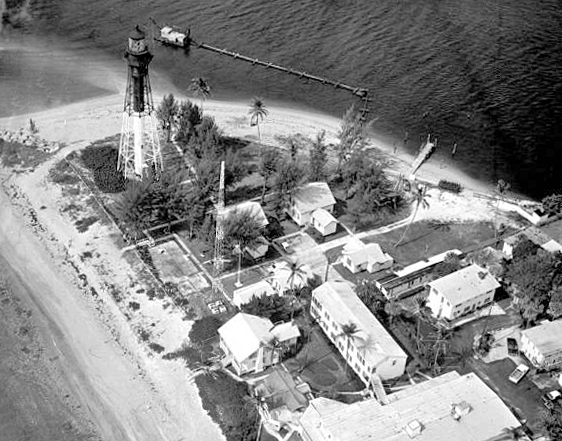
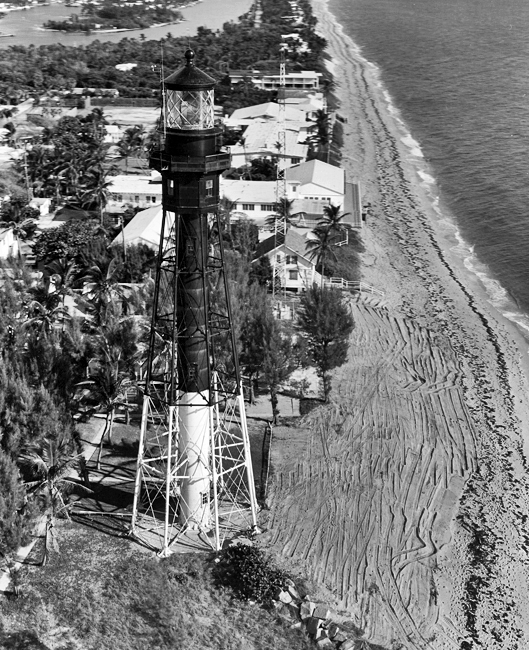
Positioned so close to the shoreline, Hillsboro Lighthouse didn’t have much of a buffer to protect it from the tidal surge, which accompanied the occasional hurricane. Keeper Knight noted that a hurricane that struck the station in September 1926 caused the tower to vibrate to such an extent that mercury sloshed out of its trough and mantles in the incandescent-oil-vapor lamp were broken. “From 3 to 8 a.m. on September 19, 1926, solid green seas swept entirely across the reservation, carrying away the boathouse and the decking of the wharf,” reported Keeper Knight. “The bank around the base of the tower was cut away, so that the concrete foundation is exposed to a depth of 8 feet, and at high tide the sea continues to wash around the base of the tower. Fifteen persons whose houses were completely destroyed were given refuge at the station during the hurricane. Damage was also done to the dwelling, and supplies stored in the boathouse were lost.”
The effect of a 1936 hurricane was also recorded by a keeper: “On November 4, at 5 a.m., barometer reading 29.79; at 11 a.m., wind NE, about 70 miles per hour, barometer reading 29.30; at 4 p.m. wind SE. about 50 miles per hour, barometer reading 29.60. Seas swept across entire reservation from 11 a.m. to 3 p.m. Steps and platforms of dwellings and base of tower were covered under sand; also concrete walks. Grounds were covered with trash and debris. Some mercury was slopped out of tub in tower, but lens operated O.K. No damage was done to Government property.” The station didn’t fare so well in 1947, when another hurricane destroyed the head keeper’s dwelling.
The lighthouse was electrified in 1932, and the resulting increase in power from 630,000 to 5,500,000 candlepower reportedly made the light the strongest in the world at the time. With no resident keepers following the lighthouse’s automation in 1974, the dwellings became beachfront vacation cottages for senior military personnel. For decades, the revolving Fresnel lens continued to cast its beam out over the ocean, until the electric drive mechanism abruptly failed in 1992. As a temporary measure, a modern beacon was installed on the railing outside the lantern room. The two-ton Fresnel lens sat motionless for years, while its future was debated. A report was completed in 1996 that recommended the lens be removed and placed in a museum. The following year, a group of concerned citizens formed the Hillsboro Lighthouse Preservation Society, whose primary goal was to reactivate the Fresnel lens.
In 1998, the Coast Guard announced that the lighthouse would be renovated and the Fresnel lens reactivated. Several hundred pounds of mercury, which by then was of course known to be toxic, were removed from the lantern room, and a ball-bearing system was installed to facilitate the rotation of the lens. A re-lighting ceremony was held for the refurbished lighthouse on January 28, 1999. Everything had been operating smoothly for several weeks, when the ball-bearing system failed, and the lens was again frozen in place. It was back to the drawing board. A new ball-bearing system, designed by Torrington Bearing Co. and capable of supporting twenty tons, was placed beneath the lens and another re-lighting ceremony was held on August 18, 2000.
|
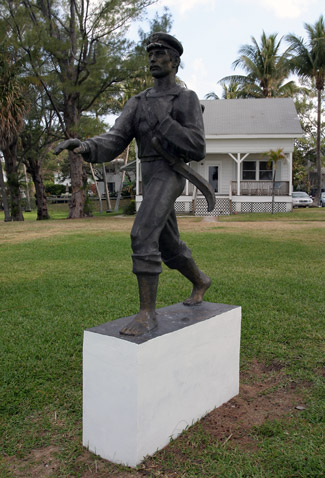
Between 1885 and 1892, letter carriers would travel the sixty-eight-mile-long coastline between Palm Beach and Miami. Twenty-eight of the miles were covered by small boat, but for the remaining forty miles, the carriers would walk barefoot along the hard sand at the water’s edge – hence the name Barefoot Mailman. When the carrier would reach Hillsboro Inlet, he would cross the waterway using a rowboat kept there for that purpose. Although several men served as letter carriers along the route, it is James E “Ed” Hamilton that is typically remembered as the Barefoot Mailman.
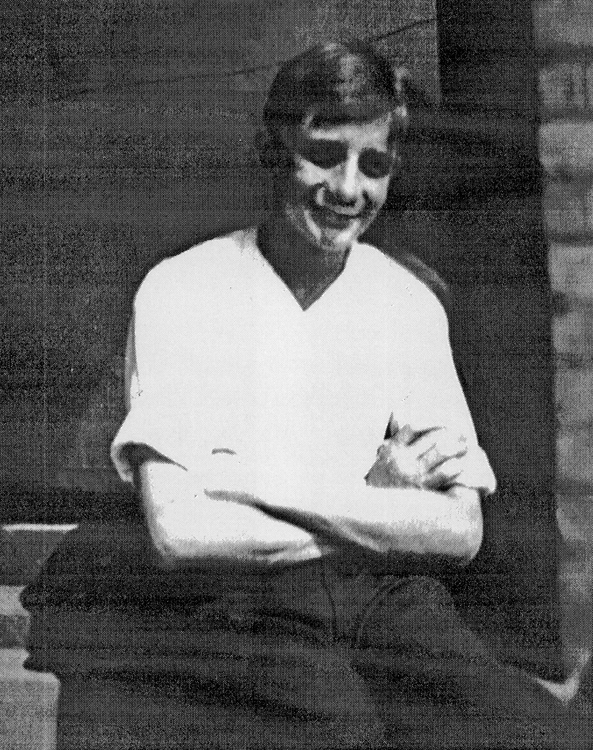
In October 1887, Ed was making his way south along the route. Although he was not feeling well, he insisted on completing the trip. When he failed to return on the expected day, two of his friends set out to search for the missing mailman. Upon arriving at Hillsboro Inlet, the friends found Hamilton’s mail pouch, trousers, and shirt hanging on the limb of a tree, and his underclothes near the water’s edge. The rowboat used for crossing the inlet could not be found. It was theorized that a stranger, seen in the area recently, had taken the rowboat, forcing Hamilton to swim the inlet. As Hamilton was an excellent swimmer, it is believed that alligators, whose tracks were noted by Hamilton’s friends, must have been responsible for his disappearance.
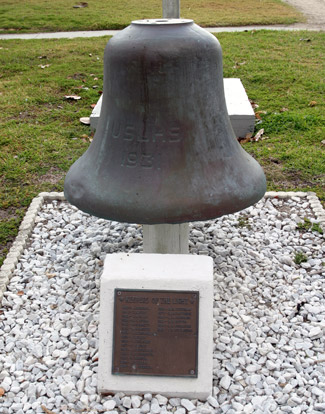
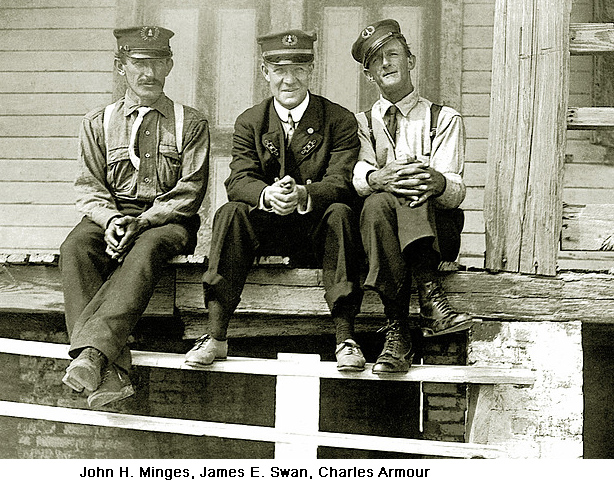
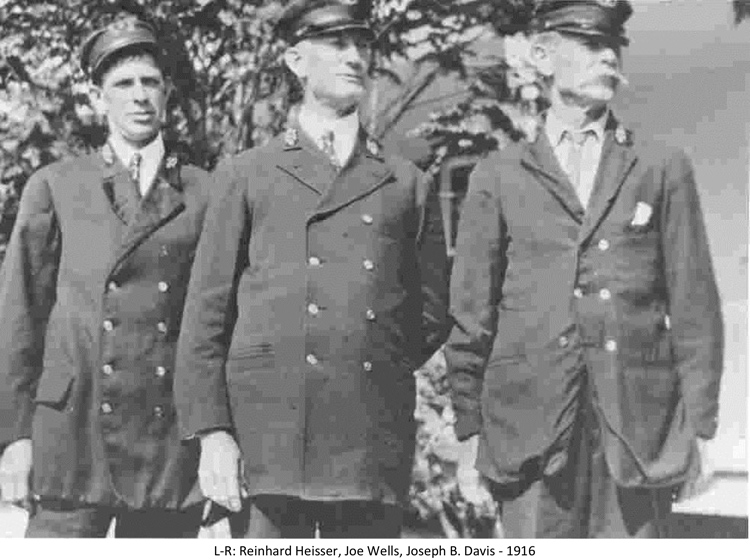
The Barefoot Mailman Statue now overlooks the inlet where one of the storied carriers lost his life. The statue, however, is not the only memorial on the lighthouse grounds. Near the generator and radio building that now serves as a small museum, stand a flagpole, fog bell, and plaque, honoring the keepers who served at Hillsboro Lighthouse. With these two monuments on the lighthouse grounds, the service rendered by these dedicated servants will hopefully not be soon forgotten.
After receiving repeated complaints from sea turtle advocates that the light from Hillsboro Inlet Lighthouse was allowing predators to prey on hatchlings before they could reach the ocean, the Coast Guard announced in 2012 that they were soliciting public comment on the lighthouse’s value as a navigational aid. Based upon the feedback, the Coast Guard said it would shut down the light completely, obscure portions of the light, or maintain the status quo. It was decided to leave the light in operation, though it is obscured between 114° and 119°. In 2013, the Coast Guard passed all responsibility for maintenance and operation of the lighthouse to the Hillsboro Lighthouse Preservation Society.
The Hillsboro Lighthouse Museum and Information Center opened in March 2012 in a 400-square-foot space on the grounds of Hillsboro Inlet Park in Pompano Beach. The museum houses artifacts related to the lighthouse and a ten-foot-tall stone statue of the Barefoot Mailman.
Keepers:
References